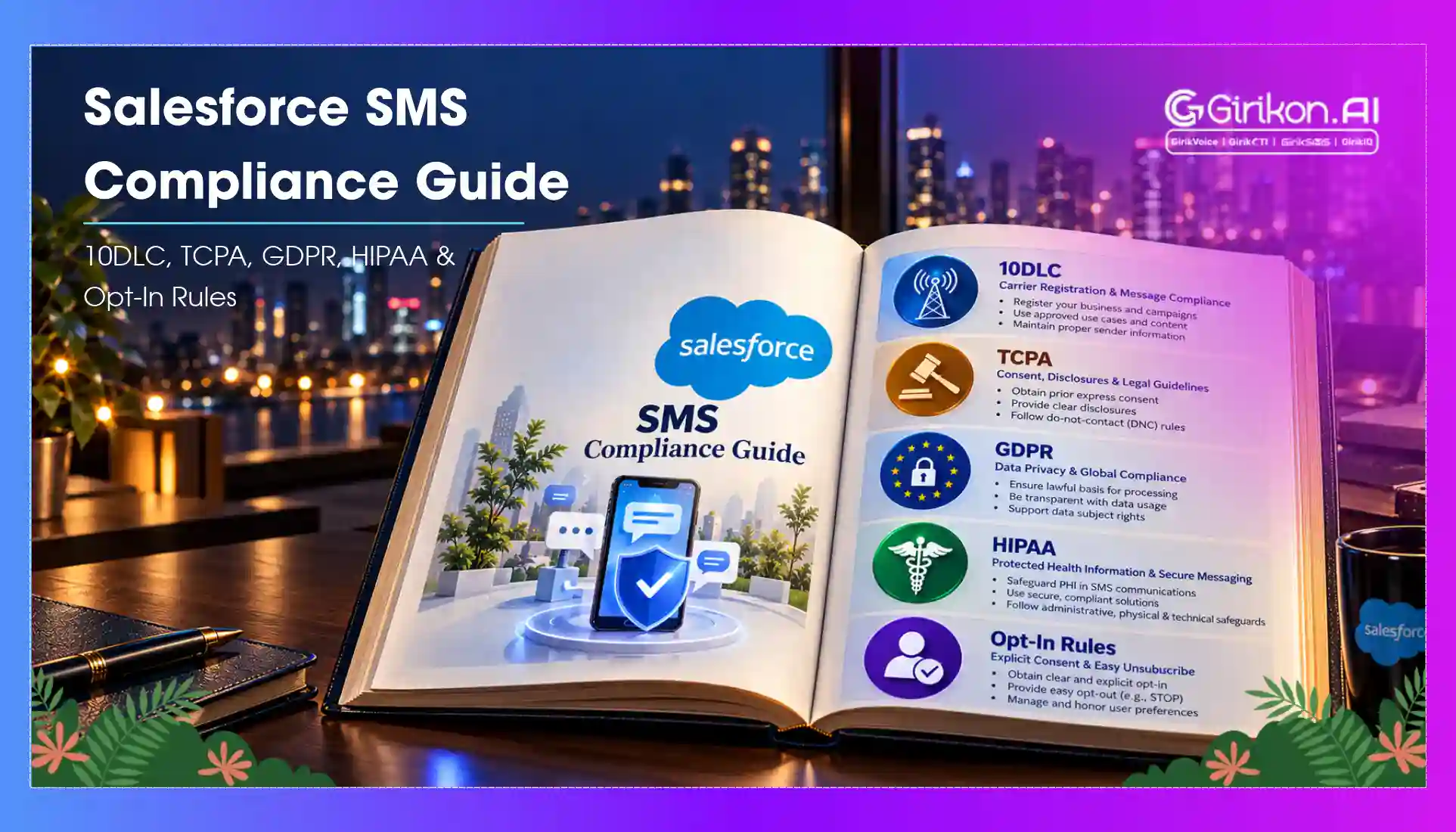
Running a big Salesforce setup these days? SMS is baked right into how we connect with customers today. Messing around with TCPA SMS compliance means tougher scrutiny all around, where a single slip can trigger hefty fines and stalled campaigns that leave you scrambling. One tiny oversight in your process, and what was supposed to be effortless customer touchpoints becomes this tangled mess of reviews and blocks. So, tackling these rules - think of it as chasing a shape-shifter, with carriers tweaking demands and laws adding fresh twists year after year.
Why Salesforce SMS Compliance Matters
SMS open rates hover around 98% these days, blowing email out of the water. Enterprises love it for alerts, support, and sales nudges - straight into customers' pockets.
Does anybody really prefer long email chains anymore?
Customers love it - over 69% prefer texting businesses instead of calling, with messages read in under three minutes on average. But mess up the rules? Fines stack up fast, and trust goes poof. We've seen campaigns tank over simple oversights.
Salesforce makes it seamless with built-in Messaging tools, but compliance? That's where most teams trip up. Honestly, fines from regulators can hit thousands per violation.
It's bigger than dodging fines, really - think long-term relationships. People want brands that honor boundaries, and botched SMS efforts chip away at that goodwill quickly. You see campaigns fizzle because nobody trusts the sender anymore. Anyway, let's dig in.
Salesforce SMS Compliance in 2026: How the Rules Layer Up
This boils down to layering carrier rules, laws, and platform smarts. Premier carriers demand registration; laws like TCPA enforce consent. Salesforce logs everything - opt-ins, outs, content - for audits.
Miss a step? Messages get blocked, trust scores tank. We see it all the time: big enterprises wasting budgets on undelivered texts. So, let's break it down by regulation. Jump into the main U.S. piece first. Messaging's been around forever, sure - but the rules around it shift constantly, and this year brings more of the same. Here's the real talk: get ahead of it, or watch your ROI vanish.
10DLC Requirements: Registration, Trust Scores and Throughput
Any business-to-consumer SMS traffic using standard 10-digit phone numbers for application-to-person messaging requires registering both your brand and specific campaigns through The Campaign Registry, or TCR, as we call it.
You'll need solid proof of customer permission - think timestamped screenshots from website sign-up forms, keyword triggers customer texts like "JOIN" to start, or even scanned paper agreements from events. Consent can't be fuzzy anymore; carriers demand it spelled out plain as day, no room for guesswork. Content-wise, steer clear of anything edgy - promos tied to adult themes, divisive language, alcohol offers, weapons, or smokes - they're off-limits from the start.
10DLC requirements 2026 lean harder into verification, making sure every campaign's legit before it scales. Trust scores control your sending speed. Scores from 75 to 100 mean you can fire off 225 messages a second for those enterprise-scale pushes; anything lower drags you down to 12 per second, stalling out urgent promotions. Add in costs like $4 for the brand ID, $15-plus to get campaigns approved, and those per-message carrier fees that nibble away.
Here’s a quick table on throughput by score:
| Trust Score | Max Throughput (MPS) | Best For |
|---|---|---|
| 75–100 | 225 | High-volume enterprises |
| 50–74 | 120 | Mid-scale campaigns |
| 1–49 | 12 | Low-volume testing |
| Low-Volume Mixed | 3.75 | Mixed use cases |
To be fair, Salesforce partners often smooth out the registration hassle, but always double-check your setup matches the latest carrier tweaks. It's worth the extra call. Run a test campaign early to feel out the limits. Spot any red flags? Fix 'em before launch day.
Those low scores? They come from sloppy opt-ins or spammy vibes. We've watched teams climb back up by cleaning lists and documenting everything tightly. Patience pays here.
SMS Opt-In Requirements in Salesforce: The Non-Negotiable Basics
Here's the thing: SMS opt in requirements aren't optional. They're baked into how Salesforce handles messaging, whether through MobileConnect or Service Cloud channels. You can't just blast away; carriers and laws demand proof of permission.
Start simple. Customers text a keyword like "START" or "JOIN" to your short code. Salesforce offers single opt-in (one text does it), double opt-in (they confirm with "YES"), or even double with age checks for stricter rules like alcohol or gaming promos. Double opt-in? Smart move. It weeds out fakes, bots, and accidental sign-ups, keeping your records crystal clear for audits.
We set this up in MobileConnect pretty easily: pick your dedicated short code or long code, set keyword filters, message throughput limits per month, and boom - automated flows handle the rest, sending welcome texts right away. Implicit opt-in happens too, like when they message you first on WhatsApp, Apple Messages for Business, or in-app chats, but for pure SMS campaigns, explicit is king to stay safe.
Anyway, track it all on contact records - consent status (like Opted In, Opted Out, Pending), timestamps, source keyword. Salesforce logs everything meticulously, so you're always audit-ready if the FTC knocks. Oh, and don't forget help keywords - customers text HELP, you reply with opt-out info instantly.
- Single Opt-In: Quick setup for transactional stuff, but riskier for marketing blasts.
- Double Opt-In: Gold standard - text back "YES" to confirm interest and age if needed.
- Age-Gated Opt-In: Mandatory DOB check for sensitive content, blocks under-13s automatically.
Is It Illegal to Text Without Permission?
Short answer: Yes, mostly. Fire off texts sans consent, and you're playing roulette with the law - and losing.
Is it illegal to text without permission? Under TCPA in the US, it is absolutely for marketing blasts. Prior express written consent means a clear, documented yes - think web forms with checkboxes, keyword texts, or signed agreements tied directly to their mobile number. No consent? Statutory damages hit $500-$1,500 per text, and class actions multiply that nightmare.
Transactional texts get a slight pass with implied consent - like if they've voluntarily shared their number at checkout or for account alerts - but even then, honor opt-outs instantly, no exceptions. Salesforce enforces this smartly via custom consent fields like SMS_Consent__c or Messaging Consent Status - toggle it off, and no automated sends until they re-opt-in.
Here's a quick breakdown to visualize:
| Consent Type | When to Use | Salesforce Fit | Risk Level |
|---|---|---|---|
| Implied | They text first or share number | Auto-triggers in enhanced channels | Low for trans |
| Express Written | Marketing, promos | Double opt-in keywords + web forms | Required |
| Revocable | Always | STOP/END keywords process instantly | Honor or fine |
To be fair, not every random text screams "illegal," like a one-off service update to an existing customer. But why risk a lawsuit when setup takes minutes? One bad actor, and your whole campaign's toast. Kind of makes you think twice before hitting send.
TCPA SMS Compliance: US Rules That Bite Hard
TCPA - Telephone Consumer Protection Act - rules SMS like it does robocalls. Born back in 1991, but updated repeatedly for digital messaging realities. It's enforced by the FCC, with teeth.
The core of TCPA stays steady - no dialing up marketing messages without getting that prior express written consent first - but wow, the regulators are coming down harder than ever in 2026, chasing down repeat offenders with audits that dig deep into logs. Every campaign needs upfront clarity: spell out what kinds of texts, how often, and how to bail out.
Every message ends with "Reply STOP to unsubscribe." Process those right away - skip the extra pings or second-guessing replies. And timing matters: keep sends between 8 AM and 9 PM based on where the customer sits to avoid time-window complaints. Mess up? Penalties climb as high as $1,500 for each non-compliant text, and class actions love piling on.
Key hits everyone forgets: Send only during reasonable business hours (8 AM-9 PM local time, per recipient's timezone), identify your brand or short code clearly in every message, and provide a crystal-clear opt-out like "Reply STOP to end." Salesforce? It's built-in magic. Standard opt-out keywords (STOP, END, REVOKE, UNSUBSCRIBE) auto-process: update status, close active chats, suppress future sends across journeys.
Text opt out is sacred ground. Customer hits STOP? Honor it within 10 minutes, send a one-time confirmation like "You've been unsubscribed. We'll miss you!" No re-marketing without a fresh opt-in. Pro tip: Use Salesforce Flows to automate escalations - tie to campaigns, like weekly deals needing a separate Marketing_Consent__c field.
Salesforce really steps up here, with built-in double opt-in flows that confirm interest twice over, customizable preference centers where customers tweak their settings, and ironclad logs that serve as your proof in any audit. We recommend running reconfirmation drives every six to twelve months - throw in a little incentive like a discount code, and response rates stay healthy. Overmessaging? It tanks engagement anyway, so why risk it? Segment by past opens to keep it fresh. Pull those reports weekly; patterns jump out.
Stats back it up: Compliant setups don't just avoid fines; they boost long-term trust. Non-compliant ones? Carriers blacklist you, open rates plummet. You know, it's kind of wild how TCPA even covers internal employee texts - get prior consent, or it's dicey territory. We've dodged headaches by scripting reminders in Apex triggers.
Tips for Enterprise Teams
- Double opt-in: Send confirmation, wait for "YES."
- Log everything: Salesforce tracks it automatically.
- Segment lists: No blasts to cold contacts. Break lists by engagement history - hot leads get priority.
You wonder why more companies don't nail this. It's those little habits that separate the pros from the panic mode. Build review cadences into your workflow - make it weekly, not yearly. Teams that swear by it.
Transactional vs Promotional SMS: How to Classify Messages
Here is something that trips up even experienced Salesforce admins more often than you might expect - and nobody really talks about it openly. A customer places an order. The system fires an automated text. Someone in legal sees it and starts asking about consent - and suddenly what felt like a routine confirmation message is sitting in a gray zone nobody on the team is fully comfortable resolving. The distinction between transactional SMS vs marketing SMS sounds simple enough on paper, but inside a live Salesforce org with multiple business units, overlapping journeys, and a few legacy automations nobody wants to touch, the classification question gets messy fast. Understanding SMS compliance requirements is what separates teams that navigate this cleanly from those that end up in reactive legal conversations.
Worth noting upfront: this is not just a labeling exercise. How you classify your messages has direct downstream effects on what consent mechanisms you need, what Salesforce tools you should be using, and - most pointedly - whether you are exposed to TCPA litigation.
Getting Oriented Before the Rules Even Matter
Most teams start with the TCPA and work backward. Honestly, that is the wrong order. The more useful starting point is operational: map out what types of messages you are actually sending, or planning to send, before you start placing them into regulatory buckets. Otherwise you end up in a situation where someone has categorized a win-back campaign as transactional because it references a past purchase, and that decision gets baked into a production flow before legal ever sees it.
The categories sit on a spectrum - not clean binary endpoints - and that distinction matters more than most documentation lets on. A message that starts as a service notification can tip into promotional territory the moment someone drops in offer language, a discount code, or phrasing that is pretty clearly pulling someone back in rather than keeping them informed. That drift is almost never a conscious decision. What usually happens is a stakeholder quietly added "and use code SAVE15" to a template that had been running fine for months - nobody flagged it, nothing else about the template looked different, and nobody meant to create a problem. It just slipped through.
Anyway, let us get into what the actual distinctions look like in practice.
Where the Line Actually Sits
| Message Type | Classification | Consent Standard | Typical Salesforce Tool |
|---|---|---|---|
| Order confirmation | Transactional | Prior business relationship | Marketing Cloud or Flow |
| Shipping update | Transactional | Prior business relationship | Marketing Cloud or Flow |
| Appointment reminder | Transactional | Prior relationship or express consent | Marketing Cloud or Health Cloud |
| Flash sale announcement | Promotional | Express written consent (TCPA) | Marketing Cloud Journey |
| Product recommendation | Promotional | Express written consent (TCPA) | Marketing Cloud Journey |
| Account security alert | Transactional | Implied / relationship-based | Any SMS-integrated tool |
| Re-engagement campaign | Promotional | Express written consent (TCPA) | Marketing Cloud Journey |
| Loyalty reward earned | Context-dependent | Depends on message framing | Case-by-case review |
The loyalty message row is there intentionally. That is one of the categories where teams consistently get it wrong. "You earned 200 points" is transactional. "You earned 200 points - use them before they expire on a curated selection just for you" has tipped into promotional territory, even though it still references a genuine account event.
The TCPA Standard and Why It Treats These Categories Differently
Here is the thing that does not always land clearly in internal training sessions. TCPA transactional SMS messages are not fully exempt from the law, they are just held to a less demanding consent standard. The common shorthand - "transactional messages don't need consent" - is imprecise enough to be dangerous. What is closer to accurate is that transactional messages can generally be sent on the basis of an existing business relationship, whereas promotional messages require express written consent, documented in a form that meets FCC specifications.
The regulation has real ambiguity baked into it - more than most compliance guides admit upfront, honestly. Courts and the FCC have not always landed in the same place on where the line sits, and the 2024 FCC one-to-one consent rule added another layer that caught a lot of multi-brand orgs off guard - specifically around how consent travels across business partners. If your consent was collected under a parent brand name and you are now messaging on behalf of a subsidiary, that is not something to resolve with an internal policy memo. Get counsel involved directly.
A practical framework that compliance teams tend to use when auditing SMS messages:
- Does the message contain any offer, discount, incentive, or promotional language - even buried in a postscript? If yes, call it promotional. Doesn't matter what triggered it, doesn't matter how small the offer language is.
- Would a recipient who never asked to receive marketing from you feel surprised or vaguely misled getting this message? That gut-check catches framing problems that formal checklists often miss entirely.
- Has consent been documented in a format that includes the sender's identity, the types of messages being authorized, and a disclosure about message and data rates? For promotional messages, the absence of any one of those elements is a vulnerability.
How Salesforce Orgs Create Classification Problems Without Realizing It
This is the section that does not get enough attention in vendor documentation. Salesforce as a platform does not enforce message classification for you. Journey Builder, Marketing Cloud Engagement, and Salesforce Flow will send whatever you configure them to send - the classification logic being sound or not is simply not something the tool checks. Compliance infrastructure lives elsewhere: in how you capture consent, how your data model is structured, and whatever governance your team has wrapped around template approval.
What actually goes wrong in most orgs is layered. Marketing teams own journey logic but not consent data. IT owns the data model but not the business rules for message classification. Legal reviews policies but rarely audits individual templates before they go live. Nobody designed that gap on purpose - it is just what happens when a flexible platform gets built out across teams that each own only part of the problem.
A few failure modes worth naming specifically:
- Journey cloning is one of the more common culprits. Someone duplicates a transactional journey to build a promotional one and keeps the original audience entry conditions, which do not account for the stricter consent requirements promotional messaging demands.
- Data extensions inherited from older implementations sometimes include contact records where consent status is null rather than false - and a null gets treated as an eligible record by a journey that was not designed with that edge case in mind.
- SMS keyword opt-out handling is frequently not tested end-to-end. A contact texts STOP to a short code, gets pulled from one journey, and stays fully eligible for another because suppression lists are siloed by business unit and nobody ever connected them. That is the kind of gap that shows up in litigation rather than QA - and by the time it surfaces there, it is a much harder conversation than it needed to be.
Before any new SMS journey goes live in Salesforce, someone on the team should be able to answer these three questions without hesitation - what is the classification of this message, what consent mechanism covers this audience, and where is that consent documented in the data model? If any of those answers require a conversation to produce, the journey is not ready to deploy.
Building a Governance Layer That Does Not Collapse Under Pressure
The teams that handle this well tend to share one characteristic. They have made message classification a step in the build process, not a review that happens after the fact. Practically, that looks like a short classification checklist embedded in whatever intake or request process your marketing ops team uses - not a separate compliance review that only triggers when someone flags a concern.
Short feature table for what that governance layer typically includes:
| Component | Purpose |
|---|---|
| Message classification checklist | Forces explicit categorization before build begins |
| Consent field audit in data model | Ensures promotional audiences are filtered on express consent |
| Template approval workflow | Routes promotional SMS templates through legal before activation |
| Suppression list governance | Confirms opt-outs propagate across all relevant business units |
| Quarterly journey audit | Catches classification drift in long-running automations |
The quarterly audit is the one most organizations skip. It is also the one that would catch the "SAVE15 crept into a transactional template" problem before it becomes a legal conversation.
GDPR SMS Consent
Over in Europe, GDPR SMS consent rules demand "freely given, specific, informed, unambiguous" opt-in. No pre-checked boxes; explain data use, storage, and sharing. Double opt-in is the gold standard, especially in Germany and Austria. Link to the privacy policy every time. Renew consent regularly – GDPR is forever watching. Miss a beat, and you're explaining to lawyers.
For enterprises, channel prefs matter: Let users pick SMS over email. Frequency caps prevent fatigue. Fines? Up to 4% global revenue. Not kidding. That's enterprise-killer territory.
Salesforce integrates sender IDs (alphanumeric for EU) and respects suppressions. Here's the thing: treat it like email, but higher stakes. Mix in some A/B testing on consent language - shorter, friendlier flows convert better. Track regional variations; some countries layer on extra telecom rules. France? Extra picky on frequency. Document it all.
Consent fatigue is real. Keep it simple.
Global SMS Opt-In Laws: GDPR, CASL, Spam Act, TRAI and LGPD
Text opt in laws around the world work slightly differently. Here’s an overview:
US TCPA is tough, but go global? Layer on a patchwork of rules.
Europe's GDPR: Explicit, granular consent - customers must actively opt-in, withdraw just as easily, with "right to be forgotten" meaning delete data on demand. Canada’s CASL: Among the strictest - express consent required, full sender ID in every text, unsubscribe link or keyword every time.
Australia's Spam Act mirrors TCPA: Opt-in mandatory, accurate info, simple unsubscribe. India's TRAI caps sender IDs and demands DND (Do Not Disturb) checks. Brazil's LGPD? Consent records for years.
Salesforce flexes for all this via Messaging Setup - custom keywords per language/region, tiered consent levels from Implicit to Double Opt-In. Set geofencing in journeys to apply rules dynamically.
| Region | Key Rule | Opt-Out Keyword | Record Retention |
|---|---|---|---|
| US (TCPA) | Written consent, hours | STOP | 5 years |
| EU (GDPR) | Explicit, revocable | UNSUBSCRIBE/ABORT | As requested |
| Canada (CASL) | Express + proof | CANCEL | 6 years |
| Australia | Opt-in + ID | OPT-OUT | 3 years |
Kind of makes you think: One platform for endless rules. Salesforce's centralized consent statuses keep us sane across borders.
CASL SMS Compliance: Canada’s Text Messaging Rules in Detail
Every commercial text sent to a recipient in Canada falls under Canada’s Anti-Spam Legislation (CASL), and text messages get no exemption. Three things must be in place before a message goes out: valid consent, a clearly identified sender, and an unsubscribe option that works. Skip one and the message is non-compliant, however good the intentions. Enforcement is real: penalties reach up to CAD $10 million for businesses and $1 million for individuals, and directors and officers can be held personally liable. CASL complaints can also become public, which damages credibility more than any fine.
- Express vs implied consent: Express consent is explicit, like a checked box, a keyword reply or a direct sign-up. Implied consent applies in narrower cases, typically an existing customer relationship, and generally expires after two years.
- Clear sender identification: Every message must name the business sending it. A generic or unlabeled number won’t meet the standard even if the content is fine.
- Easy opt-out: A “STOP” reply must remove the recipient promptly, with no extra steps.
Compliant example: “Hi Sarah, this is XYZ Business. Your order has been shipped. To stop receiving updates, reply STOP.”
Exposure varies by industry even though the rules stay fixed: retailers sending frequent promotions carry more risk through volume, financial institutions face extra scrutiny because texts touch account details, and healthcare providers face the tightest standard because patient messages fall under both CASL and privacy law.
| Factor | GDPR | CASL |
|---|---|---|
| Scope | All personal data processing of people in the EU | Commercial electronic messages sent in or to Canada |
| Focus | Privacy and data protection across industries | Anti-spam and consent for electronic marketing |
| Consent | Lawful basis; explicit consent for sensitive data | Express or implied consent before sending |
| Penalties | Up to €20M or 4% of global turnover | Up to CAD $10M (businesses), $1M (individuals) |
| Authority | EU data protection authorities | CRTC, Competition Bureau, Privacy Commissioner |
GDPR governs how personal data is protected; CASL governs whether you may send a commercial message at all. Neither replaces the other, so complying with one does not make you compliant with the other.
5 CASL SMS Compliance Best Practices
Track and Document Consent
Proof of permission is the first thing regulators ask for after a complaint. Record the date and source of every opt-in, and keep the trail current rather than rebuilding it after an issue.
Use Double Opt-In for Sign-Ups
A confirmation text removes doubt about whether a customer meant to subscribe, making the opt-in far harder to dispute later.
Automate Unsubscribe Workflows
Manual, batched opt-out processing creates exposure. Automation applies every STOP request immediately.
Audit Campaigns Quarterly
Review consent expiry, message content and opt-out functionality on a schedule, not only after a complaint.
Segment Lists by Consent Type
Express and implied consent expire on different timelines. Keeping them separate stops you texting someone whose implied consent lapsed months ago.
HIPAA SMS Compliance for Healthcare
SMS HIPAA compliance in Salesforce gets tricky with ePHI (electronic protected health information). No unencrypted PHI in texts - use secure gateways.
Healthcare flips the script entirely. HIPAA SMS compliance demands encryption in transit and at rest - standard SMS won't cut it, period. PHI (protected health information) like appointment details, meds, or billing can't float unencrypted.
Salesforce isn't natively HIPAA, so route via compliant add-ons like Paubox. Verify org-wide emails and user settings. Access controls: roles, 2FA, audit logs. Skip these, and you're exposed.
Plain SMS? Big no. Use secure channels via Salesforce partners, which log every two-way exchange with full audit trails. Sign a Business Associate Agreement (BAA) with your SMS provider first - Salesforce Health Cloud integrates compliant messaging natively, with end-to-end encryption and role-based access.
Patient consent must be explicit for health reminders. Opt-outs should be immediate. Examples include appointment confirmations and medication reminders - but without including sensitive PHI. Mask details smartly.
| Feature | Standard SMS | HIPAA SMS |
|---|---|---|
| Encryption | Optional | Required for ePHI |
| Logging | Basic | Full audit trails |
| Integrations | Open | Salesforce + secure relay |
| Consent | Marketing | Health-specific |
| Retention | Flexible | Strict purge rules |
Quick checklist for sanity:
- Encrypt all PHI texts end-to-end, no exceptions.
- Maintain detailed access logs for authorized staff only.
- Avoid PHI in unencrypted customer replies - use coded confirmations.
Breaches? Civil fines up to $50K per violation, criminal charges if willful. So, craft reminders like: "Your appt is tomorrow at 2 PM - reply YES to confirm." Safe, logged, fully compliant. Honestly, healthcare sees 20% engagement lifts in preventive care outreach this way - worth every extra config step.
Healthcare teams, enable SSO, automate opt-ins. It works. Really, layer in staff training - one loose forward can trigger a breach report. Schedule mock audits to stay sharp. We've heard horror stories from one-click slips.
HIPAA-Compliant Texting for Healthcare Providers
Patients prefer health-related information or promotional offers delivered to them via text. It’s fast, engaging, and matches how they already communicate day‑to‑day. But this expectation struggles against healthcare privacy rules and HIPAA-compliant SMS services. Standard SMS was never built for protecting protected health information. It travels through carrier networks with no encryption, and once it's sent, there's no real control over who ends up reading, facing both breach and data privacy fines. This is why a growing number of organizations are moving to HIPAA-compliant texting with patients.
Done right, HIPAA-compliant texting solutions give providers the convenience patients expect, minus the compliance risks.
Why Standard Texting Fails HIPAA Requirements
Consumer texting apps were designed for casual conversation, not for handling sensitive medical information, this is why they cause issues like:
- Messages travel unencrypted, anyone intercepting them can read them
- There's no clear path to cross-check, meaning no record of who saw what, or when
- Doesn't come up with a Business Associate Agreement, so the texting solution isn’t fully protected against risks
- A missing or stolen device makes the stored data at risk of misuse.
What is HIPAA-Compliant Texting?
HIPAA-compliant SMS services is a way of messaging that meets the Security Rule's safeguards while offering the patient the experiences of an ordinary text conversation. PHI consists of sensitive details and needs to be sent by text message with proper technical guardrails to protect against any security breach or data theft.
4 Core Capabilities of a HIPAA-Compliant SMS Service
- Full Journey Data Protection: Make sure messages have keys that let only those who have it be able to intercept or read the message. It should be applied to when messages are sent and when stored.
- Role-Based Access Controls: Limit access to sensitive information according to the role, allowing only relevant people to have PHI who need it in conducting their job function.
- Audit Logging: All messages, logins, and deletions are dated and logged. If a problem does occur, then administrators will be able to see what happened and when.
- Signed Business Associate Agreement: It makes the vendor legally responsible for critical patient details they handle. Without it, your organization alone carries the risk if there’s a non-compliance issue.
Patient Communication via Text: Security and Compliance Practices
Get Consent in Writing, First
Any clinical texting that you send needs to have a documented opt‑in record on what kind of information the patient agrees to receive by text. It protects the patient's choice and the practice. Patient communication preferences change; review consent regularly. Skipping consent altogether remains one of the more common, and entirely avoidable, compliance failures.
Keep Messages to the Minimum Necessary
The minimum necessary rule doesn't stop applying just because the channel is texting. Appointment reminders, general instructions, visit feedback, none of that needs clinical detail. Diagnoses, reports, anything sensitive, should be confined to a secure portal or a phone call instead. Use text messaging for operational coordination, never for substantive clinical disclosure.
Train Staff on Secure Messaging
A secured platform will fail to deliver safe messaging if the team lacks awareness of best practices for handling PHI. Offer ongoing training that focuses on which channel to use, what content is acceptable, and how issues get handled. New hires especially need this early to prevent unsafe habits from becoming routine.
Build in Timeouts and Message Expiration
Enable a feature that locks conversations after a stretch of inactivity and configure older messages to expire on the planned schedule. This lowers the possibility of a misplaced or unattended device exposing patient info. It also supports data minimization and shows auditors that you keep data as long as it's necessary and left unattended or vulnerable to attacks.
Audit Regularly, Not Just Once
When you conduct regular audits, it helps you track issues like texting with personal phones or missing consent approvals, etc. and stops them from becoming major escalations. You can also confirm if the right measures and actions are recorded and followed.
SMS Compliance for Banking: GLBA, TCPA and CTIA
When there’s an unusual charge, a failed login, or a low balance message, customers want the banks to notify them immediately. SMS is the fastest, most preferred channel. But it doesn’t offer strict guardrails to protect customer data and privacy. This is why banking communications face a dual issue: they need to ensure customers receive trusted notifications on time while following rigid compliance across every message. Salesforce SMS for banking provides balance: speed with security, communication with compliance.
Financial services texting, which already works in a tightly regulated environment, must manage GLBA SMS compliance, TCPA restrictions, and CTIA guidelines.
GLBA SMS Compliance Explained
The Gramm-Leach-Bliley Act or GLBA defines the rules for how information gets collected, shared, and protected across the industry. GLBA has the Safeguards Rule that directly involves text messaging, and institutions bound by this rule must maintain a written information security program. The program must include administrative, technical, and physical safeguards applied consistently to customer data.
However, standard SMS doesn’t offer end-to-end encryption, and that's an issue for banks. Because sending account numbers, balances, or transaction details over plain text can expose sensitive data to interception, putting institutions at odds with GLBA SMS compliance requirements. The safer path is to use texts as alerts and prompts, not as a medium for the data itself, directing customers to verified channels for anything sensitive.
CTIA Guidelines
Carrier-level standards add further constraints. The CTIA publishes rules and regulations on how often messages should be sent, the clarity with which they should be written, and the way opt-out instructions should appear. Wireless carriers rely on these standards to screen incoming traffic. If your messages aren’t following the set rules, they get filtered or completely blocked.
Why Salesforce SMS is the Solution for Banking Compliance
Banking institutions need to adhere to these overlapping rules to protect customer data and their credibility, and to avoid hefty fines. Manual verification of requirements is prone to errors and time consuming. Salesforce SMS for banking manages the process and brings consent tracking, data governance, and messaging controls into one connected system.
- Unified system for consent records, so opt-in and opt-out status stays accurate and auditable
- Applies data masking to keep sensitive account details out of message content
- Captures every message for mandated reporting and internal review.
- Connect with core banking systems to trigger timely, relevant alerts
5 Best Practices for Secure and Compliant Banking Communication
Keep Messages Action-Oriented
Text content should show what it is about and the next step. It should never list full names, balances, and similar details in the message body. The goal is to prompt immediate customer action without exposing sensitive data over a channel that is not secured.
Define Escalation Protocols
Not every customer responds to a first message, and banks cannot assume silence to be safety. The workflow needs a defined next step: an initial text, a follow-up attempt, and when neither land, a phone call. Without this sequence, a genuine fraud case can stall simply because one alert went unread.
Ensure Realistic Alert Timing
A fraud alert sent at three in the morning, without regard for the customer's time zone, rarely gets timely attention. Set delivery windows within Salesforce that reflect when customers are genuinely likely to see a message and act on it. Thoughtful timing improves response rates and reduces the chance of a real threat going ignored for hours.
Enforce Opt-Out Compliance
Every fraud alert should carry a clear, working opt-out instruction, and that request must be processed immediately once received. Any delay between a customer's opt-out and its actual execution creates direct exposure under TCPA rules. The issue can be solved with Salesforce by automating the process and removing manual lag, keeping consent records accurate, and protecting the institution from compliance violations.
Review Message Templates Regularly
Regulatory requirements and carrier filtering standards change over time, and static templates are at risk of failing to meet both. Schedule periodic reviews of alert wording, checking each template against current GLBA, TCPA, and CTIA guidelines. It also helps you stop outdated language from slipping past compliance checks and keeps every notification dependable if it's ever reviewed.
Banks cannot choose between speed and compliance; they must deliver both. GLBA sets the boundaries for what data can travel over text. TCPA and CTIA guidelines shape how and when that message reaches a customer. Salesforce SMS for banking gives institutions a medium to meet all three without slowing down the notifications that protect customers' banking details.
SMS Compliance for Regulated Industries: 7 Steps to Get It Right
Since legal exposure is huge, the regulatory frameworks explicit, and proper documentation a must, SMS compliance for regulated industries cannot be treated as incidental. A small compliance failure can cause both financial and reputational damage. Salesforce provides infrastructure to meet those requirements. However, the platform isn’t sufficient to help you achieve compliance. It needs proper setup, governance, and consistent audit.
Financial services providers use SMS for transaction alerts and fraud notifications under PCI DSS. The rule tells how payment data should be handled in those messages. The BFSI providers cannot send sensitive details in plaintext or keep message logs without proper measures for access controls, as it creates compliance risks bigger than the convenience it may offer.
In the Insurance sector, SMS is used for policy updates, changes in claims status, and notices for renewals. Each of these communications needs to follow TCPA guidelines in the US. Messaging without documented consent, or continuing after an opt‑out, triggers TCPA penalties that increase as the volume does.
Government and public services organizations use SMS for emergency alerts and citizen engagement, often under GDPR obligations in European jurisdictions. These all apply: consent frameworks, data retention limits, and the right to erasure, and unlike commercial organizations, government bodies face stronger public scrutiny if they fail to protect data from breaches or attacks.
Establish Consent Before Messaging
Ensure SMS consent management is administered before you send any message. Salesforce saves opt-in information at the time of data collection, stores it against the contact record, and makes it retrievable without reconstruction. It’s important that the consent records contain details about what was consented, when and by what means of communication.
Using broad or assumed consent creates compliance exposure. Only precise, category‑specific consent prevents it. It becomes too late to include this step when a messaging platform is being implemented.
Apply Regulation to Each Message
Not every message carries the same compliance requirements. Transaction alerts, appointment reminders, and promotional updates each sit under different rules depending on sector and geography. Before building templates in Salesforce, organizations should document which regulatory framework applies to each message category. Enterprise messaging compliance built on a single blanket policy will create gaps that eventually lead to non-compliance or spotting an error too late.
Automate Opt-Out Handling
A delayed or partial opt-out is a compliance failure. Salesforce SMS security configuration allows opt-out keywords to trigger immediate suppression across all relevant message queues, logged with a timestamp and no manual step required. At the volumes most regulated organizations operate, manual opt-out management is structurally unreliable. With automation, you can ensure consent is enforced, records are audit‑ready, and compliance holds under scrutiny.
Implement Audit Trails Early
Both regulatory checks and customer disputes require clear records: what was sent, to whom, when, and under what consent basis. This can be logged as a message and permanently stored with the help of customer communication governance in Salesforce and can be retrieved at any time. Organizations that build audit infrastructure into their messaging setup from the beginning are better prepared for audits or examinations than those trying to reconstruct records later.
Apply Sending Hour Restrictions
TCPA compliance restricts outbound messaging to specific hours. Similar rules apply across other jurisdictions. Salesforce allows sending windows to be enforced at the campaign or message-type level, preventing dispatch outside approved hours regardless of when an automated workflow triggers. This control is simple to configure but gets overlooked during implementation, leading to breach of a customer’s preference to not receive a message at an impermissible hour.
Segment Audiences by Specific Consent Type
A contact who agreed to fraud alerts has not agreed to policy renewal reminders. Treating general consent as permission for all communication categories is a common error with real regulatory consequences. With Salesforce SMS communication, consent attributes sit against each contact record and function as send-time filters. Properly segmented lists mean every outbound message reaches only contacts whose documented consent covers what's being sent, enforced by the system, not dependent on manual review.
Conduct Regular Compliance Reviews
Regulatory frameworks for Salesforce SMS security and regulated industry communication don’t stay static; they keep changing. SMS platforms that meet requirements at launch may not remain compliant without structured review. There have been changes to TCPA interpretations over time because of litigation; GDPR guidance is updated on a regular basis, and there have been sector-specific changes in the healthcare and financial services industry, which also see ongoing updates. So, conduct periodic assessment of consent records, message templates, and configuration settings regularly, not as a one-time implementation task.
How to Set Up Opt-In and Opt-Out in Salesforce
Ready to roll without the headaches? Let's walk it through, no fluff.
MobileConnect Setup
Navigate to Messaging > MobileConnect, create opt-in journey - pick keyword, single/double toggle, set monthly limits.
Channel Consent Levels
Setup > Quick Find "Messaging Settings" > Define required consent (e.g., Double Opt-In for promos).
Custom Keywords
Add STOP, HELP, REVOKE - craft auto-responses, link to Flows.
Custom Fields & Automation
Create Consent__c checkbox + Timestamp__c. Flow Builder updates on keyword match, suppresses sends.
Testing & Preview
Send trial messages, check Contact records, and debug logs.
Text opt out auto-handles across the board: STOP closes chats, blocks all outbound till re-opt-in, even emails if linked. Duplicate opt-in attempts? Polite "You're already subscribed - reply REFRESH if needed" fires off.
Enterprise SMS Compliance Checklist
Your enterprise SMS compliance checklist starts with an audit. Map campaigns to regulations: 10DLC for the U.S., GDPR for the EU, and HIPAA for healthcare.
Assign owners per region. Cross-check with legal once a quarter. Make it a living document.
Key Steps
- Register brands/campaigns at TCR.
- Document opt-ins: CTAs, screenshots.
- Implement double opt-in everywhere.
- Add "STOP" and "HELP" in every message. Test replies across carriers.
- Time sends: daytime only.
- Link T&Cs and privacy policy. Update quarterly and track changes.
- Monitor throughput and trust scores. Set alerts for drops.
- Train teams - avoid SHAFT content and spam. Role-play scenarios monthly.
- Use Salesforce logs for audits. Export monthly and store offsite.
- Test quarterly: send samples, check delivery, involve compliance leads, and scale gradually.
SMS opt in opt out laws are non-negotiable - STOP works universally, confirm opt-outs with "You're unsubscribed." Suppress globally. Extend to all channels - don't let email sneak in. Build suppression syncs across platforms. One master list rules them all.
Salesforce Tools That Make SMS Compliance Easier
Spring '26 updates? Verified OWAs prevent spoofing and improve deliverability. Messaging tracks MFA, SAML - security boost.
Preference hubs allow users to choose channels. Suppression lists update automatically. Content filters help block risky material.
For scale, integrate toll-free if 10DLC throughput limits bite. Or WhatsApp - flexible rules, but opt-ins still key. We've seen hybrids boost engagement 30%. Experiment with flows that let users switch channels mid-convo. Seamless wins.
Anyway, automation's your friend. Set up journeys that pause on opt-out, resume on re-opt-in.
Common SMS Compliance Pitfalls (And Fixes)
- Pitfall 1: Weak CTAs. Fix: "Text JOIN for deals. STOP to end. Rates apply."
- Pitfall 2: No reconfirmation. Fix: Run annual campaigns with incentives like discounts. Track decay rates and intervene early.
- Pitfall 3: HIPAA oversights. Fix: Always secure PHI and audit vendors yearly. Ensure SLAs are solid.
- Pitfall 4: Ignoring throughput. Fix: Validate campaigns early and simulate volumes in a sandbox.
- Pitfall 5: Cross-border mix-ups. Fix: Tag lists by region and route messages accordingly.
- Forgetting retention: Store consents 4-5 years min. Salesforce timestamps handle it.
- Ignoring new revokes: REVOKE keyword now mandatory - update all channels ASAP.
- Mixing consents: Email opt-in ≠ SMS. Use separate fields per channel.
- No disclosures: Every message needs "Msg&data rates may apply. Reply STOP to end."
- Timezone fails: Use local recipient time - Salesforce geolocation helps.
Stats show compliant teams see 90%+ delivery. Non-compliant? Blocked cold. Kind of obvious, right? But routines save the day. Share wins internally to build momentum.
Rhetorical question: Why do carriers block 10x more non-compliant senders? Simple - they protect users from spam fatigue. We've saved clients thousands by auditing first.
How to Choose a Compliant Salesforce SMS App
Not every SMS app built for Salesforce meets the standards banks or healthcare providers are held to. Therefore, to find the right app you need to go beyond basic messaging features and assess certain key considerations specific to your industry.
For Healthcare Providers
Ensuring compliant and secure texting with patients requires a lot of effort and may take away your time that could be used in offering better patient outcomes. Therefore, we’re helping you select the right vendor so that while you focus on delivering quality care and experience, the vendor manages messaging.
Confirm Legal and Audit Safeguards
You must sign a BAA and have immutable audit logs. These two make sure the vendor is responsible for handling both compliance reviews and protecting you against disputes or regulatory penalties. If a vendor cannot provide exportable records of all access and message activity, it’s better to switch.
Demand Native EHR Integration
Select platforms that integrate directly with existing Electronic Health Records. Centralized workflows reduce inefficiency, prevent unauthorized workarounds, and strengthen adoption while maintaining secure environments for sensitive patient data.
Enforce Documented Patient Consent
Vendors must support standardized documented processes with explicit patient consent. These records should specify permitted communication categories and be reviewed regularly, ensuring compliance with HIPAA and TCPA while respecting patient preferences.
Apply Security and Access Controls
Ensure platforms apply the minimum necessary standard for SMS to use and support role-based access controls. When you limit the access to who gets to use PHI, it reduces internal exposure and boosts the impact of overall HIPAA compliant SMS service.
To make communication compliant, reliable, and interactive, you can also choose an enterprise-grade SMS app for healthcare to deliver AI-powered, HIPAA-compliant healthcare messaging services.
For Banks and Financial Services
- Confirm the app supports encrypted data handling and masks sensitive account details in messages.
- Check for built-in consent management that tracks opt-in and opt-out status automatically.
- Set up direct connections with core banking and fraud detection platforms; don't rely on external systems.
- Verify that the vendor provides message tracking and reporting suited to GLBA and TCPA review requirements.
Having a Salesforce SMS app helps you streamline your SMS workflow and enables you to build compliant communication systems and customer trust.
Quick Wins for Compliant Campaigns That Convert
- Mini Framework for Success: Consent Audit > Compliant Content > Time It Right > Instant Opt-Out Confirm.
- Stats reminder: 98% open rates, 45% response rates - don't squander with fines or blocks.
- Hybrid tip: SMS + WhatsApp? Separate consents per channel, but shared contact records streamline it.
- Bonus: A/B test opt-in messages - "Join for 10% off? Text YES" crushes generic ones.
Salesforce really shines here - centralized, scalable, future-proof. Lean in smart, stay compliant, and watch engagement soar without the drama.
SMS vs Alternatives: Compliance Burden Compared
| Channel | Compliance Burden | Open Rate | Use Case Fit | Global Reach |
|---|---|---|---|---|
| SMS | High (10DLC/TCPA) | 98% | Alerts, 2FA | Ubiquitous |
| Medium (GDPR) | 90% | Conversational support, 2B+ users | Global | |
| Low-Medium | 20–30% | Detailed nurtures | High | |
| Push | Low | 40% | App engagement | App-limited |
SMS wins speed, but compliance costs time. Blend 'em. Enterprises mixing channels report 25% lift in conversions. Test combos for your audience - data doesn't lie.
To be fair, not every business needs the full stack. Pick what fits your stack.
Where SMS Compliance Is Heading
There is a version of this problem that governance frameworks and classification checklists do not fully address, and it is worth naming. The TCPA was drafted well before anyone imagined a CRM platform that could fire millions of individualized, behavior-triggered messages across dozens of brands from a single org. Regulators wrote rules for broadcast telemarketing. What exists now is something structurally different, and courts are still working out what the old standards actually mean when applied to this architecture.
The direction the industry is heading is toward more granular consent - more specific opt-in language, consent scoped to message type, narrower definitions of what qualifies as an established business relationship. That direction makes sense. Whether the regulatory framework catches up in a coherent way, or produces another round of ambiguous enforcement followed by reactive compliance scrambles, is genuinely unsettled. The classification discipline you build now matters and offers real protection. It is also not a fixed target, and anyone who frames it as fully solved is probably oversimplifying.
Conclusion: Build SMS Compliance In, Don't Bolt It On
Compliance isn't some buzzkill checkbox; it's your secret edge in a noisy world. A messaging channel built on proper controls is less costly to maintain than one corrected under enforcement action. This investment in compliance today protects both financial stability and brand credibility tomorrow.
Look, enterprises juggling global ops need this dialed. Start with your checklist today. Run a quick audit this week - spot gaps before they bite. It'll pay off in reliable reach. Questions? Dive into Salesforce docs - they're gold. Or ping your admin; fresh eyes help.
Make every Salesforce text compliant by default
See how GirikSMS handles consent, opt-outs, sending windows and audit trails inside Salesforce.