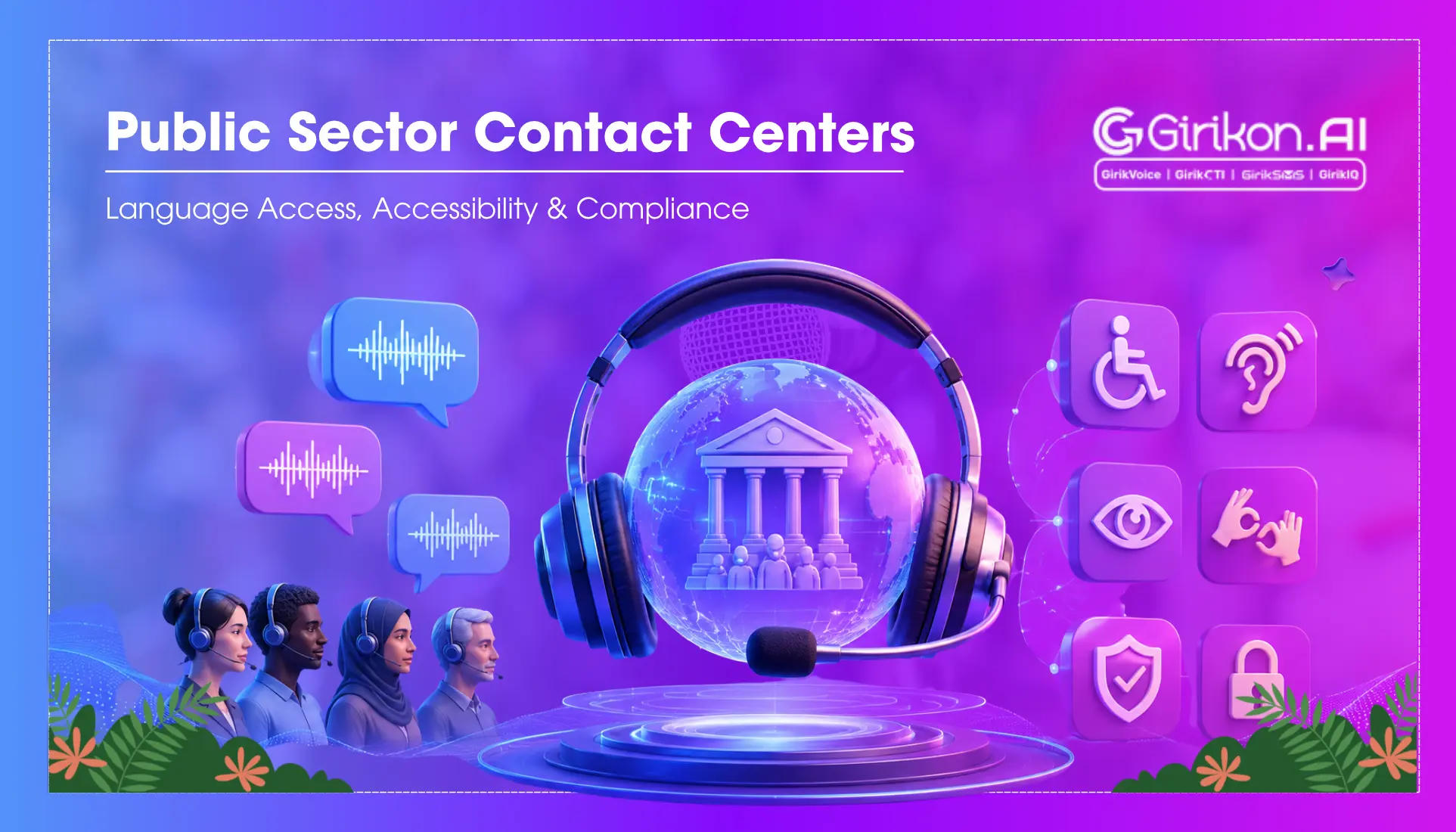
Public sector contact centers must ensure equitable language access, accessibility for people with disabilities, and compliant call recording practices. Strong policies, trained staff, and secure systems help agencies deliver inclusive, transparent, and legally compliant services.
- 1Prioritize language access and accessibility to ensure all citizens, regardless of language or disability, can effectively interact with government services.
- 2Implement AI-powered solutions for voice recognition and language routing to improve first-contact resolution and reduce communication barriers.
- 3Design simple and intuitive IVR menus, offering clear paths to live agents, to accommodate users with cognitive or literacy challenges.
- 4Provide alternative communication channels beyond traditional IVR systems to cater to citizens with varying digital literacy and communication needs.
- 5Ensure robust call recording, safeguarding, and retrieval processes to comply with policies and protect sensitive citizen information.
Public Sector Contact Centers: Language Access, Accessibility & Call Record Compliance
Every citizen interacting with the government should not face problems while navigating through various voice prompts and communicating in their native language. They should also not be concerned about their conversations being legally monitored when discussing sensitive or private information with government representatives.
Nevertheless, the fact is that public sector contact centers do have some issues when it comes to making services accessible to diverse populations, meeting accessibility requirements, and handling sensitive citizen information securely and responsibly.
For government agencies, contact center modernization is therefore about more than reducing wait times. It is about making every interaction secure, understandable, accessible, and accountable. This is where public sector contact center Salesforce solutions, including a Salesforce AI contact center, accessibility support, voice AI capabilities, transcription processes, and call recording automation, come into play to help create more satisfying experiences for citizens.
Why Do Public Sector Contact Centers Need Special Attention?
Government contact centers accept calls from various segments of population, including disabled people, elderly citizens, and people who do not speak English well and do not have access to the Internet.
These citizens may contact government to get assistance with:
- Permits and applications
- Complaints and case updates
- Healthcare and social services
- Education and community programs
- Tax and licensing questions
That creates several operational priorities:
-
Language Access: The public must be able to comprehend and interact with the organization.
-
Accessibility: Communication means must be convenient for individuals with speaking, hearing, visual, or movement difficulties.
-
Documenting: Organizations must ensure that they are able to preserve, safeguard, and locate call records in accordance with their guidance and policy.
-
Privacy and Security: There may be personally identifiable information and confidential details within calls.
-
Transparency: Citizens have a right to information about handling their communication, particularly if it gets recorded or transcribed.
How does Language Access Affect Citizen Services?
Language barriers can turn a simple government interaction into a frustrating one. A citizen may struggle to explain their situation to an English agent when they want to apply for a benefit or renew a license. To meet language access requirement calls, an automated voice system can identify a caller's preferred language and route the interaction accordingly.
This can help agencies:
- Improve first-contact resolution
- Reduce communication barriers
- Create a more consistent citizen experience
- Make services easier to access
AI Role in Multilingual Contact Centers
While recognizing common requests, collecting basic information, and providing approved responses, AI can route callers based on their needs and language preferences.
For example:
The Spanish speaking citizen reaches out to a public benefits agency. The technology of voice recognition identifies that the citizen requires Spanish explanations, comprehends the nature of the call, and refers the caller to an agent who speaks Spanish.
In addition to that, rather than relying solely on automated translation, public service agencies should always be aware as to when live interpreters should be used, which is a specific skill area, as well as when bilingual experts must be involved. This ensures that callers can quickly connect with a trained representative when their situation goes beyond what AI can appropriately handle.
What Does Accessibility Mean for Contact Centers?
Accessibility should extend beyond government websites and physical offices. Besides, contact centers should also be designed to support people with visual, hearing, cognitive, speech, and other accessibility needs.
This signifies the need for public sector contact center to support citizens with:
- Limited digital literacy
- Speech disabilities
- Hearing impairments
- Visual impairments
- Age-related accessibility needs
Based on the service and applicable requirements, agencies can:
Make IVR menus simple
When someone calls an IVR line, long menus can feel like too much. This can be hard for people with mental disabilities and for others who struggle with similar issues. That is why companies should keep the Salesforce IVR menu short. The choices should be simple to read and quick to follow. It also helps to add a clear way for the caller to reach a live agent. Callers should not have to search through many steps to get support.
Offer Alternative Communication Channels
Not every citizen can easily navigate traditional IVR systems or wait in a call queue. An ADA accessible contact center must offer AI voice agents and AI-based voice assistants that allow citizens to voice their needs without having to go through various menu options. An AI agent is capable of listening to a query, providing information, taking action, and connecting a caller to a representative when human assistance is essential.
Implement Assistive Technologies
Public sector contact centers need to ensure that their voice and digital channels are functional alongside common assistive technology devices. For instance, it would be beneficial for such centers to use text-to-speech software, screen reader software, and telecommunication relay services. Such technologies serve the citizens with auditory, speech, and vision disabilities and let them access government information easily.
Why Does Call Recording Compliance Matter?
Phone calls in the public sector can include private details. These may be a person's name, home address, payment or banking facts, ID numbers, and prior case notes. Because of that, public sector groups often need to keep call recordings. They use the recordings for later review, staff coaching, performance checks, and official recordkeeping. Salesforce call recording compliance is meant to support this work. It helps agencies keep the recordings safe. It also supports rule requirements, the ability to audit what happened, and careful handling of sensitive information.
However, agencies also need to ensure that call recordings are handled securely in line with applicable requirements, like:
- When calls can be recorded
- Who can access them
- When recordings should be archived or deleted
- How long they should be retained
- Whether callers need to be notified
Government call records retention depends on the applicable jurisdiction, legal requirements, and records-management policies captured during the interaction. Agencies should also have clearly defined protocols for secure storage, processing, archiving, and destroying call recordings.
Depending on the jurisdiction, applicable laws, and type of information, call recording should be treated as part of the broader security, privacy, and records-management strategy.
Usefulness of Call Transcription in Organizing Call Records
The transcription of the calls enables agents and managers to review calls easily without the need to listen to the entire audio recording when looking for specific details, making Salesforce call monitoring more efficient and accessible.
This ultimately helps in:
- Quality assurance
- Case documentation
- Follow-up activities
- Call disposition
- Agent coaching
- Knowledge management
What Should Public Sector Contact Centers Look for in a Modern Contact Center?
While evaluating contact center technology, public sector organizations should look beyond basic inbound and outbound calling and ensure they have the right contact center performance metrics to measure service quality, accessibility, compliance, and operational efficiency.
-
Accessibility Evaluate support for simple IVR design, accessible communication channels, interfaces, and relay services that accommodate different user needs.
-
Call Recording Controls The platform should provide configurable recording capabilities and appropriate controls for access, retention, storage, and auditing.
-
CRM Integration Connecting telephony with systems such as Salesforce allows agents to provide contextual information without requiring them to switch between multiple applications.
-
Human Escalation Instead of creating another barrier between government services and citizens, the system should provide clear escalation paths to trained human agents.
-
Multilingual Support Look for multilingual voice AI capabilities, including multilingual IVR, language detection, interpreter integration, and routing based on agent skills and language.
-
Transcription and Search Searchable transcriptions can make call records easier to review, but agencies should evaluate how transcript data is governed and secured.
Conclusion
Public sector contact center Salesforce can help agents access relevant citizen information, streamline follow-up workflows, and manage interactions from a connected platform. However, it works best when supported by privacy retention, clear accessibility, and escalation policies.
GirikCTI brings these capabilities together by connecting voice interactions with Salesforce, helping public sector teams manage calls, route citizens to the right representative, and support AI-powered voice assistance when human support is needed. Book a free demo to learn more.