AI voice payments require careful PCI planning to keep cardholder data out of AI systems, recordings, and other sensitive environments. Learn how DTMF masking, secure IVR handoffs, tokenization, and PCI scope help build safer voice payment architectures.
- 1Understand that PCI DSS scope is determined by where cardholder data flows and is stored/processed, not solely by the presence of AI on a call.
- 2Implement DTMF masking to prevent card digits from reaching AI systems, recordings, or transcripts, thereby reducing PCI scope.
- 3Adopt secure architectures such as AI voice with DTMF-masked payment capture, secure IVR handoffs, or tokenized payment workflows to minimize data exposure.
- 4Recognize that compliance failures can result in significant fines, loss of customer trust, and damage to brand credibility.
- 5Map all potential card data entry points within the call flow to accurately define PCI scope and avoid compliance gaps.
PCI Compliant in Voice Payments: What DTMF Masking Calls and PCI Scope Mean
AI voice agents are increasingly used to manage customer interactions, and payment conversations are now part of that scope. Once cardholder data enters an AI system or a contact-center environment, PCI DSS obligations apply. PCI compliant voice payments are defined not by if AI can process payments, but by whether cardholder data should enter these systems. To achieve this, enterprises use methods such as DTMF masking calls, secure IVR handoffs, and tokenization. Each applies separation differently, reducing exposure but requiring full validation within the broader PCI scope contact center framework.
Compliance failures carry significant consequences. Fines can begin at $25,000 per card type, but it’s not just the monetary damage. Non-compliance also leads to diminished customer trust and brand credibility. Enterprises must therefore understand how separation methods function. In this blog, we explain where PCI scope applies, understand how to take card payments voice AI, and provide a step-by-step guide to selecting the right architecture for AI voice deployments.
Does Taking Card Payments with AI Voice Put Your Contact Center in PCI Scope?
Card data can show up in several places during a call. The AI agent. A human agent listening in or assisting. DTMF keypad entries. Call recordings. Transcripts. CRM records. Analytics tools. The payment gateway itself. The list goes on. Each of these is a potential exposure point, and PCI scope isn't triggered by AI's presence on the call. It's determined by where the data actually flows and which systems store or process it. Two contact centers can run nearly identical AI voice tools and still end up in very different scope positions, depending entirely on how their AI contact center automation architecture is built underneath.
Why PCI Scope Matters for Contact Centers
Once cardholder data falls inside scope, it leads to more than monetary damage.
- Security controls expand with audit requirements getting stricter.
- Every connected system: CRM, analytics, storage, now needs its own assessment.
- Recordings and transcripts carry particular risk here, since spoken card numbers or captured DTMF tones can end up stored without anyone realizing it happened.
- For teams evaluating AI voice platforms, understanding AI voice agent security compliance alongside PCI scope implications early can help avoid costly redesigns later.
What are DTMF Masking Calls?
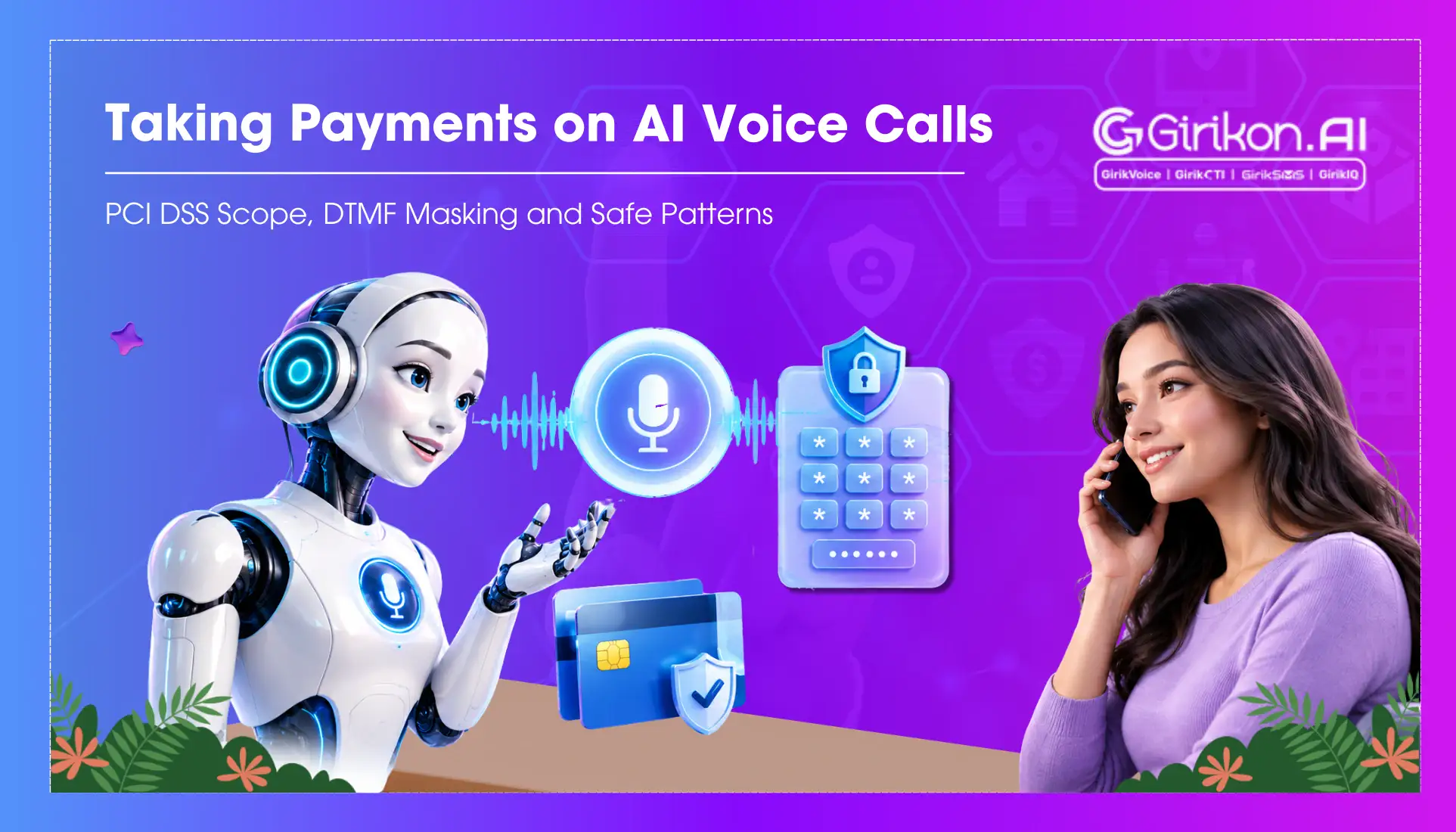
DTMF Masking Calls is a technology that captures the audio that gets generated when a customer touches the keypad mid-call and blocks it from reaching the AI system, any human agent, or the recording system. The digits themselves are routed through a secure channel direct to the payment processor, so raw card data stays out of the conversation layer.
5 Benefits of DTMF Masking:
- Card digits never reach AI processing or show up in transcripts
- Fewer systems fall inside audit scope
- The conversation stays natural and uninterrupted during payment
- Risk tied to recorded or stored call data drops significantly
- PCI assessments move faster with narrower data exposure to review
However, DTMF masking calls itself doesn't equal PCI compliance. It closes off exposure at one specific point in the call, but everything around it like recording infrastructure, storage practices, network segmentation still needs full validation.
How to Build Safe Architectures for PCI Compliant Voice Payments
Pattern 1: AI Voice + DTMF-Masked Payment Capture
The AI runs the conversation as it normally would. When you take card payments voice AI, though, the customer enters card details through the keypad rather than speaking to them out loud. That payment data skips the AI layer entirely. The call still feels continuous, and exposure drops meaningfully at the same time.
Pattern 2: AI Voice + Secure Payment IVR Handoff
When payment intent is detected, the call shifts to a secure IVR for authorization. After completion, control returns to the voice agent to continue the conversation. Separation here is stronger than in Pattern 1, but there's a brief handoff moment that can break the customer's flow.
Pattern 3: AI Voice + Tokenized Payment Workflow
Tokens stand in for raw card numbers on recurring transactions, which means stored payment methods never expose actual card data on future calls. This pattern works best for organizations with mature payment infrastructure already in place and repeat billing relationships to support. It does, however, ask for more integration to work upfront.
5 Steps on How to Take PCI-Compliant Payments on AI Voice Calls
Step 1: Map the call flow
List every point where card data may appear for agents like AI, recordings, transcripts, CRM, or gateways. This map defines the PCI scope when you want to take card payments voice AI. If not done, your process is exposed to gaps later, causing compliance risks and costly fixes that could have been avoided with early visibility.
Step 2: Define payment frequency
DTMF masking calls and IVR handoffs fit single transactions. Tokenization supports repeat billing. Decide which frequency you want to opt for. Clear planning keeps the system efficient and reduces redesign costs later. It also lets you meet compliance requirements without impacting customer experience or needs.
Step 3: Balance compliance and experience
Understand that DTMF masking keeps the conversation flowing with fewer breaks. IVR handoffs enforce strong separation but interrupt calls. What method you should choose depends on customer expectations and how much interruption is acceptable to you during payment. Choosing clear insight helps maintain security while still delivering a smooth payment experience.
Step 4: Validate the architecture
Check that recordings and transcripts exclude payment details. Review storage, segmentation, and integrations together. A qualified assessor should confirm if the system works before deployment. They also ensure all controls operate together to meet PCI contact center requirements and TCPA compliance for AI voice calls, preventing gaps that could weaken compliance.
Step 5: Confirm processor compatibility
Verify that your payment processor supports masking or tokenization before development. Discovering gaps midway forces redesign and raises costs. Upfront validation ensures chosen workflows align with processor capabilities, prevents compliance issues, and protects customer trust while keeping payment operations efficient and reliable.
Conclusion
Using AI voice for card payments does not automatically place the entire contact center in PCI scope. The deciding factor for making PCI compliant voice payments is architecture where cardholder data moves, which systems it touches, and what gets recorded. Methods such as DTMF masking calls, secure IVR handoffs, and tokenization reduce exposure only when built into a validated design.
Enterprises should treat payment handling as an architectural choice from the start. Choosing the right enterprise AI voice agent deployment guide matters. A platform with secure separation and processor support ensures you’ve compliant PCI scope contact center, builds customer trust, and keeps payment operations dependable.