A practical guide to choosing the right messaging channel at every stage of the customer journey — and making them work as one.
Your customer gets an order confirmation via email. A delivery update via SMS. A promotional offer via WhatsApp, and a support follow-up that is never received. Same business, four different touchpoints — and not one of them feels connected.
This is the reality for most businesses today. It is not about lack of communication, but coordination.
Earlier, 73% of businesses were using only one messaging channel. Fast forward, and 97.7% of messaging traffic now comes from businesses using multiple channels simultaneously. The shift happened fast. But knowing which channel to use, when, and why — that's where most omnichannel messaging strategies still fall short.
The question was never really "should we use SMS or email?" It's always been "what does this customer need right now, and which channel actually delivers that?" Get it right, and the journey feels seamless. Get it wrong, and you're just adding noise.
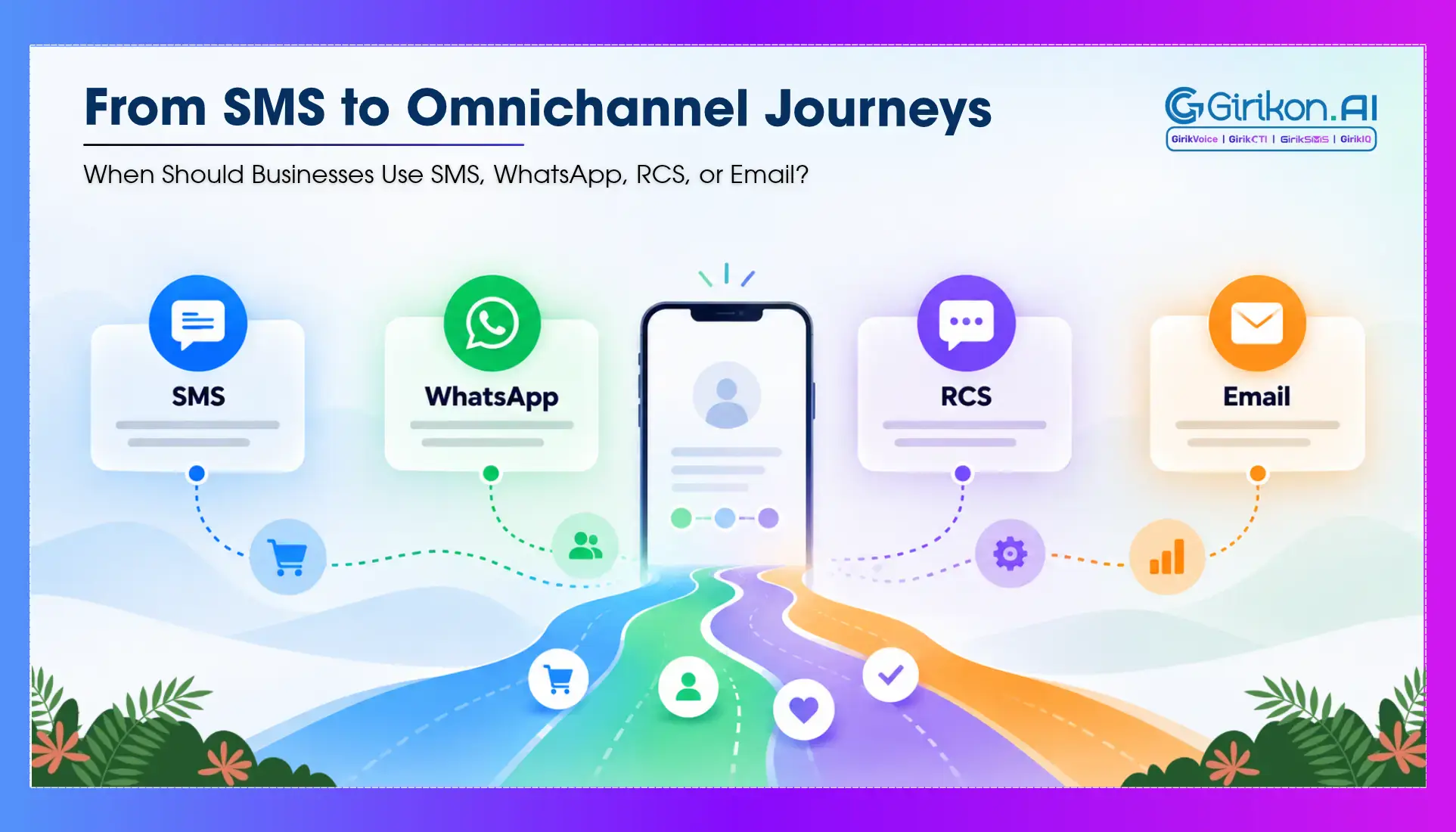
This blog breaks down exactly when to use SMS, WhatsApp, RCS, or email — and how to bring them together into a customer communication strategy that actually works.
What Is Omnichannel Marketing, and Why Do Customers Expect It?
In the middle of all the noise online, what is omnichannel marketing is really just a fancy way of asking: are we showing up where our customers already are? It’s less about theory and more about being present in the places they naturally use every day - sometimes that’s a well-written email with context, other times it’s a short SMS with the essentials, and often it’s a quick WhatsApp exchange that feels like a normal chat. When those touchpoints feel connected instead of random or repetitive, people start to feel like the brand “gets” them, and that usually translates into stronger loyalty over time. At the heart of it, this approach accepts that everyone has their own communication style and gives them the freedom to pick how they want to engage with us.
Most of us, without even thinking about it, already have a pecking order for notifications - some we read immediately, others we swipe away or mute - and customers apply that same logic when deciding which brand messages deserve their attention.
Twilio's latest numbers show more than 80% of folks would rather message a company than pick up the phone for support. Wild, isn't it? Still, tons of companies stick with those old-school email dumps or endless hold music.
At the end of the day, customers don't really care about any communication channel; all they want is to have a conversation without repeating their query multiple times on different communication platforms.
That's where many businesses struggle. Their marketing emails might be planned in one system; SMS campaigns are running on a completely different system. A siloed approach leads to a disconnected customer experience because the messages get duplicated, the context is lost, and customers feel like they are starting from scratch each time.
According to Salesforce’s report, 73% of customers expect companies to know their requirements and expectations and make communications connected rather than disconnected.
Point is, nurturing means paying attention to what they actually want. Miss the mark, and you blend right into the background chatter.
Multichannel vs Omnichannel Marketing: What's the Difference?
What Is Multichannel Marketing?
Simple: it's us reaching out across multiple channels without them talking to each other. Picture sending an email promo, then an SMS follow-up, then a WhatsApp nudge - all separate silos. It works, sure. Gets eyes on your brand. But it's clunky. Customers get bombarded, confused even. "Wait, did I already respond to this?"
Multichannel's been around forever. Think catalogs, TV ads, emails. Solid for awareness. But nurturing? It falls short because there's no seamless flow. You know the frustration - replying to an email only to get a disjointed SMS next. Anyway, it's a start. Just not the endgame.
Level Up with Omnichannel: The Seamless Shift
Now, benefits of omnichannel marketing? Game-changer. It's multichannel on steroids - channels that sync. Start in email? Pick up in WhatsApp without repeating yourself. Customer switches from SMS to app chat? History follows. Result? Personalization that feels magical.
Take Zappos. They nailed this: a half-read email leads to a WhatsApp summary, pulling in your past chats. Engagement jumps 30-50%, per Gartner stats. Loyalty builds because it respects their flow. No more "who is this?" moments.
Here's a quick framework to get started:
- Audit preferences: Survey customers. "Email, SMS, or WhatsApp?"
- Link up your tech: Omnichannel messaging platforms handle the cross-channel magic.
- Tag interactions: Track every touchpoint in one CRM.
- Automate smartly: Trigger WhatsApp if email opens flop.
- Measure and tweak: A/B test. What converts?
Kind of makes you think - why isn't everyone doing this already?
What Makes an Omnichannel Messaging Strategy Work?
If businesses are already using numerous messaging platforms, how come it always feels disconnected? - because adding channels is not the same as connecting them.
Today, customers communicate with businesses through all available messaging channels, yet the biggest challenge is that they feel disconnected despite raising queries across all channels. Because they are just repeating their queries (or requests), meanwhile, the actual context is being missed somewhere.
That is where an effective customer communication strategy changes the approach.
Instead of asking, “Which channel should we use?”, businesses should ask:
- What is the objective of a customer?
- What level of urgency does the customer exhibit?
- Is this just an update, or will the request necessitate conversation?
- What channel makes the experience easier?
That is the transition that takes multichannel engagement to an actual omnichannel messaging.
For instance, some service updates would come in best via SMS, simply because speed is an imperative here, whereas an enquiry about products might be delivered better on WhatsApp, and a proposal or an onboarding project will be sent through email.
Again, the intention isn't to centralize every communication channel into one platform, but to ensure a level of continuity across all business touchpoints.
If businesses shift their focus from channels, then customer journey automation becomes quite simple for building and scaling.
Therefore, comes the next question– what are the key things that would make business use SMS, WhatsApp, RCS, or email in each scenario?
Why Email, SMS, and WhatsApp Work Better Together
Companies can utilize the right omnichannel messaging, WhatsApp, email, and SMS strategy to meet the customer’s expectations. There is no single communication channel that can handle every customer interaction.
Each communication platform serves a different purpose, for example:
- Email is the ideal communication platform for sharing detailed information.
- SMS is effective at capturing someone’s attention instantly; but it isn’t the right channel for ongoing communication.
- WhatsApp is perfect for fast and easy two-way communication, but it cannot be applied in all campaigns.
The actual value lies in using the most suited communication platform during the right stage of the customer journey.
Imagine a typical journey of any customer:
- Email: Receive a product brochure
- SMS: Get a webinar invitation and reminder
- WhatsApp: Ask product-related questions
This is what makes omnichannel communication platforms more effective.
The approach works beyond marketing campaigns and extends to other touchpoints such as appointments, order confirmation, billing notifications, customer service, or even post-sale engagements.
Companies should take advantage of the communication channel which aligns well with their audience’s intention instead of sticking to only one channel for all purposes. In doing this, they will create a unique “communication journey” where Email, SMS and WhatsApp are used differently yet to fulfill the exact purpose.
The real advantage lies in ways each channel complements each other. With these communication platforms sharing information about customers rather than working on their own, companies can provide relevant experiences, minimize communication barriers, and ensure consistency in their branding efforts from beginning to end.
That is what an omnichannel messaging platform for chat, SMS, and WhatsApp necessitates—and why more Salesforce firms are adopting a unified messaging strategy.
SMS, WhatsApp, RCS, or Email – Which One Is Best to Use and When?
There is no “one right channel”. It just depends on what a customer requires of you at that point of time and their communication preferences.
A successful omnichannel strategy just needs a defined purpose behind every channel and to consider where it actually has a great impact. Every planned interaction with the customer's ongoing journey feels more relevant and connected, and not just a repetition of the same conversation.
It's easy to visualize like:
SMS: When Speed and Reach Matter Most
SMS remains one of the most reliable channels when the message needs immediate attention.
Use SMS for:
- OTPs and verification messages
- Appointment reminders
- Delivery and service updates
- Time-sensitive notifications
- Payment reminders (for example, to alert a user of an upcoming or real-time transaction)
SMS messaging has remained a popular way to connect with customers, as it's both highly efficient and easily accessible - it does not require any app, nor does it depend on internet access to deliver messages.
Some messages need instant attention - payment confirmation, appointment notifications, OTP, package information or limited time offers - these are a few of them which would draw more customer attention if sent over SMS than email. It is not about replacing emails but making sure that the customer gets the information on time.
WhatsApp: When You Need Two-Way Conversations
WhatsApp works well when engagement matters more than just delivery.
Use WhatsApp for:
- Customer support
- Lead nurturing and follow-ups
- Conversational sales
- Sending confirmations with quick responses
- Promotional materials with a strong visual component (such as product demos or game teasers)
This channel helps businesses create more natural interactions instead of one-way communication. It is especially useful when customers may have questions and expect faster responses.
WhatsApp gives companies an option that is not available on other one-way channels; it enables companies to keep the conversation going. It is possible for customers to ask their queries, seek any information regarding the products, make an appointment confirmation, or seek assistance all on this same platform.
RCS: When Messaging Needs to Feel More Interactive
RCS brings richer experiences directly into the messaging environment.
Use RCS for:
- Promotional campaigns
- Product announcements
- Interactive updates
- Branded customer experiences
If SMS delivers information, RCS adds context through richer content and interactive elements. It can be useful for businesses looking to improve engagement without moving customers into another app.
Email: When Context and Detail Matter
Despite the latest messaging channels, email still plays an important role.
Use email for:
- Proposals and quotes
- Onboarding journeys
- Reports and detailed communication
- Long-form updates and documentation
Email offers the benefit of giving customers some space to process information on their terms, and returns to it later, letting them make informed decisions.
Email is most effective when there is more than just an update to give to the client. The email can be used for product launch, training, or lead nurturing. It enables one to share in-depth and personalized content since it gives you room to share your whole story without having to alarm the customer with constant notifications.
Email vs SMS vs WhatsApp at a Glance
When teams talk about their main nurturing channels, they usually end up circling around the same trio: email, SMS, and WhatsApp. Each one plays a different role in the mix, with its own strengths, limits, and best-use moments for keeping relationships warm instead of just pushing out generic campaigns.
| Channel | Speed | Open Rates | Best For | Drawbacks |
|---|---|---|---|---|
| Medium (hours) | 20-30% avg | Detailed nurturing, stories, attachments | Filters, spam fears, longer reads | |
| SMS | Instant (seconds) | 98% | Alerts, reminders, urgency | Character limits (160), costs add up |
| Instant | 90%+ | Conversations, media, groups | Needs opt-in, regional limits |
(Data pulled from industry averages like those from Mailchimp and Meta reports - kind of eye-opening, huh?)
Email's your reliable workhorse. Great for storytelling. SMS hits like a lightning bolt - perfect for flash sales. WhatsApp feels personal, like texting a friend. To be fair, not every business needs all three. But ignoring any? You're passing up real opportunities.
Businesses often see greatest returns not from choosing just one channel over others, but from leveraging a strategic combination of each messaging channel in an omnichannel messaging strategy to align with the entire customer experience.
SMS vs WhatsApp Marketing: Which Works Better?
WhatsApp and SMS are the two most popular direct messaging platforms among consumers. While SMS texting costs have risen in recent years, WhatsApp is very popular in certain regions. Does that mean WhatsApp should take precedence over SMS for marketing communication?
Not at all!
What Distinguishes WhatsApp Marketing from SMS Marketing?
There is no denying the popularity of WhatsApp and SMS as digital marketing channels. Despite their apparent similarities, the two have diverse functions and are especially effective with different audiences.
| Feature | SMS | |
|---|---|---|
| Reachability | Doesn't require a smartphone or internet access. | Available only to people who have installed WhatsApp app and have internet access. |
| Cost-effectiveness | Only the campaigns with the highest return on investment are cost-effective. Prices differ by location and depend on message volume. | Incredibly economical for messages that are rich in media and interactive. |
| Personalization | Basic level of personalization, mostly restricted to adding customized links or the recipient's name. | Sophisticated personalization features, such as customized content and chatbot-powered interactive scripts. |
| Interactions | Text-only, usually one-way communication, though links for responding to messages may be included. | Extremely interactive, supporting documents, GIFs, videos, pictures, and text. Can have chatbot features as well. |
| Compliance | Subject to strict laws like the TCPA or GDPR, which call for cautious handling of user data and opt-ins. | Though more flexible under compliance, it is nonetheless regulated. Businesses must comply with WhatsApp's business policy. |
| Analytics & tracking | Basic delivery and read reports that, unless combined with web links, have limited capability to track audience engagement. | Comprehensive reports on delivery, interaction rates, and message read status, particularly when utilizing business tools. |
| Industries | Typically used in Retail, Health Services, Financial Services, Travel and Hospitality. | Travel & hospitality, e-commerce, gaming, and other sectors centered on customer support interactions. |
| Best used for | Time-sensitive communication. Usually alerts, offers, and reminders. | Customer service, thorough product information, and rich media marketing strategies. |
SMS: The Preferred Channel for Important Communications
Consider the most recent texts you have received. They probably dealt with urgent or significant issues. Because of this, SMS is particularly well-liked in sectors like banking and healthcare where anonymity and speed are crucial.
With 78% of text messages receiving a response within the first ten minutes, SMS is renowned for its high engagement rate of 98%.
However, compared to other channels, SMS is costly because a single text message can cost anywhere from $0.06 to $0.25. Because of this, marketers typically save it for time-sensitive communications and promotional initiatives with the highest expected return on investment.
Users can still receive SMS texts without an internet connection, which is the primary advantage of SMS as a communication channel. For transactional or time-sensitive messages, it is therefore the best choice.
WhatsApp: An Engaging Channel for Two-Way Communication
WhatsApp has a far smaller user base than SMS since it can only reach people who have the program installed on their smartphone and have access to the internet.
WhatsApp offers a number of advantages. There are two main ones:
- Supports real-time two-way communication.
- Supports rich media communication irrespective of the recipient's provider.
Given that 85% of users interact with WhatsApp every day and that users spend an average of 18 hours on the app every month, WhatsApp makes it easy to connect with your audience. More significantly, 2 out of 3 users complete a purchase after interacting with a brand on WhatsApp, demonstrating the platform's excellent conversion rates.
It is also the ideal avenue for businesses looking to enhance the customer experience. Given that customers' expectations for customer service are always rising, WhatsApp stands out from rivals because about 60% of messages are answered within the first few minutes.
Is WhatsApp Ideal for Targeted Regional Marketing?
WhatsApp's widespread use across different regions is another significant benefit. WhatsApp has close to 3 billion active users across 180 countries. For companies that operate globally, a reach like this creates almost endless options. But it must be done correctly.
To successfully execute customized WhatsApp promotional strategies, for instance, it's critical to appropriately set up your consumer segmentation. Here, tools like GirikSMS's sophisticated audience segmentation can be quite helpful in helping you craft more regionally appropriate messaging. GirikSMS is a 100% native Salesforce SMS platform and works seamlessly over WhatsApp to engage with your CRM contacts.
With technologies like GirikSMS, including WhatsApp messages in your communication strategy doesn't have to be difficult. With our help, you can personalize messages, build customer segments, automate workflows, and even use GirikSMS to directly respond to your contacts' WhatsApp messages.
Combine SMS and WhatsApp for Higher Impact
The real advantages of text communications emerge when you learn to use both WhatsApp messaging and SMS together, even though either can improve your marketing plan on its own.
If you’re looking for the most cost-effective option, choose WhatsApp.
As we've shown, SMS can soon become very expensive. Because of this, it's usually a good idea to designate WhatsApp as your favorite messaging app and save SMS for emergencies.
Just make sure the user can be reached on WhatsApp and submit your message there to get it to work. GirikSMS's native integration with Salesforce Journey Builder is a reliable tool for creating sophisticated automation workflows that incorporate both channels and carry out reachability tests.
As a result, you'll have greater freedom to organize your communications (for example, by using rich media like videos or gifs) and can later take advantage of comprehensive reporting.
Keep SMS as your backup channel.
Additionally, send an SMS if the person cannot be reached via WhatsApp for any reason, such as not having the program installed or not having an internet connection.
This is especially helpful for important updates to reduce unfavorable customer experiences.
For instance, it's best to use SMS to make sure the customer doesn't miss their flight if your system is unable to send the default WhatsApp notice with updated flight departure information.
Why Use WhatsApp and SMS at the Same Time?
By utilizing both WhatsApp and SMS, you can maximize the outreach and engagement of your marketing strategy by leveraging each platform's advantages while reducing its drawbacks.
When you utilize both channels, you get:
- Greater reach: You can connect with a larger demographic in terms of financial status, age, and geography by utilizing two channels simultaneously.
- Improved customer experience: Depending on the goal of the messaging and the intended customer experience, you can modify your communication strategy.
- Enhanced engagement: You can maintain consistent communication that resonates with your audience by using both WhatsApp and SMS.
- Cost-effectiveness and efficiency: Depending on the kind of communication and the expected ROI, you can use both channels to maximize your marketing budget.
- High open rates translate to higher revenue. Because of their high open rates, WhatsApp and SMS can be smartly used to increase your sales while also saving money.
SMS is renowned for being both costly and successful. WhatsApp provides strong conversion rates and is far less expensive. It also makes more rich media possible.
It will be easier to get the right person to view your message at the right moment if you have automated cross-channel messaging with WhatsApp as the primary target and a backup SMS text for those who are not on the app.
How Do I Decide Between WhatsApp and SMS Marketing?
As we have established, using WhatsApp and SMS channels in tandem is the most efficient method to tailor your marketing communication. To assist you in selecting the appropriate channel for the appropriate scenario, below is a brief synopsis:
- Do you want to issue an urgent alert and don’t know whether the recipient has an internet connection or not? Use SMS since it's dependable and quick.
- Do you want to offer comprehensive product documentation, user guides, or demonstrations? To send rich media, use WhatsApp.
- Is it necessary to monitor interactions and message reads? WhatsApp offers detailed reports.
- Sending marketing and transactional messages? WhatsApp is best for engaging customers with promotional material and SMS is best suited for one-way, transactional texts (like payment or appointment reminders).
- Want to cross-sell or upsell? WhatsApp is ideal for post-purchase support and promotions. SMS texts on the other hand can notify customers about upcoming deals.
RCS vs WhatsApp vs SMS: Which Channel Delivers Better Engagement?
Deciding between RCS vs WhatsApp Business vs SMS is one of the most common points of confusion for business owners. Each comes with its own set of pros and cons, so the right pick depends on your expectations and goals. RCS is the modern version of SMS, built into native messaging apps, with high-resolution media and real-time interactivity. SMS is the traditional 160-character format that works on any phone. WhatsApp Business is the conversational powerhouse with rich media and interactive features.
| Features | RCS | SMS | |
|---|---|---|---|
| Primary channel | Native messaging apps | Third-party messaging app | Cellular network |
| Internet required | Yes | Yes | No |
| Media and interactivity | High-resolution media, carousels, buttons | High-resolution media with voice notes | Text only, 160 characters per segment |
| Security | Transport encryption | End-to-end encryption | No encryption |
| Business verification | Verified business profiles | Verified business badge | Sender ID |
When comparing the three, customer experience is the deciding factor. Every channel has a role to play: some are best for reach, others for interactive conversation.
Customer Reach and Accessibility
If reaching the maximum number of customers is your top priority, SMS remains difficult to replace. Customers get an SMS whether or not their internet is on, while WhatsApp needs the app and a data connection, though it offers a more conversational experience once customers are online. RCS sits in between: it runs natively in existing messaging apps, so brands can deliver rich communications without customers downloading anything new.
Customer Engagement and Interaction
SMS remains best for notifications and one-time passwords, but leaves limited scope for real conversation. WhatsApp allows more engaging exchanges through media sharing, quick replies and catalogues, so businesses can answer queries, nurture leads and run transactional conversations. RCS offers similar interactive capabilities with images, carousels, buttons and personalized branding that prompt action. Organizations communicating at scale should combine channels rather than rely on one.
Integration and Scalability
With conversational commerce, businesses can track engagement, personalize messages, and automate responses in one interface. Connecting RCS, WhatsApp and SMS to Salesforce ties every interaction to CRM data and automation, so teams keep context from one campaign to the next. Our guide to Salesforce messaging automation shows how.
There is no definitive winner. SMS is the proven choice for reaching a broad audience, WhatsApp suits personal, interactive conversations, and RCS blends native accessibility with rich interactivity. Your decision comes down to where your customers are and how they prefer to interact.
Salesforce SMS vs Email: 7 Key Differences
SMS and email serve very different functions inside a CRM-driven business. Salesforce SMS exists to get a response when waiting is not an option; it shows up where people already look and asks for very little time in return. Email offers context: information accumulates, and customers engage on their own terms. Here is how they differ in practice.
Speed of Attention and Response
SMS operates in the present: messages are seen while the context that triggered them still exists, so it performs well where delay introduces friction or loss. Email is built for deferred attention; messages sit until the recipient chooses to engage. That is not a weakness, but it means email works best when urgency is secondary to clarity.
Depth and Complexity of Communication
Email allows ideas to develop and supports explanation, sequencing, and reference. SMS is intentionally narrow; its strength lies in removing complexity, not managing it. Force detailed communication into SMS and you trade speed for confusion.
Customer Perception and Emotional Weight
Customers read a text as deliberate, even when it is automated, so relevance is non-negotiable: a well-timed message feels useful, a poorly timed one feels intrusive. Email carries less emotional weight because customers expect business email and filter or defer it more easily. That makes email safer, but also easier to ignore.
Response Rates and Engagement Behavior
SMS works when the customer already understands the request and only needs a prompt to act. Email performs better when customers are evaluating information or forming an opinion. Expecting immediate action from email leads to misaligned metrics rather than meaningful engagement.
Role Within Salesforce Workflows
SMS fits event-driven workflows: a status changes, an action is required, and communication follows. Email aligns with journey-based workflows, where messages accumulate meaning over time and support progression rather than interruption.
Compliance, Consent and Risk
SMS operates within tighter regulatory boundaries; consent must be explicit and respected consistently, and errors are visible and hard to correct once delivered. Email compliance remains essential but is operationally more forgiving. See our Salesforce SMS compliance guide.
Tolerance and Fatigue Threshold
Customer tolerance for SMS is limited, so frequency and relevance must be managed deliberately; fatigue appears quickly and visibly. Email fatigue develops quietly as customers disengage without complaint, often long before teams notice.
Use Salesforce SMS for appointment confirmations and reminders, service alerts and security messages, quick sales follow-ups, and time-bound offers. Use email for onboarding and education, product announcements, nurture and retention sequences, detailed proposals, and brand storytelling. Neither is the winner; they address different sides of the same goal.
How Salesforce Marketing Cloud Connects Email, SMS, and WhatsApp
Incorporating Email, SMS, and WhatsApp in your marketing strategy is one thing. But, how to make them work together as one customer journey is another. When businesses do not use a single platform, customer messages tend to become lost in different applications which diminishes the chances of providing personalized and seamless customer experience.
This is where the Salesforce Marketing Cloud comes into play. Rather than running all channels as separate campaigns, it lets companies run their communication based on customers' behaviors and interactions with the company in one common environment.
Suppose a customer checks their email but does not go through with a purchase; they receive an SMS reminder after a predefined time. In case they do not take any action but then visit your website or place an inquiry, the journey can continue via WhatsApp with an answer at their disposal. Such exchanges are organized in a way that each of them builds on the previous interaction.
This kind of coordination is made possible by the fact that Marketing Cloud integrates data from the customer in the Salesforce environment. Without having to make any assumptions about the people you are dealing with, companies can segment their customers based on the data from the CRM system, purchase behavior, and customer preferences.
Automation also plays a significant part in this regard. Rather than manually determining when to send the next message, organizations can craft customer journeys that react to immediate actions. This could be a welcome journey, cart abandonment reminder, appointment confirmation, or even a post-purchase journey - the choice is endless as every journey is triggered by the customer's behavior and not by time.
As a result, the enterprise offers a cohesive experience to the customers instead of running various campaigns — ensuring that the customer receives appropriate messaging through the most suitable channel at a specific time.
5 Omnichannel Customer Journey Examples with Email, SMS, and WhatsApp
Following are some examples that will help Salesforce businesses integrate email, SMS, and WhatsApp without any hassle.
| Customer Journey Example | Omnichannel Workflow |
|---|---|
| Lead Nurturing | The prospect receives the eBook download and receives a welcome email. If he or she does not schedule a demo at that point, an SMS reminder follows a few days. As soon as the prospect shows interest, the sales process continues through WhatsApp. |
| Abandoned Cart Recovery | The customer adds products to his/her shopping cart but doesn’t complete the purchasing process. The customer is reminded of the items via email, and then an SMS is sent highlighting that there is a limited time offer on the products. In case of no response, WhatsApp can be used. |
| Appointments & Service Reminders | Email is used for confirming an appointment, while an SMS alert is helpful for reducing missed appointments at a later stage. Then customers can communicate through WhatsApp without making any calls to the customer care center. |
| Order & Delivery Updates | The clients will be informed about their orders via emails, get their shipping alerts through SMS, and get live delivery updates or assistance via WhatsApp. |
| Post-Purchase Engagement | Once the clients have purchased something, businesses can give them onboarding material via email, collect client feedback on WhatsApp, and inform their clients about loyalty programs via SMS. |
How to Run Email, SMS, and WhatsApp Nurture Campaigns
Power Up with Email and SMS Campaigns
Email and SMS campaigns are nurture gold. Email builds the long game: welcome series, tips, case studies. Open rates hover around 25%, but clicks? That's where personalization shines. Segment by behavior - abandoned carts get a gentle nudge.
SMS? It's fast. Really fast. 98% open rates mean your "Your order ships tomorrow!" lands instantly. Pair them: email for depth, SMS for reminders. One study from Klaviyo showed combo campaigns boosting revenue 20%.
But don't spam. Opt-ins are key. And timing - SMS at 10 AM, email evenings. Pro tip: use SMS for urgency, email for value-adds.
WhatsApp: The Personal Touch Customers Crave
WhatsApp's no longer just personal chats. Businesses are all over it. With close to 3 billion users, it's nurture heaven - rich media, voice notes, quick polls. Why don't more businesses use WhatsApp to provide quicker support? Regulations and setup, mostly.
Nurture flows here: post-purchase check-ins ("How's the fit? Photo?"), upsell chats, loyalty perks. Meta's Business API makes it scalable. In India, it's huge - 90% penetration. Stats? WhatsApp drives 40% higher response rates than email, per Business of Apps.
Challenge: Keep it conversational. No salesy blasts. Respond in minutes.
Mixing It Up: What Is Mixed Campaigns Marketing?
It's that sweet spot - blending channels fluidly within one campaign. Not fully omnichannel (no deep sync), but smarter than multichannel blasts. Launch with email storytelling, follow with SMS urgency, close via WhatsApp demo.
Example: E-commerce flash sale. Email teases ("Sneak peek!"). SMS reminds ("24 hrs left - tap here."). WhatsApp seals ("Personal discount code?"). Conversion? Often 2x higher.
Benefits of omnichannel marketing shine here too - context carries over. Modern marketing platforms can orchestrate this kind of flow without us having to juggle everything manually.
7 Best Practices for Building an Effective Omnichannel Strategy
Even with the proper technology, the omnichannel approach can still fail if there is no proper planning involved. Here are some best practices which can assist Salesforce companies in forming a better customer experience through an omnichannel approach.
Define the Purpose of Every Communication Channel
Just because one has the ability to send a message using Email, SMS, and WhatsApp does not mean that he/she should use all three to send the same message. There should be a specific purpose for using each mode of communication.
Personalize Communication Using Salesforce Data
Leverage the CRM data, such as customer preference, buying behavior, interaction record, and other such things to make each message relevant. Personalized marketing becomes more effective when all channels use the same customer information base. Use names, past buys. "Hey Priya, loved that blue top?"
Automate Journeys Based on Customer Behavior
Don’t schedule emails on specific timeframes; rather, craft journeys based on customers’ behavior. Whatever a person does, from opening an email through abandoning a shopping cart to asking for a demo, the following step should be taken accordingly.
Respect Customer Communication Preferences
Not everyone prefers to receive every update via the same contact method. Giving customers the choice of how businesses can communicate ensures greater engagement and prevents message fatigue. Easy unsubscribe = more opens long-term.
Time It Right
Think about daily patterns - short SMS nudges during the day, WhatsApp in the early evening, and emails when people have a bit more headspace.
Add Value First
Tips before sells. Builds trust.
Measure Performance Across the Entire Journey
Do not analyze each campaign of Email, SMS, and WhatsApp individually. Analyze the performance collectively based on customer engagement, conversions, response rate, and journey completion. Use UTM links. See what works.
If all of this feels like a lot to bite off, start with one simple use case - like welcoming new customers - and test how layering two or three channels changes engagement.
Omnichannel Messaging Challenges and How to Solve Them
It's not all smooth. Compliance - GDPR, TCPA - looms large. SMS needs consent; WhatsApp too. Tech stacks? Pricey at first. And staff training: chats feel casual, but scale 'em wrong and it's chaos.
Solution? Low-code platforms. Salesforce cloud or AppExchange apps plug right in. Track the payoff: lifetime value climbs 25%, churn drops 15% (Forrester numbers).
Small teams? Dip in free: WhatsApp Business app plus simple SMS tools.
Build the Right Mix for Your Business
There is no one size fits all approach that helps you determine how to choose a suitable messaging channel because business needs, behaviors, and objectives vary.
The aim here is not to maximize channel utilization but to ensure that all channels perform their own roles within the larger scheme.
For well-established businesses, those decisions may slowly lead to customer journey automation and more collaborative use of Salesforce messaging channels across different departments.
At the same time, companies must pay attention to various engagement metrics, such as message open rates, click rates, or delivery rates.
This is where measuring the messaging ROI comes into play—companies will know what paths of communication lead to their goals and where to invest their effort and money in future.
Conclusion: Connect the Channels, Not Just the Messages
Customer expectations have evolved. Customers no longer look at businesses on the basis of how many channels they offer; rather, they look at them on the basis of their connectivity.
Consumers will keep shifting between Email, SMS, and WhatsApp without even giving it a second thought, and consumers expect businesses to do the same.
Each channel—SMS, WhatsApp, RCS, and email—serves a specific purpose, but it is only through the effective integration of these channels that true value is gained.
Omnichannel messaging does not necessarily mean reaching out across all channels. It means using the most appropriate channel at a suitable time to deliver the right message to the customer.
When it comes to businesses leveraging Salesforce, the integration of email, SMS, and WhatsApp within a single customer experience is not about enhancing the level of engagement, but about creating more meaningful interactions which will help in building stronger relationships. It all depends on how well you leverage the right data, automation, and context for your customer experience.
Nurturing on preferred channels - email, SMS, WhatsApp - isn't a nice-to-have. Nail omnichannel, and we're not just pushing products; we're creating real fans.
As you aim to create more integrated messaging experiences and foster long-term engagement, now is the time to look into ways your communication channels can work together.
Bring SMS, WhatsApp, and Email Together in Salesforce
See how GirikSMS connects every customer conversation inside your CRM.