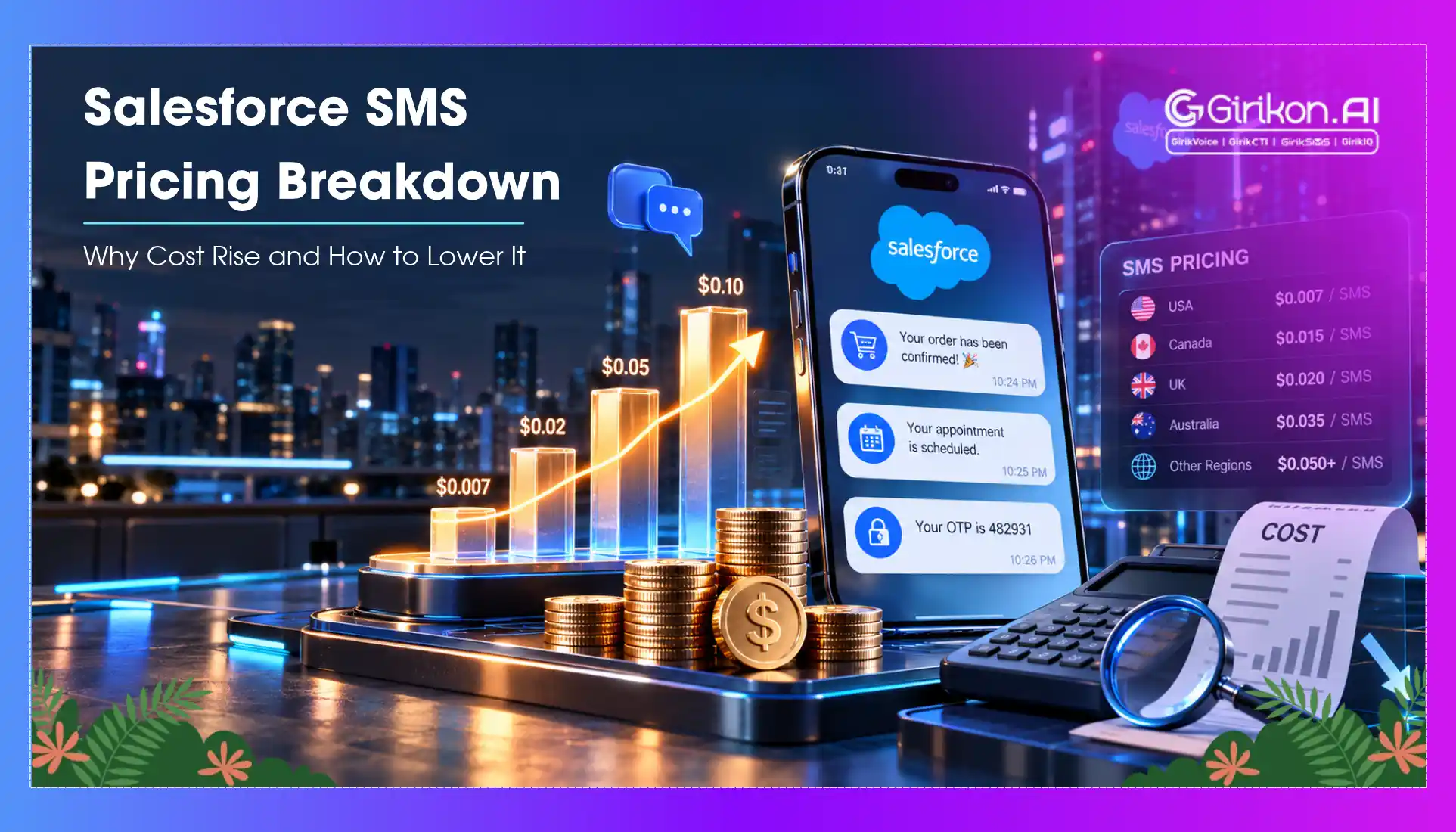
Salesforce SMS apps offer a lot of benefits like 2-way communication, streamlined engagement, faster response, thus improving customer satisfaction, and helping them build long-lasting relationships. However, most businesses struggle when it comes to understanding the real Salesforce SMS pricing because it's often treated as an addition to an existing Service Cloud app. SMS from Salesforce is not a lightweight feature, it follows a licensing and consumption structure. This leads to a model that grows steadily and is more challenging because the cost is divided across licenses, usage metrics, and third-party dependencies.
So, you need to understand these factors and metrics to avoid surprise expenses and make accurate budgets to match your Salesforce investment with operational goals. In this blog, we’ll explain some of the common Salesforce SMS metrics that add to the cost, what role the Digital Engagement model plays, and a few steps to reduce the cost of Salesforce SMS apps post roll-out.
How Salesforce SMS Pricing Really Works
SMS from Salesforce is not a standalone communication channel and is enabled through Digital Engagement. It's an add-on for Service Cloud that lets businesses connect with customers across multiple channels like messaging apps, SMS, live chat, and social media all within the CRM platform.
That design choice has direct pricing consequences, but mostly SMS costs in Salesforce are shaped by these factors:
- User licensing: Every agent who handles SMS needs a Service Cloud license and Digital Engagement access, regardless of how frequently they use the channel.
- Conversation consumption: Salesforce measures usage in conversations, not just messages. A single thread that stays open over days or weeks continues to consume capacity.
- External delivery costs: Telecom charges are billed separately by carriers, and most implementations rely on AppExchange providers to manage numbers, routing, and compliance.
What businesses need to know is that SMS pricing is not message-first but license-first. Message volume matters, but it only becomes relevant after the platform costs are already in place.
Salesforce SMS integration cost usually starts long before the first text is sent. For many teams, that means you’re paying twice per agent - once for the core license, then again for the messaging add-on. And that’s just the platform. If you look at AppExchange solutions or third-party providers, the structure shifts but the pattern remains: base subscription plus variable usage. Apps like GirikSMS commonly charge a per-user or per-org fee, plus a block of message credits. CPaaS integrations flip it: low platform overhead, but strictly pay-per-message. Either way, the real number only appears once you map actual traffic, not just what the marketing page says.
You know how many teams skip that mapping step? Too many.
Salesforce Digital Engagement Pricing Model Explained
Digital Engagement is the gatekeeper. Without it, native SMS simply does not exist inside Salesforce. While pricing varies by contract, the structure below reflects what most teams encounter in practice.
| Cost Component | Estimated Cost | Features |
|---|---|---|
| Service Cloud License (Core Platform) | $75–$165 / user / month | Core case management, automation workflows, and agent console |
| Digital Engagement Add-On (Omnichannel) | $75 / user / month | SMS, live chat, WhatsApp integration, and social messaging channels |
| SMS Messaging Fees (Usage-Based) | $0.007–$0.04 / message | Carrier-based charges for inbound and outbound messaging |
| SMS App / Provider (Infrastructure) | $20–$100+ / month | Phone numbers, routing logic, delivery tracking, and compliance tools |
Digital Engagement is now sold as Agentforce Contact Center Digital. Prices as listed on Salesforce.com in October 2026; contracted pricing may differ.
Salesforce SMS Monthly Cost: What You Actually Pay
Salesforce SMS monthly cost looks predictable on paper - flat licenses, clear tiers. In reality, it behaves more like a mobile data plan from the early 2000s. Digital Engagement has conversation and volume limits: you’ll often see caps on inbound conversations per user and total outbound messages per org, with overage blocks that quietly crank up the bill.
If you’re on Marketing Cloud instead, the monthly pricing moves to heavier bundles that include SMS as part of broader engagement packages (Marketing Cloud Engagement starts at $2,000/org/month for Pro+, per Salesforce.com in October 2026). Great for advanced journeys or large-scale campaigns, but heavy-handed for teams that just want appointment reminders or simple order updates. That’s how you end up paying enterprise money for basic use cases.
AppExchange vendors try to simplify this by offering small-business plans: a modest user fee plus a pool of messages, making the monthly cost much easier to forecast. CPaaS providers can appear even cheaper on paper, especially for US numbers, but those fractions-of-a-cent charges still snowball if you push big volume day after day.
Salesforce SMS Pricing: The Real Cost Breakdown
Let’s explain the three factors that have a role in deciding the SMS pricing:
Salesforce Licensing Costs
SMS access is tied to people, not usage, so even if only a subset of agents actively text customers, licenses must be provisioned at the user level. One more thing, Salesforce does not offer granular, usage-only access for messaging.
SMS Messaging Fees
Every inbound and outbound message incurs a carrier charge. It can be nominal based on the carrier charges. Take it as a two-way conversation to multiply consumption quickly, especially when agents use SMS instead of email or calls.
App Pricing
Teams often use third-party apps to manage phone numbers, opt-ins, sender IDs, and delivery logic. Salesforce SMS apps are important because they offer a unified tool to manage so many tasks but also bring in recurring costs that often go unnoticed during planning.
Hidden Salesforce SMS Costs Most Teams Overlook
We have discussed a few of the regular cost factors that will influence the Salesforce SMS pricing, now shift focus to some of the hidden cost factors that businesses often ignore:
Conversation-Based Usage Creep
Salesforce measures SMS usage by conversations, not individual messages. When threads stay open for follow-ups, acknowledgements, or delayed responses, they continue consuming Digital Engagement capacity. Even low-volume teams can see costs rise simply because conversations are never formally closed.
Automation-Driven Consumption
Flows, bots, and auto-responses count toward SMS usage even when no agent is involved. Reminder messages, fallback replies, and misfiring automations quietly add volume over time. Without regular audits, automated messaging becomes one of the most common reasons SMS costs drift beyond expectations.
Compliance and Consent Overhead
SMS requires strict opt-in and opt-out handling, especially in regulated regions. Managing consent, storing audit logs, and responding to STOP requests often needs paid add-ons or third-party tools. These compliance costs are rarely included in early estimates but become unavoidable in production.
Regional Delivery and Routing Premiums
SMS delivery costs vary widely by country. Some regions require local sender registration, approved templates, or premium routes to ensure deliverability. These requirements increase per-message costs and setup effort, particularly for businesses expanding SMS beyond a single market.
Peak-Period Scaling Costs
The volumes of SMS increase dramatically during seasonal spikes or campaigns. To keep the speed of delivery and cover the area per agent, the teams may have to upgrade the license temporarily or increase the throughput level. Such temporary increases may raise costs drastically unless they are planned.
Reporting and Analytics Limitations
Salesforce basic SMS reporting is often inadequate to conduct any operational analysis. To measure the delivery rates, response times, and conversation results, teams often rely on such advanced features as analytics tools or custom dashboards. These extensions do enhance visibility but also add extra ongoing expenses.
Vendor Lock-In and Migration Costs
When Salesforce Flows and case logic are heavily integrated with SMS workflows, a switch to a different provider will be challenging. Migration involves reconfiguring automation, templates, and compliance settings. This lock-in limits pricing flexibility over time and can make future cost optimization harder than expected.
SMS Integration Charges That Creep In
Those sneaky SMS integration charges reviewers skip rarely show up in glossy comparison charts, but they absolutely show up on invoices. A few of the big ones:
- Carrier pass-through fees for specific regions or routes.
- Extra charges for MMS, which can cost several times more than basic SMS.
- Registration and compliance fees for things like 10DLC campaigns in North America.
- Premium per-message rates for short codes or high-trust sending.
Native Salesforce options abstract some of this complexity, but the underlying economics still bite. International texting can jump dramatically in price, especially across regions with more restrictive telecom rules. Third-party apps or CPaaS-based flows may spell it out more clearly, yet they still bill those extras - just itemized instead of bundled.
You kind of start to see why smart teams treat SMS cost modeling as part of their project scoping, not an afterthought.
Hidden Operational Costs Nobody Mentions
Money doesn’t only leave through per-SMS billing. There are softer costs that reviewers barely touch:
- Admin time spent configuring, testing, and maintaining flows and templates.
- Developer time integrating CPaaS APIs or custom logic in Salesforce.
- Training sales or support teams on new interfaces and workflows.
- Time spent dealing with carrier filtering or compliance issues when messages fail silently.
Articles rave about “easy integration” but rarely talk about the weeks of sandbox testing, data modeling, or regression checks after Salesforce seasonal releases. That’s operational cost, and it matters just as much as the line items on your telecom bill.
Some vendors soften this with managed onboarding, done-for-you campaign setups, or better documentation. Others leave you largely on your own. When we evaluate SMS costs, we include that human effort - even if it doesn’t show up on the app’s pricing page.
Salesforce SMS Limits That Drive Up Costs
Official documentation lays out message caps, throughput constraints, and guidelines for how many texts you can push per second or per day from specific number types. Long codes might be limited to a small number of messages per second, while toll-free numbers or short codes have higher throughput but higher recurring costs.
Content rules layer on top: overly long messages get split into segments, and each segment counts as a separate billable SMS. So that “one” 3-part message? It’s billed as three. High-volume marketing campaigns, especially ones that aren’t ruthlessly concise, can quietly triple your usage.
AppExchange tools inherit those carrier realities. Some vendors add their own message or user limits on starter plans, pushing you into higher tiers once adoption grows. Native or not, ignoring these limits means delayed delivery, throttled campaigns, or - worse - unexpected overage charges when you cross plan thresholds.
Does anybody really read the fine print on message segmentation rules before launching a big promo? Not often, and it shows.
Native vs AppExchange vs CPaaS: SMS Pricing Compared
The classic fork in the road: go native with Salesforce or lean on an external or AppExchange SMS solution.
Native Digital Engagement gives you tight UI integration, omnichannel routing, and a single-vendor stack. Pricing is concentrated in per-user add-ons and organizational caps. That can feel comfortable for teams that want one contract, one support channel, and tight security alignment.
AppExchange options diversify the picture. These apps layer on top of Salesforce but own a lot of the messaging logic and billing structure themselves. They often include quality-of-life features like template libraries, better inbox views, or power-user automation without requiring full Marketing Cloud.
Third-party services like Twilio or similar CPaaS providers sit even further out, offering rock-bottom per-message rates in exchange for development work and ongoing maintenance. They can be unbeatable at scale, especially for global reach, but they do demand technical ownership that not every team has.
| Option | Typical Monthly Pattern | Who It Suits Best |
|---|---|---|
| Native Digital Engagement | Per-user add-on + limits + overage blocks. | Support teams living fully in Salesforce. |
| AppExchange SMS apps | Per-user or per-org + message credits. | Sales/CS teams with moderate volume. |
| CPaaS integration | Tiny per-SMS cost, no per-user license. | High-volume, dev-savvy organizations. |
Anyway, the “right” monthly spend only appears once you match your messaging habits to the right model. To be fair, not every business needs to optimize to the last fraction of a cent. But once your SMS volume starts creeping into the tens or hundreds of thousands, those fractions become very real money.
How to Reduce Salesforce SMS Costs: 4 Tips
Here are ways you can lower the Salesforce SMS cost effectively:
Limit SMS Access to Roles That Actually Use It
Avoid assigning Digital Engagement licenses by default since many agents rarely need SMS. Restrict access to teams actively handling customer conversations to prevent fixed per-user costs from inflating your baseline spend month after month.
Separate Conversational SMS and Transactional Messaging
Not all messages need Salesforce context; for instance, appointment reminders, alerts, and confirmations are better handled outside Service Cloud. If you keep transactional SMS on third-party platforms, it stops Digital Engagement licenses from being consumed by automation-heavy, low-value interactions.
Close Conversations and Audit Automation on a Fixed Schedule
Flows, bots, and autoreplies quietly drive message volume. Without regular audits, they continue firing even when no longer needed. Reviewing automation monthly helps catch duplicate messages, redundant triggers, and background activity that inflates SMS costs.
Choose Cost-Efficient SMS Apps and Providers
Not all AppExchange SMS tools price the same, some, like GirikSMS, focus on lean pricing, predictable billing, and essential features without unnecessary add-ons. Choosing an affordable, well-integrated provider can significantly reduce ongoing SMS expenses without compromising the value.
More Practical Ways to Keep SMS Spend Under Control
- Use templates and character counters to avoid unnecessary message fragmentation.
- Consider using WhatsApp or other channels where appropriate if your audience is already there and pricing aligns.
- Regularly audit inactive users and unused sender numbers.
- Run A/B tests on message frequency - often fewer, better-timed SMS perform just as well, if not better, than high-volume blasts.
- Don’t ignore international route pricing until after campaigns go live.
- Set caps or alerts on usage, so you know you’ve blown the plan before finance flags the invoice.
You wonder why more companies don’t do this as a standard operating practice. It’s not hard - just easy to ignore.
A 5-Step Framework for Building Your SMS Cost Strategy
You can avoid a lot of pain with a simple framework:
- Map your use cases (alerts, reminders, marketing, support).
- Estimate message volume per use case by region.
- Choose a provider type (native, app, CPaaS) that matches that pattern.
- Set automated dashboards and alerts on volume and spend.
- Review quarterly and renegotiate or switch tiers when usage changes.
Look, messaging isn’t new - but the economics and regulations keep evolving. We can’t just “set and forget” this anymore.
In the end, managing Salesforce SMS integration cost isn’t about chasing the cheapest price per message. It’s about aligning your use cases, your team’s capabilities, and your growth plans with the right mix of native tools, AppExchange apps, and possibly CPaaS platforms. We map the terrain like this: native first if you want simplicity and can swallow the per-user premiums, AppExchange if you want flexibility and mid-range volume, and CPaaS solutions when scale eclipses everything else.
Key Takeaways on Salesforce SMS Pricing
Salesforce SMS pricing is not excessive by design, but it’s easy to misjudge, since costs accumulate through licensing commitments, conversation-based usage, carrier fees, and supporting tools, often together rather than in sequence. But when you understand the factors including the hidden ones, you’ll be able to use the app according to your Salesforce investment and objective. Hopefully, this blog has given an in-depth understanding of the key considerations that may impact Salesforce SMS pricing, so you can engage with your customers, offer personalized communication, and build customer loyalty.
It’s fast. Really fast communication. But if we’re thoughtful upfront, the only thing accelerating is our customer experience - not our monthly bill.
Predictable SMS pricing inside Salesforce
Compare GirikSMS plans built for Salesforce teams of every size.