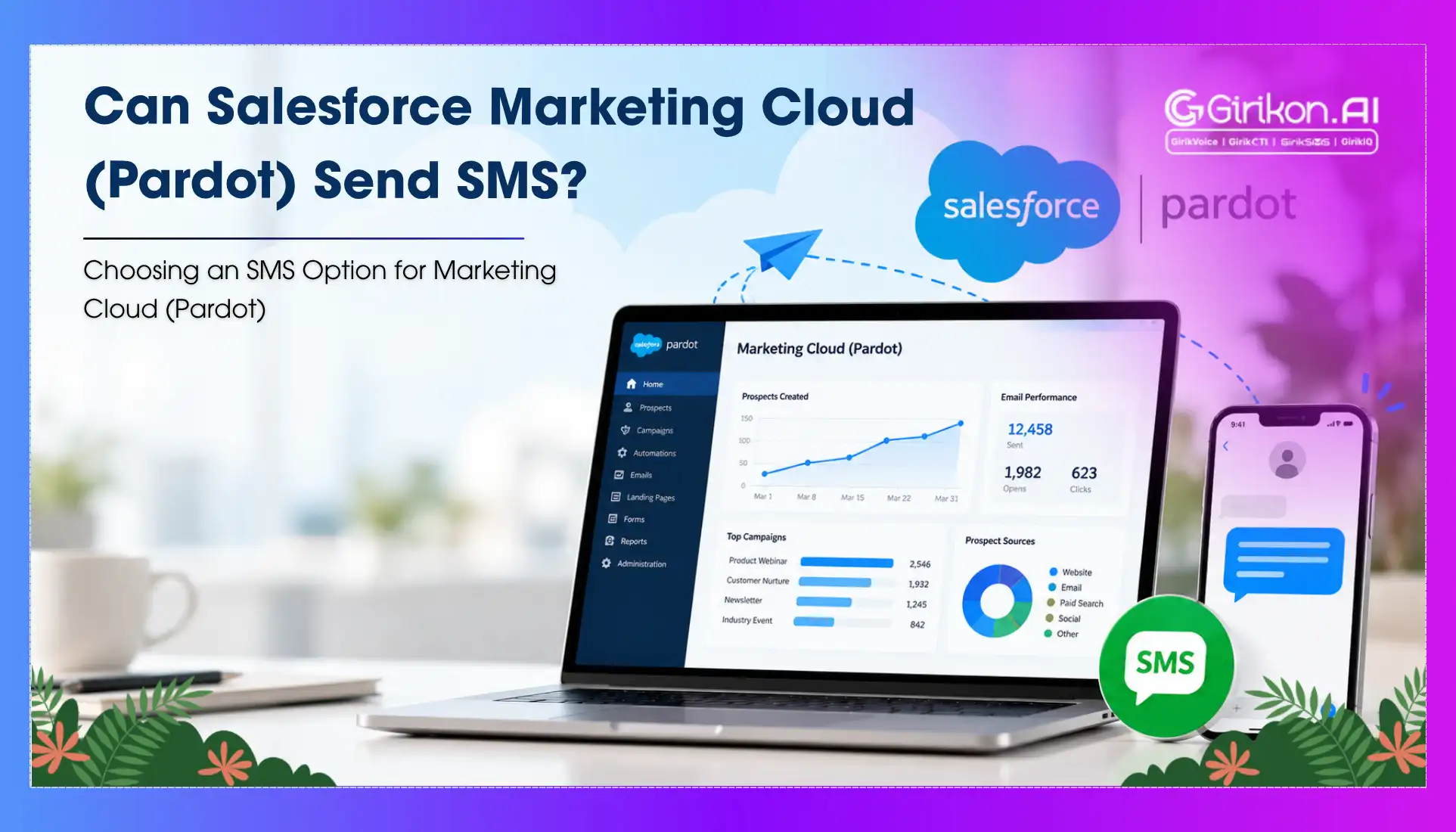
Native SMS options, limits and setup for Marketing Cloud and Pardot (Account Engagement), and when a Salesforce SMS app fits better.
In today’s cut throat business era, businesses must engage thoroughly with their customers to remain relevant. With the market flooded with robust channels of communication, it might be intimidating for businesses to opt for a reliable channel. However, SMS (Short Messaging Service) continues to be a preferred channel with extraordinary open rates and immediacy of mobile delivery. However, teams face the dilemma of making a choice between a dedicated Salesforce SMS integration or the native SMS capabilities of Salesforce.
Today's businesses must meet their customers, leads, and prospects where they are, which means they have to connect with them on their mobile devices. And what better way than to use a communication channel that has a 98% open rate - SMS? However, you may be wondering if Salesforce SMS texting is supported if you're using Pardot - the marketing automation tool from Salesforce. As more and more businesses begin using email and SMS in tandem to interact with and convert prospects, this question is becoming increasingly significant.
While both the options involve taking SMS functionality to Salesforce, both serve different purposes, have their own forte, and align with different objectives. Comprehending the differences—and how they align to your use cases—can turn out to be a differentiator between a successful SMS strategy and the one that creates more intricacy than value.
Through this article, let’s dive into Salesforce SMS Integration and can Marketing Cloud send SMS. Let’s compare them across key dimensions, pros and cons, real-world cases and pricing considerations that can help you make the right choice for your team. We'll also explain whether sending Pardot SMS is feasible, how utilizing GirikSMS can enhance your Pardot-powered marketing and the benefits this integration can offer your company.
Can Salesforce Marketing Cloud Send SMS?
Salesforce Marketing Cloud is a great tool for businesses looking to provide tailored experiences to their customers. It offers a full suite of tools to engage with customers via multiple channels and enables the management of anything from social media marketing to email campaigns. In any case, a lot of marketers wonder if Salesforce Marketing Cloud can meet their needs when it comes to SMS (Short Message Service) communication. SMS is the perfect tool for businesses trying to stay in touch with their customers because it's currently one of the most effective ways to interact with them.
The answer is, indeed. Mobile Studio supports SMS capability. Supporting mobile-friendly marketing campaigns, such as the ability to send SMS texts to your contacts, is one of the key aspects of Mobile Studio. You can promote products and services, send notifications, and complete transactions straight to your consumers' mobile phones with this service.
While this news is exciting, the main focus should be on outlining some of the challenges associated with SMS messaging via Marketing Cloud. First of all, new users can find the Salesforce Marketing Cloud SMS setup to be a little cumbersome. This is particularly true when it comes to third-party suppliers for message-sending integration and delivery alternatives. Additionally, the cost of the Salesforce Marketing Cloud SMS service could be considerable, particularly if you need worldwide SMS coverage or send a lot of messages. As a result, some companies may face financial constraints because of their tighter marketing budget.
Marketing Cloud SMS: Features and How It Works
Built inside Salesforce Marketing Cloud, Marketing Cloud SMS is designed for enterprise-grade mobile engagement, this platform is also a part of a wider suite that includes email, social, web personalization, and analytics.
Besides powering message campaigns, long and short codes, Marketing cloud SMS also sends keyword responses, and mobile journeys that are deeply integrated with Marketing Cloud Journey Builder, Contact builder and analytics tools.
Key Features of Marketing Cloud SMS
- High-volume SMS campaigns
- Support for Short and long code
- Keyword automation and subscriptions
- Mobile-centric journey orchestration
- Advanced Reporting and analytics
- Integration with multiple channels
Marketing Cloud is registered as a distinct product from core Salesforce Service and sales Clouds and is preferred by larger marketing teams with complex mobile strategies.
Salesforce SMS Integration: The CRM-Native Alternative
A Salesforce SMS integration acts as a third-party connector or app that brings capabilities of SMS directly into standard objects such as Contacts, Leads, Cases, and Opportunities without the involvement of Marketing Cloud. These integrations are available on the Salesforce AppExchange and sync SMS with standard Salesforce data.
Key Features of Salesforce SMS Integrations
- Standard Salesforce records send native text messaging
- SMS triggers via Apex and Flow automatically
- Logging of bi-directional messages
- Support for informal texting
- Integration with standard objects
- Custom workflows are made-to-order with respect to sales and support teams
These solutions serve as a powerful way to embed SMS into everyday operations.
Salesforce SMS Integration vs Marketing Cloud SMS: 5 Key Differences
Ease of Implementation
Salesforce SMS integrations are usually fast and easy to deploy. Most solutions are available on the AppExchange and can be directly installed from there. They can be configured without deep technical expertise, and can run on standard Salesforce objects and Salesforce UI. In several cases, teams can set up workflows, and automations using clicks rather than code. This makes it easy for different teams to start using SMS without waiting for IT support.
Marketing Cloud SMS, conversely, comes with a process heavy setup. Besides requiring a full Marketing Cloud environment, this platform often involves onboarding with specialists, and includes further steps such as deploying short and long codes. These setups require technical expertise and longer time period for implementation. Consequently, if your goal is ease and nominal technical overhead, a native Salesforce SMS integration is typically a practical option.
User Experience & Adoption
Salesforce SMS Integration offers a unified experience. This allows support and sales teams to send and receive texts beside calls, tasks, and emails, with every interaction captured by default in the activity timeline of every contact, lead or case. With this, SMS appears to be a natural extension of daily CRM workflows rather than a separate tool. On the contrary, Marketing Cloud SMS operates within the interface of Marketing Cloud, which is primarily created for campaign execution and marketing teams. While it can be connected to Salesforce CRM via tools such as Marketing Cloud Connect, additional setup is still required to support customer-specific engagement with full CRM visibility. For teams that function inside Salesforce — native Salesforce SMS integration is way easier to adopt and delivers a more intuitive user experience.
Automation and Execution
Salesforce SMS integrations are designed to react to activities that occur inside Salesforce. Flows trigger messages when leads change stages, cases escalate, or status of appointment change. As a result, teams use texting as a real-time layer tied directly to various events. Marketing Cloud SMS, on the other hand, is designed for structured, multi-step journeys. Journey Builder allows organizations to map SMS with push notifications, email and other channels through lengthy customer journeys. This makes it appropriate for multi-channel programs. Marketing Cloud excels at event coordination and execution, while Salesforce SMS is optimized for event-driven automation.
Reporting & Analytics
Salesforce SMS integrations provide teams with the required visibility from within the CRM. This enables teams to track messages sent and responded to in the context of leads, cases, and opportunities. Consequently, they can see how text messaging impacts everyday outcomes with respect to sales and service.
Marketing Cloud SMS with built-in analytics dashboards, exhaustive channel performance metrics, and journey-level insights takes the lead. These tools help marketers comprehend how SMS performs across events together with email, notifications, and other channels. Overall, Marketing Cloud offers more sophisticated reporting for cross-channel operation analysis.
Cost Considerations
Salesforce SMS Integration offers flexible and manageable pricing, with licensing that is often based on message volume, without the need for a separate Marketing Cloud license. Marketing Cloud SMS, on the contrary, requires a full-fledged license, which can be expensive, along with certain other charges for short codes, SMS credits and other messaging services. Its complex onboarding process can also trigger implementation costs.
How GirikSMS Extends SMS in Marketing Cloud
Customers can benefit from improved SMS features and cost benefits with a 100% native Salesforce messaging app - GirikSMS.
Many organizations are still searching for more flexible and affordable options for Salesforce SMS messaging, even though Mobile Studio offers integrated SMS capability. These issues are addressed by the GirikSMS platform, which streamlines your SMS messaging, lowers expenses, and provides you with additional capabilities that enhance your communication strategy as a whole.
Lower Marketing Cloud SMS Costs
GirikSMS for Marketing Cloud significantly lowers Salesforce Marketing Cloud SMS costs. You might be spending more than you anticipated using Salesforce's Mobile Studio, particularly if you're running extensive SMS campaigns. Your SMS campaign costs will be significantly lower than costs associated with sending SMS texts using Mobile Studio.
Simplify Message Building
Historically, automating SMS messages in Marketing Cloud can be cumbersome and time-consuming. With GirikSMS for Marketing Cloud, however, things are different. It provides you with an innovative message composer with an easy-to-use point-and-click user interface. Personalized messaging journeys are now possible without having to create complex automation for every campaign.
Streamline SMS Automation
A typical problem with the conventional Salesforce Marketing Cloud SMS setup is the requirement to build separate tasks for every SMS automation. With GirikSMS, you don't need to do that anymore. This implies that you can more effectively automate SMS messages, freeing up resources and bandwidth for other strategic marketing tasks.
Combine SMS with Email Campaigns
One of GirikSMS's best features is that it allows you to include SMS messages in your email campaigns. As a result, you can provide your audiences with a seamless experience that raises the bar for customer satisfaction. Campaigns that are more focused and successful can be executed with a unified view of customer and campaign data.
Personalize and Target with CRM Data
By using GirikSMS for Marketing Cloud, you can retrieve customer information from your CRM and leverage it to create SMS campaigns that are more tailored to each individual. Approximately 89% of marketers report that running targeted marketing translates to a higher return on investment. This can be easily accomplished by using information on past interactions and purchase history to create highly tailored SMS campaigns that will resonate with your audience.
Additionally, GirikSMS enables you to more efficiently handle email and SMS marketing. Not just that. You can use a variety of channels to assess customer interaction. This enables you to fine-tune your SMS communication strategies for optimal results.
What Is Pardot (Marketing Cloud Account Engagement)?
When searching for a B2B marketing automation platform, Salesforce users often turn to Pardot. Not only is Pardot fully integrated into Salesforce's core platform, but it is also affordable enough for many businesses and attracts new customers with a low learning curve.
Pardot a.k.a. Marketing Cloud Account Engagement shines at email automation, lead nurturing, scoring and campaign management.
What Pardot Is Used For
Pardot can be utilized for some or all of the following, depending on the nature of the business:
- Email marketing: Includes automated email journeys and one-time emails sent to prospect lists. Certain actions, triggers, or pre-configured wait times can serve as the foundation for email automation. This works very well for lead nurturing.
- Forms: Gather information from new prospects or enhance records of current ones. You can also solicit information for the prospect's record's blank fields.
- Engagement History: Keep track of every action potential customers take on your website, landing pages, and other online resources.
- Segmentation: For more focused marketing, there are several ways to divide your prospect database into segmented audiences.
- Scoring: Prospects are rated based on how they engage.
- Grading: Prospects are ranked according to how well their demographic information matches your desired customer profile.
- Lead qualification: Your sales reps should target prospects based on their Pardot score and grade.
- Social media marketing: Publish content on Facebook, Twitter, and LinkedIn, then monitor engagement with your content. Activity on a prospect's Engagement History will show up if they are known and monitored in your Pardot database.
- Search marketing: Track rival SEO performance, analyze keyword SEO data, and add or modify keywords for tracking.
- Marketing analytics: Provide information on the effectiveness of campaigns and the pipeline that marketing has influenced using the Campaign Influence feature.
- Multi-channel marketing: Salesforce's wide range of marketing products allows it to be connected to other platforms, including digital advertising (like Google and Facebook Ads) and sophisticated website analytics (like Google Analytics).
Can You Send an SMS with Pardot?
Pardot does not come with SMS messaging functionality by default. It is primarily a marketing automation tool that helps businesses generate leads and nurture them through the sales process. Although SMS messaging is not one of the platform's primary functions, it excels in email automation, creating drip campaigns, and bespoke landing pages. Businesses may find that using email alone is insufficient if they want to take advantage of the efficiency and immediacy of SMS communication.
This does not preclude utilizing an SMS service, though. GirikSMS is a 100% native Salesforce messaging app and can be easily integrated with Pardot to enable you to start sending marketing SMS messages from the tool along with the rest of your marketing automation. Because of this, marketing becomes more effective when it comes to communicating with leads, and companies are able to respond to changing customer behavior more quickly and accurately, which translates to improved conversion rates.
Why Add SMS to Your Pardot Campaigns
When it comes to engaging customers in the B2B space, email marketing holds special relevance. However, in today’s competitive business landscape, relying totally on email marketing can restrain campaign performance with prospects being overwhelmed with emails daily making it extremely difficult to capture their attention.
Making SMS a part of your marketing automation strategy is indeed a smart move.
By integrating SMS with your Pardot campaigns, prospects can be engaged through another highly effective channel of communication. With an open rate of 98 percent, which is significantly higher than emails, makes them ideal for notifications that are time sensitive.
Whether you are launching a new product, demos, or campaign related to client onboarding, integrating SMS into your Pardot Engagement Studio programs allows you to reach prospects immediately without disturbing your remaining workflows.
Since modern customers communicate across multiple channels, Pardot SMS integration helps marketers:
- Increase rates of engagement
- Deliver crucial messages instantaneously
- Enhance event attendance
- Pace up sales follow-ups
- Create omnichannel client journeys
- Reach prospects who might have missed emails
SMS complements email rather than replacing it by sending small, actionable messages that foster urgent responses. When SMS and email work in association with each other, engaging customers becomes easy.
What Is Pardot SMS Integration?
Pardot SMS integration connects a Salesforce-native SMS app with Pardot (Marketing Cloud Account Engagement). This integration allows marketers to initiate messages based on Engagement Studio actions, prospect behavior, automation rules, completion actions, or Salesforce events.
Rather than sending messages manually, marketers can automate SMS within their existing nurture journeys.
How SMS Works in Pardot Engagement Studio
Pardot Engagement Studio SMS integration allows SMS actions to become a part of nurture programs.
A typical workflow looks the following way:
Prospect Enrolls in Engagement Studio
A prospect downloads an eBook or submits a form. They enter an Engagement Studio program by default.
Email Is Sent
Pardot sends an email presenting your product or service.
Prospect Behavior Is Assessed
Engagement Studio probes several things such as whether the email was opened, the link clicked, was the form completed and was the registration of webinar successful and more.
Trigger SMS
Based on the lead behavior, a text message is shared by default.
Continue to Nurture
The workflow persists with SMS reminders, tasks for sales reps and CRM updates. This creates an orchestrated, multi-touch engagement journey.
How to Send Text Messages from Pardot in 7 Steps
Since Pardot does not have in-built SMS capabilities, marketers wonder how to send text messages from Pardot. Rather, an application integrating Salesforce and Pardot with an SMS App is what companies do.
A typical implementation includes the following steps:
Choose an SMS Platform
Select a solution that amalgamates with Salesforce and establishes marketing automation. Preferably, opt for a Salesforce-native app to minimize intricacy and expand security.
Connect with Salesforce
The SMS platform connects with Salesforce objects - enabling marketers to make the most of CRM data for highly tailored messaging. By leveraging client data stored in Salesforce, it’s possible to send SMS campaigns depending on every prospect's profile, stage in the sales journey and engagement history. This leads to significant interactions and better engagement.
Configure Pardot Automation
Pardot automation should be implemented to initiate SMS messages at the right stage of a client's journey. You can use Completion Actions, Automation Rules, Salesforce Flows to send text messages by default depending on prospect behavior, form submissions, campaign engagement, lead status changes, and other CRM events. This ensures tailored messaging without the need for manual intervention.
Build SMS Templates
SMS templates can be re-utilized for common communications regarding discounts, booking notices, event notifications, and more. Besides ensuring steady messaging, templates ensure time efficiency, and tackle campaign execution via Pardot workflow automation.
Test Your Campaign
Make sure to test phone number formatting, message delivery, opt-in status, timing and more prior to launch. End-to-end testing helps figure out issues early to avoid costly failures.
Launch the Journey
Once the testing is done, make sure to activate your Engagement Studio program. SMS messages will be sent by default whenever the preset trigger conditions are met. This ensures timely and customized communication all through the customer journey.
Track Performance
Keep track of key metrics such as delivery rates, CTR, response rates, and more to measure performance of your campaign. Regular assessment and continuous optimization help optimize the efficiency of future campaigns.
6 Benefits of Pardot SMS Integration
Higher Client Engagement
SMS messages attain greater open rates than emails - making them one of the most appropriate channels for crucial communications. Clients are also likely to respond quickly to text messages - enabling faster and more effective engagement.
Better Lead Nurturing
Rather than depending completely on emails sent days apart, marketers can add strategic SMS point of contact to ensure consistent engagement with prospects across the purchase journey.
Faster Sales Follow-Up
Sales teams often miss critical opportunities when response times get delayed. Automated SMS enables companies to engage prospects after key actions such as demo requests, estimate inquiries, and more. By delivering follow-up implications, it's possible to keep prospects engaged, optimize rates of response, and increase the chances of turning leads into clients.
Improved Event Attendance
Many events such as webinars fail to transform into actual attendance. SMS reminders help bridge this gap by sharing timely notifications to registrants at key intervals, such as one hour, a day or even few minutes before it begins. These properly timed reminders optimize involvement and decrease no-show rates.
Reduced Manual Work
Without automation, marketers waste their valuable time uploading phone numbers into different SMS platforms, exporting prospect lists and more. With Pardot SMS integration, text messages are triggered by default based on preset logic and prospect behavior, doing away with manual tasks – augmenting efficiency, and ensuring consistent communication.
Better Customer Experience
Customers give importance to timely and relevant interaction throughout their journey. Rather than getting generic email campaigns, they receive tailored SMS updates initiated by their actions and stage in the client lifecycle. This creates a responsive, engaging and seamless experience while fortifying customer relationships.
GirikSMS Features for Pardot SMS Campaigns
Even while email marketing encompasses the majority of Pardot's functionality, GirikSMS extends its capabilities by adding robust SMS possibilities. Here's how using Pardot SMS messaging to create business value will be made possible by deploying the GirikSMS app.
Engage Customers Across Multiple Channels
When paired with SMS, the efficacy of email in your marketing strategy grows significantly. You can incorporate Facebook Messenger, WhatsApp, SMS messaging, and more into Pardot campaigns with GirikSMS. This ensures that the messaging remains consistent, and you connect with customers on the channels that they prefer. Through a variety of touch points with greater open rates and quicker response times, it also tends to draw in more leads, improving customer satisfaction and conversion rate performance.
Schedule Messages to Cut Outreach Costs
As long as you are reaching out at the appropriate time, GirikSMS's scheduling features can be a huge help and propel your campaign to success. By scheduling communications for the best moment, businesses can enhance response rates while using fewer human resources, making marketing more cost-effective.
Track Links for Deeper Insights
Understanding how prospects respond to your communications is essential for campaign optimization. GirikSMS gives you access to comprehensive link tracking so you can see which messages generate the most interaction. These insights make data-driven decisions possible, increasing the effectiveness of campaigns and assisting companies in focusing on strategies that yield the best return on investment. Pardot's email monitoring is enhanced by this extra level of visibility, which offers a comprehensive view of prospect activity.
Build Relationships with 1:1 Conversations
Businesses have to constantly struggle for the attention of prospects and customers. Personalization is one of the most effective ways to create enduring customer relationships. To elaborate on the use of SMS in Pardot, you can utilize this tool to show each lead hyper-tailored content. Building trust and maintaining longer-term communication can be achieved not just in routine scenarios like birthday messages and shipment tracking updates, but also in many more useful applications, such as making a tailored product offer, offering a custom deal, having a chat, and then sending a follow-up SMS.
Run Multichannel Drip Campaigns
While Pardot's campaigns are good, SMS offers a more potent multi-channel experience. GirikSMS allows you to perform drip campaigns not only through email but also through SMS and WhatsApp. This strategy ensures that no lead is left stranded. Depending on how involved the lead is, you can modify the message and follow up as needed.
GirikSMS does more than just integrate SMS with Pardot. It empowers companies to realize the full benefits of this integration. GirikSMS experts can guide you to create automated workflows that support your sales and marketing objectives since they have a thorough understanding of Salesforce's ecosystem. They make sure that your company completely benefits from SMS Pardot integration, from establishing multichannel marketing to creating workflows that send messages at the right moment.
Frequently Asked Questions About Marketing Cloud and Pardot SMS
What is the limit for sending SMS from Marketing Cloud?
Although there isn't a fixed SMS limit with Marketing Cloud, the volume of messages you can send is determined by your contract and price plan. The cost of each message is determined by volume and geographic criteria. However, companies can take advantage of a more adaptable and scalable approach with GirikSMS for Marketing Cloud. GirikSMS is perfect for growing your messaging campaigns as your organization grows because it enables you to easily scale your SMS messaging needs.
How can I test SMS in Marketing Cloud?
Use Mobile Studio's "Test Send" feature to test SMS in Marketing Cloud. You can also create a pilot test journey to make sure the SMS's functionality, content, and delivery are all in order before distributing it to a wider audience. Testing is made simpler with GirikSMS for Marketing Cloud. It provides more user-friendly features like drag-and-drop capabilities, innovative message composers, and streamlined messaging. This eliminates the need for laborious manual settings and streamlines testing.
Is SMS messaging available in Salesforce?
Yes, you can send SMS from Salesforce by using a 100% Salesforce native SMS messaging tool like GirikSMS. For Salesforce messaging, the SMS-integrated platform offers more sophisticated and multichannel features.
How is SMS messaging used?
SMS messaging can be used for campaign follow-ups and real-time information. Additionally, GirikSMS allows customers to customize communication, employ no-code automation, and accomplish a lot more when utilizing Salesforce.
Key Takeaways: Choosing an SMS Option for Marketing Cloud and Pardot
There is no one and only best SMS platform in Salesforce that best fits your goals. CRM-based SMS integrations are well-suited for sales and support teams that require fast, cost-effective and object-oriented interaction within Salesforce, while Marketing Cloud SMS seems better for enterprises running high-volume and complex customer journeys. Several organizations use both, uniting functioning texting with deliberate marketing to drive more engagement without adding friction.
Through Mobile Studio, Marketing Cloud provides SMS functionality. The Marketing Cloud SMS pricing and setup may be restrictive for large-scale deployments for organizations using the Salesforce suite of marketing products. A more adaptable and economical way to handle all of your SMS messages, communications, and expenses is with GirikSMS for Marketing Cloud.
Though email plays a vital role in B2B marketing, combining it with Pardot SMS creates an efficient engagement strategy. Pardot Engagement Studio SMS integration enables follow-ups, notifications and customized messages. By learning how to send messages from Pardot using a Salesforce SMS platform, businesses can augment engagement, amplify conversions, and provide seamless customer experiences.
Ready to unlock the combined power of an SMS app for Salesforce, Marketing Cloud and Pardot?
Talk to a Marketing Cloud expert.