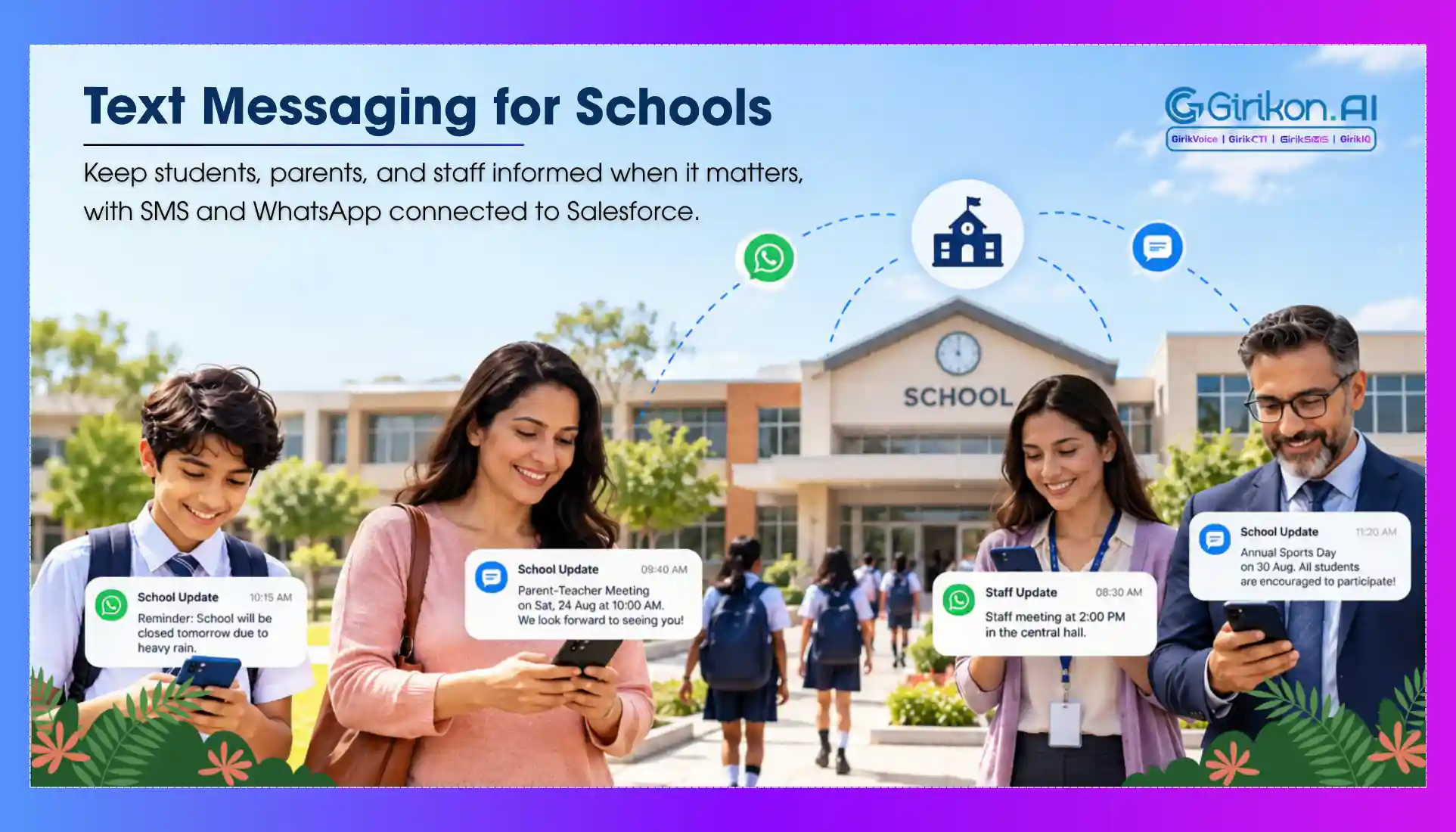
How a connected texting platform keeps students, parents, and staff informed when it matters — without the follow-up chase.
Every day, schools reach out to hundreds, if not thousands, of individuals who could be students, potential applicants, parents, teachers, and support staff to deliver various messages. These messages may include anything from an effort aimed at helping students fill out application forms, giving parents any information concerning their children, to letting people know about new classroom activities or administrative updates. Now, the challenge is not sending messages to keep people updated but making sure that they actually see it when it matters.
Important emails often remain unread. Calls are left unanswered, and thus critical information easily gets lost among competing priorities and busy schedules. With communication becoming increasingly distributed within teams and media, schools spend time following up rather than engaging. This is one reason many institutions adopt a text messaging service for schools. It makes the communication process easy to handle and even easier for the schools to reach out to parents and engage in better communication within the institution.
The youthful and active student community tends to shun emails and phone calls. The most effective way to engage with this dynamic segment is to use a Salesforce SMS app to send text messages.
How Modern Schools Are Using SMS as Part of a Connected Communication Ecosystem
The reason emails and calls fall short is not always the channel itself. It is that they operate separately from the systems that generate the information schools need to communicate in the first place. In fact, communication practices in modern schools have changed a lot in recent years. Initially, SMS communication was used exclusively for notices, reminders, and emergencies. Though that is still true, there are other aspects of communication, including admissions, academic, administrative, finance, student services, and parent communication, being handled all at the same time.
Every day, schools generate information tied to applications, attendance records, fee payments, classroom activities, events, and student support. The difficulty is not creating that information. It is ensuring that it reaches the intended recipients without having to depend on any manual prompts or isolated systems.
This explains why a text messaging service for schools is most useful if it integrates well with other technologies that exist in the school setup. Instead of just being used as a messaging tool, SMS could be integrated with Student Information Systems (SIS), Enterprise Resource Planning (ERP) platforms, Customer Relationship Management (CRM), and admissions software to facilitate communication based on their activity.
An inquiry made by the prospective student will get the required information about how to proceed further with the application process. Attendance records can trigger notifications to parents. Payment reminders based on status and due dates can be generated and managed by fee management software. Communication is incorporated into the process rather than being something separate and manual for staff.
For schools managing larger relationship pipelines — admissions funnels, alumni networks, parent communication — that integration goes deeper. Salesforce adds another dimension to this process. Schools already use CRM systems for managing their relationships with prospects, applicants, parents, and alumni. By integrating SMS with Salesforce, the communications process is driven by the data that the team can use on a daily basis. Admissions teams can follow up faster, engagement activities become easier to track, and communication history stays connected to the people behind it.
The result is a communication model that feels more coordinated across departments. The exchange of information becomes more efficient; follow-up is easier and more students, parents, and faculties get updates that suit their requirements. Contemporary school SMS communication has moved beyond simply delivering announcements in mass form. It has become part of the operational systems schools already depend on, helping communication stay connected to the events, activities, and decisions happening across the institution.
How SMS Supports Every Stakeholder in the School Community
A major challenge for communicating within schools is that every audience is expecting different things and possibly at different times. A prospective student waiting to hear about their admission status, a parent trying to get information about their child’s attendance, and a faculty member arranging an event—all require some form of communication. A modern text messaging platform for schools helps bring those conversations together through a single communication framework.
SMS for Students
SMS messages help schools to maintain contact with students throughout the entire process, from the moment they become an inquiry to graduation.
- Admissions and Enrollment: SMS services can be used to get inquiries made, communicate the status of applications, and share other important information regarding admissions to prospective students. It is equally useful in keeping students from getting disinterested in the process.
- Deadlines and Academic Reminders: Deadlines for assignments, examination timings, and registration timelines become easier to manage when there are direct reminders for the students.
- Attendance and Student Assistance: Problems related to attendance, counseling appointments, and assistance to the students can be conveyed before the problem starts affecting the grades of the learners. Such communication usually allows the learners to seek assistance where necessary.
- Event Participation and Campus Engagement: Workshops, orientation, extracurricular activities, and campus events frequently stand to gain from timely reminders, which boost participation. You can easily remind people about events like club meetings and student get-togethers by using group text messaging features. As a result, message boards will no longer be required.
- Student Success Programs: A lot of educational facilities make use of text messaging for schools as a tool to facilitate the processes of retention, engagement, and student success.
SMS for Parents
The involvement of parents in the learning process of their kids depends upon timely updates.
- Absence and Late Arrival: Timely alerts on attendance allow parents to be up-to-date with the current status of their kid’s education process.
- Payment and Administrative Alerts: Reminders on deadlines for payments, registration procedures, and account information can be sent using the school SMS messages.
- Emergency Notifications: Notifications that concern school closures, transportation disruptions, weather forecasts, and safety notices frequently need communications that reach families instantly.
- School Communications and Announcements: The institution’s announcements or academic communications can be communicated using text messages.
- Program Details and Mark Sheets: SMS messages can contain links to books, grade reports, mark sheets, and course details. Parents can also sign up for SMS alerts in case reports are lost or misplaced.
- Parent-Teacher Communication: Allow educators to send personalized messages to parents about a student's conduct or academic performance. By employing two-way SMS messaging, parents can quickly confirm their availability or reschedule when setting up conferences or meetings.
- Involvement of Parents: Keeping the family in the loop about their child’s activities helps foster collaboration between schools and parents.
SMS for Faculty and Staff
Communication issues may arise in the background too, with faculty and administrators coordinating everyday work activities.
- Scheduling and Calendar Notification: Meeting reminders, scheduling changes, and calendar notifications are easily disseminated among different departments.
- Team Coordination: Different teams have to coordinate with each other for the completion of one task. Through SMS communication, delays in the process are avoided.
- Operational Communication: Schools frequently use mass texting for schools to distribute updates affecting multiple teams, particularly during major events or time-sensitive situations.
- Administrative Updates: Policies, training courses, compliance policies, and internal announcements can be conveyed through this channel instead of using email only.
- Emergency Staff Communication: Unexpected situations — campus incidents, weather disruptions, facility issues, or operational changes — often require rapid coordination. SMS helps ensure important information reaches faculty and staff without delay, regardless of whether they are monitoring email at that moment.
SMS is more than a channel for notifications when supported by a connected communication platform. It ensures that schools sustain consistent communication with students, parents, faculty, and staff and ensures that relevant information remains linked to day-to-day operations within schools.
5 Ways Schools and Universities Use SMS and WhatsApp on Salesforce
The education sector has to go through prospecting, lead generation, and student assessment, much like any other enterprise. Thus, in order to connect, engage, and assist students, educators also want a means to engage in prompt and convenient communication. Thus, SMS for Salesforce in education can facilitate communication between different departments and help engage with potential students at scale, whether the communication is internal or external. Additionally, having a variety of communication channels makes interactions more adaptable and encourages diverse forms of engagement.
Attract Applications from All Over the World
Due to texting restrictions between nations, the usage of Salesforce SMS in education may be limited in both reach and application volume.
This is where you can use GirikSMS to reap the benefits of WhatsApp for communication in education. WhatsApp can be used for prospecting and drawing in applications from students worldwide.
Automate Student Qualification Workflows
Every school or university has its own requirements and academic standards for admission to various courses. Therefore, it is essential to qualify and determine whether a potential student is a good fit for your school before pitching to them about any course. SMS for educational institutions can be more than useful here.
With automated interactions, this process is expedited. In order to minimize manual intervention, texting apps like GirikSMS enable you to create and administer surveys independently and automate the student qualification process.
In this manner, you can give advisors and counselors a qualifying list so they can focus their time and energy on applicants who are worthy of being pursued.
Assign Leads Automatically to the Right Department and Person
Administrators and professionals in schools and universities can also save a great deal of time by reducing the amount of manual lead assignments they must make to the appropriate departments.
In GirikSMS, you can send out bulk messages asking prospects about the courses they are considering. Additionally, the lead would be immediately assigned to the appropriate department as soon as potential students respond with the name of the course. Following this, students can speak with concerned department members one-on-one to get their questions answered more quickly and to educate them.
Share Videos on Challenging and Important Subjects
Throughout their student life, students may encounter difficult subjects. They need to interact with someone who can fully explain and assist them in understanding the subject.
For rich media communication, educational institutions can rely on GirikSMS-powered WhatsApp engagement. They can share audio or video clips to provide clarifications on complex topics. In this manner, students can go over this media over and over without having to ask for assistance.
Leverage Voice Messaging for Alerts and Reminders
You can use SMS for instructional workflows or Salesforce WhatsApp to send voice messages for faster conversations at scale. To send alerts, reminders, or make crucial announcements, you can either record audio messages instantly or use pre-recorded speech templates.
You can enhance students' experiences by sending these voice messages over WhatsApp or MMS.
Taking School Communication Further with a Multichannel SMS Platform
It is not only about adopting SMS inside a school communications system; rather, it is about making sure that the outreach accommodates people with varying communication preferences. Communication trends are constantly changing, and depending only on one type of communication may not always work. The manner in which a prospective student reacts to a follow-up may vary from how a parent wishes to be informed by the school.
This is where schools begin moving beyond a standalone text messaging service for schools and adopting a more connected, multichannel approach. Rather than managing separate tools for every channel, modern texting platforms for schools bring SMS, WhatsApp, WebChat, and automated messaging into a single environment while remaining connected to systems such as Salesforce.
The value is not simply having more channels available. It is having the flexibility to use the most effective channel for each situation. Admissions departments are able to follow up with prospective students in the ways they would react best; notifications can be sent out to parents through a means that they prefer. Faculty and administrative teams can coordinate more efficiently without switching between multiple applications throughout the day.
The admissions team, academic department, administrative staff, financial department, and student services communicate with the same people on different grounds. As schools expand, a centralized approach must be prioritized. When all departments use their messaging tool separately, visibility can suffer, and follow-ups become difficult to manage. Having a single system allows everyone to operate within the same history of interactions, resulting in better consistency.
Such platforms make it easier to centralize communication for schools without having to handle a scattered setup of systems. For instance, GirikSMS is a native Salesforce text messaging app for schools that provides one channel to manage SMS, WhatsApp, and WebChat interactions while connecting every conversation to the right student, parent, or staff account.
Sending SMS messages to faculty, administrators, parents, and students is made easy using GirikSMS. Scheduled messaging, message threading, and CRM integrations (like Salesforce) are all entirely within your control. GirikSMS's functionality can be accessed from a spreadsheet, web browser, or even an email program, and dedicated numbers make it simple to differentiate between multiple departments.
Regardless of their size or location, schools and universities work together with GirikSMS. It is scalable, reasonably priced, and backed by a company that has been a Salesforce partner for more than ten years.
When it comes to one-to-one communication, student recruitment, or even mass text messaging for schools, a unified messaging platform can be much more beneficial than separate platforms doing the same thing. At this point, an SMS service for schools helps with broader engagement with effective results.
Benefits of Text Messaging for Schools: What to Expect from a Connected System
Implementing a text messaging service for schools is not only an innovation in communication; it is also a step toward achieving consistency and efficiency in keeping everyone informed.
Admissions Teams Convert More Inquiries
When follow-ups occur automatically via the same channel that the prospects respond through, there are fewer cold inquiries. This results in the admissions team spending less time trying to contact non-respondents and more time engaging in real dialogue with potential students who have shown genuine interest. The response rate becomes higher not due to additional efforts but due to the timeliness and relevance of communication.
Parents Stay Informed Without Schools Having to Follow Up Twice
When parents receive updates through a channel they notice, the back-and-forth reduces significantly. Attendance concerns get acknowledged faster. Fee deadlines are met more consistently. Emergency notifications reach families when it matters rather than hours later when an email is finally opened. Schools that previously spent significant time on follow-up calls find that most of those calls become unnecessary.
Administrative Teams Reclaim Time Spent on Routine Communication
A connected school text messaging system removes the manual effort behind routine outreach. Payment reminders go out without someone generating a list. Appointment confirmations send without a staff member making individual calls. Event reminders reach the right people without a coordinator manually tracking who received what. The time recovered is not insignificant — it accumulates across every department managing communication daily.
Faculty and Staff Coordinate Without the Email Dependency
Internal communication that previously relied entirely on email becomes faster and more reliable. Schedule changes reach the right people immediately. Urgent coordination during unexpected situations does not depend on whether someone is monitoring their inbox. Departments that regularly work across functions find it easier to stay aligned when updates arrive through a channel that does not compete with hundreds of other messages.
Engagement Becomes Measurable Rather Than Assumed
One of the less visible but significant shifts is that schools gain visibility into how communication is actually performing. Open rates, response patterns, and previous interaction, all are documented, removing the scope for guesswork in determining the right time for outreach, what method to use, and how to personalize communication for maximum impact. They are based on what the data from previous interactions actually shows.
Beyond these outcomes, SMS messaging brings a few more benefits to schools and universities:
- Enhanced engagement: Quick engagement is a key component of educational operations. SMS messaging facilitates a more dynamic and responsive communication environment between schools, parents, and students. Educational institutions can refine their policies and programs by utilizing text-based polls and surveys to obtain feedback.
- Reduce expenses: Schools can save a lot of money that would otherwise be wasted on phone and paper bills. Schools can use SMS messaging platforms such as GirikSMS to reduce manpower costs.
- Two-way messaging: Schools and universities can rely on SMS messaging to improve alumni relations, expedite emergency announcements, and convey graduation information.
- Deeper faculty-student connections: Sharing deadlines and timetables is not the only use case for bulk SMS messaging services. It fosters deeper and more meaningful relationships between teachers and students.
- Draw in, engage, and retain students: Education is a dynamic and highly competitive sector. Schools that wish to engage and retain students are always working to improve their visibility and learning processes.
SMS messaging solutions are quickly becoming the preferred choice for schools because of their amazing open rate (98%), cost, dependability, and deliverability. Schools looking to maintain their competitiveness are aware of the limitless potential of SMS messaging for schools and universities.
Conclusion: Remove the Friction from School Communication
Schools are not only communication centers. Schools are where students decide their future, parents put their trust, and the faculty turns up each day to facilitate both of these. When a communication breakdown occurs, it not only highlights an operational problem but also a real decision that has been made and a real individual who is affected by it. While a school text message communication system might not solve every problem, it eliminates the friction that creates such instances of poor communication. That matters beyond the metrics.
Connect Every School Conversation to Salesforce
See how GirikSMS brings SMS, WhatsApp, and WebChat together for students, parents, and staff.