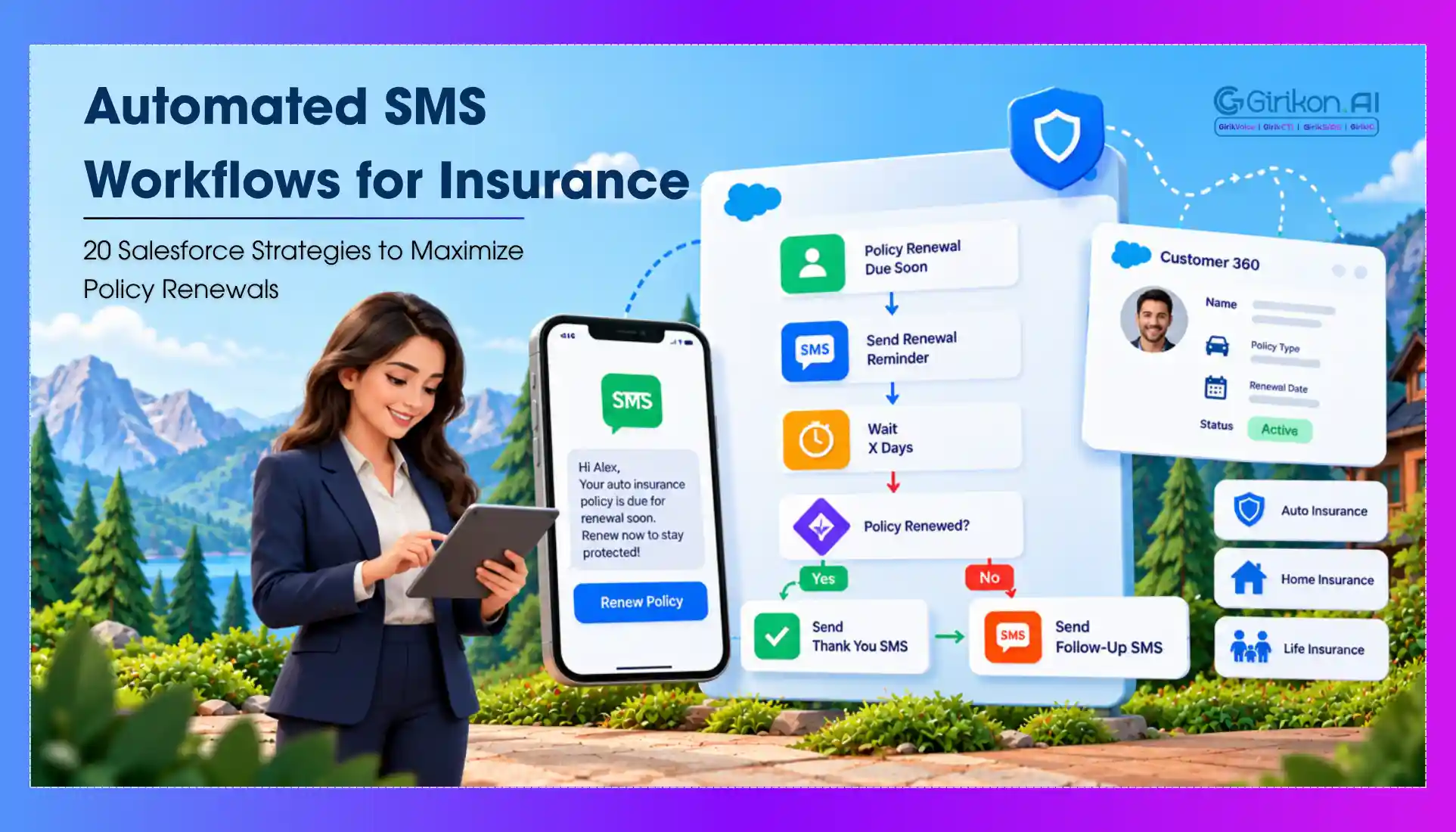
Renewal, payment, lapse and claims texts that run on your Salesforce policy data, so retention doesn’t depend on manual follow-up.
Policy renewals are time-sensitive, and when agents manage large books of business, manual outreach becomes inconsistent. Follow‑ups often stall, leaving contacts unattended and policies at risk. Insurance providers require a system that draws CRM data to issue renewal alerts immediately, ensuring coverage stays intact without relying on manual effort. Salesforce automated SMS workflows for insurance offer this capability, converting policy records into scheduled, condition‑based communication.
With insurance texting software, reminders reach policyholders on time, every message is logged, and insurance agencies gain documentation that supports audits and retention analysis. This blog will discuss how agencies can achieve insurance SMS automation with 20 Salesforce insurance automation workflows to secure renewals, strengthen retention, and reduce compliance risk.
Why Use Salesforce SMS for Insurance Communications?
From emails unanswered, ignored calls or missed deadlines, modern insurance agencies often struggle with the management of policies and client retention. These risks can be minimized with lead time and knowledge through early outreach. Since communication channels like emails or calls fail to capture the attention of busy policyholders, using SMS workflows for insurance agents can help. With intelligent Salesforce-native messaging, brokers can reach clients instantly on the devices they use most and solve this communication gap.
Salesforce already holds what matters for your insurance company: client records, policy timelines, renewal schedules. Integrating SMS into that environment means outreach is driven by data, not memory. Messages go out at the right moment because the system determines the trigger, not a producer’s calendar reminder. SMS also outperforms email on open rates, consistently exceeding 98%, which makes it the more dependable channel for communications where timing is material.
5 Benefits of Salesforce SMS for Insurance Agencies
- Clients receive renewal reminders through a channel they monitor consistently.
- Automated sequences reduce the follow-up burden on producers and account managers.
- Policy data in Salesforce drives message delivery without manual intervention.
- Two-way communication lets clients respond, ask questions, and confirm decisions directly.
- All interactions are logged within Salesforce, maintaining a clear record for compliance purposes.
20 Automated SMS Workflows for Insurance Renewals and Retention
90-Day Renewal Reminder
Renewal Workflow: When expiration is 90 days out, invoke the first touchpoint for renewals. Prompt communication to customers provides sufficient time for review of terms. At this time, insurance text message templates should be informative, mentioning the policy number, the upcoming renewal date, and contact of a personal agent to get in touch without pressure.
Ask customers whether they want to renew their current coverage. This early start makes the renewal process smooth and less rushed, enabling both the client and the broker to get ready prior to the policy date.
60-Day Follow-Up and Coverage Review Request
Follow-Up Workflow: If the 90‑day message does not receive a response, send the follow‑up at 60 days. Pull updated CRM fields: coverage type, premium amount to personalize the content. Personalized policy renewal reminders outperform generic follow-ups in response rates consistently.
At the 60-day mark, your workflow should move to a more defined next step. For that, send an automated SMS message to ask the client to verify if their current coverage is still suitable. Include a scheduling link in the message, enabling them to arrange a review call without requiring any further communication. Policy renewal automation in Salesforce triggers this message based on the policy expiry date listed in the client's record, and there is no need for manual queue setup.
30-Day Urgency Alert
Retention Workflow: At 30 days, the message tone needs to change and be direct, emphasizing the approaching deadline. Reference the lapse date explicitly and provide a clear action path. Policyholders who have not responded to earlier insurance renewal text messages often engage at this stage when urgency is stated plainly.
Quote Delivery Notification
Quote Workflow: Upon creation of the renewal quote and its addition to Salesforce, it is automatically sent to the client in the form of an SMS. There is a time delay in being aware of the need to take action with the information received through email, whereas a direct text message provides instant notification and prompt action.
Premium Change Alert
Pricing Workflow: In cases where the premium is increased, send a targeted SMS to the client and let them know in advance. With a measured and factual message you acknowledge the adjustment and offer an opportunity to discuss it, thus reducing the chances of cancellation. It is better to be transparent before starting the conversation rather than explaining once a client has responded.
Unsigned Document Follow-Up
Signature Workflow: Renewal agreements go unsigned for a range of reasons: competing priorities, overlooked emails or delayed decisions. This can be resolved by a reliable SMS workflow for insurance agents. It’s a structured follow-up sequence that activates when a document remains unsigned past a defined threshold. The SMS app for Salesforce sends reminders on day three, day seven, and day ten, with varied wording across each message to maintain a professional tone while still applying consistent pressure.
Premium Payment Due Reminder
Payment Workflow: Deliver a payment reminder 10 days before the due date to the insured party. Include a payment link or agent contact number. This single workflow reduces unintentional non-payment lapses, one of the most recoverable and preventable retention failures in any agency.
Missed Payment Notification
Payment Recovery Workflow: When payment didn't go through or wasn’t successfully recorded in the system, issue a same‑day alert. Delays reduce the window for corrective action and increase reinstatement risk. SMS reminders for insurance agents at this stage should be concise, direct, and include reinstatement guidance.
Payment Confirmation Message
Confirmation Workflow: Confirm every premium payment via SMS upon posting, with a reference number. Clients who receive confirmation messages generate fewer inbound verification calls. It’s a low-cost touchpoint that reinforces reliability and reduces administrative load on agency staff.
When clients know the status of their payment, it also makes them aware that they're dealing with an organized and reliable agency. Even though the customer engagement is transactional in nature, with the right approach, you can nurture the trust between the customer and your insurance agency.
72-Hour Lapse Warning
Critical Alert Workflow: When coverage is within 72 hours of lapsing, trigger a final alert. This is among the highest-priority automated insurance workflows in any retention framework. The message should identify the risk clearly and include an immediate contact path to the assigned agent.
A missed payment or a renewal left unresolved past its threshold date can also trigger a three-stage lapse-warning sequence within Salesforce. The first message is informational, outlining what remains outstanding, then the second offers direct contact details for clients who need assistance. The third message sent close to the lapse date, informs clearly what becomes at risk if no action is taken. Each stage gives the client a distinct opportunity to respond before coverage is interrupted.
Post-Lapse Re-Engagement
Reinstatement Workflow: When there’s a lapse, after 24 hours of confirmation, send a re-engagement message. Outline reinstatement steps and assign a named agent to the outreach. Speed matters here, the longer the gap between lapse and contact, the lower the reinstatement probability.
Post-Renewal Confirmation
Renewal Confirmation Workflow: After the policy is bound, an automatic SMS provides details of the effective date, the covered period and the assigned contact. This communication will give the client final closure on the renewal process, overcome the uncertainty of coverage and ensure professional standards have been reinforced. Formalizing this transition into the new policy year streamlines the process and introduces a structured approach to continued engagement.
Post-Renewal Satisfaction Check-In
Relationship Workflow: The 30-day period following renewal confirmation is the point where communication changes from being purely transactional to becoming more relational. The client receives a short SMS to confirm whether the existing coverage is appropriate and to see if the mid-year review would be beneficial. If the customers are given thoughtful outreach at the renewal stage, they are less likely to search for other quotes the next time they reach renewal deadline.
Post-Renewal Referral Request
Referral Workflow: After a confirmed renewal, trigger a referral request. Policyholders who have just renewed are the strongest referral sources available. Keep the message brief and include a simple response mechanism.
New Policy Welcome Sequence
Onboarding Workflow: Send a structured welcome message upon policy binding. The message must have key coverage details, payment schedule, and the agent's direct contact. When you deliver a strong onboarding experience, you set up communication standards policyholders expect and appreciate throughout the relationship.
Annual Coverage Review Invitation
Engagement Workflow: Trigger a coverage review invitation 45 days before each policy anniversary. This opens the renewal conversation early and creates a structured opportunity to address coverage gaps, supporting both insurance customer engagement and upsell potential.
Life Event Follow-Up
Customer Lifecycle Workflow: When a CRM record is updated to reflect a qualifying life event like marriage, property purchase or adding new dependents, share a consultation message. These moments show insurers genuine coverage needs, and timely outreach reflects your agency as more proactive than transactional.
Document Request Notification
Underwriting Workflow: When underwriting requires additional documentation, notify the policyholder via SMS immediately. Documentation delays are a recurring cause of policy cancellation. Automated alerts reduce processing time and improve client experience during underwriting.
Claims Status Update
Claims Workflow: After a claim is filed, automate status updates at defined intervals. Policyholders who receive consistent claims communication are more likely to renew. But no activity or silence during the claims process can become a common driver for non-renewal.
Seasonal Coverage Alert
Seasonal Engagement Workflow: For property and auto lines, trigger seasonal alerts aligned to regional risk periods such as storm season, winter conditions, and wildfire risk windows. These messages add value outside the renewal cycle and support year-round insurance customer retention strategies.
5 Best Practices for Insurance Customer Retention with Salesforce SMS
Register Before You Send
Compliance infrastructure must precede outreach. Complete A2P 10DLC registration and confirm TCPA consent capture before activating any insurance SMS automation campaign.
Use CRM Data for Personalization
Generic messages underperform. Pull policy-specific fields into every insurance text message template to make each message relevant to the recipient's actual coverage situation.
Sequence, Don't Flood
Space messages deliberately across the renewal cycle. Automated insurance workflows should follow a structured pattern, not cluster multiple messages within short windows, which increases opt-outs.
Track Engagement at the Record Level
Log every SMS interaction against the Salesforce contact record. Use that data to identify which workflows drive responses and which require adjustment.
Assign Agent Ownership to Every Workflow
Every automated message should route responses to a named agent. Salesforce insurance automation handles initiation; human follow-through closes the retention loop.
Conclusion: Turn Renewal Gaps into a Structured Retention System
Retention mostly fails because manual processes cannot match the volume and timing that policy management demands. Churn in insurance is due to missed communications, delayed responses, and a client experience that begins to feel like an afterthought. Automated SMS workflows for insurance convert that gap into a structured, automated system, without requiring additional headcount or a restructured process.
This blog discusses 20 automated insurance workflows to give agencies consistent, scalable outreach across every stage of the policy lifecycle. Use these to build the automated SMS workflows for insurance that address your current retention gaps first, then build toward complete insurance customer retention strategies.
Agencies that implement insurance renewal text automation through Salesforce are not simply adding a communication channel. They are establishing a consistent, data-driven client experience that operates reliably across every account, regardless of how much bandwidth the team has in any given period. The Salesforce SMS app for insurance agencies lets you achieve the return that is measurable with fewer lapses, stronger retention, and a renewal process that no longer depends on individual follow-through.
Automate Insurance Renewals in Salesforce
See renewal, payment and lapse-warning SMS workflows running on your policy data.