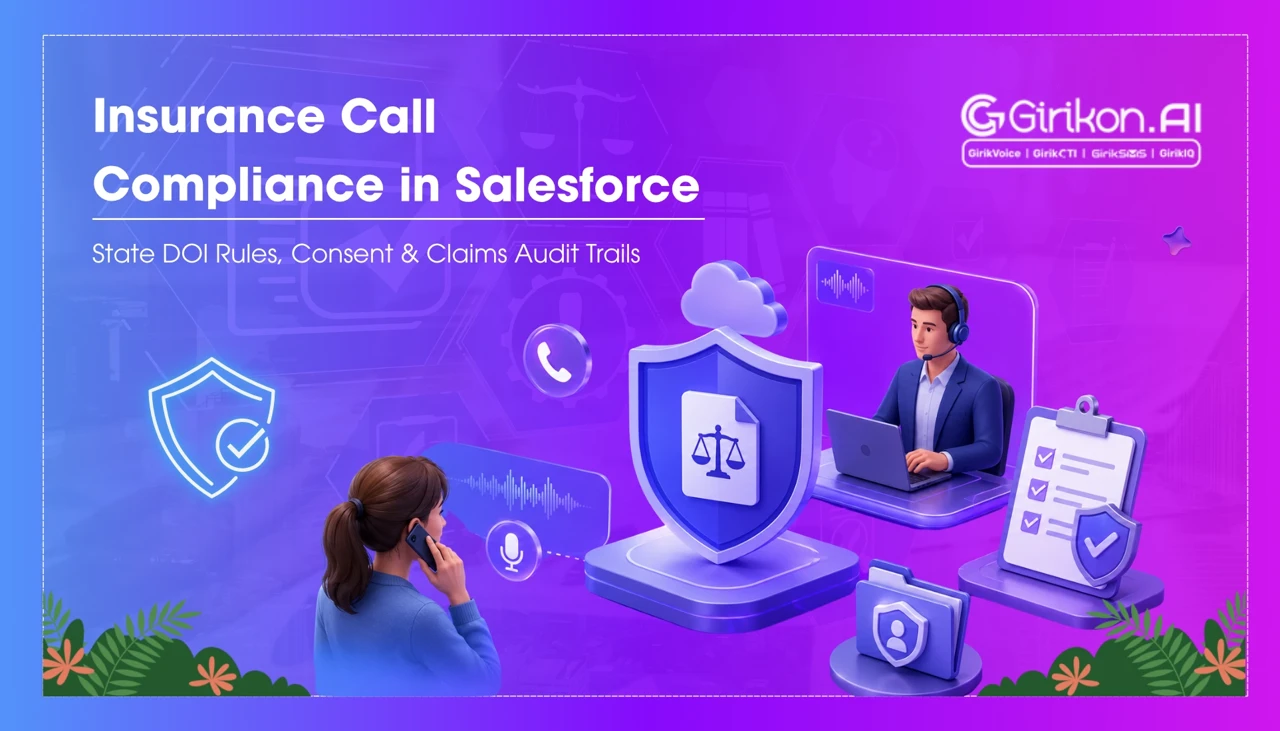
Insurance call recording compliance is becoming increasingly important as insurers face stricter documentation, regulatory, and audit requirements. Learn how DOI call recording rules, consent requirements, retention policies, and claims audit trails can help insurers maintain compliant and defensible records.
- 1Ensure call recording practices align with state-specific Department of Insurance (DOI) rules and broader privacy laws, considering jurisdictional consent, call type, retention, disclosure, and audit linkage.
- 2Capture granular consent details for each call, including customer/agent location, call purpose, recording status, applicable rules, and retention duration, to meet regulatory expectations.
- 3Integrate Salesforce CTI systems with jurisdiction-aware logic and regularly validate consent requirements with legal counsel, as Salesforce alone does not guarantee compliance.
- 4Link call recordings and consent records to specific policyholder or claim records within Salesforce to create an auditable trail for regulatory scrutiny.
- 5Implement comprehensive call consent records, capturing identifiers, timestamps, consent status, recording status, and relevant business links, along with any consent withdrawals.
Insurance calls are no longer routine customer interactions; they are regulatory records. A single conversation can involve policy terms, claims status, coverage decisions, and consent requirements, each carrying distinct compliance obligations. When these calls run through Salesforce-connected telephony, Salesforce call recording and insurance call recording compliance cannot stop at simply recording or logging the audio. Insurers must capture who provided consent, when it was given, and under what conditions the call occurred.
Every call becomes part of the compliance record, not just a customer service exchange.
This shift in framing is central to insurance consent requirements calls in Salesforce. The platform must support auditable consent events, call metadata, and traceability to claims or policyholder records. So, let's understand how? In this blog, we'll explore three aspects of DOI call recording rules: state DOI rules, customer consent management, and claims audit trails. In addition, we'll also share a quick checklist to help insurers in setting up Salesforce and CTI systems to meet regulatory expectations.
What are State DOI Rules for Insurance Call Recording
State DOI rules make insurance call recording a regulatory issue, not just a technical one. For organizations using Salesforce CTI for financial services compliance, insurers must align their call recording practices with both insurance-specific mandates and broader privacy laws. Here are the key dimensions:
Jurisdictional consent: Some states require all parties to agree before recording; others allow one‑party consent. DOI rules overlay these general statutes with insurance‑specific obligations.
Type of call: Quotes, claims, and policy changes need stronger compliance than routine service conversations.
Retention and disclosure: There's a minimum retention timeline for calls and may need disclosures before or during recording.
Audit linkage: Recordings must attach to policyholder or claim records, while Salesforce call monitoring enables compliance teams to track call events with greater transparency and maintain a clear audit trail.
Key Factors for Insurance Consent Requirements Calls
- What's the location of both the customer and agent when the call happens
- The purpose of the call: service, sales, claims, or renewal
- Whether the call is being recorded at all
- Whether it touches a claim, policy change, quote, or payment
- Which state and federal rules apply to that specific scenario
- Retention duration and who's permitted to access the record
Why Nationwide Rules and Salesforce Alone Don't Guarantee Compliance
Insurance call recording compliance cannot be managed with a single nationwide policy. DOI call recording rules vary by state, and regulators update guidance often enough that organizations need to continuously update their processes to meet current standards. A uniform script risks falling out of compliance the moment a call crosses a state line. Salesforce CTI security and compliance configurations need jurisdiction-aware logic, while compliance teams must regularly validate insurance consent requirements for calls with legal or regulatory counsel.
Salesforce provides features to support compliance, but the platform itself does not determine it. Recording behavior depends on the CTI or telephony system, while storage and access controls outside the platform govern who can reach the data. Compliance rests on organizational policy and applicable law. Testing implementations against state‑specific rules and maintaining a claims call audit trail are essential to withstand regulatory scrutiny.
Salesforce Call Consent Records: What to Capture and Why They Must Be Linked
- Customer or contact identifier, it ties the consent record to a specific individual, which matters when disputes or audits arise later.
- Call ID connects that consent event to the exact recording or transcript it belongs to.
- Agent or representative records who actually handled the call, useful for accountability and training purposes alike.
- Date and time set the timeline, which becomes important once consent rules or disclosures change over the years.
- Consent or disclosure status confirms whether the customer agreed to record, and what disclosure wording was used.
- Recording status shows whether the call was actually recorded, which isn't always the same as whether consent was given.
- Relevant policy, case, or claim links the call back to the business record it's tied to.
- Consent withdrawal or change captures a later revocation, since that carries its own compliance implications.
- None of this data holds up well when it sits disconnected from the interaction it describes. Linking consent directly to calls, cases, and claims closes gaps that otherwise only surface during an audit. It also removes compliance teams' dependence on agent notes or memory, replacing that guesswork with a history that's traceable and ready for regulatory review.
7 Steps to Insurance Call Recording Compliance with Salesforce and CTI Systems
Map applicable regulations
Before configuring anything, figure out which state DOI call recording rules and federal requirements apply to each customer segment. This should factor in both customer and agent location, since some rules key off either party. Document the findings so later configuration choices for your Salesforce telephony integration trace back to a regulatory basis, not assumption.
Define consent workflows
Build disclosure scripts and consent steps that adjust automatically by customer location and call type. A claims call may need a different language than a sales or renewal call. Static, one-size scripts tend to miss the stricter jurisdictions in a customer base.
Configure CTI recording rules
Set recording behavior within the CTI platform to match jurisdictional needs rather than one default across the board. Recording might be enabled in some states and restricted elsewhere, with disclosure prompts for playing beforehand. Confirm with the telephony vendor that these settings actually behave this way once live and meet insurance consent requirements calls.
Link records systematically
Apply retention and deletion timelines based on whichever requirement is strictest for that record type: state DOI rules, federal standards, or internal policy that goes further than either. Automating retention in Salesforce prevents records from being deleted too early or kept beyond the required period.
Restrict access by role
Limit viewing, exporting, or downloading of recordings and consent files to staff with a valid business need. Every attempt: approved or denied, must be logged to prevent misuse and reinforce accountability.
Review and audit regularly
Regulations change, and workflows built two years ago may not meet current standards. Schedule reviews more often than once a year to confirm the claims call audit trail stays complete and current. It also avoids the higher cost of problems found during a regulator's examination.
Closing Remarks
Insurance call recording compliance in Salesforce is measured not by the presence of audio files, but by the ability to prove their integrity under examination. In Salesforce, that responsibility is continuous. State rules shift, consent requirements vary by jurisdiction, and audit expectations keep tightening. But the platform alone doesn't deliver compliance. It's on insurers to design secure systems, enforce role-based controls, and keep workflows aligned with evolving regulations. As insurers roll out AI voice agents, they still need to meet the same rules for security, consent, and how long data is kept. When a company takes direct ownership of this work, it is usually in a stronger spot during audits. It also helps keep customer trust intact and reduces the risk to customer data.