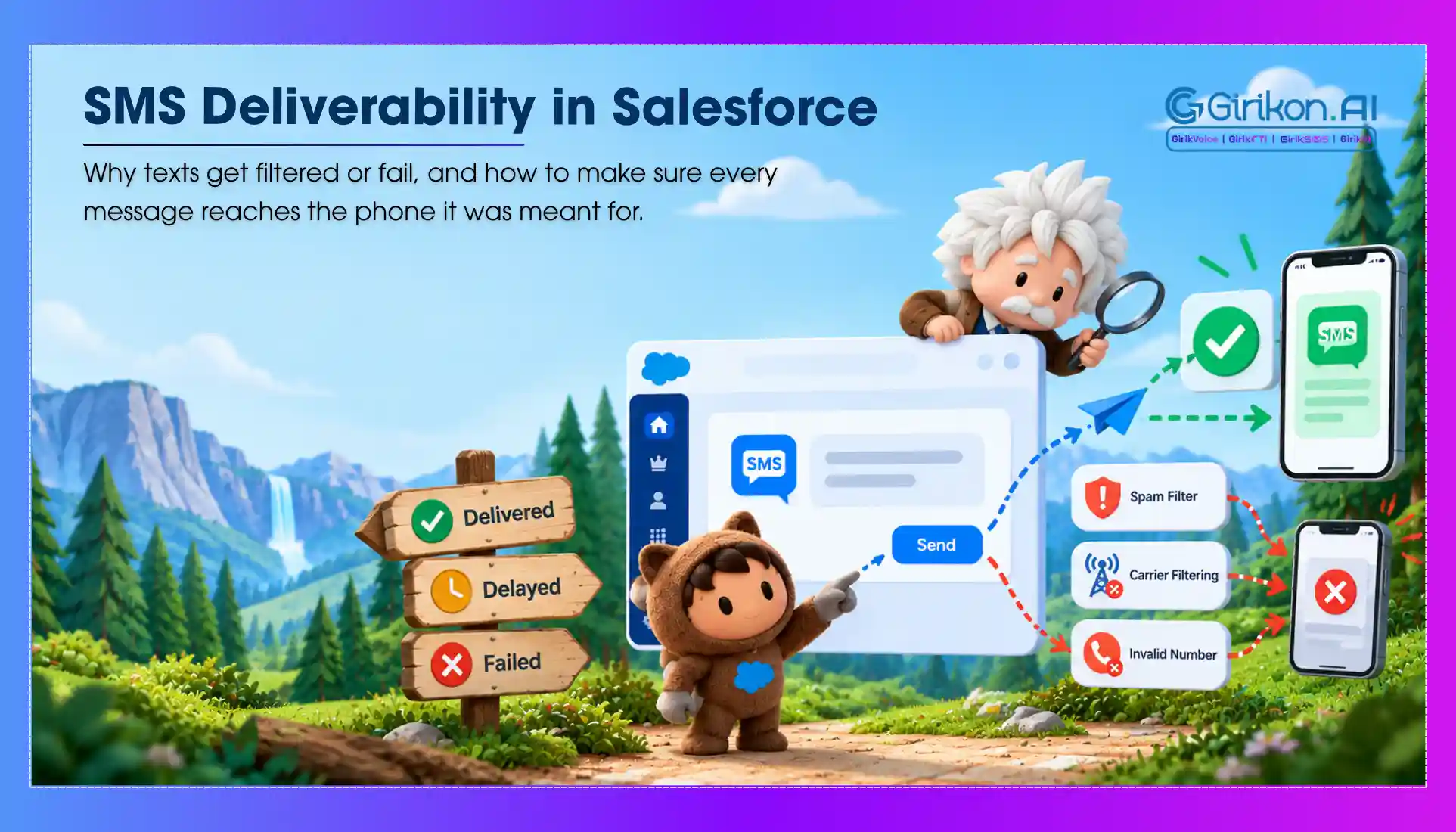
Sent isn’t delivered. Here’s what carriers check, why Salesforce texts get filtered, and how to keep delivery rates high.
You crafted the perfect SMS campaign. Yet the responses fell short of expectations. The ultimate problem may be SMS deliverability.
As compliance requirements continue to evolve, carriers strengthen delivery regulations, and SMS spam filters become more sophisticated, SMS deliverability in 2026 turns out to be far more difficult than just simply pressing “send.”
The consequences go far beyond missed messages, i.e., a failed delivery notification can trigger unnecessary support calls, and an undelivered appointment reminder can result in costly no-shows. For sales teams that use Salesforce, such poor deliverability can quietly undermine successful communication strategies.
SMS inside Salesforce tends to be treated as a reliable channel by default but at times, it’s not. Delivery is conditional, and carriers decide what reaches your end-users. The problem usually surfaces late when messages appear “sent” in Salesforce, yet a portion never arrives. Campaign reports begin to show inconsistencies. As a result, engagement drops without a clear explanation. In most cases, carrier filtering or silent rejection is already in effect. However, this isn’t a tooling issue alone. Deliverability depends on how messaging is structured, how numbers are registered, how content is written, and how consistent traffic is handled over time.
That’s why it is important to understand the factors affecting SMS delivery rates and implement the right business texting practices. Read throughout to learn more.
What Is SMS Deliverability in Salesforce?
To understand the real context of SMS deliverability, it is crucial to differentiate between sending and delivery.
SMS deliverability in Salesforce refers to whether a message reaches a recipient device after being processed by external messaging providers and telecom carriers. The distinction matters because Salesforce initiates the message, but delivery is determined elsewhere.
While sending indicates that a message has left the texting platform, delivery occurs only when the message successfully reaches the recipient’s mobile device after passing several checkpoints like:
- Carrier approval
- Spam and fraud detection checks
- Regulatory compliance
- Mobile device availability
- Recipient consent validation
- Message content review
A message can pass internal checks and still be filtered at the carrier level. This is where most failures occur. High-deliverability Salesforce SMS setups are not defined by volume or speed but by consistency. Consistency in sender identity, campaign registration, message intent, and audience selection and without that, delivery becomes unpredictable.
Once a message is denied or rejected during the validation process, it will no longer be retrievable. Hence, businesses must give significant thought to the number of texts they send as well as the steps taken to improve SMS delivery rate through data quality, compliance, and best practices.
Why Salesforce SMS Deliverability Fails: 5 Common Causes
Carrier Filtering
Mobile carriers may temporarily filter some messages when they identify suspicious, non-compliant, and spam-like patterns in messaging, including:
- Sudden spikes in campaign activity
- Shortened URLs
- Repetitive content
- Overly promotional language
- Unregistered sender numbers
This negatively impacts engagement rates, affects legitimate business messages, and causes carriers to restrict delivery.
Messages that rely on urgency, excessive promotion, or unclear intent are flagged more often. This includes repeated templates with minimal variation, and these factors reinforce each other.
Poor Contact Data Quality
Not just the well-crafted but even the most compliant campaign can also flop if businesses are reaching for improperly maintained contact records, like:
- Disconnected device
- Invalid phone number
- Inactive subscribers
- Incorrect landline numbers
- Duplicate records
- Inappropriate country codes
These failed deliveries waste messaging resources and affect sender reputation over time.
Missing Customer Consent
Obtaining customer permission is a critical requirement for effective SMS communication. However, many businesses fail to do so. This can cause carrier filtering to flag the traffic as potentially spammy and unwanted.
Also, it leads to compliance violations, message blocking, and reduced sender trust. Over time, repeated unverified messaging activity can negatively affect future campaigns and damage the sender’s reputation.
Consent is often assumed rather than recorded, and that’s why opt-out instructions are sometimes omitted. Carriers don’t treat these as minor gaps. Messages are filtered early when compliance signals are weak.
Unstable Sender Reputation
SMS sender reputation scores are built gradually and lost quickly. Sudden increases in volume, irregular sending patterns, or messaging to outdated contact lists affect how carriers classify traffic.
Incomplete 10DLC Implementation
10DLC deliverability rules are not optional in regulated markets. Partial registration or mismatched campaign details create immediate restrictions, leading to a drop in throughput and an increase in filtering.
How to Measure SMS Deliverability in Salesforce
Instead of being treated as a one-time initiative, deliverability should be consistently monitored. Organizations that are leveraging Salesforce can use extensive reporting capabilities and analytics such as delivery rates, opt-out rates, and response rates to measure the overall performance of each marketing piece. Moreover, they can get insight into possible issues to work on the marketing campaign accordingly.
Delivery issues are rarely visible without deliberate tracking. Standard campaign metrics don’t always reveal filtering behavior unless examined closely. Salesforce reporting, combined with provider-level logs, should be treated as operational inputs rather than post-campaign summaries. Three areas require continuous attention:
- Delivery outcomes over time: Delivery rates should remain stable. Fluctuations, even small ones, often indicate filtering thresholds being triggered.
- Carrier response patterns: Failure codes are not generic errors. They point to specific causes such as content violations, unregistered traffic, or throughput limits.
- User-level reactions: Opt-outs and non-response patterns provide indirect signals. A rise in opt-outs may indicate content mismatch. A drop in engagement may indicate partial delivery.
Understanding Salesforce SMS Compliance Requirements
Not just in improving SMS deliverability, but compliance plays a crucial role in maintaining sender's reputation and building customer trust. Here is how you can ensure the Salesforce SMS compliance:
Consent Management
Companies must receive explicit opt-in approval from customers prior to sending any transactional or promotional text messages and must retain verification of customer authorization, including how and when permission was granted. These historical accounts help both in demonstrating legitimacy to carriers and supporting compliance efforts.
Opt-Out Management
Companies must also provide customers with an easy withdrawal method using common industry standard keywords (e.g., UNSUBSCRIBE, CANCEL or STOP) and should process any requests to opt-out posthaste. By providing customers with the ability to opt out of text messaging, the companies will help ensure compliance and thereby only communicate with customers who wish to receive these messages. Doing so will further help increase deliverability and enhance customer experience.
Data Privacy Compliance
Based on where an organization operates, SMS programs must also align with applicable industry guidelines and data privacy regulations, this may include:
While focusing on data collection, personal information handling, and communication preferences, these frameworks ensure the protection of customer data while reducing compliance and legal risks.
Audit Trails
Managing detailed audit records is another essential aspect when it comes to improving SMS deliverability in 2026. That means, organizations should keep records showing:
- How consent was gathered
- Where consent was provided
- Opt-out history
- Message activity and delivery records
- The source of SMS subscription
4 Business Texting Best Practices to Enhance SMS Deliverability
Maintain a Clean Contact Database
Ensuring strong SMS deliverability begins with accurate customer information. That means, organizations should regularly review and remove opted-out contacts, duplicate records, invalid phone numbers, and inactive subscribers to ensure that messages are directed towards active and reachable recipients.
Automate Consent and Preference Management
By automating consent management, Salesforce users can easily maintain compliance records and track customer opt-ins records. Moreover, they can enable customers to learn how and when they receive communication. Ultimately, this ensures that organizations will remain compliant while still providing their customers with the opportunity to receive only the messages they have opted in to receive.
Use Workflow Automation
Timing is important for SMS to perform effectively. So, no matter if you are sending order updates, service notifications, or appointment reminders, automated workflows ensure that the messages are delivered at the right time based on business events, predefined workflows, and customer actions.
Monitor Messaging Frequency
Overly frequent messaging may cause irritation to customers, thus making SMS engagement less effective for businesses. This can also result in spam reports, customer dissatisfaction, and increased filtering by carriers. Therefore, all organizations should establish a set of messaging frequency guidelines for their customers to respect their preferred mode of communication.
5 Steps to Improve Salesforce SMS Success Rates
Optimize Sender Reputation
Sender reputation is cumulative, and each campaign contributes to how future messages are treated. Reputation does not improve through volume. It improves through consistency, and a strong SMS sender reputation reduces friction at the carrier level and supports high SMS deliverability in Salesforce. So, do these:
- Send messages to verified users, with opt-in on.
- Keep volume increments gradual and not sudden.
- Maintain predictable sending intervals
- Remove inactive contacts without delay
Follow 10DLC Deliverability Rules
10DLC frameworks exist to give carriers visibility into business messaging. Without proper registration, traffic is treated as unverified, though gaps in 10DLC deliverability rules don’t always result in immediate blocking. However, more often, they result in gradual throttling and increased filtering, which is harder to detect. Avoid these by:
- Register brand and campaign details accurately
- Align actual message content with declared use cases
- Avoid using one campaign for multiple unrelated purposes
- Monitor registration status and updates regularly
Using verified mobile phone numbers as part of a company's text messaging initiative increases the likelihood of engagement because most consumers will more readily respond to messages from known senders. A verified sender provides easily identifiable proof that communications from a given source are indeed legitimate and builds customer trust through familiarity, enhances visibility of brand recognition, and further increases SMS deliverability.
Craft Compliant and Relevant SMS Content
Your message content must be clear and aligned with user expectations. Repetition without variation is a common issue, and identical messages sent repeatedly increase the likelihood of filtering. Therefore, content should remain consistent in intent, not identical in structure. Follow these steps:
- State the purpose of the message directly
- Avoid exaggerated claims or forced urgency
- Include opt-out language where required
- Keep formatting simple and readable
Avoid Carrier Filtering in SMS
Avoiding SMS carrier filtering issues requires operational discipline more than technical changes. Filtering isn’t always immediate and often increases gradually as patterns are observed. So, early corrections prevent larger disruptions:
- Don’t send multiple messages within short intervals unless expected by the user
- Avoid re-sending failed messages without identifying the cause
- Use registered sender identities consistently
- Ensure message timing aligns with user activity patterns
Improve SMS Routing Practices
Routing decisions affect both speed and reliability of deliveries, and using indirect or unreliable routes poses a risk that can be avoided. Additionally, at times, the best practices of SMS routing are not considered seriously since they operate in the background. So, to follow the best measures, do these:
- Use providers with direct carrier connections where possible
- Evaluate route performance by region, not globally
- Monitor latency alongside delivery rates
- Maintain fallback routing for critical communication
Conclusion: Treat SMS Deliverability as an Ongoing System
Addressing challenges like poor data quality, advanced SMS spam filters, and evolving compliance requirements lays out the foundation of strong SMS deliverability. By combining accurate customer data and effective texting strategies, organizations can easily improve SMS delivery rates. Moreover, they can strengthen messaging performance, leveraging effective tools for consent management and engagement tracking inside Salesforce.
SMS delivery within Salesforce isn’t guaranteed and is influenced by factors that sit outside the platform and operate under strict carrier controls. Sender reputation, 10DLC compliance, content discipline, and routing decisions each play a role in whether messages are delivered or filtered. There is no fixed state where deliverability is permanently solved and requires ongoing attention.
Organizations that treat SMS as an operational system rather than a campaign tool tend to maintain stable performance. In addition, having an effective Salesforce SMS app will help you avoid SMS carrier filtering issues more effectively and sustain higher delivery rates without relying on corrective actions after failure.
Make Every Salesforce Text Count
See how compliant, high-deliverability SMS runs inside Salesforce.