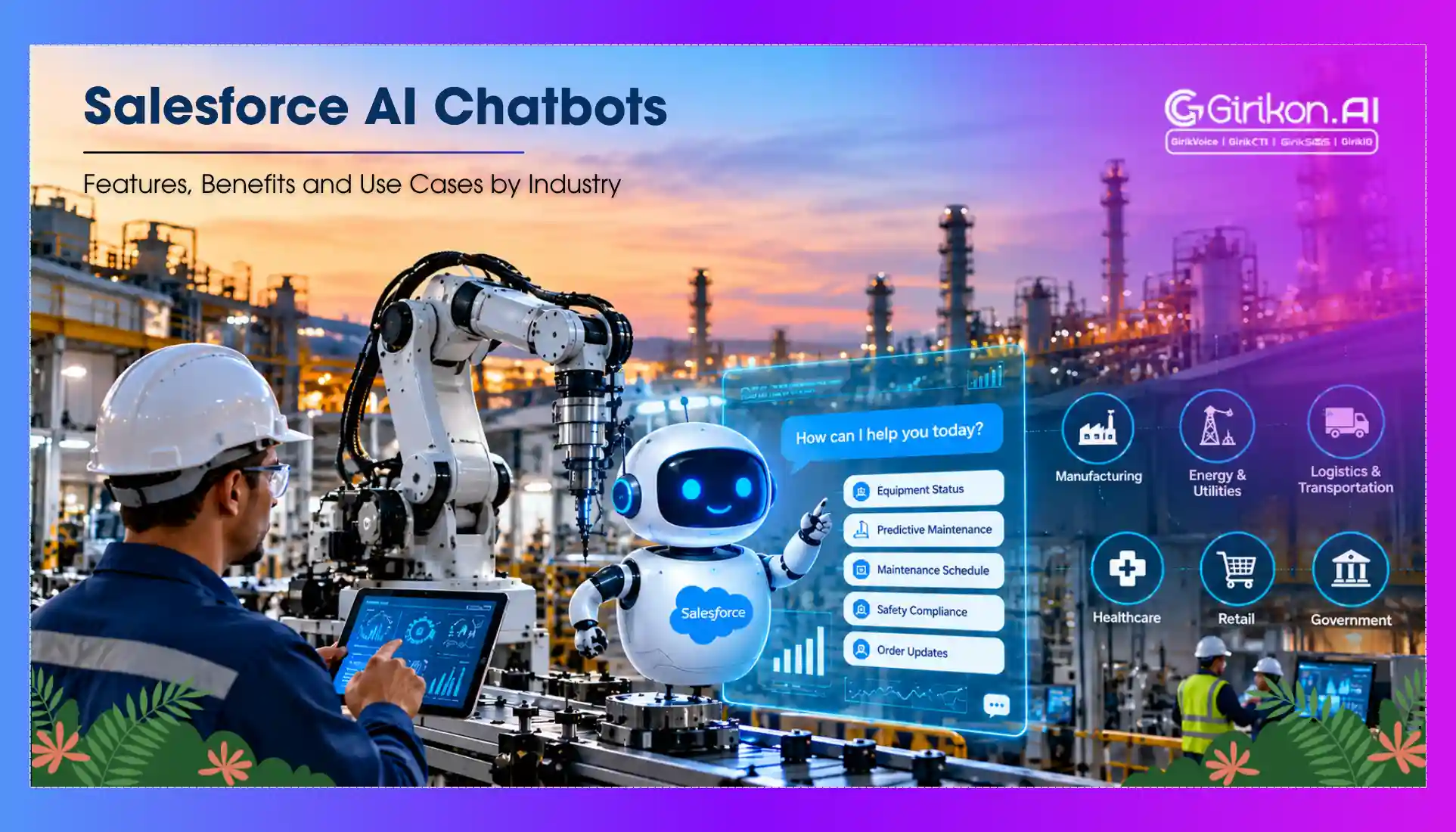
A practical guide to AI chatbots inside Salesforce, from features and copilots to rollout best practices.
Already priced at USD $4.7 billion in 2022, the AI chatbot market is likely to grow 23.3% and reach $15.5 billion in 2026. This clears out the cloud on AI chatbots are the next solutions that you ultimately need. Aaahaa! But, no one would ever tell you that your business may bring more benefits upon using AI chatbots with Salesforce. Yes, that’s true! You can interpret the intent behind customer queries, adapt their responses, and learn from experiences.
The dynamic collaboration of Salesforce and AI offers everything that lets you navigate in the right direction. Wondering, “why wouldn’t you use them before? Are they easy to use? How would they be different from an average chatbot?” Let’s check out this glossary and get all the answers about this essential tool.
What Is a Salesforce AI Chatbot?
An AI chatbot is a computer program that uses artificial intelligence (AI) and natural language processing (NLP) to mimic human conversations.
AI chatbots are everywhere, from social media to online shopping platforms, almost every industry uses these chatbots. But, with Salesforce integration, these chatbots move to another level. Infused with Salesforce’s Einstein AI technology, these chatbots interact with users, automate responses, understand customer requests, provide relevant assistance, etc. This way, the chatbot streamlines support processes, enhances customer engagement, and increases customer satisfaction.
On top of that, Salesforce chat bots let you automate tedious admin tasks like pricing inquiries and appointment booking. This brings more time to agents to focus on complex issues. Most importantly, chatbots work as a piece of software, enabling customers to engage with your business without the need for a human agent. Upon smartly implementing the chatbots with the help of the right Salesforce consultants, you can easily interact with customers.
Effective customer service is the cornerstone of every business, and the key to earning customer loyalty is to improve your customer’s experience. Over the past few years, with increased digitization, customer expectations have evolved significantly. Today, customers expect prompt response to their queries from businesses irrespective of the time, location and channel. That’s where chatbots come into the picture. Powered by Artificial Intelligence, customer service chatbot functions as an automated tool for improving communication as they assist in providing immediate assistance to customer queries without the involvement of a human operator.
If you are one of those who buy products or services online, you've likely engaged with a chatbot in the past month without realizing it. As more businesses tap into the disruptive technology of conversational AI, the usage of Chatbots is on the rise. In fact, Survey Monkey research indicates that only 38% of customers prefer to talk with a human agent when engaging with a business. This opens a multitude of opportunities to get answers that don’t involve human conversation.
7 Key Features of Salesforce AI Chatbots
It is essential to look for features before choosing the best Salesforce AI chatbots for the job. So, jump directly into this section and learn how these features can maximize your business potential.
Built-in Templates
From a vast range of in-built templates, you can choose the one that specifically suits common or more specific situations. For instance, you can select one template for the common questions raised by various customers about product or service offerings. With these templates, not just you can elevate your chatbot’s productivity but also launch your bots quicker.
Bot Analytics
Without accessing and analyzing KPIs, reporting, and metrics, how will you measure success led by chatbots? Well, that’s why you must use AI chatbots with bot analytics capability. This feature grants you the right information, chat data and performance graphs in front. Using such metrics lets you ensure a real-time tracking and optimization of bots’ value.
Omnichannel Capacity
Omnichannel capacity lets you capture your customers’ attendance towards your services earlier before anyone could do. This enables you to make yourself present on all platforms where your customers are. Thus, letting you enjoy an omnichannel contact centre for live chat with your customers on mobile apps, SMS messaging, and websites.
CRM Integration
Other than this, you must ensure to have CRM integration in your chatbot solution. With a CRM like Salesforce, you can have a huge database. Accessing and utilizing the same lets you instantly learn about customers’ demographics, preferences, and history. This ultimately helps in speeding up issue resolution, and providing personalized services.
Multistep Conversation
Many times, Salesforce chatbots need to access more information on customers’ generated queries. That’s where multi-step conversations come into the picture. It creates follow-up questions to get a better understanding of the user intent and align answers accordingly. Here is how an AI chatbot with multistep conversation works.
- Q1 ⇒ A1
- Q2 based on A1 ⇒ A2 (to have more understanding)
- Q3 based on A2 ⇒ A3 (precise answer)
Sentiment Analysis
Being equipped with machine learning and natural language processing techniques, Salesforce chatbots analyze customers’ sentiments too. They understand the feelings behind what customers have just written by classifying utterances into different emotions. This lets businesses adapt responses based on those emotions, letting them create a more memorable customer experience.
Group Messaging
That’s not it, various Salesforce AI chatbots come with group messaging too. This feature enables businesses to send the same messages to various customers and different groups. For instance, you can generate captivating text informing about some new arrivals coming to your website. Therein, send the same to all customers on their registered WhatsApp number and email addresses.
Benefits of Salesforce AI Chatbots for Businesses
Generative AI chatbots have transformed customer service in recent years. They offer a variety of benefits that increase customer satisfaction and enhance operational efficiency.
Provide Fast, 24/7 Customer Service
Customers want quick and accurate service, even during peak hours. Chatbots never sleep or rest and don’t take holidays. They eliminate wait times with instant availability and provide 24/7 support on any channel, even when agents are unavailable.
Most companies cater to a global customer base, which means customers could be from any location and time zone. A chatbot can be programmed to raise the query to a human customer service rep if a certain query cannot be addressed by the chatbot. It can also be programmed to serve customers' queries in multiple languages, which improves convenience for your customers.
Reduce Hold Time
When a customer has a query, they might experience a delay in getting assistance from a customer service representative. This might be due to a higher-than-usual volume of calls on a certain day, the waiting times can extend, leading to customer frustration. However, by implementing a chatbot, customers can enjoy immediate access to help at their convenience. This significantly reduces wait times for all customers and demonstrates how AI can augment the overall customer experience. AI chatbots are designed to comprehend and address a wide range of concerns, such as customers seeking quick access to shipping details, updates on reservations, or troubleshooting guidance when setting up a new product or service.
Handle a High Volume of Queries
AI chatbots for customer service can handle multiple concurrent conversations, greatly reducing customer wait times and boosting productivity. Artificial intelligence (AI) powered service chatbots enable higher flexibility during peak periods or during marketing campaigns to support your human service teams.
Deliver Personalized Experiences
Salesforce Chatbots can leverage CRM data to deliver personalized experiences.
- Adapt messaging corresponding to the stage of the customer journey.
- Recommend products or services based on customer data and preferences.
- Offer deals and promotions based on past purchase history.
- Provide automated order status and tracking.
Communicate Better with Stored Data
A live agent dealing with new customers might not have knowledge about their needs and why they are reaching out. To assist users, live agents must deduce the information from the ongoing conversation. Since a chatbot has access to stored data it can grab details about customer preferences and their personal information. This capability simplifies the process of addressing users’ needs enabling the chatbot to tackle the problem at hand.
Provide Consistent Support
Customers rarely interact with the same support agent twice. Consequently, there may be inconsistencies in the customer experience because the level of expertise and training varies with each agent. Chatbots for Salesforce work on pre-established frameworks and serve up answers from a unified source of data to deliver consistent customer service experiences.
Reduce Human Error
Chatbots are employed for various reasons, one being freeing up time of service reps for other activities while delegating tasks to automation. Chatbots possess a remarkable memory and are not forgetful, which makes them trustworthy. They are designed to tap into extensive knowledge resources, enabling them to provide precise answers to customer inquiry.
Offer Self-Service Options
Salesforce Chatbots can provide self-service options to customers with interactive menus so that they can resolve basic issues on their own whenever convenient. For instance, Salesforce Chatbots can direct customers to FAQ pages or help articles or serve them up right within the conversation. They can also serve up information from an existing knowledge base to answer common customer questions. Salesforce Chatbots learn from every interaction and keep getting better over time.
Provide Proactive Customer Service
While Salesforce Chatbots can proactively engage with customers to resolve basic issues, they also recognize when an agent handover is appropriate and proactively assess customer intent if they wish to connect with a support agent to resolve their concerns.
Deliver Omnichannel Support
Today’s customers engage across multiple digital channels such as email, social media, web, and messaging apps to interact with brands. They expect connected conversational journeys across channels and devices, from right where they left off.
With Salesforce Chatbots, you can connect your email, website, Slack, and messaging to deliver a seamless connected experience.
Collect Customer Feedback
A Chatbot for Salesforce can be programmed to solicit customer feedback after every interaction. And to encourage feedback, Chatbots can offer intelligent deals and discounts for survey participation. Businesses can analyze chatbot conversations and survey responses to identify commonly asked questions, and popular products and improve the customer experience with every interaction.
Improve Customer Engagement
Not just AI-powered customer service, Chatbots can also improve customer engagement in the following ways:
- Send automated messages for order status and tracking, payment issues, subscription renewals, bill payments, and much more.
- Collect customer feedback after the resolution of a case.
- Engage in seamless, connected conversational journeys across channels.
- Send appointment reminders and confirmations.
- Leverage CRM data to offer deals and promotions for cross-selling and up-selling.
Chatbots can prompt customers about products or services they might be interested in based on their past purchases and interaction history. With embedded interactive menus, forms, and rich text, Chatbots for Salesforce can deepen customer engagement.
Streamline Service with Intelligent Routing
Chatbots for Salesforce can collect important information from customers at the start of an interaction and intelligently route the conversation to the most appropriate agent based on expertise, experience, availability, and case priority. Seamless case routing by Chatbots can help streamline customer service, save agent time, and improve the customer experience.
Boost Sales
Salesforce customers can use Chatbots to do routine sales tasks such as collecting information and qualifying leads, scheduling product demos, and serving up additional product details.
Chatbots can interact with potential customers with proactive communication by answering questions and educating them about your brand’s products and services. They can help:
- Decrease the bounce rate
- Boost conversion
- Re-engage abandoned shopping carts
- Automate cross-selling and upselling
Increase Lead Generation
Salesforce Chatbots leverage customer data, machine learning, and natural language processing to recognize customer intent to engage in conversations with customers. Data from these interactions can then be analyzed to gather customer insights and trends for targeted marketing campaigns.
Enhance Conversational Marketing
Salesforce Chatbots can be deployed across channels to influence customers wherever they are. As an example, brands can deploy bots on their e-commerce stores to act as virtual assistants to answer product related questions and offer proactive deals and promotions to nudge them to make a purchase.
Gain Analytics and Insights
AI chatbots for customer service can collect massive volumes of data from customer interactions, providing valuable insights into the target audience's requirements and preferences. Businesses can leverage this data to optimize service delivery.
Improve Agent Training and Onboarding
Salesforce customers can also use Chatbots to onboard new agents and provide guidance throughout the training process. Bots enable self-learning for new hires and leverage AI to serve up relevant help articles to accelerate learning.
Reduce Costs and Increase Efficiency
Utilizing chatbots in customer service offers the benefit of cost reduction and enhanced efficiency for your business. By employing chatbots, you can reduce the need of recruiting and training additional human agents, as well as lower costs associated with infrastructure, software, and upkeep. Furthermore, chatbots can enhance the efficiency of your customer service operations by automating mundane assignments like scheduling appointments, verifying orders, dispatching confirmations, and gathering feedback. Implementing chatbots allows you to achieve time and monetary savings while concurrently augmenting the caliber and effectiveness of your customer service effort.
Foster Innovation
Employing chatbots in customer service can drive innovation for your business, granting you a competitive advantage and a distinctive value proposition. Employing chatbots offers a distinctive advantage over competitors, as they provide a dynamic and captivating way to interact with your customers. Additionally, chatbots can customize solutions according to individual customer needs and preferences. Moreover, they enable you to foster innovation in customer service by providing a platform to explore new ideas, features, and products while gathering valuable feedback and insights from your customer base. Embracing chatbots allows you to showcase your creativity and expertise, ultimately attracting and retaining a broader customer audience.
Increase Customer Loyalty and Satisfaction
Using chatbots offers the advantage of strengthening customer loyalty and retention through the establishment of trust and rapport with your clientele. Chatbots have the capability to generate a positive and immersive customer experience by employing authentic and conversational language, injecting humor and emojis when appropriate. Additionally, they can deliver supplementary services like providing advice, suggestions, discounts, and incentives, thereby augmenting customer contentment and loyalty.
How B2B and B2C Businesses Use Salesforce AI Chatbots
80% of customers want customer service representatives to assist them with almost everything from product purchase to its delivery. Thankfully, service reps can trust AI chatbots for this role while they themselves can focus on more crucial tasks. Here is how both B2B and B2C can use Salesforce AI chatbots.
- Seamless Enterprise System Integration: Upon successfully integrating with CRM, chatbots can easily access information required for the sales team to learn about their customers. This integration ensures a fluid flow of information among sales, HR, and customer support departments. Thus, enhancing both internal communication and workflow all across the organization.
- Customer Support Automation: By automating tasks like setting appointments, answering inquiries, and taking orders, chatbots accelerate customer support services. This streamlines call-center operations and ensures consistent interactions across versatile channels. Moreover, as these chatbots are equipped with advanced algorithms, they not only respond but learn from interaction.
- Personalized Virtual Assistance: Salesforce AI Chatbots work as virtual assistants for agents who want to automate their routine tasks while focussing on more complex projects. These assistants bring the most out of the data stored, letting you utilize it effectively to deliver personalized services and offerings. Along with this, they improve their responses upon getting exposed to more data.
Salesforce AI Chatbot Use Cases by Industry
AI Chatbots for Insurance
Today around 4 out of 5 insurance customers interact with their insurance providers across multiple digital channels. It comes as no surprise therefore that insurance businesses must automate conversations to scale engagement with their customers. This is where GirikSMS Salesforce Chatbot can be very useful.
Chatbots are relatively new to the technology world and constantly evolving. And IT departments across insurance firms are not yet fully aware of the potential of Chatbots in their line of business.
GirikSMS Salesforce Chatbot are native to Salesforce which means they can leverage your CRM data to drive powerful and compelling user experiences. They are powered by Artificial Intelligence (AI) and Natural Language Processing (NLP) capabilities to simulate human agents and drive engagement at scale. Insurance businesses can leverage GirikSMS Chatbots in:
Insurance policies. When GirikSMS Salesforce Chatbot interact with customers or prospects, it can:
- Provide customized quotes to potential customers: GirikSMS can collect relevant data and information from potential customers such as income, age, assets (property or vehicle), and health history to provide recommendations on insurance claim allowances, and offer them tailored insurance plans that fit their criteria.
- Cross-sell: GirikSMS can leverage CRM data and built-in machine learning capabilities to predict which insurance policies and plans the customer is likely to purchase. GirikSMS can derive insights from customer conversations and their data to offer personalized cross-sell options to them.
- Answer customer queries: GirikSMS Chatbot can provide instant information 24/7 to customers about their policy details, what is covered and what is not, quotas and allowances, areas of coverage, premiums, and more. It is available 24/7, can answer FAQs, can provide accurate, consistent answers with up-to-date information, and provides a secure channel to access and modify personal information without the need for any human intervention. And when customers come up with complex queries, GirikSMS Chatbot can route the conversation to an agent to resolve their concern.
Claims management. Typically claims processing varies across insurance firms depending on insurance types and internal guidelines. Having said that almost all claims go through the following steps:
- Claims filing: Policyholders have to fill up an application form and, in some cases, attach supporting documents to file for a claim. GirikSMS Chatbot can collect the data and associated documents over a chat conversation to expedite the filing process of a claim.
- Damage assessment: Based on the type of insurance and the insured asset or entity, physical verification and eligibility are required. GirikSMS Salesforce Chatbot can ask the customer to share pictures and videos of the asset (eg. property or vehicle) to inspect the damage (eg. an accident) and route it to a human agent for further action. It can also use machine learning or computer vision technology to verify and assess the damage and ascertain liabilities depending on the policy type.
- Claims processing: Once the process of damage assessment and evaluation is completed, the GirikSMS can inform the policyholder of the claim amount and initiate automated payment to the policyholder’s bank account.
- Settlement: This is the step when the insurance company pays the processed claim amount to the policyholder. The GirikSMS Chatbot can send proactive information about updates, payment amounts, and disbursement dates to the policyholder.
- Fraud detection: Insurance fraud is fairly common in the insurance industry and has a significant impact on an insurance company’s financial health. In fact, in the US alone, insurance fraud costs over 80 billion dollars annually. AI-powered GirikSMS Salesforce Chatbot can assess claims, validate policy details, check on the policyholder’s past history and track record, and run claims through a fraud detection mechanism. After validation, it can either send the claim application to an agent or send payment instructions to the bank to process the claim.
Broker management. Brokers are firms that sell insurance products on behalf of insurance companies. In simple terms, they are authorized insurance product re-sellers.
- Q & A: Though brokers are quite knowledgeable on the insurance products they work with, there are occasions when they face complex customer inquiries, or routine queries that take up a lot of their time. Brokers can rely on GirikSMS to resolve these queries quickly so that they can focus on more complex queries.
- Communicating new policies: When a customer signs up for a new policy, that broker needs to ensure that the insurance company starts the coverage immediately. Failing to do so could lead to legal claims in case the insured asset (eg. a vehicle) meets with an accident the same day. Most of the communication about changes in existing policies or new insurance products happens over email making the information exchange between brokers and insurance firms disconnected. GirikSMS App can bridge this gap by enabling brokers to access the latest changes or additions over chat and keep policyholders updated.
In today’s pandemic reality, customers prefer digital interaction. Most industries have witnessed a remarkable spike in digital engagement in this period and the insurance industry cannot afford to be left behind. Our App offer a convenient way for customers to interact with insurance firms, assess products, seek clarification, and purchase, renew, or upgrade policies. All over a chat conversation.
As businesses across industries continue to invest in the disruptive technology of AI, insurance businesses, which have been largely traditional in the way they operate, will witness a marked rise in the adoption of Chatbots to enhance the customer experience.
AI Chatbots for Financial Services
In today’s pandemic era, financial services have become one of the top 5 industries leveraging chatbots and conversational AI to drive the customer experience. Industry data indicates that 2 out of 3 global financial services businesses have implemented chatbots and conversational banking to comply with social distancing regulations.
With continuous innovation in natural language processing and machine learning, chatbots are now empowered with interactive features to enhance the customer experience in the financial services industry, reduce fraud, assist with financial planning, and improve employee productivity and efficiency of internal operations.
GirikSMS chatbots can interact with customers 24/7, answer frequently asked questions, check account balances, provide sound financial advice, alert customers on suspicious activity, and more. A single GirikSMS Chatbot can handle hundreds of concurrent requests coming from multiple channels such as a mobile app, website, social media, SMS, and WhatsApp. And because of GirikSMS Salesforce integration, GirikSMS Chatbots are connected to the company’s data to support both customers and employees. Let’s look at how GirikSMS Chatbots can be used in the financial services industry.
- Onboarding new customers: GirikSMS Chatbots can help with onboarding new customers by uploading and validating all required documents; sending agreements for review and reminding customers to sign them; setting up a new account and guiding customers on exploring various services associated with the account; helping customers to download and install the financial app on their smartphone and guiding them on how to use it; collecting customer reviews about their customer journey and supporting them throughout the onboarding journey for detailed analysis; and scheduling appointments.
- Transaction support: GirikSMS Chatbots can help customers do financial transactions. By serving up an interactive menu, GirikSMS Chatbots can assist customers in selecting the transaction options and guide them to complete it. Transaction examples include reporting a missing card or an unauthorized transaction, changing passwords or security questions, fund transfer, product/service upgrade or new product purchase, modifying account limits, and applying for a loan.
- Provide financial advice: GirikSMS Chatbots can leverage CRM data and act as personal financial advisors. They can advise on monthly and quarterly spending, recommended saving plans, setting triggers for spend alerts or transactions, taxation and insurance, and wealth management. When customer inquiries are complex, the GirikSMS Chatbot will send your customers to one of your advisors for their expertise.
- Cross-selling: Financial services companies provide a range of products and services such as insurance, loans, investment advice, wealth management, etc. GirikSMS Chatbots, powered by deep learning models, can understand customer intent, analyze their behavior throughout the conversation and recommend add-on products or services, or offer relevant promotions based on the customer’s CRM data.
- Expense tracking and account analysis: You might be wondering how GirikSMS Chatbots could help your customers get their spending under control. Simple! By guiding customers to set up alert rules, tracking their expenses, and notifying them when any of those rules are breached. Customers can track their expenses and view expense reports without having to contact the bank. With GirikSMS Chatbots for financial services, customers can create expense reports, add any missing expenses, or modify any transactions to their reports. This helps customers to track their expenses accurately and saves your business a significant amount of agent time.
- Balance notifications and bill reminders: With GirikSMS Chatbots, your customers will never miss a bill payment deadline or exceed their budget. GirikSMS Chatbots for financial services send timely reminders to customers for due bills and account balance notifications. Customers can use this feature to set payment reminders for credit cards and improve their credit rating. GirikSMS Chatbots can help improve spending habits for your customers and engage in conversations that they would feel awkward to have with an agent.
- Preventing fraud: Data privacy is one of the biggest concerns for a financial services business. GirikSMS Chatbots can help your business deal with that. You can configure GirikSMS Chatbots to flag any suspicious activity and prevent it from happening. GirikSMS Chatbots record all user conversations and can leverage natural language understanding to detect any suspicious behavior or even identify any warning signs to alert human agents to act in real-time. Data extracted from GirikSMS Chatbot conversations can be used to identify fraudulent patterns and the chatbot can be trained on updated data.
- Onboarding employees: GirikSMS Chatbots can be used to assist new recruits by answering questions about the company’s rules, regulations, and policies; providing onboarding support such as documents, photos, or videos; setting up their accounts in the enterprise systems; and training new recruits on how to handle financial inquiries of customers.
- Helping with internal operations: GirikSMS Chatbots can be virtual assistants for financial advisors or banking staff. Employees can rely on GirikSMS Chatbots for quick answers when dealing with customers on topics such as policies or regulations, information about the company’s products and services, and forecasts about customers.
Chatbot efficiency in financial services comes down to their speed of query resolution and their ability to handle concurrent traffic. GirikSMS Chatbots for financial services can handle thousands of customer queries concurrently, across channels, freeing up dozens of agents. Bots can take over routine service queries and deliver personalized customer service. Research indicates that over 85% of customers are satisfied with chatbot-based customer service in financial services.
AI Chatbots for Airlines
Disruptive technologies such as Artificial Intelligence and smart automation are transforming the way customers interact with airlines and online travel agents. Automated interactions with AI-powered chatbots are paving the way for an enhanced customer experience, greater customer satisfaction, and reduced operational costs. The key lies in personalizing the customer experience and offering assistance at the right time, throughout the customer journey - literally.
GirikSMS Salesforce Chatbot for Airlines is a conversational tool that interacts with customers in real-time, just like a human agent. It allows them to book tickets, modify bookings, check in to flights, track flight status, answer FAQs, and even assist them with planning their trip.
In recent years, the adoption of chatbots in the travel industry has witnessed a significant rise. This is because customers prefer everyday use messaging platforms such as WhatsApp and SMS to interact and manage their travel, instead of having to wait in queue over a phone call. 2-way text messaging with chatbots is convenient, queueless, and always available. It's no surprise therefore that many airlines around the world are embracing the disruptive technology of conversational AI-powered chatbots as a part of their customer experience strategy.
Benefits of chatbots for airlines.
- Fast and convenient: Customers don't have to deal with back-and-forth emails or endure long wait times over the phone to resolve their concerns. With GirikSMS Chatbot for Airlines, customers can get their queries answered in seconds via an interface they are completely familiar with- chat. According to Salesforce research, 69% of customers prefer interacting with chatbots because of their ability to provide instant responses. In other words – zero wait times.
- Higher customer satisfaction: GirikSMS Chatbot for Airlines can deliver a more engaging and responsive customer experience compared to traditional customer service channels such as phone or email. According to a customer service study conducted by eDigital, messaging-based customer support had the highest satisfaction levels at 73%, while email and phone-based support stood at 61% and 44% respectively. This was because customers can multitask while chatting and messaging offered a real-time 2-way conversation.
- Time-saving and scalability: With the conversational capability of GirikSMS Chatbot, airlines can now reach more customers faster, allowing them to scale customer service quickly. An issue that earlier took hours to resolve over a phone call can now be resolved instantly. Airlines can now be equipped to handle a high volume of customer requests and can go live in a matter of hours.
- SLA and cost-reduction: GirikSMS Chatbot for Airlines does not just reduce the response and resolution times for customer queries. It can also have a direct impact on airline SLAs, improving them from hours to minutes. GirikSMS Chatbot for Airlines can deal with thousands of customer queries at once, allowing airlines to scale their customer service without the need for additional investment in human resources, translating to significant cost savings for airlines.
Airline chatbot use cases. Here are some use cases where airlines can use them to enhance the customer experience.
- Search and book flights: The most obvious goal of an airline chatbot would be to simplify and accelerate the flight search and booking process. Instead of scouring through countless flight options, customers can simply initiate a conversation with GirikSMS Chatbot for Salesforce, specifying their travel dates, source, destination, and airline preferences, and GirikSMS Chatbot will automatically find them the ideal flight. Customers can then complete the booking and make payment right within the chat, enabling a frictionless booking in minutes.
- Cancel or modify a booking: Customers don’t want to wait in queue when they want to cancel or modify a booking. GirikSMS Chatbot for airlines can automate cancellation by understanding customer requests in natural language and responding by following a predefined authentication workflow to proceed with the cancellation. Modification of travel itinerary can be a pain for passengers. Just the idea of having to wait in a queue for long periods over a phone call causes stress. Just like with cancellation, GirikSMS Chatbot for airlines can ease the burden on call center agents and save passengers unnecessary hassle. It can verify the passenger and flight details and approve the change quickly.
- Answer FAQs: A significant volume of call center queries involves basic customer questions. Answering repetitive queries is not only an inefficient way of working for agents, it’s also frustrating. GirikSMS Chatbots can answer routine customer queries quickly and encourage them to find answers themselves without any wait times. And in case of complex queries, they can route the conversation to an agent.
- Check-in: Over the last few years, many airlines have given an option to passengers to do an off-airport check-in via their mobile device. Checking-in via GirikSMS Chatbot benefits both passengers and airlines in several ways, most importantly saving time for both passengers as well as airline staff. With GirikSMS Chatbot for airlines, customers don’t have to wait in queues for hours any longer, let alone the added stress of whether they will make it to the boarding gate in time or not. This translates to reduced airport manpower and associated costs, and reduced printing infra and consumable costs, saving time and money for both.
- Flight tracking and updates: One of the most frustrating and often stressful experiences for passengers is waiting to catch a flight. They must constantly check if it's on time, delayed, or canceled. GirikSMS Chatbot for airlines can eliminate these problems by sending automated updates to passengers about their flight status right on their mobile devices.
- Upselling personalized offers: One of the key advantages of GirikSMS Chatbot for airlines is its ability to upsell additional products and services to existing customers. Based on the passenger’s profile, GirikSMS Chatbot for airlines can offer personalized deals tailored to each customer's individual needs and travel details. For instance, offering in-flight meals and entertainment for a traveling family, or upselling lounge access if their flight is delayed. This opens up revenue opportunities for airlines while providing a more enjoyable experience for their passengers, translating to greater customer loyalty.
- Baggage claims and refunds: After missing a flight, losing luggage is perhaps the biggest stress-causing factor for passengers. And the stress doesn’t end there. Retrieving the lost baggage can be an extremely cumbersome process. With GirikSMS Chatbot, airlines can streamline this process by giving them real-time updates on the location of their baggage, thereby calming down an already stressful situation. GirikSMS Chatbot for airlines can even provide guided assistance to passengers to fill up a baggage claim form, as well as request refunds, all within the chat conversation. With GirikSMS Chatbot for airlines, customers don't have to wait for hours on the phone listening to piped music!
AI Copilots: 5 Ways to Use an AI Chatbot at Work
Imagine composing an email in 10 seconds instead of 10 minutes, drawing insights from customer data in seconds rather than working sleepless nights, or getting the entire history of customer interactions on your smartphone in a single click. This is the power of an AI chatbot or copilot. It represents next-generation innovation by leveraging generative artificial intelligence (Generative AI) technology where all you have to do is tell the copilot what you want and have it served instantly to you.
While hundreds of millions have flocked to the latest generative AI platforms such as ChatGPT ever since its launch, a copilot takes AI to a whole new level. AI copilots are not your normal bots that you find on a website. They are in an invisible conversational AI layer that seamlessly weaves into your everyday workflow by connecting organizational data and business processes to deliver indelible user experiences.
In layman’s terms, a copilot flies the plane for you if you are the captain while you sip your coffee. In business, this translates to someone doing all the heavy lifting on your behalf. The most exciting aspect of an AI copilot? You just tell it what you want it to do in plain language, and voila! Copilot technology is now being applied by businesses across sales, marketing, customer support, training, and more across industries and functions. If you’re a knowledge worker, an AI copilot is your BFF.
Industry research indicates that 55% of the global workforce is already using generative AI on an intermittent basis (1-3 times a week), but they are yet to witness measurable productivity gains. We are at the cusp of the tipping point as generative AI integrates into everyday workflows. It is predicted that generative AI technology will translate to 300 billion man-hours being saved every year by 2030. That’s a lot of zeroes to ignore.
So, how do these productivity monsters go about their job? Just like any popular AI platform, copilots leverage large language models (LLMs) to deconstruct enormous amounts of data in seconds. Not only that, they take the output and execute the tasks for you. Given their unique and extraordinary functionality, AI copilots are at the cusp of transforming every business function. It makes sense therefore to become an early adopter.
AI Copilots for Sales Professionals
Sales professionals spend up to 15 minutes composing an email for a customer. Being able to dish out more emails in the same time unlocks true value for these professionals.
If you are a Salesforce customer, imagine you are empowered with an AI-powered Salesforce chatbot within your CRM console that creates tailored email drafts personalized for each individual customer. These aren’t your one-size-fits-all vanilla messages. Generative AI can leverage CRM data for past interactions and customer preferences to automatically segment your audience and then draft personalized emails and text messages to significantly improve engagement rates.
Sales professionals can also use an AI copilot to prioritize tasks. For instance, you can ask your Salesforce app to give you the top three sales leads at the start of your workday. A copilot will do that in seconds and more, like give you context. The AI assistant can serve up recent news articles about the lead with important information to drive the next steps for eg. they are planning to invest in new geographies or about to announce the launch of a new product line.
Once you’ve established contact with a lead, the AI assistant can summarize conversations and highlight customer needs and preferences. It can also generate comprehensive sales summaries by merging call data with all account information and history.
Hit a wall and unable to figure out the next steps to move a deal forward? An AI assistant can review contacts, recent email exchanges and call data, and meeting summaries to recommend the next-best actions. For instance, if a customer is ready to close, the AI copilot can automatically send them detailed information about your offering and a limited-time offer to nudge them to close.
Based on the customer’s preferences, the AI copilot can even suggest meeting times via the native Salesforce Texting app. Once the customer confirms, the copilot can generate a task list; draft an email for key people which you can review, edit, and then hit the send button; and mark the deal as closed and update the CRM with all relevant details.
This kind of end-to-end support is possible when your AI copilot has access to all organizational data accessible at a unified place. While many businesses have siloed data across departments, using a CRM like Salesforce can unify all that data into a single place to reap the full benefits of AI copilots.
AI Copilots for Service Teams
If you are a business leader, you already know how critical customer service is to your business and chatbots aren’t new to you. With an AI copilot, however, you turbocharge a service agent’s ability to resolve customer issues. AI copilots can intelligently access the most relevant information about a customer quickly to help service reps close cases faster, allowing them more time to work on more complex problems that require their immediate attention.
Let’s look at a scenario. A customer raises a ticket for an excess billing for their monthly internet usage. The service rep simply asks the copilot to:
- Retrieve the billing information for the said period.
- Retrieve the purchase order and relevant agreement terms for the service.
- Compare the bill amount for the current period with the same period in the previous year.
- Retrieve service usage information and analyze if there is any increase in usage.
- Discover if there have been any changes in pricing or agreement terms.
- Draft a proposal on how to address the case.
Now in traditional businesses, gathering all this information could take an agent several hours and they would have to connect with several departments with their data spread across multiple systems. All the associated delays will, in most cases, cause unnecessary frustration for the customer as well as the agent.
AI Assistants for Self-Service Customers
The verdict is clear and emphatic: Customers don’t want to call a business for routine service requests or issues. Salesforce research indicates that 60% of customers prefer digital channels such as text or email to interact with businesses for simple issues such as checking the status of an order or updating an address.
How can an AI copilot augment these interactions? AI copilots go one step further than regular chatbots. They don't just provide a link to assist customers to complete a task. They can dive into the company knowledge base, customer data, and other relevant sources to serve up personalized data. This level of self-service with conversational functionality such as provided by a Salesforce messaging app provides more human-like interactions that customers expect.
AI Assistants for Retailers
Brands across the world have been leveraging product recommendation technology for several years but these engines lack the personalization and attention to detail that customers have come to expect. AI copilots are about to change the way the retail game is played.
Now, a customer can simply type "Show me a tuxedo I can wear to a formal dinner” on a retailer’s website and the AI copilot will serve up relevant options. In the background, the AI copilot is leveraging machine learning algorithms to understand natural language prompts to quickly throw up the best-fit results to the customer.
Using this example, an AI copilot can also be a digital concierge, helping customers discover the right product via a normal human-like conversation. The AI assistant would draw on the customer’s profile to recognize intent and give recommendations based on purchase history and preferences.
AI assistants are a potential game-changer for retailers. Complex tasks such as managing catalogs and personalizing product promotions can be executed easily by AI copilots by simply asking them to perform those tasks. They can also analyze past sales data to understand what sells more than others and leverage that understanding to create product descriptions in multiple languages. Marketing professionals in retail businesses can save significant amounts of time by asking their AI copilot to craft a targeted promotion for a specific customer segment for eg. creating a promotion for snowboots for loyalty program members. And like in any technological innovation, early adoption holds the key to deriving long-term benefits.
AI Copilots for Marketers
Marketers spend a lot of their time doing research to analyze trends, understand customer behavior, create customer segmentation plans, and establish product competitiveness. They also spend a lot of their time to create personalized messaging content.
If you are a marketing professional, you can ask your AI copilot to:
- Analyze customer data to refine customer segmentation, and tailor marketing strategies to work on a more personal level.
- Craft marketing content uniquely tailored for each customer segment.
- Track and analyze how your customers are engaging with your brand at every step of the marketing journey and then recommend the next-best actions.
- Leverage customer data to establish which channels they prefer, and what topics they like, and then personalize your offerings and other information on those channels.
- Understand how customers prefer to communicate with you, where their interests lie, and prioritize your messaging aligned with their preferences and interests.
AI has already demonstrated that it can automate routine tasks, process large amounts of data quickly, and help businesses make data-driven decisions across functions. Now, with AI copilots, we’re at an inflection point similar to how smartphones changed the way we interact with the world.
AI copilots have access to all business data – structured and unstructured, which means their actions can be derived from data that previously could not be analyzed such as PDFs, presentations, web pages, and emails, marking a transformational shift in the way businesses function.
AI assistants are not here to automate people out of a job but to help them do more and help them shine in their current roles.
How to Humanize Your AI Chatbot
In today’s digital era, technology is reshaping the way businesses interact with their audience. One such outstanding innovation that has paved the way for this transformation is Chatbot AI. The advent of AI-driven chatbots has reshaped the consumer shopping experience. Over the years, this transformation has gained traction with technologies such as Artificial Intelligence and Natural Language Processing taking centerstage. Moreover, consumers tend to favor human interactions over interactions with chatbots, which are generally perceived to be lacking the personal touch associated with humans.
Indeed, customers may face unsatisfactory encounters with AI-powered customer assistants. For instance, chatbots might not be able to provide appropriate responses to the user requests, leading to a disconnect between the expectation of users and the system’s effectiveness. So, humanizing chatbots, fostering a seamless and natural two-way communication with users, is a crucial endeavor.
This is where conversational AI comes to the picture. Let’s understand how Chatbot AI is transforming digital engagement, underscoring its comparison to human interactions and its capacity to celebrate the uniqueness of every individual.
- Bridging the Gap: One of the outstanding features of Conversational Chatbot is its capacity to tide over the gap that existed between human interaction and technology. Unlike conventional chatbots that provide pre-programmed responses, conversational chatbots adapt to users’ language while creating interactions that exude a human touch.
- Personalization: Conversational Chatbot AI extends its capabilities beyond simple interactions by proficiently identifying and integrating the distinguishing qualities of every person, such as subtle facial features, accents, expressions, and more. This enhanced level personalization communicates an individualized dimension to every interaction.
- Expressing Empathy: Conversational chatbots can express compassion and comprehension thereby creating a sense of being appreciated and acknowledged among users. This emotional rapport helps in elevating user contentment and loyalty.
- Naming Your Chatbot: Providing an appropriate name to your chatbot can eliminate the impersonal, robotic feel that users often face during their interaction. Including characters, names, and personalities into live chats fosters a stronger connection between customers and your brand, while enhancing the overall humanization of their experience when engaging with your service. To accomplish this, it's crucial to bring your chatbot's character in line with your brand identity, while ensuring it complements your brand image and sets you apart from your competitors.
- Creating a Conversation Flow: It’s easy to keep your customers attracted and engaged with the help of conversational marketing. Crafting tailor-made responses, fostering two-way communications, and providing quick solutions help organizations create a chatbot conversation strategy that is formidable, and value driven. You can begin by developing the conversation flow to create all the potential scenarios that the chatbot could come across. It is essential to keep in mind the kind of customer experience you wish to deliver to your customers while designing this flow. You can proceed to script development once the conversation flow is in place.
- Use of Visual Expressions: Words do not always suffice the purpose and it is essential to make use of visual expressions to express yourself. This can be done with the chatbots as well. You can add emojis, images and videos to chatbot database and program them for using different kinds of media to send their communication to the customers. This will enable your chatbots to connect with the users and earn their trust. Your bot should be programmed in a way that makes users believe that you are a trustworthy brand they can depend on.
- Natural Language: Your chatbot should be able to create a genuine and realistic interaction when engaging with both new and old users. Yet, being too formal can make it appear too distant. If you wish to present your chatbot as human, it should be able to emulate human speech and behavior. Users tend to develop a connection with whoever they interact with while feeling at ease when they feel they'll receive assistance. Thus, it's essential to create a chatbot with informal interface and program it to address users by their names, fostering a sense of familiarity and comfort as though they are communicating with someone familiar. Natural language processing plays a crucial role in enabling computers to extract, interpret, and comprehend human language while bridging the gap between computer and human interaction. Integrating natural language processing can provide a human touch to your chatbot while improving its capabilities. It empowers chatbots to recognize keywords besides differentiating the underlying meaning of the messages they are responding to.
- Contextual Understanding: Context plays a crucial role even in our routine conversations and this should be mirrored in chatbot conversations. Chatbots should be designed in a way that allows them to have a contextual understanding to know what the users are looking for. For instance, if a user fails to recall the name of your product, the chatbot should be able to comprehend it based on description provided by the user regarding product attributes and appearance. If your chatbot is designed to rely solely on keyword identification, it will result in ineffectiveness. To prevent miscommunication, it is essential to design your chatbot in a way that it can easily discern user intent through context. This feature augments the quality of conversation, making it more engaging, useful and relevant.
Best Practices for Implementing Customer Service AI Chatbots
When it comes to deploying AI chatbots for customer support, adhering to best practices is critical to ensuring a successful implementation and maximizing the technology's benefits. Here are some critical recommended practices for a successful customer service AI chatbot implementation strategy:
Begin with a Pilot Program
Fine-tuning a chatbot on a massive scale presents problems, and it is prudent to thoroughly address potential risks in order to accomplish a smooth implementation. A pilot program allows you to define how the chatbot will work with a limited group of users or in a certain environment before launching it to a larger audience.
This strategy encourages you to recognize and resolve any challenges or complexity that may arise as the implementation is extended to a larger audience. During the pilot phase, you collect information about the preferences of customers and service agents for the given chatbot, as well as the detailed statistics of its functioning, and make the required changes to optimize the efficacy of the tool.
Customers who contact your organization with complaints or queries will not be inconvenienced by a chatbot that is not fully tested; you can progressively develop and expand the chatbot's capabilities to cover your entire customer base without the risk of losing them due to inadequate support.
Define Clear Use Cases
To make the chatbot as effective as possible, it must be limited to the areas of a business where it is most appropriate. Chatbots are extremely efficient at repetitive and mundane jobs such as answering customer queries, providing product specs, and order status, and handling order returns.
To avoid building a limited-scope, poorly branched tree of chatbot interactions, identify the use cases first and focus the training data, interaction flow, and knowledge base on frequently faced case scenarios. With this focused strategy, one can ensure that the chatbot will provide maximum value in the areas where the impact will be greatest.
Integrate with Existing Systems
Chatbots are usually not deployed in isolation. Instead, they are integrated with other systems that are used to manage customer interactions or knowledge bases. The chatbot can access customer data, product details, a variety of support resources, and even a history of prior customer conversations thanks to this integration.
As a result, by integrating with these platforms, the chatbot can adjust and offer more accurate and pertinent information, make product and service recommendations depending on the context of its interactions with customers, and give a consistent brand experience.
Train on High-Quality Data
The most crucial factor in customer service is the quality of the chatbot's responses. A chatbot's ability to understand customer queries and subsequently provide relevant responses depends on the quality of the training datasets the chatbots feed on. Therefore, it is crucial to invest a great deal of time and energy in gathering a varied and high-quality dataset that includes domain-specific knowledge bases, comprehensive product information, genuine customer interactions, and frequently asked questions.
Additionally, since AI-driven chatbots will use the same datasets in various contexts, it is imperative that the dataset be appropriately prepared, making sure it is correct, clean, and current. Businesses can build robust AI conversational capabilities based on natural language recognition, intent understanding, and response generation by training the chatbot with high-quality data. This makes it simpler and more accurate to provide customers with more meaningful interactions.
Monitor and Enhance Continuously
Deploying and managing chatbots is a continuous process of optimization and maintenance rather than a one-time event. Establish a good tracking and profiling of the performance data that reveals the success rates of customer conversations handled by the chatbot, how satisfied customers are, and what leads to a failed conclusion.
Align these KPIs to find opportunities. Combine them with feedback from service staff and customers. Use these to update the language models utilized in the system, and the knowledge base's content, and refine the conversational patterns.
To further improve the chatbot's efficacy, it is also essential to keep an eye on the industry's continued development, shifts in consumer demands, and new product features.
Establish a Smooth Escalation Procedure
Even while AI chatbots can be helpful in answering the majority of customer questions, there will always be occasions when a human agent must take over the conversation. Complex questions, problems that are seen as subjective, or problems that the chatbot is unaware of or lacks context for could all be the cause of this.
Here, it is important to make sure that a smooth escalation process is put in place, allowing for a seamless shift from chatbot to real operator. Customers should be able to quickly and freely chat with a human agent as needed.
Additionally, the escalation process's flexibility needs to be linked to your customer support function so that agents can examine the specifics of the conversation, the customer's background, and any additional information the chatbot has collected.
The goal of customer service AI chatbots in the future will be to balance the human element while producing more efficient, tailored, and engaging service interactions. Customer service AI chatbots will likely become an even more crucial component of the customer support ecosystem as AI develops further.
9 AI Chatbot Trends to Watch
Businesses are re-imagining customer interactions by leveraging AI chatbots. Whether it is handling customer queries, providing real-time customer support, or offering personalized product recommendations, businesses of all sizes are embracing this technological innovation to deliver enhanced customer experiences. Here are 9 global trends centered around chatbots, compiled by our CRM and AI experts.
Better Use of Machine Learning
AI Chatbots leverage customer interactions and training data to learn and get better over time and at the heart of AI chatbots are Large Language Models (LLMs). The more data LLMs have access to, the better the efficiency and efficacy of chatbot interactions. GirikSMS Chatbot can be integrated seamlessly with your CRM and embedded into your workflows to deliver personalized customer experiences. Over time, businesses will see chatbots being embedded into every department's work processes to boost employee productivity and drive efficiency across the organization.
Human-Like Chatbots
As technology evolves, the adoption of chatbots is not just limited to customer service organizations but is being adopted by all types of businesses. Going forward, chatbots are expected to be an integral part of businesses across industries because of their ability to provide 24/7 human-like customer support.
GirikSMS Salesforce chatbot don’t just draw upon predefined answers or scripts. These virtual assistants leverage natural language processing capabilities to mimic human interaction. With the rise in customer expectations and the pressing need for automation of business processes, a revolution in the adoption of AI-powered digital assistants is not too far away. Industry research indicates that by 2026, the investment in conversational AI assistants will cross $18 billion. This trend is likely to continue as new models come up and more and more data is available to AI chatbots making them smarter with every interaction.
Advantageous Virtual Assistance
Chatbots are transforming the way companies interact with their customers. Chatbots are a convenient way to interact with customers at scale and enable businesses to automate specific aspects of customer service by integrating with your CRM and leveraging data to drive efficiency in your workflows.
GirikSMS Chatbot comes with out-of-the-box Salesforce integration which allows Salesforce customers to automate service interactions and go live in a matter of days. Businesses can now take advantage of improved productivity, reduce costs, and deploy AI quickly to take their customer service to the next level.
Smarter AI Chatbots
Keeping pace with the rapid advances in technology, engineering and development teams are working overtime to continuously refine their AI models to bridge the gap between humans and machines. AI models can understand natural language prompts, recognize sentiment and context to engage in human-like conversations with customers. As these models get trained on more data and learn from every interaction, AI chatbots can only get better in providing more accurate and relevant responses to customer inquiries.
Augmenting and Automating Business Processes
AI powered process automation is already a reality today. With their ability to understand common language, AI chatbots can understand written instructions and create automated flows on the fly. Whether it is processing orders, answering queries, offering intelligent product recommendations, tracking shipments, and offering post-purchase service, AI can do all of this and much more without any human intervention. Chatbots will become a norm in multiple use cases across departments and functions such as talent acquisition, financial advice, healthcare adherence, asset management, and much more. The demand for AI chatbots to align with business goals is only going to rise.
Voice-Based Apps
The use of digital voice assistants has been rising steadily with the surge in the usage of smart home devices. With the meteoric rise in OTT platforms, smart TVs will have a big role to play in showcasing the power of voice-assisted AI. More and more people will benefit from AI-assisted viewing, creating a level playing field for service providers. It shows what is possible when cutting-edge technology is available to us at the press of a button.
Automated Payments
Chatbot technology has gone through accelerated evolution in the last year or so and business leaders predict that AI chatbots will become an integral part of our daily lives in the days ahead. We all transact with brands to buy products and services and use our devices to transact. Whether it is insurance services, banking services, healthcare services, asset management, or product/service subscriptions, many kinds of routine financial transactions can be automated using AI chatbots.
AI chatbots provide 24/7 support to customers allowing them to pay at their own convenience. Chatbots are a great way for global businesses that need cost-effective and efficient payment systems to offer enhanced customer experiences to their global audience.
Chatbots for HR
Talent acquisition and employee skill development is another area where our experts believe AI Chatbots will play a big role. As companies, regardless of size, must stay current on new laws and regulations, there is an imminent need for uniformity and accuracy in HR processes. With AI Chatbots you can automate employee onboarding, streamline training and skill augmentation, help employees with quick answers to commonly asked questions, manage leave requests, manage shifts, and provide relevant and accurate information quickly.
With GirikSMS Chatbot for HR, you can go live in a matter of days. Our solutions are easy to unbox, can integrate with your existing HR systems and CRM, and come with an intuitive click-and-drag interface. While chatbots may not completely replace your HR department, they can certainly improve its efficiency and help you get your new recruits up to speed much faster than ever.
Integration with Social Media
This application of chatbots is witnessing rapid growth. Integration of AI chatbots with popular social media platforms and apps will allow brands to create more engaging customer experiences. They can offer 24/7 customer support, respond to questions quickly, collect feedback, and offer intelligent product recommendations.
AI is a classic example of technology closing the gap between start-ups and the big boys. AI levels the playing field allowing enterprises of all sizes to leverage this emerging tech to facilitate seamless customer interactions with hyper-personalization. As learning models evolve, in the not too distant future, we will literally see the rise of the machine - AI chatbots with advanced problem-solving capabilities and emotional intelligence as indispensable tools for delivering exceptional customer experiences.
Conclusion: Put a Salesforce AI Chatbot to Work
GirikSMS, specifically built for Salesforce users, consists of sentiment analysis, group messaging, built-in templates, and omnichannel capacity. With such features in place, you can instantly resolve queries from different customers across the globe. Moreover, you can determine a suitable response upon receiving repetitive queries, thus automating your entire workflow.
Artificial emotional intelligence equipped within GirikSMS lets you identify emotions and respond accordingly. In summary, GirikSMS as Salesforce chat bots provides 24/7 customer support, drive user engagement, and answer customers’ questions. It frees up human agents’ time, letting them utilize their expertise effectively and focus on core activities.
If your customer service queue is often choked with simple requests, it’s time to re-imagine your customer service. Salesforce Chatbots will seamlessly resolve these common, low-level cases leading to faster customer support and higher customer satisfaction. For businesses using a CRM-integrated Salesforce SMS App as a business communication tool, it’s prudent to integrate a chatbot within the App to ensure quick and seamless communication.
GirikSMS has been developed by Girikon, a Salesforce Consulting Partner for over a decade. With our extensive expertise and a proven global delivery model, we have helped global businesses across industries leverage the world’s leading CRM platform to drive success. Want to unlock powerful features of an AI chatbot tailored for every industry and business? Connect with our experts and let your business achieve progressive milestones.
Ready to put an AI chatbot to work inside Salesforce?
See how the GirikSMS AI Chatbot handles SMS, WhatsApp and web conversations natively in Salesforce.