Discover actual WhatsApp OTP and SMS costs in India, compare pricing, calculate monthly expenses and find the smarter authentication option for your business.
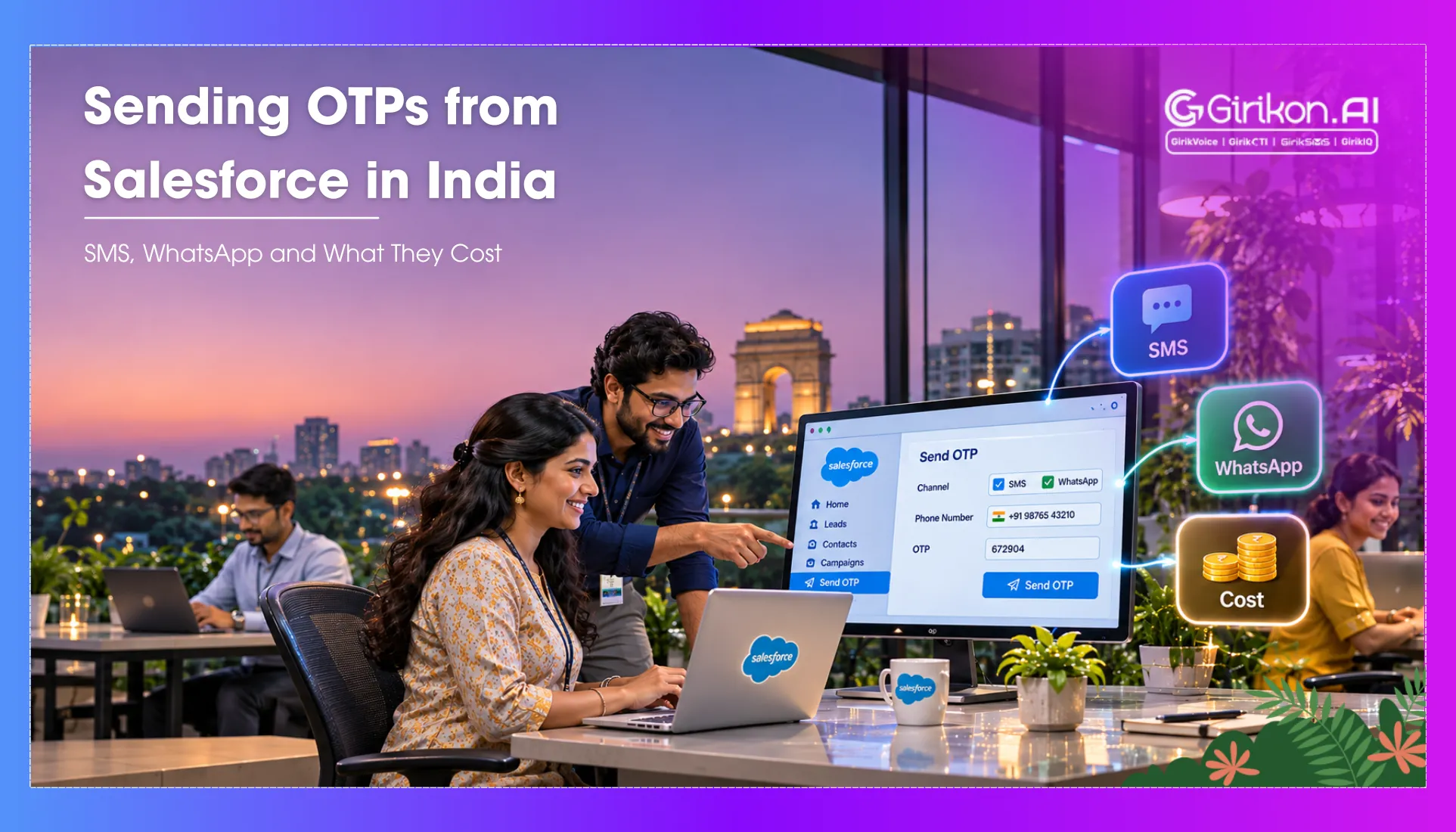
WhatsApp OTP vs. SMS in Salesforce: How Much Does Sending OTPs Actually Cost in India?
Ever wondered how much your business spends just to tell customers, "Here's your OTP"? It's probably not something you think about every day. But when hundreds or thousands of customers log in, sign up or verify their accounts through a Salesforce SMS app, those little messages can add to a surprisingly big bill.
For years, SMS has been the familiar choice for OTP authentication. Now, WhatsApp is opening up another possibility. And with Meta reporting that 91% of online adults in India chat with businesses every week, it's easy to see why businesses are paying attention to this channel.
But here's the catch: is WhatsApp OTP cheaper than SMS, or does the cost advantage disappear once delivery failures, retries and integration charges enter the picture?
Let's compare WhatsApp OTP vs SMS pricing in India, — put the numbers into perspective and find out which option makes more financial sense for your Salesforce business.
WhatsApp OTP vs SMS OTP: How Do They Work in Salesforce
In the case where a user needs to access Salesforce Experience Cloud, register an account or verify one's identity- the OTP delivery channel plays a crucially important part.
SMS OTP can be generated by Salesforce and sent to the user's registered mobile phone number through an SMS API integration. The delivery is based on telecom networks, SMS routing, and relevant compliance for the DLT services of India.
WhatsApp OTP follows the same logic as a different carrier. Salesforce still generates the code, but the integration sends it to the WhatsApp Business Platform using an authentication template WhatsApp has approved. An authentication template can be utilized with the authorization to send verification codes through the WhatsApp Business Platform.
What makes it unique? In comparison to WhatsApp that requires nothing but Internet connectivity and a valid account, SMS requires infrastructure from telecom companies. While both can authenticate users, there are differences between them.
WhatsApp OTP and SMS Pricing in India
When comparing WhatsApp OTP with traditional OTP SMS — the biggest difference comes down to how each channel is priced. WhatsApp authentication messages follow Meta's applicable authentication rates — whereas SMS charges depend on the pricing structure, message volume and delivery route offered by your OTP service provider.
Below is a comparison using ₹0.115 per WhatsApp authentication message and ₹0.20 per SMS
| Monthly OTP volume | WhatsApp OTP | OTP SMS |
|---|---|---|
| 1,000 | ₹115 | ₹200 |
| 10,000 | ₹1,150 | ₹2,000 |
| 50,000 | ₹5,750 | ₹10,000 |
| 1,00,000 | ₹11,500 | ₹20,000 |
At these assumed rates — WhatsApp OTP costs approximately 42.5% less per message. However, the actual difference depends on your commercial agreement and additional charges.
Businesses using an SMS API India solution should compare transactional SMS routes, monthly volumes and provider-specific rates. Similarly, WhatsApp costs may include business solution provider fees and integration expenses
So, before choosing an OTP service provider — look beyond the advertised per-message rate. The real question is how much you're spending to authenticate each customer through Salesforce successfully.
CTA: Are You Ready to Find the Best Possible Solution for Your Salesforce Company?
Consult with our specialists and see what would suit your Salesforce best.
Which Channel Offers Better Delivery and Reliability - WhatsApp or SMS OTP?
Cost gets most of the attention in OTP discussions, but a code that arrives late loses more than a slightly pricier one. Here is how the two behave.
- OTP SMS uses the telecom network and needs no internet on the customer's phone. Delays come from operators at busy times, and from registration problems, such as an unregistered template, under India's Distributed Ledger Technology (DLT) rules.
- WhatsApp OTP depends on the customer having a WhatsApp account and an internet connection. Both must be in place, because the message travels through the WhatsApp Business Platform.
Where organizations are using the Salesforce application—the best option is dependent on customer reachability, delivery needs, and OTP delivery failures.
The best way is to apply a multichannel strategy where if a WhatsApp OTP fails to be delivered within a specific time—the organization can configure SMS as a fallback mechanism.
Note that neither the two channels are guaranteed uninterrupted delivery. The most important thing is to select an OTP service provider that offers delivery tracking, retries and fallback delivery mechanisms.
How to Choose the Right OTP Service Provider for Your Salesforce Business?
When looking for an OTP provider — you must consider beyond the lowest per-message rate. Find a solution that works well with Salesforce and can manage your businesses' increasing authentication needs.
- Transparent Pricing Structure: Do not get lured with reduced pricing structures. Ensure there are no additional fees on OTP messages, integration and retry mechanisms so as to determine how much you pay.
- Salesforce Compatibility: Your OTP system must not complicate things. Rather, it must seamlessly integrate into your Salesforce workflow so as to deliver OTPs, sending and verifying them without the need for extra effort.
- Scalability and Technical Support: Your OTP requirements will increase along with the growth in your company and its requirements. Therefore, ensure your chosen system is scalable and offers technical support services.
After all, the ideal OTP service provider would be one that helps you optimize messaging costs, reliability and Salesforce integrations, rather than one that only gives you the best price.
What Should Businesses Choose Between WhatsApp OTP and SMS in Salesforce?
While choosing between WhatsApp OTP and SMS, it all comes down to what matters the most to the organization. Although SMS is still an effective choice when it comes to reaching customers that do not have access to the Internet, there is always an alternative for organizations that have customers that make use of the application.
In the case of Salesforce businesses -- the best way to determine the right choice is through comparison of real costs for the messaging service along with its delivery quality, integration needs, and customer preferences. There might be situations when a combination of both channels will give more flexibility than the sole use of one of them.
A good choice is never the least expensive option per message but the one that delivers reliable authentication at the budget your business has agreed upon.