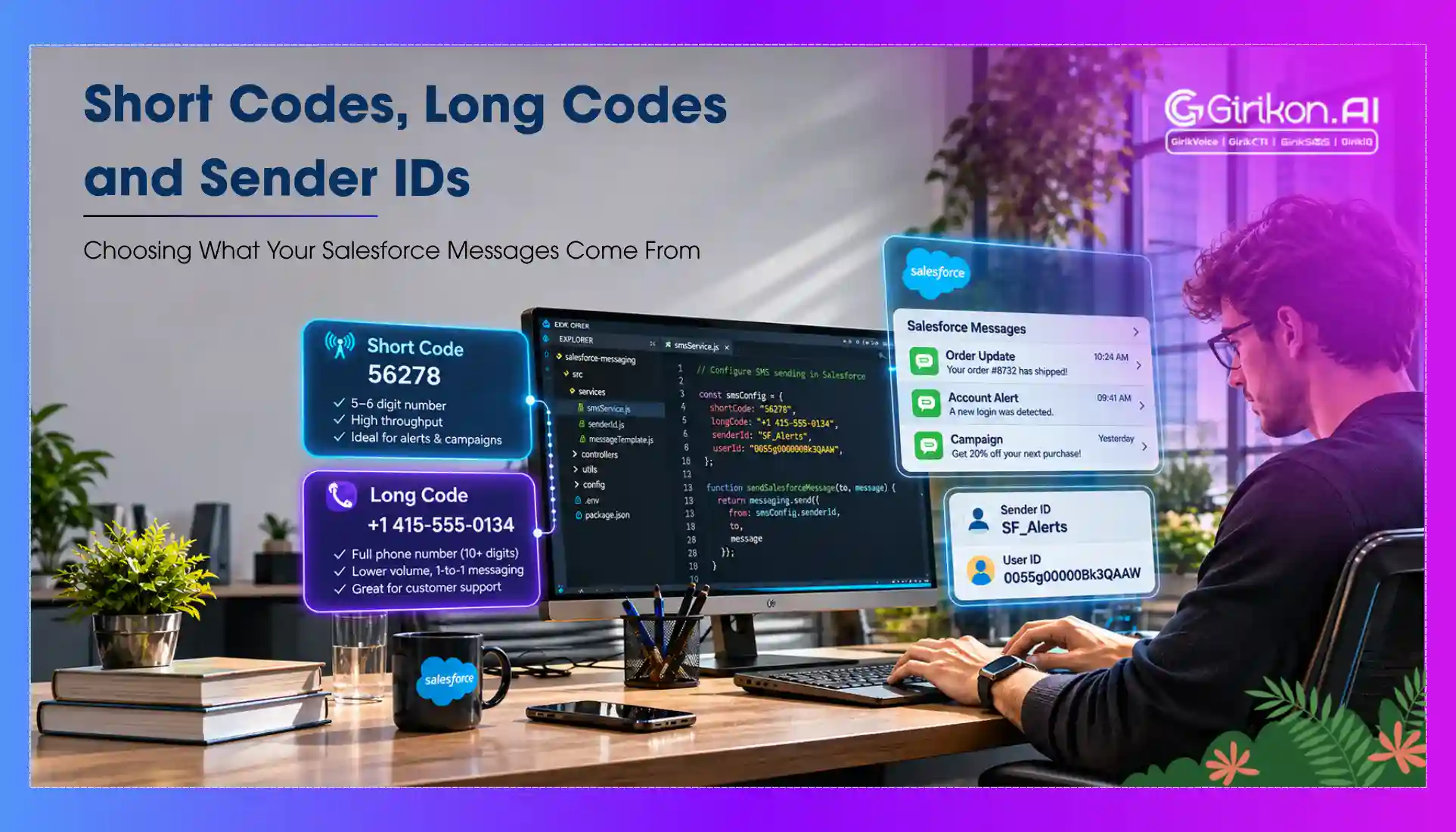
Short code, long code or alphanumeric sender ID? Compare SMS sender types for Salesforce messaging — volume, two-way replies, compliance and brand recognition.
Short Code, Long Code, or Sender ID? Choosing the Right SMS Identity in Salesforce
When your business sends a message, it's always identified by a sender through an SMS sender id. This can be an SMS short code, a long code, or an alphanumeric sender ID. The choice decides how recipients recognize your messages, how quickly you can send them, and what regulations apply in different countries. Teams using Salesforce SMS for customer communication should treat the choice as more than technical. This impacts compliance, customer trust, delivery, and brand recognition. So, each option deserves a close look before a campaign starts. In addition, the right SMS short code service provider can also help a business lift engagement, build brand awareness, and keep its messaging consistent across channels.
What is the Short Code?
Businesses use short codes, numbers of five or six digits, for both outgoing and incoming texts. Unlike a standard person-to-person (P2P) number, a short code is built for application-to-person (A2P) messaging and can carry heavy traffic.
A customer might, for example, text the keyword "JOIN" to a number such as "56789" to enter a promotion. Short codes are most often used for:
- Event updates and special offers
- OTP and authentication messages
- Service notifications and appointment reminders
- Loyalty programs, contests and customer surveys
- Subscription confirmations and keyword-based opt-ins
Such programs can also run automated two-way exchanges. Replies come as preset campaign keywords, for instance CANCEL, STOP or HELP, and the exact set depends on how the campaign is configured and on local regulations.
Dedicated vs Shared vs Vanity Short Codes
| Factor | Dedicated Short Code | Shared Short Code | Vanity Short Code |
|---|---|---|---|
| Use | One business | Several businesses | One business |
| Keywords | Exclusive | Shared or limited | Exclusive |
| Reputation | Your business controls it through its own management system | Affected by other users | Controlled by your business |
| Cost | Higher | Lower | Highest |
| Best For | High-volume programs | Lower-volume programs | Brand-focused campaigns |
What are Long Codes?
A long code is an ordinary-length phone number. Businesses use it to send messages and to receive them. Depending on the country, that may be a local mobile number, an international one, or a number registered to the business.
Typical uses include:
- Support conversations with customers
- Added delivery or service details
- Confirming appointments
- Follow-ups after a sale
- Transactional notifications
In the US, A2P messaging requires a business to register its name and set up a campaign with the messaging service. Long codes can't carry the volume that short codes handle. They still suit companies with moderate inbound traffic that want an ongoing conversation with customers.
What is an Alphanumeric Sender ID?
Alphanumeric Sender ID doesn't show phone numbers, but codes that display the company or brand name. The recipient sees "ACME" or "BRANDNAME" where a number would normally appear. The point is brand visibility, and it counts most for transactional messages, alerts and delivery updates.
It's typically used for:
- Order and payment notices
- Delivery and shipping updates
- Announcements about a service
- Alerts on account activity
- Promotions that need no reply
Most alphanumeric sender IDs support one-way SMS only. The recipient can't reply to the name shown.
Registration rules for numbers vary from one country to the next. A number of markets want sender IDs registered beforehand. Others limit use cases, character length, ID format, and similar details. SMS businesses in the USA aren't allowed alphanumeric sender IDs, so they send from a numeric one.
Short Code vs Long Code vs Alphanumeric Sender ID: What's the Difference
| Factors | Short Code | Long Code | Alphanumeric Sender ID |
|---|---|---|---|
| Format | Typically, 5--6 digits | Standard number | Brand or business name |
| Message volume | High | Moderate to high, based on registration and provider | Varies by market and provider |
| Two-way messaging | Yes | Yes, where supported | Generally, no |
| Brand recognition | Moderate | Moderate | High |
| Setup requirements | Carrier approval | Registration may apply | Country-specific registration |
| Typical use | Campaigns, OTPs, alerts | Conversational and transactional communication | One-way notifications |
High-volume senders of high-priority messages in the USA often want a short code built for their own needs. Elsewhere, the pattern varies. Branded messages work best in countries and regions that run on alphanumeric sender IDs, while conversational messaging fits those that run on long codes.
How to Choose the Right SMS Sender for Salesforce
- Messaging volume:
Estimate how many texts you'll send daily or monthly and what they'll contain. Settling this at the start points you to the right sender type and avoids needless spending later. - Two-way interaction:
Where customers should be able to reply, call back or book and manage appointments, choose a number that works in both directions. - Target geography:
Sender ID availability and registration depend on the country. A format proven in India or the UK may be unavailable in the USA. - Compliance considerations:
Every campaign need registration and carrier approval. Collect consent before sending and check each country's limits before launching. - Salesforce integration:
Check that your Salesforce environment supports the SMS short code service provider and that it offers inbound replies, automation triggers, and delivery reports. The provider should also publish clear pricing, explain how provisioning works, and allow sender responsibilities to be transferred to a new owner when updates are made.
Treat Your Salesforce SMS Sender Choice as Strategic
The sender ID type you manage shapes brand recognition, deliverability and customer interaction. A short code offers higher throughput, while an alphanumeric sender ID favors the brand alone. Picking either one without giving customers the best experience can waste your effort. Before you decide, weigh the audience, the volume, the messaging, regional requirements and how you want to reach people. With the right SMS infrastructure linked to Salesforce, a business can keep messaging consistent and still meet each client's particular demands.