Measure AI voice agent quality beyond call volume with key metrics like containment, escalation, task completion, customer experience, error rate, FCR, and deflection.
- 1Measure AI voice agent quality beyond call volume and automation rates by focusing on whether the AI actually resolves customer issues.
- 2Track containment rate, but do not rely on it solely; ensure AI also resolves the customer's problem to avoid false positives.
- 3Evaluate escalation rates not just by frequency but by timeliness, ensuring AI escalates complex issues promptly to prevent customer frustration.
- 4Prioritize task completion and customer satisfaction metrics to confirm AI is effectively handling requested actions and providing a positive experience.
- 5Analyze error and failure rates, categorizing them by type and severity, to identify specific areas for AI improvement and ensure accurate intent recognition and process execution.
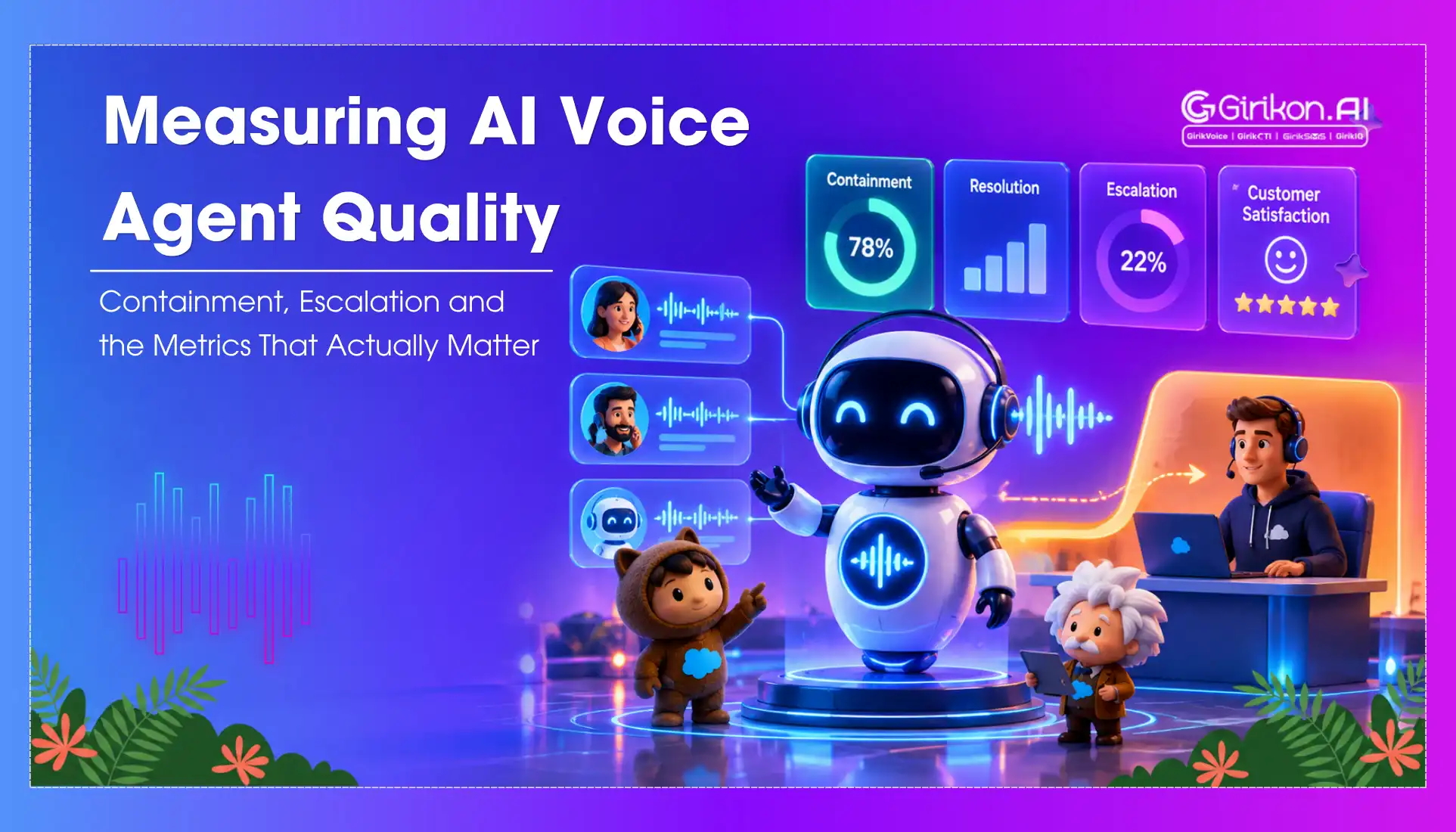
Measuring AI Voice Agent Quality: Containment, Escalation and the Metrics That Actually Matter
An AI voice agent that keeps customers engaged in conversation but cannot resolve their problems brings no real value. At the same time, a low escalation rate may seem to show efficiency, but it may also mean that AI is not able to decide when a human operator should come into the conversation.
This is why voice AI performance metrics need to go beyond call volume and automation rates. Because they don’t tell you whether the AI actually helped the customer.
Businesses need to dig deeper and analyze several factors, such as how AI handled the conversation and whether the expected result was reached. All these factors considered together will show if the AI voice agent does the job of delivering real business value.
Why Traditional Contact Center Indicators Do Not Reveal Everything
Despite the fact that traditional contact centers rely on several indicators, such as abandonment rates, average handling time, number of calls received, and first-contact resolution of issues, they are insufficient for evaluating voice AI applications.
As AI becomes part of the conversation, businesses also need to measure what happens inside the interaction– not just what happens before or after it reaches a human agent.
In other words, a client’s phone call that does not get through to a live representative might seem to be a successful interaction at first. However, if the AI misinterprets the customer's needs and the person has to call back later to resolve his/her issue, the interaction is not truly successful.
This is why voice AI performance metrics need to measure more than automation volume. Deflection and containment can show how much work AI is handling, while the quality of escalation, task completion, customer satisfaction, and error rate allow understanding whether this automation is efficient enough.
Which Performance Metrics Should You Track to Measure Voice Agent Quality
Companies need to keep track of several metrics related to conversations, operations, and customers’ experience to gain a better understanding of how efficient an AI voice agent works.
Let’s look at each one of them:
1. Containment Rate
While referring to the percentage of eligible conversations that an AI voice agent handles without transferring the customer to a human agent, a strong containment rate can indicate that AI is effectively handling routine requests and reducing the workload on human support teams.
However, a high containment rate voice AI is not automatically a sign of high-quality AI. If customers remain in an AI conversation but do not get their issue resolved, the containment rate may look positive while the actual customer outcome remains poor.
2. Escalation Rate
The escalation rate refers to how many conversations have been transferred to a human agent because they require human assistance. High escalation rates are not necessarily an indicator of low-performing AI. There are instances that genuinely require human judgement or access to information the AI cannot handle.
Nevertheless, the significant concern is whether the AI escalates calls in a timely manner since late escalations can lead to frustrations of customers stuck in trying to address issues that cannot be resolved by the AI.
3. Task Completion Rate
With such a metric, businesses will be able to easily calculate how many times the AI has managed to do what the customer wanted. It can be either checking order status, making an appointment, launching an insurance claim, among others.
For instance, the AI voice agent can correctly understand that the customer wants to reschedule the appointment; however, when it fails to get into the scheduling system, the call will be considered unsuccessful. The process of monitoring the completion of tasks allows companies to find out if AI is really handling the work for which it has been designed.
4. Customer Experience Quality
Customer satisfaction is another parameter used by firms to know how the customer perceives his or her engagement with an artificial intelligence voice agent. Firms use various metrics like customer effort scores, the number of complaints, survey conducted after calls, sentiment analysis, and CSAT score to know whether clients were satisfied with their engagement and if it was easy for them.
Moreover, they would be able to determine whether AI has provided good customer experience or merely closed the dialogue without meeting the customer's needs. An instance could be a customer who has done everything in accordance with procedure but got frustrated because of repetitive questioning from the AI program.
5. Error and Failure Rate
Even advanced AI voice solutions may provide wrong answers, fail to complete actions, or start a wrong process. The error rate will show how often these failures take place.
Common failures can include:
- Routing customers to the wrong department
- Recognizing the incorrect customer intent
- Misunderstanding numbers or account details
Instead of looking at one error percentage, businesses should categorize failures by error type, intent, severity, workflow. This makes it easier to identify where the AI requires improvement.
6. First Contact Resolution
First call resolution (FCR) refers to identifying if the client’s query was resolved during the first call and without further action or follow-up calls. It is especially useful for evaluating AI voice agents’ performance because it identifies issues that could remain hidden from containment.
An AI agent may successfully contain a conversation, but if the customer calls again later because the issue was not resolved, the interaction was not truly successful. This brings the importance of combining containment with FCR for a clearer picture of whether AI is actually reducing customer support demand.
7. AI Agent Deflection Rate
While escalation is all about moving the conversation to human agents, deflection refers to how effectively AI prevents customer interactions from reaching human support teams.
Routing requests such as appointment confirmations, order status checks, basic account inquiries, and business hour questions are often strong candidates for AI deflection. A high deflection rate creates value when the customer’s need is actually addressed by AI without relying on a human support team.
Conclusion
The idea behind using voice AI is not just to automate more calls but to finalize more conversations, achieve better customer effects, and escalate cases if necessary. With GirikVoice, companies can go beyond their basic automated metrics and see more relevant data about how their AI voice agent is utilized during customer interactions.
So, are you ready to track what is working, where AI needs to improve, and where conversations break down? Explore GirikVoice with a free trial and start measuring what really matters.