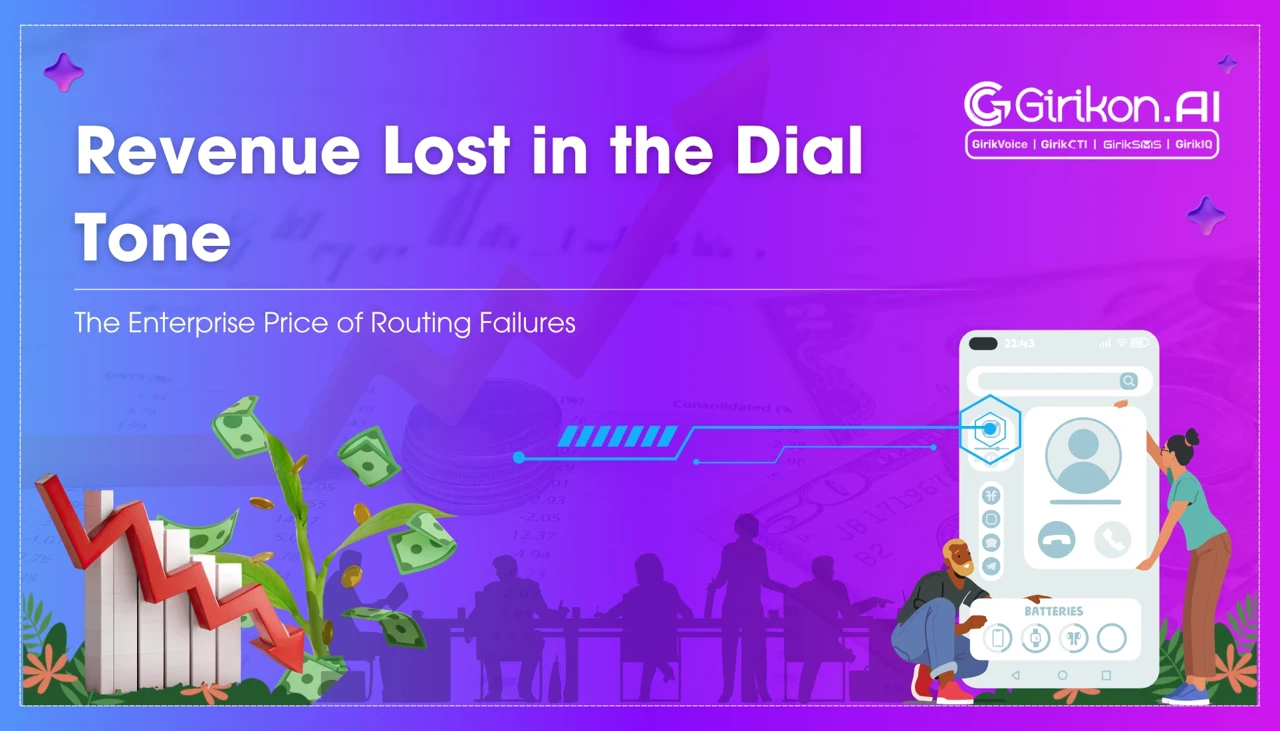
Poor call routing costs enterprises revenue before agents even speak. Missed connections, longer wait times, and frustrated customers lead to lost opportunities and lower satisfaction.
- 1Implement AI call routing to leverage real-time data and context for more efficient and effective call distribution.
- 2Integrate AI call routing with CRM systems like Salesforce to personalize routing based on customer history, deal stage, and account value.
- 3Reduce revenue leakage by ensuring sales inquiries are routed directly to sales teams, preventing delays and lost opportunities.
- 4Improve operational efficiency by minimizing call transfers, reducing average handle time, and empowering agents with pre-call context.
- 5Enhance customer satisfaction and retention by delivering quicker, more informed resolutions through optimized call routing.
The Hidden Cost of Poor Call Routing: How Enterprises Lose Revenue Before a Conversation Starts
You can tell by one simple incident how much a business values your time. The process can begin with an innocent question, after which the caller is left waiting, routed to another department, or made to repeat the whole thing all over again in order to advance further. It does not necessarily look like much of an issue on the surface, but it leaves an impression on the customer.
In the case of enterprises, this cost goes beyond just wasting time. Misrouting calls could result in delays in closing the sale, dissatisfied customers, and additional work for support personnel prior to actually talking to them. This is where the importance of AI call routing in enterprise communication emerges.
What is AI Call Routing and Why It Matters for Salesforce Businesses
Routing has always been a feature of business telephony, but its nature has transformed. Traditional routing was dependent on fixed queue structures, which were independent of any context. AI call routing provides flexibility to those processes, allowing decision-making on real-time input instead of predefined parameters.
This is the actual difference made by intelligent call routing; it makes use of context to minimize guessing. For Salesforce businesses, this matters because every customer interaction already has a trail inside the CRM. Open deals, support tickets, previous call logs, and account histories all carry signals about what the customer might need. Through Salesforce call routing in a Salesforce-native CTI, those signals can directly shape where the call goes. When routing works correctly inside Salesforce, the system can:
- Recognize the caller from the CRM contact database
- Pull recent cases, open opportunities, or account activity
- Apply skill-based routing based on product expertise, region, or language
This directly shapes business performance. Proper routing results in higher first call resolution as the customer reaches the correct department. This enhances the performance of the contact center as well. Since the agents have more time to solve the problem than transfer calls, it will positively impact the customer experience optimization process, starting with proper context.
The impact of poor routing becomes evident through the failure to capture leads and slow response, hence poor customer satisfaction. It is because routing is often the first layer that impacts the revenue generated in a Salesforce environment.
The Hidden Costs of Poor Call Routing
Call routing problems are normally considered a service problem, but its financial implications extend far beyond that. For enterprises, routing determines how quickly a customer gets to where he needs to be, how well informed the agent will be, and how smoothly the conversation will flow. Failure in routing will normally have consequences in two areas: revenue leakage and inefficiency in operations.
Revenue Leakage: Where Opportunities are Lost
The person who is making a call is at a higher stage of the sales process than the individuals who visit your website or even open your emails, as they have come prepared to evaluate, compare, and take action. The call is probably among the most intent-driven touchpoints in the whole process. When those calls are routed poorly, the business risks losing that momentum immediately.
The problem here is that a sales query routed to support instead of revenue might result in delays that lower the purchase intention. A high-value customer may have to wait long before the right representative is able to take the call. In business processes where service is the key factor, unresolved problems may influence renewals or contract expansion.
The financial consequences are usually invisible, as the loss does not show up under a 'lost due to poor routing' label. Instead, it appears as slower conversion cycles, missed upsell opportunities, abandoned calls, or declining retention. This is one of the biggest reasons the impact of poor call routing is often underestimated.
In Salesforce environments, this becomes even more important. When AI call routing is tied to CRM records, businesses can route based on account value, deal stage, or customer priority. Without that layer, routing decisions stay blind to commercial importance.
Operational Costs: The Internal Friction Businesses Absorb
Not every cost tied to poor routing shows up in revenue. A large part of it builds internally through wasted time, repeated effort, and slower issue resolution.
One of the clearest examples is lower first call resolution. If the customer reaches the wrong queue, the issue often moves across multiple agents before reaching the right owner. That increases average handle time and adds more follow-up work across teams.
Poor routing also weakens contact center efficiency. Agents spend time transferring calls, gathering missing context, or handling requests outside their expertise. In a high-traffic environment, these minutes translate into serious productivity loss.
For businesses using Salesforce call routing, there is also the issue of broken data continuity. When calls move through disconnected paths, CRM records can become incomplete or inconsistent. That affects reporting, customer history, and future service quality.
At some point, the differences become too broad to reverse the effect on customer experience optimization. The customer faces the friction, the agent struggles with inefficiency, and management incurs the expense. Poor routing does not usually result in a single, major problem. It results in multiple small problems that just keep recurring until they become expensive.
Conclusion
A business phone call might only last for a few minutes, but how the call gets to its destination will determine everything else that happens from there. Revenue, service support, customer relations, and operational efficiencies often begin taking shape long before the conversation itself starts. This is why telephony for Salesforce plays such a critical role—it helps ensure calls are intelligently routed to the right teams with the right customer context. That is what differentiates call routing from being just an operational layer in enterprise communication.
For businesses already working inside Salesforce, every incoming call carries context that can either be used or overlooked. While the systems remain largely hidden, their impacts do not. With customer demands becoming more specific and time windows narrowing down, routing may end up mattering even more than many enterprises expect it to.