Voice AI barge-in plays a key role in making AI voice agents feel natural during real conversations. Learn how interruption detection, echo cancellation, and audio cancellation improve production voice experiences.
- 1Implement robust barge-in and interruption handling features to ensure voice AI agents can detect, yield to, and process customer interruptions in real-time, distinguishing them from demos.
- 2Recognize that natural human interaction involves frequent speech overlaps and interruptions; a production-ready voice AI must mirror this fluidity to avoid sounding robotic.
- 3Integrate advanced technologies like smart Voice Activity Detection (VAD) and effective echo cancellation to accurately distinguish genuine user speech from AI audio and background noise.
- 4Ensure audio cancellation mechanisms are in place to halt the AI's current speech immediately upon detecting an interruption, preventing buffered audio from playing.
- 5Prioritize interruption handling capabilities as critical for real-world deployment, as they significantly impact customer experience and system effectiveness.
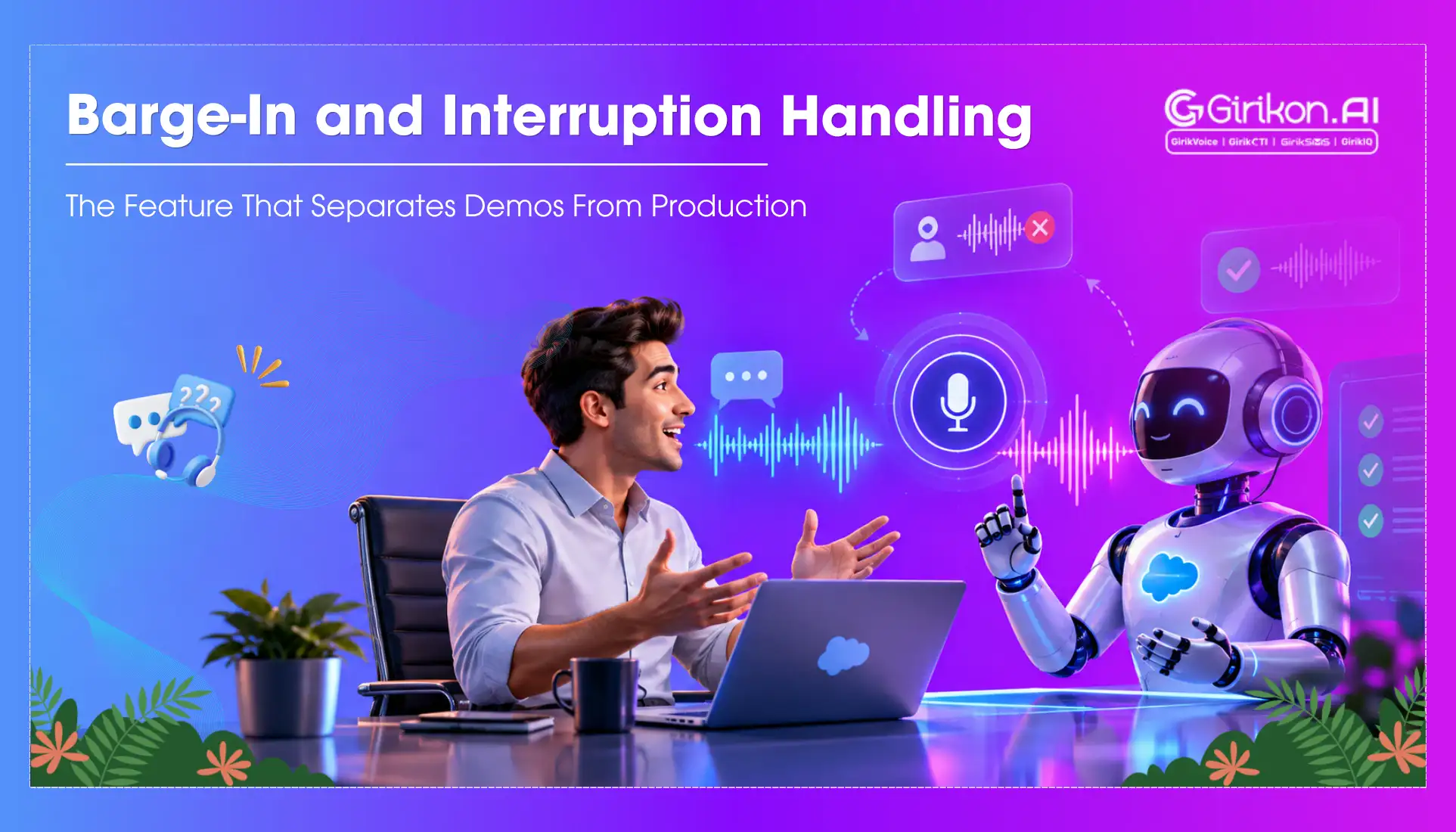
Barge-In and Interruption Handling: The Feature That Separates Demos from Production
Impressive voice, precise speech recognition, and a powerful large language model – an AI voice can have all these yet can deliver poor customer experience. So, how to ensure whether an AI voice agent is efficient enough to comprehend context and respond accordingly. The actual test begins when a client barges-in or in other words interrupts.
A pre-written demo is anticipated: the AI talks, the customer takes notes, and every exchange follows the proposed path. Real interactions are anything but predictable. Customers disrupt mid-sentence, have a change of mind, throw follow-up questions, say “yes” before the AI has completed, correct details midway through a reaction, or jump in before the agent has even finished its thought. That complex, instinctive back-and-forth is where a voice AI actually proves whether it is developed for the real world.
This is where voice AI barge-in comes into the picture. So, what is it all about?
It is the ability of a voice AI agent to detect whether a customer has started talking while the agent is still speaking, yield correctly, and process the client’s new input. Research conducted on interactive systems identifies disruption handling and taking turns as basic confronts as natural human interaction involves very small gaps between turns and repeated overlap.
For organizations deploying voice agents in client service, banking, healthcare, automotive, sales, collection and appointment management, interruption handling in voice agents isn't an aesthetic feature. It can establish whether an AI system feels interactive — or irritatingly robotic.
What Is Voice AI Barge-In?
For instance, a client calls a dealership only to hear …… “Your service department is open till 10—” before coming up with, “Can I come at 6:30?” A production-ready voice agent should instantly yield the floor, comprehend the client’s request, and respond.
A poorly designed agent may continue connecting with the customer: “Your service department is open until 10 PM. We suggest…” forcing the client to interrupt again, speak louder, or repeat themselves—turning a simple interaction into a frustrating one. This ability to figure out when a client speaks and elegantly provides them the familiar turn is known as voice AI barge-in. It is indeed way more complex than basic:
The system must continue hearing while its own audio is playing, separate the client’s voice from synthesized speech, detect meaningful activity, cancel or stop the agent’s audio in real time while handing over the conversation seamlessly back to the customer. Effective cancellation of echo is also critical thereby preventing the AI’s own voice from being flawed for a disruption. These capabilities can form the base of natural interruption handling in voice AI while making interactions feel approachable rather than robotic.
Why Demos Often Hide the Problem?
Most voice AI demos happen in controlled settings: users wait their turn, background noise is minimal, and conversations follow predictable scripts. Production calls are far less orderly. Customers interrupt, change answers, speak over the AI, use accents or multiple languages, correct responses, or ask unexpected questions. This is why barge-in, turn detection, and interruption recovery are critical production capabilities—not optional settings.
What is the Role of Interruption Handling in Voice Agents?
Effective interruption handling in voice agents needs multiple technologies to function together. This enables AI agents to recognize, interpret and reply when a user speaks amidst an ongoing conversation.
Voice Activity Detection
This is the first layer, which checks incoming audio regularly to establish when a person begins and stops speaking. But VAD won’t be able to deliver reliable disturbance handling. The system must distinguish authentic user speech from the AI’s own background noise, audio, brief responses, and other interactive sounds. A production-ready voice agent needs smart speech detection that comprehends the context of the interaction — not just whether sound is present.
Echo Cancellation
When an AI agent speaks, its audio gets leaked via the customer’s microphone and travel via the call. In the absence of effective echo cancellation, the system may consider AI’s own voice for customer speech. This triggers false disturbances or disruption turn-taking. This becomes very challenging during speakerphone calls, in deafening surroundings, or when audio quality is conflicting. Reliable echo suppression is crucial for natural and continual voice conversations.
Audio Cancellation
Once a disruption is detected, the voice agent must stop its instant response instantly. Simply halting the production of new text isn’t adequate, as audio that has already been buffered may continue to play. Effective interruption therefore requires control at both interactive, as well as audio layers. The system must quickly stop queuing up audio, halt playback, and send control to the user. This creates a natural interactive experience without delay or overlapping speech.
What Happens When Users Talk Over AI Agents?
When clients talk over AI agents, poor interruption handling can make interactions feel artificial. For instance, if a client asks to move a meeting while the AI maintains speaking, the conversation appears to be hungry for attention. Repeated intersections may cause users to pause unusually, repeat and speak louder. Rather than forcing clients to adapt to the technology, effective voice AI must understand interruptions quickly, stop speaking, and adapt genuinely as per the customer’s way of interacting.
How a Production-Grade Interruption Flow Works?
A production-grade interruption flow can be showcased in the following format:
An interruption should be considered as a potential change in conversational intent, not an error. So, if a customer changes a return request to an exchange, the AI must give precedence to the new intent instead of continuing its earlier response.
Final Words:
While a voice AI demo demonstrates an agent’s ability to speak; production shows it can interact. Voice AI barge-in, effective interruption handling, and natural turn taking AI voice enable agents to hear while chatting, stop when users disturb, comprehend new intent, and respond appropriately. Preventing clients from having to speak over AI agents is crucial for natural, receptive, production-ready voice experiences.