Voice agent prompt management helps teams safely update prompts, scripts, fallback rules, and integrations without disrupting production. Learn how version control, performance metrics, staged deployments, and rollback criteria can improve voice AI reliability and customer experience.
- 1Implement prompt and script version control for voice agents to maintain a documented history of configurations and enable safe testing, deployment, monitoring, and reversal of changes.
- 2Track essential performance metrics like containment, deflection, task completion, transfer rates, and fallback rates with context to accurately assess voice agent quality.
- 3Apply version control to all critical voice agent components, including system prompts, task prompts, conversation scripts, fallback instructions, tool integrations, and evaluation criteria.
- 4Ensure that changes to voice agent prompts and scripts are reviewed and approved to prevent unexpected negative impacts on customer experience and production workflows.
- 5Regularly evaluate voice agent quality by analyzing both measurable outcomes and the qualitative aspects of conversations, such as task accuracy, response relevance, and appropriate escalation decisions.
Voice Agent Prompt Management and Versioning: Update Scripts Safely Without Breaking Production
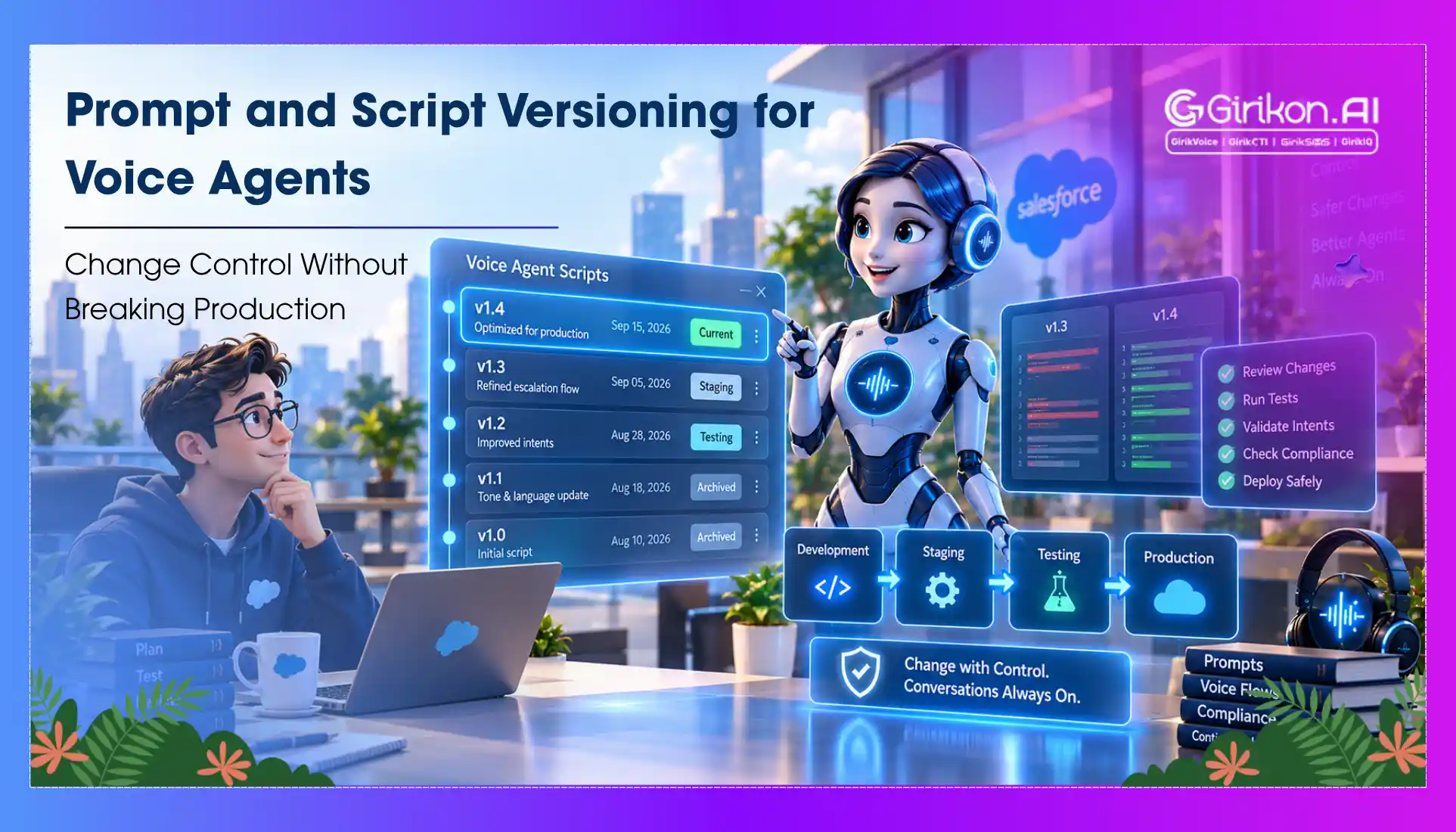
Voice agents depend on more than a single prompt. Their behavior is decided based on system instructions, task prompts, conversation scripts, fallback rules, tool instructions, model settings, and integrations. When teams modify prompts or scripts without maintaining previous versions, tracking performance metrics or identifying a sudden increase in transfers, failed workflows, or customer complaints becomes difficult. There may be no clear record of what changed, or which setting was active when the problem occurred. Voice agent prompt management can help. It gives teams a documented history of agent configurations and a reliable way to test, approve, deploy, monitor, and reverse changes.
In this blog we’ll explore why voice agent change management matters for voice agents and discuss some common performance metrics that show agent quality, including containment and deflection rates. In addition, it’ll also share practical tips for teams to implement version control voice agent prompts without slowing delivery and keep customer experience stable while ensuring compliance.
Why Does Version Control Matter for Voice Agents?
Voice conversations need context to operate well. A small instruction change can influence several stages of an interaction. Suppose an appointment-booking agent is changed, so it collects a caller's name, preferred date, and contact information in one turn. The intention may be to shorten calls.
Callers often provide only part of the information requested. This makes the Voice agent continue with the follow-up questions. If they don’t have a prior version to reference, it becomes difficult for the team to know whether a revised instruction caused the change in agent's behavior.
Version control voice agent prompts set up a consistent baseline, giving teams a reliable point of comparison. It also makes voice AI performance metrics more useful because performance can be evaluated against a specific release rather than against an undefined historical state.
Which Voice Agent Prompts and Components Need Version Control
- System Prompts and Behavioral Instructions: These establish the agent's role, operating boundaries, communication requirements, escalation rules, and decision logic.
- Task Prompts: Instructions for workflows such as authentication, scheduling, troubleshooting, order tracking, or lead qualification should be maintained separately where practical. This makes individual workflow changes easier to identify and test.
- Conversation Scripts: Opening messages, questions, confirmations, disclosures, escalation statements, and closing language can all influence customer interaction. Changes to these elements should be recorded as part of the relevant release.
- Fallback and Recovery Instructions: The agent needs defined behavior for silence, misunderstood requests, interruptions, unsupported questions, and repeated failures. These instructions should have their own version history.
- Tool and Integration Instructions: CRM queries, API calls, knowledge retrieval, and workflow actions can affect the outcome of a call. Their instructions and configurations should therefore be associated with the release in which they were introduced.
- Evaluation Criteria: Test cases and scoring criteria deserve version control voice agent prompts as well. If the evaluation standard changes at the same time as the agent, performance comparisons can become misleading.
7 Metrics Your Team Should Monitor for Voice AI Performance
| Metrics | What It Means |
|---|---|
| Containment rate | Calls resolved without human intervention |
| AI agent deflection rate | Interactions handled by AI instead of human agents |
| Task completion rate | Successful completion of the intended workflow |
| Transfer rate | Frequency of escalation to human agents |
| Abandonment rate | Calls ended before resolution |
| Average handling time | Time required to complete an interaction |
| Fallback rate | Frequency of recovery responses |
Note: These measures need context. A rise in containment may look positive while the agent is actually failing to recognize conversations that should have been transferred.
How Can Teams Measure Voice Agent Quality?
To measure voice agent quality, organizations should examine both measurable outcomes and the actual quality of conversations. Evaluation can cover task accuracy, response relevance, escalation decisions, compliance, latency, tool execution, and conversational consistency.
Automated evaluation is useful for processing large call volumes, while human review can identify issues involving context, judgment, or caller experience.
Quality assessment should also account for inappropriate automation. An agent that keeps a caller in an automated flow when human assistance is warranted may improve containment while reducing service quality.
5 Best Practices for Voice Agent Prompt Management and Safe Change Control
Keep every release immutable with deployment logs and last-known-good configurations. This ensures rollback is immediate and allows teams to compare performance shifts, such as changes in containment rate of voice AI, against a stable baseline. Maintaining records of voice agent prompts makes it possible to trace changes when performance metrics move unexpectedly.
Assign distinct identifiers to each release and link prompts, scripts, tools, and test cases. Clear identification supports voice agent change management by making it easier to trace issues and investigate metrics like AI agent deflection rate when customer experience changes unexpectedly.
Documentation helps teams measure voice agent quality by connecting operational outcomes to specific prompt updates, rather than relying on assumptions or incomplete records. So, record the reason, scope, and approval for every modification as it solidifies accountability in version control voice agent prompts.
Use sandbox and phased rollouts before production. Controlled exposure allows teams to monitor early signals, validate containment and deflection performance, and update AI scripts safely and prevent widespread disruption if a new release introduces regressions.
Set thresholds that trigger rollback, such as spikes in abandonment, failed tool calls, or compliance violations. Pre-approved rollback criteria make sure teams act quickly when voice AI performance metrics indicate deterioration, keeping voice agent prompt management aligned with service quality.
Conclusion
Prompt and script versioning gives voice AI teams a reliable way to manage production changes. Each release can be traced to its configuration, tested against defined criteria, evaluated through measurable outcomes, and reversed when necessary. This discipline ensures that refinements are documented, and their impact on performance is clear. To sustain reliability, teams must understand how to effectively apply Voice AI prompt management, since these measures let you update AI scripts safely, and keep projects stable as agents expand into more complex customer facing workflows.