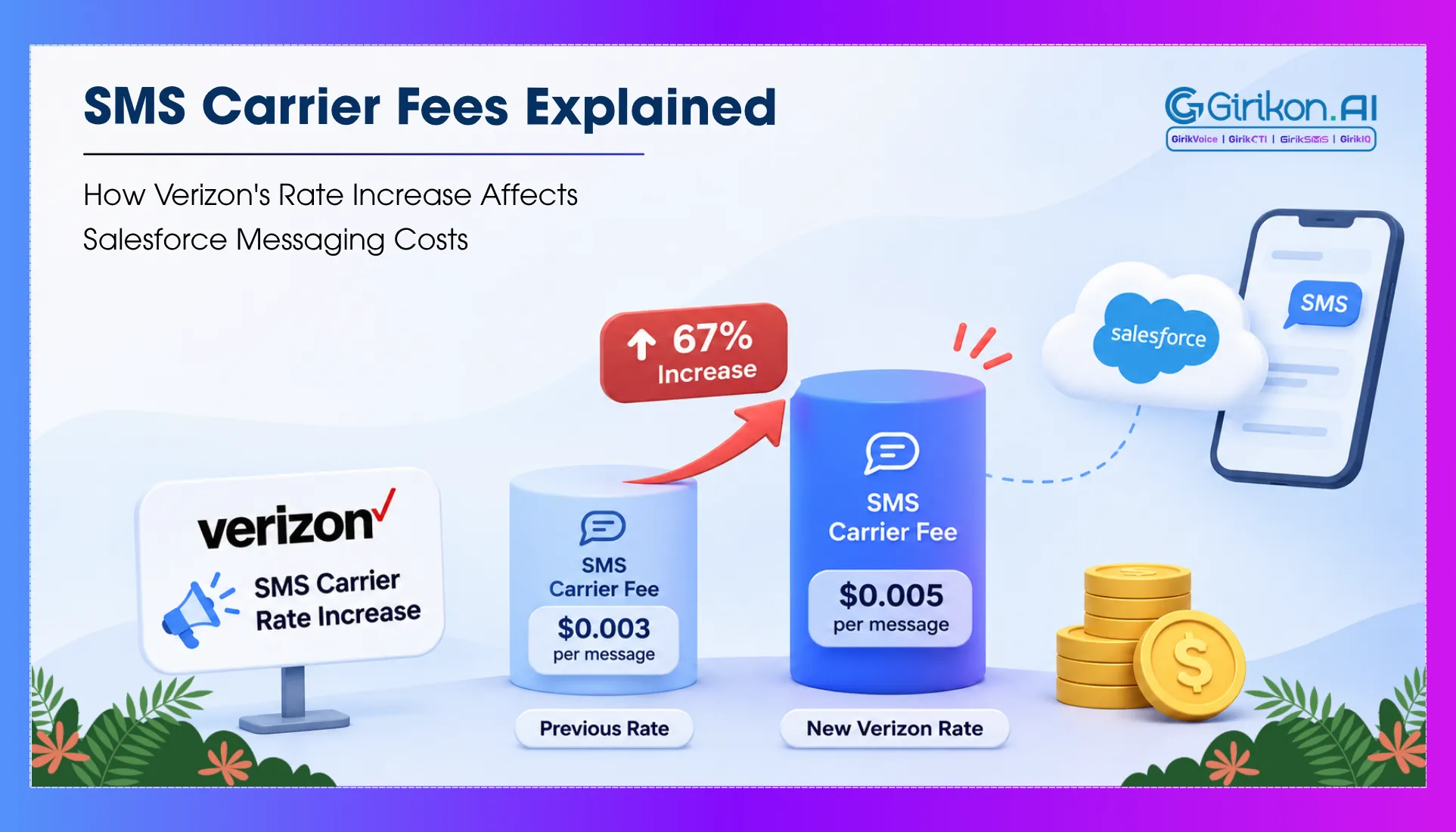
Verizon raised its outbound SMS carrier fee from $0.0045 to $0.0050 on October 1, 2026. Here is what that adds to your Salesforce messaging bill.
Ever looked at your Salesforce messaging bill and wondered why it went up when you haven’t sent a single message more than usual? SMS carrier fees may be the reason, even when the number of texts you send hasn’t changed.
According to Telgorithm’s October 2026 industry recap, Verizon was among the major US wireless carriers that raised an A2P messaging fee in 2026. On October 1, it increased its outbound SMS carrier fee from $0.0045 to $0.0050 per message.
A fraction of a cent doesn't sound like much, does it? But when your business is sending thousands of texts to customers, those tiny amounts can start adding up.
If you use messaging on Salesforce — it’s worth understanding where those extra costs might show up and what they could mean for your budget. Let’s look at how Verizon’s rate increase could affect your messaging costs, how to estimate the difference, and which charges to keep an eye on.
What Changed in Verizon's SMS Carrier Fees on October 1?
Effective October 1, 2026, Verizon increased its outbound carrier fee for SMS and RCS Rich messaging. Here’s how the new rates compare with the previous ones.
| Messaging type | Previous rate | New rate | Change |
|---|---|---|---|
| Outbound SMS (10DLC, toll-free, short code, Authy, and Verify) | $0.0045 per segment | $0.0050 per segment | 11.1% increase |
| Outbound RCS Rich | $0.0045 per message | $0.0050 per message | 11.1% increase |
| Outbound MMS | No change | No change | Unchanged |
| Inbound messaging | $0.00 carrier fee | $0.00 carrier fee | Unchanged |
The SMS fee applies per message segment — so a text split into multiple segments may incur a carrier fee for each segment. These are Verizon’s carrier pass-through fees, not the total price of sending a message through a messaging provider.
This update is part of the wider changes to A2P 10DLC carrier fees in 2026, but the October adjustment described here concerns Verizon's rates. Other carriers may have different fee schedules and effective dates.
How Verizon's SMS Carrier Fees Affect Salesforce Messaging Cost
Verizon's SMS rate increase is only one part of the cost picture — for businesses sending messages through Salesforce, the actual impact depends on how providers bill carrier fees, how messages are segmented, and which messaging channels they use.
Carrier Fee Pass-Throughs
Salesforce-connected messaging providers may pass Verizon’s carrier fees on to customers in addition to their own messaging charges.
- Separate carrier charges: Your provider may add carrier fees to its base SMS rate or include them at a combined price.
- Different billing models: How the increase appears on your bill depends on your provider’s pricing structure and agreement.
- Verizon-bound traffic: This specific increase applies to eligible outbound messages delivered to Verizon subscribers.
When reviewing carrier pass-through fees for Salesforce messaging, distinguish the carrier charge from your provider’s own messaging rate. To get more information on other fees that might impact your budget, check out these hidden costs of Salesforce SMS integration.
Message Segmentation
A text that appears as one message on a customer’s phone may count as multiple billable SMS segments.
- Standard SMS: A single GSM-7 segment can generally contain up to 160 characters.
- Unicode messages: Emojis and certain special characters can reduce the segment limit, often 70 characters for a single segment.
- Longer messages: When a text splits into multiple segments, the applicable carrier fee can apply to each segment.
This means — message length and character encoding can affect the total carrier fees generated by Salesforce notifications and automated texts.
Messaging Channel and Number Type
Verizon’s October fee update covers eligible for outbound SMS traffic sent through 10DLC, toll-free, and short code numbers — as well as outbound RCS Rich messaging. The applicable rate is determined based on the channel and the carrier fee schedule.
While considering the carrier fees for A2P 10DLC in 2026, keep in mind that the per-message carrier costs are independent of brand and campaign registration fees. Verizon’s October increase affects its applicable outbound messaging rates; it doesn’t automatically increase these separate registration costs.
SMS Carrier Fees: Cost Impact of Verizon's 2026 Rate Increase
Verizon’s outbound SMS carrier fee increased by $0.0005 per eligible message segment— from $0.0045 to $0.0050. The difference may seem small, but the additional cost grows with message volume.
| Eligible outbound SMS segments sent to Verizon | Additional carrier fees |
|---|---|
| 10,000 | $5 |
| 100,000 | $50 |
| 500,000 | $250 |
| 1,000,000 | $500 |
To estimate the impact on your business — multiply the number of eligible outbound SMS segments by $0.0005.
Let's suppose your company sends 100,000 eligible segments each month to Verizon customers; then the additional cost will amount to $50 per month, or $600 for the entire year of 12 months.
These figures represent only the additional Verizon carrier fees — not your total SMS cost per message. Your provider's messaging charges and any other applicable fees are separate, and longer texts may incur fees for multiple segments.
Need Help Estimating Your Salesforce Messaging Costs?
Get in touch with our team to discuss your Salesforce messaging needs and get a clearer picture of your costs.
Tips for Managing Your Salesforce Messaging Budget for Carrier Fee Changes
As soon as Verizon's rate increases, it is advisable to pay attention to the cost behind Salesforce messaging. Below is a practical checklist which will assist you in comprehending the expenditure and creating strategies for future updates.
- Message Volume Check: Determine the amount of outgoing SMS segments sent to Verizon customers to assess the impact of the new rate structure.
- Provider invoice check: Determine whether there is a separate line for carrier pass-through fees on your bill.
- Forecast costs: Take into account the updated Verizon charge while forecasting future costs, particularly for businesses that send messages in large volumes.
- Keep track of other carriers' charges: Note any adjustments made by other carriers, since they can be different from those made by Verizon.
- SMS message length review: When possible, keep SMS messages short to eliminate unnecessary parts while not sacrificing the content.
These audits will allow you and your team to identify changes in costs as soon as possible and make decisions regarding the messaging budget for Salesforce.
Frequently Asked Questions About SMS Carrier Fees
Are Verizon’s SMS carrier fees included in Salesforce messaging costs?
Not necessarily! Carrier fees may be charged separately by the messaging provider or incorporated into a combined rate. Check your provider’s pricing terms and invoice to understand how these fees are billed.
Are Verizon’s SMS carrier fees the same as A2P 10DLC registration fees?
No. Verizon’s SMS carrier fee applies to eligible outbound messaging traffic, while A2P 10DLC brand and campaign registration fees are separate charges. Review your provider’s pricing and invoice to see how each fee is billed.
The Bottom Line on SMS Carrier Fees
A fraction of a cent may seem easy to overlook, but at scale, even a small change in SMS carrier fees can affect your messaging budget. Verizon’s October 2026 rate increase is a timely reminder that the cost of sending a message goes beyond the rate listed by your messaging provider.
Where Salesforce messaging is concerned, it’s important to know why those charges arise. Analyze your message counts, review carrier pass-through fees— and reassess your budget ahead of time before those incremental costs start adding up.
There is a cost associated with every message — but there must always be a reason for every cost. Now that you understand your messaging costs, you will be able to make better decisions.