Porting your business numbers to a Salesforce-native phone system doesn’t have to mean lengthy downtime or disrupted customer conversations. This guide breaks down the typical porting timeline, what to expect during the transition, and how local presence helps your team maintain familiar caller IDs and stronger customer connections. Learn how to plan your number migration for a smooth, low-disruption switch.
The business landscape has evolved majorly over the years and so has the technology terrain. With businesses interacting with their customers via multiple channels, it's obvious for clients to expect instant and tailored answers to their queries. With traditional practice of calling via phone still holding relevance, it becomes all the more crucial for businesses to ensure that calling, comprehending customer context, directing and reporting is simplified and automated.
This is where moving from a traditional business phone system to a Salesforce telephony integration and Salesforce-native phone environment becomes crucial. However, one part that requires careful planning is phone number porting.
Organizations that have been using the same numbers for years needn't worry about changing their phone numbers with the change in telephony platform. With Salesforce Voice, organizations can easily port existing numbers into the platform. Salesforce explains its native telephony offering to be a way of managing voice communication within Salesforce, including number attainment and provisioning. However, the challenge lies in bringing together the port, testing the new surroundings, curtailing downtime, and deciding how local presence dialing, number allocation and called ID should work post migration.
All You Need to Know About Phone Number Porting
It is the process of shifting an existing phone number from one provider to the other while retaining the same number. Say, if a company has been using the number +1 212-555-0175 as its customer service number for a number of years, the organization can request the porting of the number from its current provider to the Salesforce's supported number and portability requirements.
Currently, Salesforce documents voice number porting of native 10-digit long-code and toll-free numbers for the US and Canada. Besides submitting a formal request, the porting process involves documentation authorization.
One thing that has to be noted is that moving to Salesforce does not mean that every existing number can be ported by default. Everything from Number type, carrier, regulatory requirements, country and the specific Salesforce telephony configuration matter.
For companies that have footprints across the globe or are functioning internationally should assess every aspect country by country rather than supposing that a US or Canadian process applies everywhere.
Number Porting vs. Number Provisioning: What's the Confusion All About?
Number provisioning and number porting are usually considered to be the same, yet they solve different issues. While number provisioning involves taking a new number for your Salesforce environment, number porting means transferring an existing number from another provider to a Salesforce environment.
Salesforce Voice permits administrators to obtain numbers by choosing a country and number type and exploring available numbers by prefix or area code. After selection, the number gets into a provisioning process and turns operational when its status shows 'Live'. Salesforce says that the number-lease information can consume up to eight hours to update before the workflow.
This makes provisioning useful during migration.
Rather than porting your number right away, you can:
-
Configure a temporary Salesforce number.
-
Set up the voice channel.
-
Build Salesforce IVR and routing
-
Test inbound, as well as outbound calls.
-
Train users.
-
Authenticate caller ID and call flows.
-
Schedule the production port.
-
Switch the active number after the new environment is complete.
Salesforce recommends taking a new number for production, as well as testing and traffic redirection from the current production number till testing is complete, before transferring the original number. That can significantly reduce migration risk.
-
flows.
-
Schedule the production port.
-
Switch the existing number after the new environment is ready.
Salesforce itself recommends claiming a new number for testing and production and forwarding traffic from the existing production number until testing is complete before porting the original number. That approach can substantially reduce migration risk.
Number Porting: Understanding the Timeline
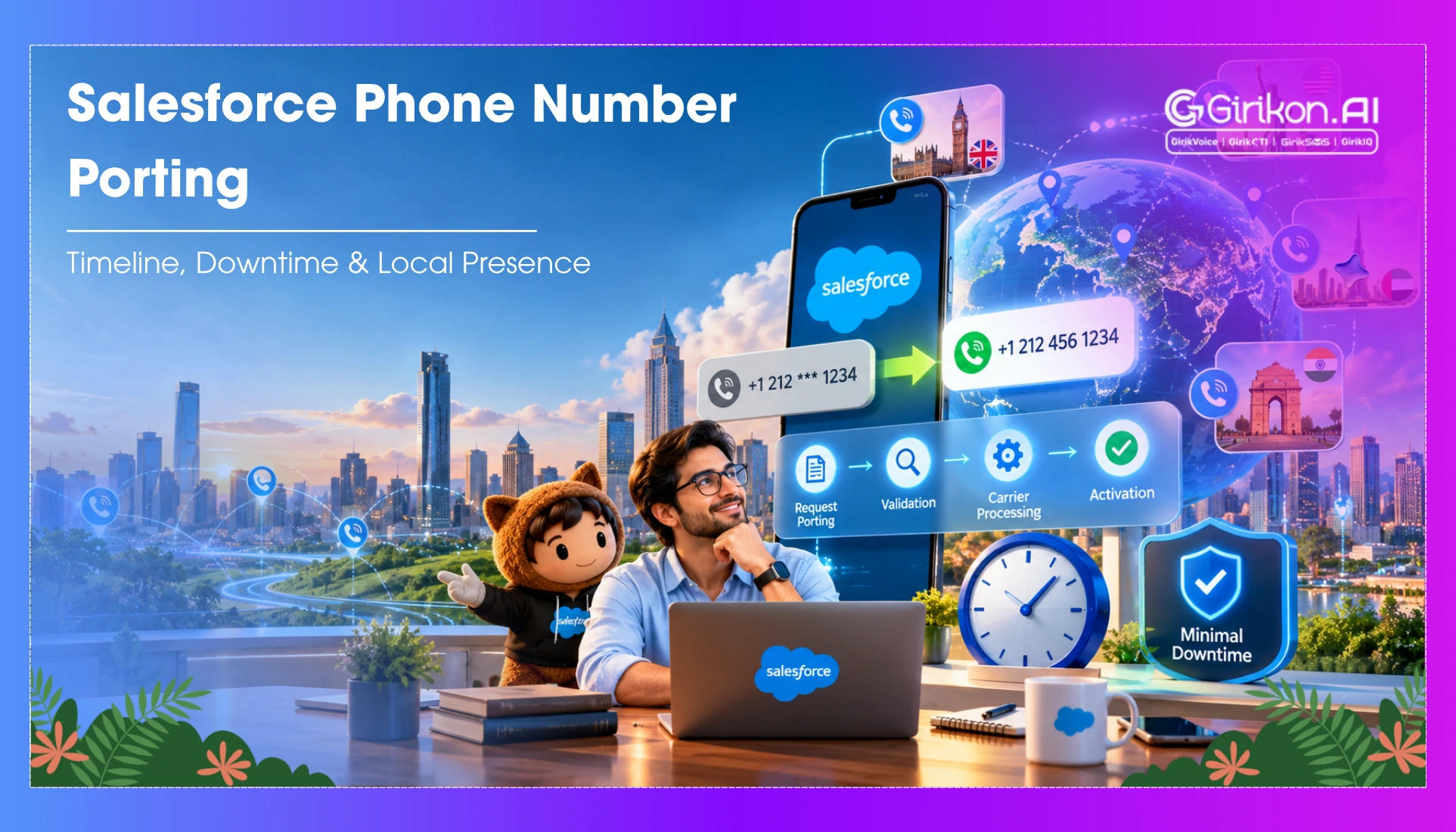
Phone number porting doesn't have a universal timeline. Time duration depends on factors such as number type, country, number quantity, documentation, current carrier, and whether the losing carrier questions or rejects the request. For Salesforce implementations, migration of numbers must be considered as a project that is weeks ahead, rather than an eleventh-hour configuration task. Salesforce advises beginning the process well before the planned go-live date because porting cannot always be expedited.
While standard U.S. ports usually take 5–15 days, rejected requests might consume four weeks or even longer. International ports may need extra time. Therefore, teams must plan time for number consideration, documentation, carrier validation, rejection resolution, port confirmation, final testing, cutover, and post-port authentication. Actual timelines finally depend on the telephony provider and carrier.
Will Phone Number Porting Cause Downtime?
Since porting involves transition between two different telecommunications environments, so certain level of risk w.r.t service interruption does exist. However, good migration planning can reduce that risk substantially.
Make sure not to cancel your existing phone service before verifying the new port, as well as the new environment. As a best practice, old numbers should be kept active while preparing the Salesforce environment priorly. To minimize service disruption, numbers should be configured before the scheduled port date.
This provides businesses an opportunity to test:
- Inbound calls
- Outbound calls
- Caller ID
- IVR menus
- Queue routing
- Agent availability
- Call transfers
- Salesforce Call recording
- Transcription
- Callbacks
- CRM record association
Besides supporting calling through the Omni-Channel experience, Salesforce Voice also supports automatic linking of outbound calls introduced through click-to-dial to the appropriate Salesforce record.
What Businesses Require Knowing About Local Presence Dialing?
Number porting Local presence dialing enables businesses to make outbound calls appearing to come from a local number - helping receivers identify a known area code. For instance, a business based in New York may exhibit a Chicago number when calling prospective customers there.
It is not only about assigning a Salesforce number for local presence. Companies need to check what their Salesforce Voice can handle these days. Number management and outbound calling from Salesforce are part of that along with outbound caller ID. This is instead of relying on the old Sales Dialer.
The caller ID might be regional or individual or corporate or toll free or even an authorized dynamic number. It depends on compliance and branding needs. I think that is the part that stands out. Some setups seem more complicated than others though.
Final Words:
Shifting a business number into Salesforce isn't all about technical configuration. Phone number porting involves documentation, carrier processes, testing, and cautious cutover planning. Besides completing number provisioning, businesses must also complete testing before porting production numbers. Local presence dialing and caller ID must be planned usefully. The objective is to port business phone number assets with minimum disruption while creating a dependable, goal-oriented Salesforce voice architecture.