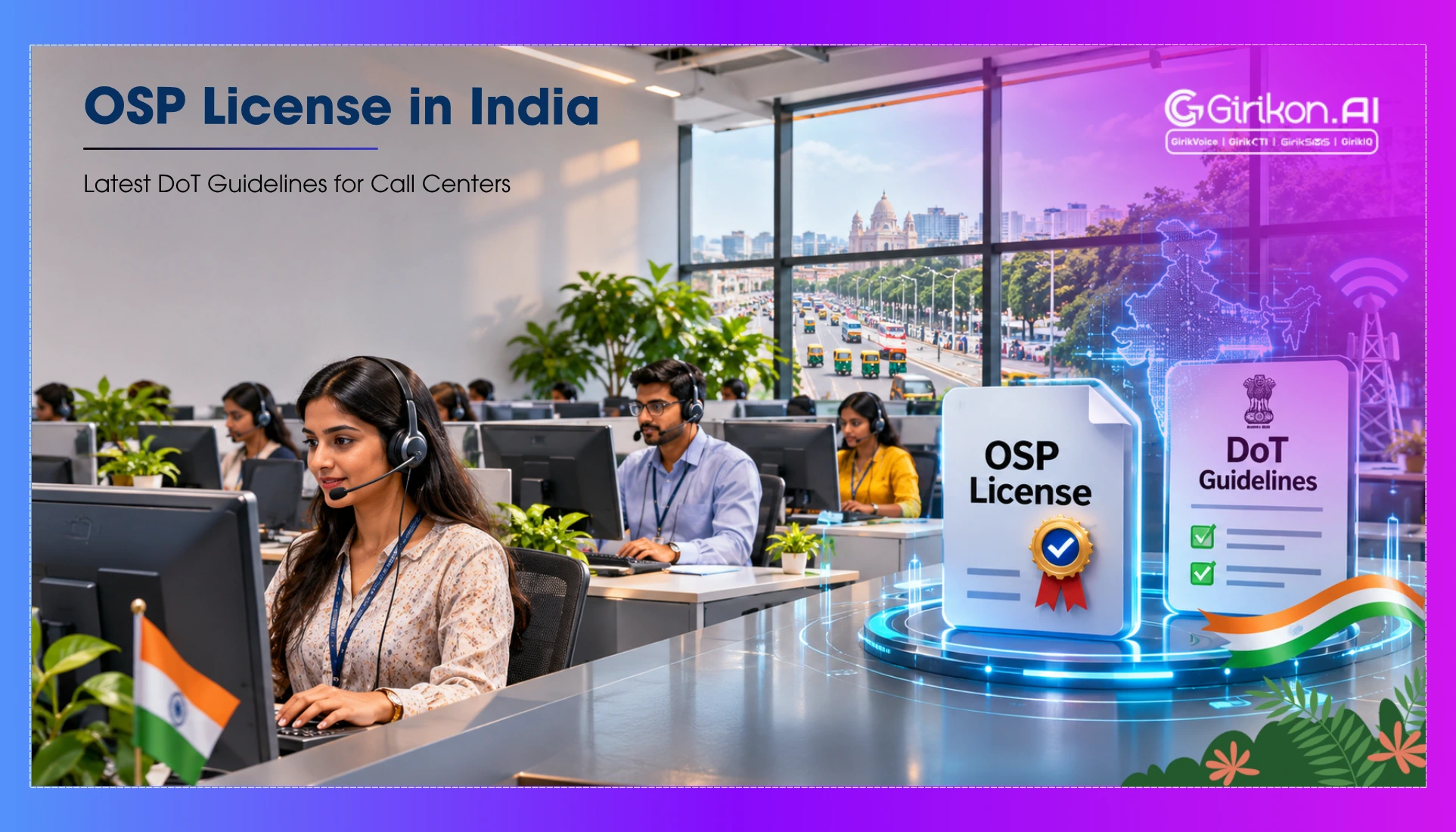
Do call centers in India still need an OSP license? See what DoT requires before your first call, the work-from-home rules, and the records you must keep.
Setting up a call center in India comes with an interesting contradiction: getting the business ready to handle hundreds of customer calls may be easier than understanding the rules governing those calls. Between telecom connectivity, agent locations, calling infrastructure and DoT compliance, there are several details that deserve attention before operations begin. One question, in particular, continues to create confusion: Is an OSP license still necessary to run a call center in India? DoT has simplified its OSP guidelines, making registration unnecessary and allowing call centers to adopt more flexible work arrangements, including work-from-home operations. However, this does not mean call centers are free from regulatory requirements. Businesses still need to follow certain rules related to telecom connectivity, security and recordkeeping before starting operations.
Let's look at what the current framework actually expects from call center operators before they go live.
What is OSP Registration and Which Call Centers Does It Cover?
OSP stands for Other Service Provider, DoT’s label for a company that runs voice-based business process outsourcing (BPO). DoT defines it as call center work where customers reach the OSP’s network through the public switched telephone network (PSTN), the public land mobile network (PLMN), or the integrated services digital network (ISDN).
Legal form matters too. An OSP is an Indian company, a limited liability partnership, a partnership firm, or an organization registered under a Shops and Establishments Act. Registration was the old gate. The OSP registration DoT once ran was location-specific, handled by DoT’s licensed service area units for each site, and it came with a bank guarantee. That history is behind every outdated checklist online, and it explains why people still ask which OSP license a call center needs.
Today, the answer relies on how the business operates and its calling infrastructure. Businesses with no voice-based BPO model fall outside the scope of OSP guidelines. However, before making any assumptions about an in-house team serving only its own customers, or an all-internet calling setup, specific arrangements are best reviewed.
What Changed in DoT’s OSP Guidelines?
The regime moved in three steps.
- Before 2020: Each site needed registration and a bank guarantee, with separate rules for domestic and international OSPs. Severe restrictions were imposed on work-from-home mode, which needed prior DoT permission and heavy bank guarantees as high as ₹5 crore.
- 5th November 2020: DoT removed the registration requirement and bank guarantees, narrowed the definition to voice-based BPO, and loosened the home-agent rules.
- 23rd June 2021: The revised guidelines dropped the domestic versus international split, ended routine reports and inspections, allowed an EPABX abroad for every OSP, and extended work from home to work from anywhere in India. An EPABX, short for electronic private automatic branch exchange, is the system that routes an OSP’s call.
A 2026 change is worth knowing, though it does not target call centers. Under the Telecommunications Act, 2023, DoT replaced the old licensing structure for telecom providers with an authorization regime in June 2026. That touches the carriers you buy lines from. No published rule so far brings call center registration back, and DoT still hosts the 2021 guidelines.
What Does DoT Require Before Your Call Center Makes Its First Call?
There is no OSP registration application to submit before a call center starts operating. Although businesses often seek a call center license in India, DoT does not mandate one, an OSP registration certificate, or a bank guarantee. The responsibility falls under self-regulation. Your call center should comply with the telecom rules and provide the necessary documentation whenever requested by DoT or other authorities. Before making any call, resolve these six issues:
- Scope: Confirm your service is voice-based BPO over public networks, and that your legal form is one the guidelines name.
- Licensed carriers: Buy lines and connectivity from licensed telecom service providers. The guidelines bar an OSP from providing telecom services itself.
- No toll bypass: This means carrying voice between India’s public network and a foreign country, or between two Indian cities, over your own network. An incorrectly configured cloud routing can cause no toll bypass without intending to.
- Logging from day one: Call data records (CDRs), usage data records (UDRs), and system logs must exist before the first call connects.
- EPABX location: You can use an EPABX located outside India. Just keep copies of its call records and system logs at an OSP center in India while providing access to authorities.
- Outbound rules: Telemarketing falls under a different set of guidelines than TRAI does, dealing with telemarketer registration and Do Not Disturb scrubbing.
Work-from-Home Call Center Representatives: What’s New?
Home agents used to be the hardest part of running an OSP. The old rules asked for prior DoT permission, a secured virtual private network (VPN) from a telecom provider, fixed internet addresses and home addresses on file, and a ₹5 crore security deposit under the home-agent arrangement.
The 2021 reforms changed the model dramatically. Agents working from home, or from anywhere in India, are simply Remote Agents of the OSP center, so no separate OSP license or approval applies to them. They may connect over any technology, including ordinary broadband, and they may connect directly to your central EPABX, your own EPABX, or your customer’s. No address list goes to DoT and no deposit is needed.
Three things did not go away:
- You carry the liability. The OSP is responsible for any toll bypass violation, and the guidelines say so inside the work-from-home chapter itself.
- Logs must resist tampering. For remote agents, system logs have to be tamper-proof, and call records plus activity logs are kept for one year.
- India only. The relaxation covers agents anywhere in India. An agent working from abroad falls outside it.
The practical effect is that identity replaced location. DoT stopped asking where the agent sits, and the logging rules still tie every call to a person and a device.
OSP Compliance Requirements: Records, Security and Monitoring
Compliance here comes down to one test: could you hand over a clean call history for any agent on any day in the past year? All other elements back that up.
For a CDR to pass the test, it must have all the information like date, time of start and end of usage, login name, gateway and trunk, and device ID like hardware address. Log records include logins, logouts, and command execution. Timestamps follow Indian Standard Time, Call Detail Records (CDRs) are split by center or media gateway, and a remote login must show who was on each position.
Salesforce users should check one gap early. A call activity record there rarely holds trunk, gateway, or device details, so the telephony platform has to supply them. Ask it directly whether it exports and retains them.
Beyond records, three duties apply: avoid providing telecom services, shut down objectionable or infringing traffic immediately, and help authorities trace malicious calls. Because DoT skips routine inspections, build your own. Each month, request one agent’s calls for one day. If the answer arrives in hours, relax. If it takes a week, start fixing.
Conclusion
The OSP license reform in India has eliminated registration hurdles but not the need for responsible call centers. Businesses have more flexibility in how they run their call centers. Agents can work from a central office, different locations, or home, with fewer DoT formalities than before. Organizations must still use authorized telecom resources, prevent toll bypass, and maintain the required logs. Check your telephony setup and recordkeeping process before going live. Speak with Girikon to assess the technology and integration requirements behind your customer communication operations.