The FTC actively monitors automated outbound calls, and enforcement actions don't typically wait for a pattern to emerge over years. One bad batch dialed without proper list hygiene can surface a complaint volume that triggers scrutiny fast.
Most outbound teams treat compliance as the layer you add after you've already built the dialing workflow. That instinct makes sense operationally - you design for the outcome you want, then bolt the guardrails on later. But when the agent making the call is AI-driven and can execute thousands of dials in the time a human team might complete fifty, do not call list scrubbing stops being a back-office hygiene task - it's really more of a foundational engineering decision, the kind that quietly shapes everything else downstream in the campaign before you've even noticed it's doing that.
Worth naming before we go further: this is not a theoretical risk. The FTC actively monitors automated outbound calls, and enforcement actions don't typically wait for a pattern to emerge over years. One bad batch dialed without proper list hygiene can surface a complaint volume that triggers scrutiny fast.
Why AI Dialing Changes the Calculus Entirely
Human agents fail slowly. They misread a list, they skip a number, they flag something that looks wrong. Those errors are frustrating but bounded. An AI voice agent doesn't slow down when something looks off - it processes what it's given.
That speed advantage is also the liability. If your contact list enters the dialing queue without being checked against the relevant do-not-call registries, the system will move through non-compliant numbers efficiently and at scale. The exposure isn't linear. It compounds per-call, and the TCPA's per-violation structure means even a modest batch of incorrectly dialed numbers can produce a genuinely serious financial outcome.
Honestly, most compliance conversations in the AI outbound space still underweight this. The discussion tends to focus on consent frameworks and call disclosure language, which matter. But the list itself - who you're calling before a single word is spoken - is where a lot of teams are quietly exposed.
The Three Layers That Need to Stack Before Dialing
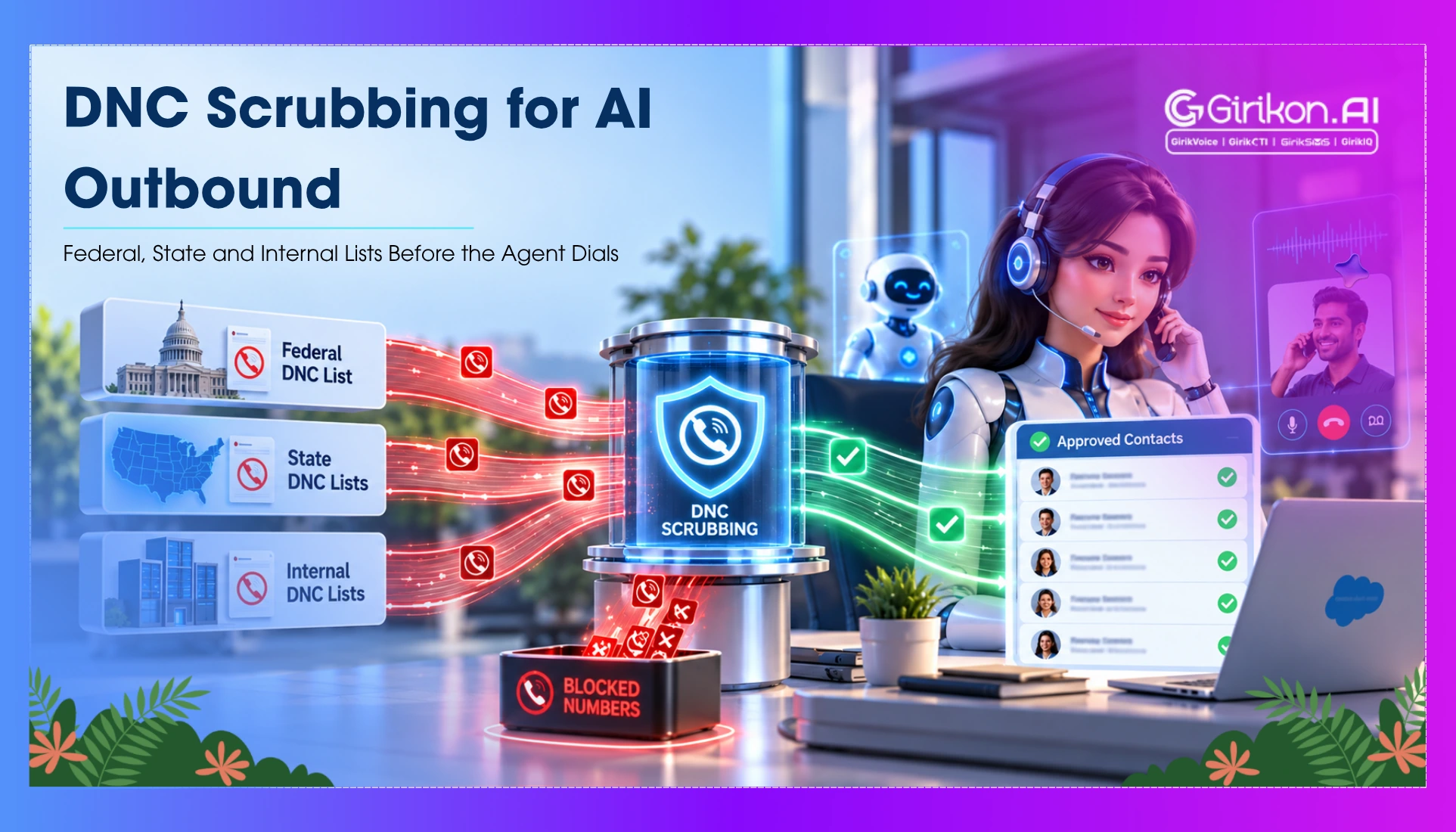
Real scrubbing for AI outbound isn't one check. It's three separate registries and processes that need to stack in the right order, and skipping any one of them doesn't just create a compliance gap - it creates the specific kind of gap that's hardest to defend later.
Federal registry first. The national Do Not Call registry business obligation isn't optional or conditional on campaign type. If your AI agent is calling consumers on their residential or mobile numbers for any commercial purpose, those numbers need to be checked against the federal registry maintained by the FTC. Businesses are required to access this registry and scrub against it before dialing, and the subscription process is tied to the area codes you intend to call. Teams that assume they're covered because they checked six months ago are often the ones caught out - the registry updates continuously, and the FTC expects organizations to reflect those updates within a defined window, typically no more than thirty-one days.
State lists next, and these are the ones that create real operational friction. A lot of states run their own do-not-call registries - parallel to the federal list, not underneath it, which is a distinction that trips people up more than it should. California, Indiana, Wyoming, and a handful of others keep state-level lists that can catch numbers the federal registry never touches. Some states have more restrictive definitions of what qualifies as a covered call. Some have shorter windows for honoring opt-out requests. For AI outbound campaigns running nationally, state-level scrubbing can't be handled with a single lookup - it requires knowing which states your contact population falls into and running each appropriate state registry check accordingly.
Internal list last - but this one is arguably the most important. The internal DNC list is where real-time consumer behavior gets captured: people who've asked not to be called during a previous campaign, contacts who've expressed a preference through your website or CRM, anyone who's opted out through whatever interaction channel you've set up. When AI agents are running outbound at volume, the internal list needs to refresh and sync on a schedule that keeps pace with the dialing frequency. A common failure mode is a contact who opts out during a campaign's first week and then receives a call from the same campaign two days later because the suppression file wasn't pushed to the dialing system in time. That's not a data problem. That's a process problem with legal consequences.
What a Pre-Dial Scrub Sequence Actually Looks Like
To be fair, the steps themselves aren't complicated. The complexity lives in the timing and the integration points between systems.
- Pull the contact list from your CRM or lead source. At this stage, before any API call or dialer handoff, the list should be treated as unvalidated. Every number on it is a potential violation until proven otherwise.
- Run the federal registry check using your active subscription. If your subscription has lapsed or your area code coverage doesn't match the campaign footprint, the scrub will be incomplete. Flag any number that matches and suppress it from the dialing queue - not archive it, suppress it, with a timestamp.
- Run applicable state registry checks based on geographic segmentation. This step requires knowing where your contacts are located, which isn't always clean data. Ambiguous location data should default to suppression, not assumption.
- Check the internal suppression file. This should be the most current version available, ideally synced within the same operational window as the scrub itself. If there's any lag between the suppression file update and the dialer handoff, document it and tighten it.
- Verify consent records for mobile numbers specifically. Under TCPA, calling a mobile number with an AI-generated voice or automated system without prior express written consent creates a separate layer of exposure that a DNC check alone won't resolve.
| Scrub Layer | Registry Owner | Update Frequency Required | Consequence of Skipping |
|---|---|---|---|
| Federal DNC | FTC | Within 31 days of registry updates | Federal enforcement, per-call fines |
| State DNC lists | Varies by state | Varies - often monthly | State AG enforcement, civil liability |
| Internal suppression | Your organization | Real-time or near-real-time | Consumer complaints, reputational damage |
| Consent records (mobile) | Your organization | At point of data capture | TCPA private right of action |
The state row in the table above is where most teams underinvest. Federal scrubbing has clear documentation and established tooling. State-level compliance is patchier, and the coverage varies enough that it requires someone to actually map which states are in play for each campaign.
The Timing Problem That Comes With AI Speed
Here's the thing about AI outbound specifically: the dialing velocity outpaces most legacy compliance workflows. A traditional BANT-qualified human outbound team might work a list over weeks. An AI agent can move through thousands of contacts in an afternoon. That time compression means a suppression file that would have been refreshed before most human agents reached the flagged numbers might not refresh before the AI agent gets there.
The answer isn't to slow the AI down - that defeats the purpose. The answer is to design the scrub infrastructure to match the agent's operating tempo. That means automated scrub triggers tied to list refresh events, not manual scheduled jobs. It means suppression files that sync on contact-level events, not batch uploads.
Whether most organizations have built that kind of real-time suppression pipeline yet is, honestly, still an open question. A lot of teams have compliance processes designed for a dialing environment that no longer exists. The tooling has gotten faster. The list hygiene hasn't always kept up.
DNC Compliance as Architecture, Not Afterthought
Built into the dialing architecture from the start, this approach behaves differently than compliance layered on afterward. When the scrub sequence is embedded in the workflow - when suppression is a gating function, not a periodic audit - the surface area for violations shrinks considerably. The AI agent simply never receives a number it's not cleared to call.
That sounds obvious, but the operational reality is that compliance is frequently handled by a separate team with a separate process on a separate cadence. The result is a gap between what the dialing system knows and what the compliance function knows, and the AI agent operates in that gap.
We're still in an early enough phase of AI-native outbound that a lot of the architectural decisions being made now will be very difficult to reverse later. Teams that wire suppression into the dialing pipeline as infrastructure will have a fundamentally different risk profile from teams that treat it as a review step. That gap probably doesn't narrow on its own.