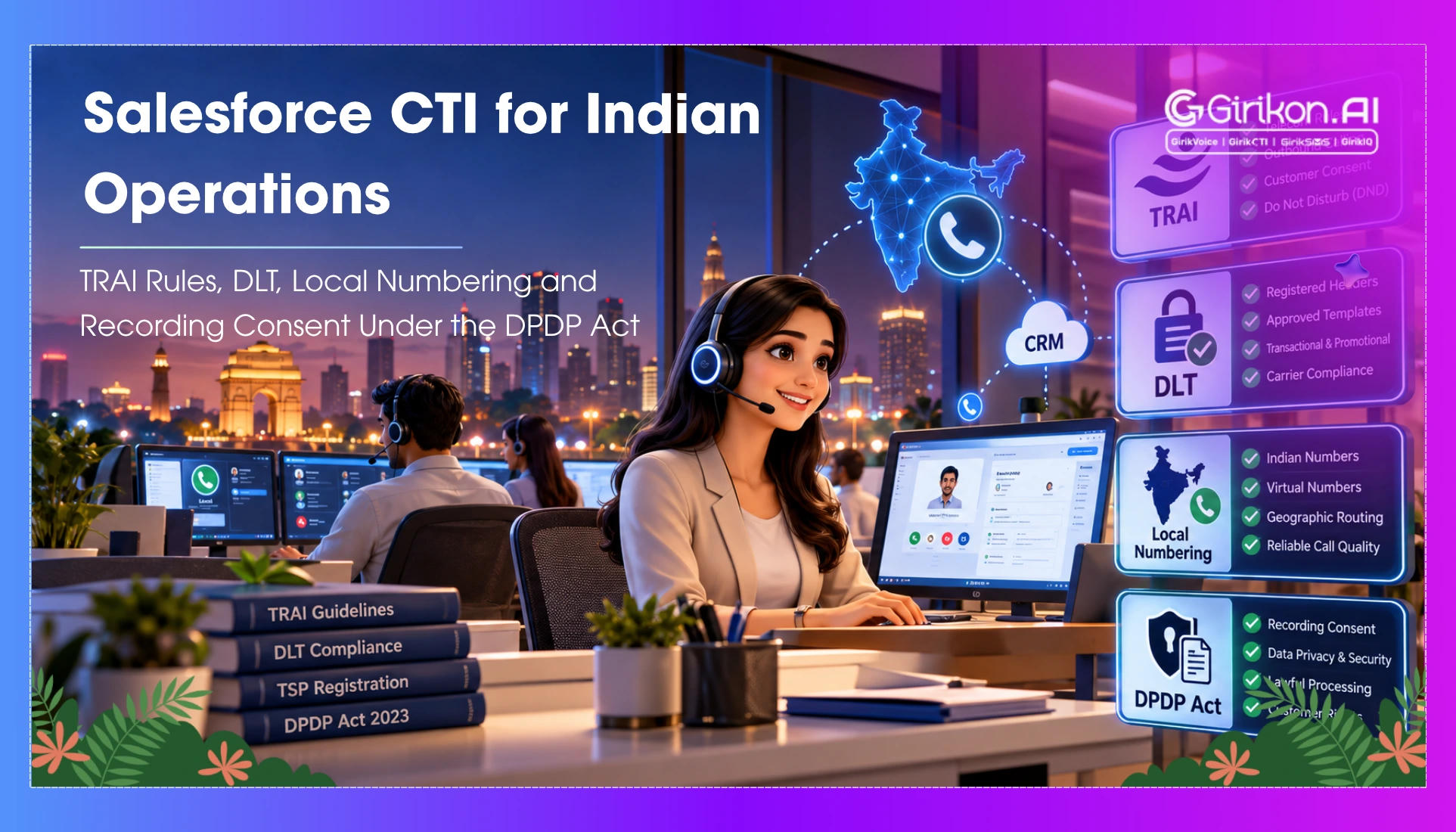
Learn how Cloud Telephony India for Salesforce complies with TRAI regulations, DLT requirements, and call recording consent rules. Discover key compliance considerations to help businesses manage customer communications securely and responsibly.
Customer communications in India involve more than connecting a phone system to Salesforce. A successful deployment must account for TRAI regulations, registration with DLT, virtual numbers, call recording, and consent requirements. These requirements by Indian regulators are also closely connected. Numbering resources, call routing, and recording practices all play an important role in how communications with customers are managed. Therefore, a decision in one area can affect compliance, call handling, and recording obligations elsewhere.
To help you understand these requirements and how to meet them, this blog will explain how TRAI regulations, DLT registration, virtual numbers, recording consent, and Salesforce CTI capabilities work together. It will also cover key considerations for building a compliant and efficient calling operation.
What Compliance Requirements Apply to Salesforce CTI in India?
The rules for deploying Salesforce CTI in India are governed not by the CRM itself, but by the regulations established by the Telecom Regulatory Authority of India (TRAI). Businesses should refer to these regulations when following a Salesforce telephony integration setup guide, particularly to understand customer calling requirements, permitted number series, and the identification of commercial communications.
To register on the Distributed Ledger Technology (DLT) platform of the telecom operators, entities must abide by Telecom Commercial Communications Customer Preference Regulations (TCCCPR). Registration includes the sender's identity, the headers, and message/ call templates. While Salesforce offers call logging and reporting capabilities, it cannot ensure a poorly set up solution is compliant. This is something your business and the service partner need to manage.
Note that a CTI platform can deliver the infrastructure, but the enterprise must maintain consent records, calling windows and number usage. This varies from team to team:
- Promotional messages have a limit to how many users it can be sent to.
- Service numbers must be known by the support teams.
- Collections teams are most exposed because when and how calls are made are subject to a thorough review by both regulators and customers.
What Does a Compliant Cloud Telephony Setup Look Like in India?
A TRAI compliant cloud telephony includes registered numbers, structured call flows, and end-to-end CRM visibility. These three key elements are:
Local and Virtual Numbers
Businesses using cloud telephony in India need to consider the region where the virtual number is assigned and the purpose of each call. Local numbers help build credibility in specific cities for regional brands. Multi location companies can assign numbers by branch or state while keeping a consistent brand. It seems important to separate promotional calls from service ones to avoid compliance issues. That is the part that stands out to me.
IVR and Call Routing
The IVR India implementation should direct callers to the right department without forcing them to navigate lengthy menus. Following Salesforce IVR design best practices, businesses should establish separate routing rules and workflows for sales, support, and collections while maintaining consistent greetings and prompts across all departments to deliver a seamless caller experience.
Salesforce Visibility
A Log should be created in Salesforce for every call. Activity tracking ties each conversation to a lead, contact or case. Reports then provide a manager with call volumes, outcomes and agent performance so they can have an oversight that is actionable. If there's no connection, telephony remains siloed, and customer interactions aren’t fully reflected in Salesforce records. A well-designed cloud telephony India deployment eliminates that disconnect.
What are Call Recording and Consent Requirements in India
Customers call always have their name, contact information, account details, and other personal information. Therefore, recording practices should be examined alongside the Digital Personal Data Protection (DPDP) Act, 2023. It states that users should be aware of the purpose of recording a call and when it takes place.
One other factor to look at is how you'll manage and process the data. Ensure you've policies on recording with access, retention, and deletion requirements in place. The recording data should be available on role-based access. In addition, these retention records are useful during audits and compliance reviews.
TRAI Compliance vs DPDP Considerations: Are They Similar
The two frameworks overlap in practice but serve different purposes.
| Areas | TRAI | DPDP |
|---|---|---|
| Covers | Business communications | Personal data |
| Focus | How customers are contacted | How customer data is handled |
| Requires | Registration and communication controls | Notice, consent, and safeguards |
| Oversight | Telecom regulators and operators | Data Protection Board of India |
What Should Businesses Look for in a Salesforce CTI Platform?
The ideal Salesforce CTI solution India businesses should have these features:
- DLT aligned configuration of headers, template and number series
- Local and virtual number setup across Indian states
- IVR options can be configured (department and skill based)
- Auto log calls with call recordings on Salesforce records
- Consent announcements and opt-out handling before recording begins
- Inform consent and offer opt-outs prior to recording
- Access to recordings based on the role with retention control
- Call volume, outcomes and agent activity must be shown in real-time dashboards
To select the right Salesforce telephony integration partner, businesses should consider a few key factors outlined in a Salesforce CTI integration guide for businesses. Cloud telephony solutions that only log calls may leave gaps in compliance reporting. If you're researching the market for Salesforce call center software India vendors, ask for a live demo of the consent capture and recording retention feature. Ensure that the provider has the relevant telecom licenses to operate in India.
Conclusion
The effectiveness of Salesforce CTI in India depends largely on the way the rules of the telecom industry have been planned along with enhancing CX and keeping data protected. This is because when there's a a TRAI Compliant Cloud Telephony and intelligently designed IVR with permission for recording, business and customers are safeguarded. If teams build these key features early in the project, they won't have to deal with disruption later in the project.
Contact our Salesforce CTI expert for a free assessment of your current Salesforce setup, and find out compliance issues before they cause you brand reputation and financial damage.