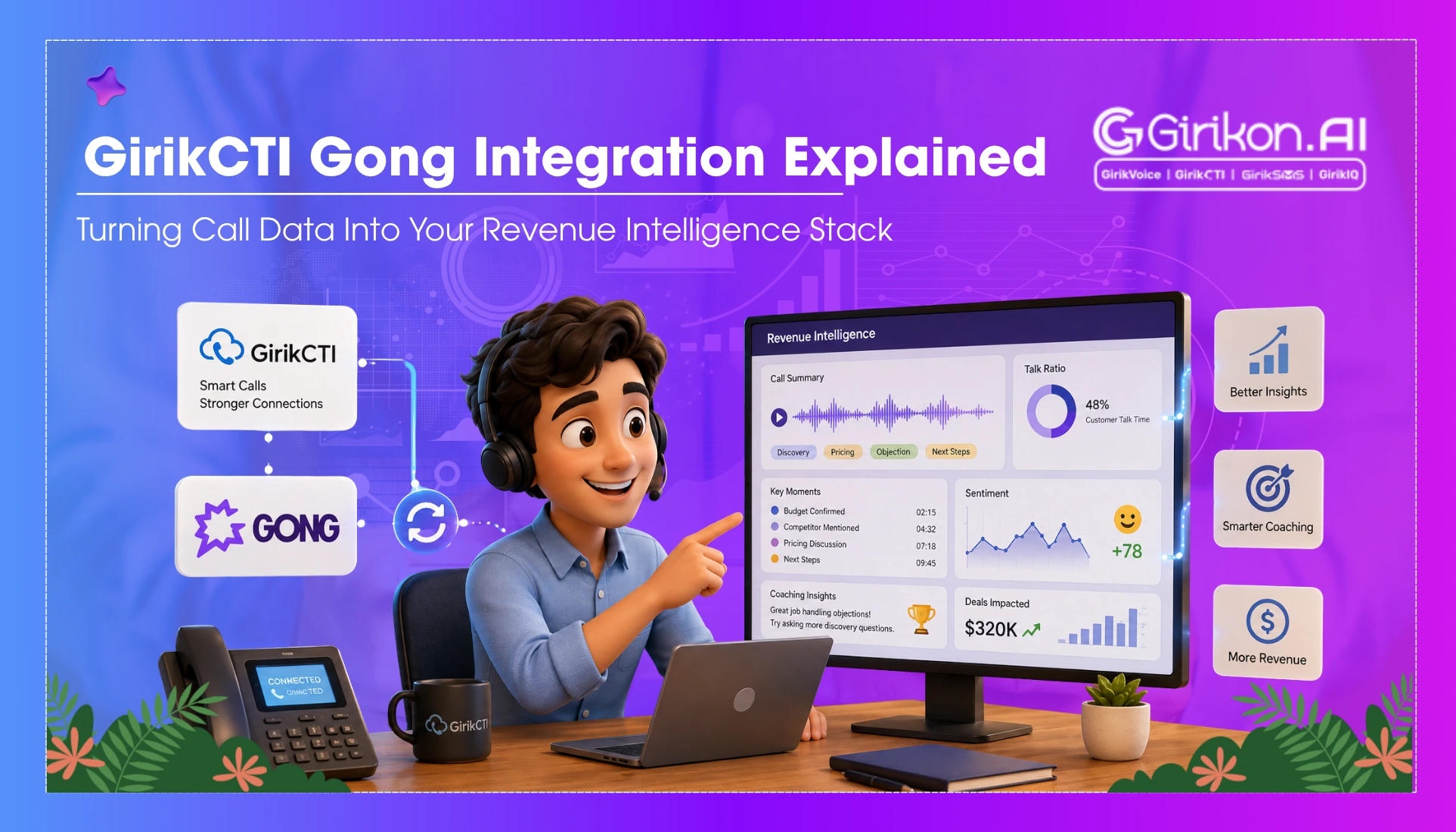
Wondering whether GirikCTI works with Gong? The answer depends on how your call data flows through your tech stack. This article explains how GirikCTI can capture and route call recordings and metadata into Gong, enabling richer conversation intelligence, accurate sales coaching, and data-driven revenue insights. Learn how integrating CTI with Gong helps your sales teams analyze customer interactions, improve forecasting, and maximize the value of every conversation.
- 1Understand that "works with Gong" means both call recording/analysis and proper CRM logging/attribution.
- 2Recognize that Gong's integration with telephony systems varies; direct integrations offer more reliability than workarounds.
- 3Leverage GirikCTI's Salesforce-native architecture for direct CRM logging of call activity and metadata.
- 4Ensure call recordings are accessible to Gong for conversation intelligence, not just activity logs.
- 5Structure your revenue intelligence stack by considering call initiation, recording capture, and Gong ingestion as distinct layers.
There is a version of the modern sales tech stack that looks clean on a whiteboard. Your telephony system sits neatly on one side, your CRM in the middle, your revenue intelligence platform on the right, and data flows smoothly between all three without anyone having to chase it down manually. In practice, of course, most teams are dealing with something considerably messier - and one of the more common points of friction we see is getting gong Salesforce telephony integration right when you are running a native Salesforce CTI solution rather than one of the more familiar standalone dialers. That friction is worth unpacking properly, because the answer to whether GirikCTI actually works with Gong is not as simple as a yes or no.
A Quick Clarification on What We Mean by "Works With"
Before getting into the specifics, it is worth narrowing what this question is really asking. When sales ops teams ask if their CTI works with Gong, they usually mean one of two things - and they are not the same thing. The first is whether Gong can record and analyze calls that originate from the CTI. The second is whether those calls get properly attributed, logged, and enriched in a way that makes Gong's deal intelligence actually useful. You can technically satisfy the first condition while completely missing the second. We see this happen regularly, and it tends to create quiet confidence in the stack until someone pulls a deal review and realizes the call data is partial, mislabeled, or not flowing at all.
How Gong Connects to Telephony Systems (Generally Speaking)
Gong doesn't connect to every telephony system in the same way. The platform supports a range of gong supported telephony systems through a combination of native integrations, VOIP ingestion, and partner-level connections - and where a particular CTI tool falls on that spectrum matters quite a bit for what you actually get on the back end.
For systems that have a direct Gong integration, you typically get automatic call recording ingestion, speaker identification, and deal attribution in a relatively reliable way. For systems that fall outside that set, you are usually looking at workarounds - recording files pushed to a shared location, manual uploads, or third-party middleware that handles the translation. None of those are unworkable, but each one introduces a layer of fragility that tends to get glossed over in the initial setup conversation.
Worth noting: Gong's integration ecosystem has expanded over the years, and their documentation is a reasonable starting point. But the documentation tells you what's possible in a well-configured environment, not necessarily what happens with your specific Salesforce org, your call flows, or your data structure.
GirikCTI Gong Integration - What Actually Connects
Okay. Here is where it gets more specific.
GirikCTI is a Salesforce-native CTI solution - meaning it is built to operate inside Salesforce, log calls directly to Salesforce objects, and surface call activity through the Salesforce interface rather than a parallel system. That architecture has real advantages for teams that want tight CRM attribution, because the call record, contact association, and activity logging all happen within the CRM environment rather than being synced in from outside.
The GirikCTI gong integration situation, as of current understanding, follows the pattern most Salesforce-native telephony tools operate under when connecting to Gong. Because GirikCTI logs calls and call metadata into Salesforce, and because Gong has a Salesforce integration layer that pulls activity data from your CRM, there is a pathway for Gong to access that call information. The question is what form that data takes and whether Gong can ingest the recording itself for conversation intelligence purposes - not just the activity log.
The distinction matters. Gong's core value is not just knowing that a call happened. It's being able to analyze what was said, score the conversation, identify deal risks, and track talk patterns across your pipeline. If your CTI feeds Gong a call activity record without an associated recording, you get attribution without intelligence. That is meaningfully less useful.
What Good Data Flow Looks Like Across This Stack
For teams building or auditing this kind of setup, it helps to think in layers rather than in simple connection checks. A rough framework:
- Call initiation and logging - the CTI captures the call event and writes it to the CRM. GirikCTI handles this natively within Salesforce, which is one of the reasons teams choose it.
- Recording capture and storage - the audio file needs to live somewhere accessible. Whether that is Salesforce, a cloud storage endpoint, or a third-party location determines how easily downstream tools can find it.
- Ingestion into Gong - Gong needs to find and pull that recording, associate it with the right deal or contact, and process it for analysis. This step is where configuration failures tend to hide.
- Enrichment back into Salesforce - once Gong has processed the call, those insights ideally flow back into Salesforce records so your reps and managers see everything in one place.
Step three and step four are where most of the complexity lives. Step one and two tend to work well when GirikCTI is configured correctly, because the Salesforce-native architecture keeps everything close to the CRM layer.
Comparing Approaches to Call Data in a Revenue Intelligence Stack
| Factor | Salesforce-Native CTI (GirikCTI) | Standalone Dialer with Direct Gong Integration |
|---|---|---|
| Call logging in Salesforce | Automatic, native | Requires sync or third-party middleware |
| Recording accessibility for Gong | Depends on storage configuration | Often handled natively by the dialer |
| CRM attribution quality | High - data stays in Salesforce layer | Variable - depends on sync reliability |
| Setup complexity for Gong connection | Moderate - may require configuration work | Lower if dialer is on Gong's native list |
| Deal intelligence completeness | Full if recording ingestion is resolved | Full in most cases with native integrations |
To be fair, neither column is automatically better. Teams that have invested heavily in Salesforce customization often find that a native CTI gives them better CRM data quality overall, even if the Gong connection requires more deliberate setup.
The Salesforce-Native Advantage for Revenue Intelligence
Here is something that gets underappreciated in these conversations. The revenue intelligence Salesforce CTI argument is not just about whether Gong can see your calls. It is about whether your call data is clean enough for any revenue intelligence tool to do something meaningful with it.
Gong's analysis is only as good as the underlying data it receives. A call that is logged against the wrong contact, associated with the wrong opportunity, or missing key metadata fields is going to produce conversation intelligence that nobody fully trusts. The Salesforce-native architecture of GirikCTI means that call attribution tends to be more reliable, because the tool is writing directly to CRM objects rather than pushing data over an API after the fact and hoping the field mapping held.
That reliability compounds over time. If your team is doing deal reviews in Gong six months from now, the quality of those reviews depends on call data that was logged correctly six months ago. Getting the attribution right at the CTI layer is not a small thing.
Tip: Before assuming your CTI and Gong connection is working correctly, pull a sample of closed deals and check whether the Gong call analysis reflects the actual conversations in your pipeline. Gaps in call coverage are often invisible until someone goes looking.
What Teams Should Actually Verify Before Assuming It Works
A few things worth confirming rather than assuming when connecting any Salesforce-native CTI to Gong:
- Where call recordings are stored and whether Gong has access permissions to that storage location
- Whether call records in Salesforce include the metadata fields Gong expects for proper attribution
- How speaker identification is handled, since Gong needs to distinguish rep from prospect to generate useful analysis
- Whether Gong insights are flowing back into Salesforce in a way your reps can actually see without leaving their primary workflow
These are not exotic questions. Most implementation teams should be able to answer them. The problem is that many initial setups skip this verification layer and only discover the gap later - usually when a manager asks why a deal that had five recorded calls shows no Gong analysis.
Where the Conversation on CTI and Revenue Intelligence Is Actually Headed
The honest observation here is that the broader question of how CTI Tools to Integrate with Salesforce connect to platforms like Gong is still sorting itself out across the industry. The expectation from revenue leaders is increasingly that call data should flow automatically and cleanly into whatever intelligence layer sits above the CRM, but the actual infrastructure to deliver that expectation reliably is still catching up in many organizations.
GirikCTI's Salesforce-native approach gives teams a solid foundation on the CRM data quality side of this. Whether the Gong layer connects at full fidelity depends on how the implementation is configured, not just which products are involved. That distinction is worth sitting with before anyone assumes the stack is working simply because the tools are technically connected.