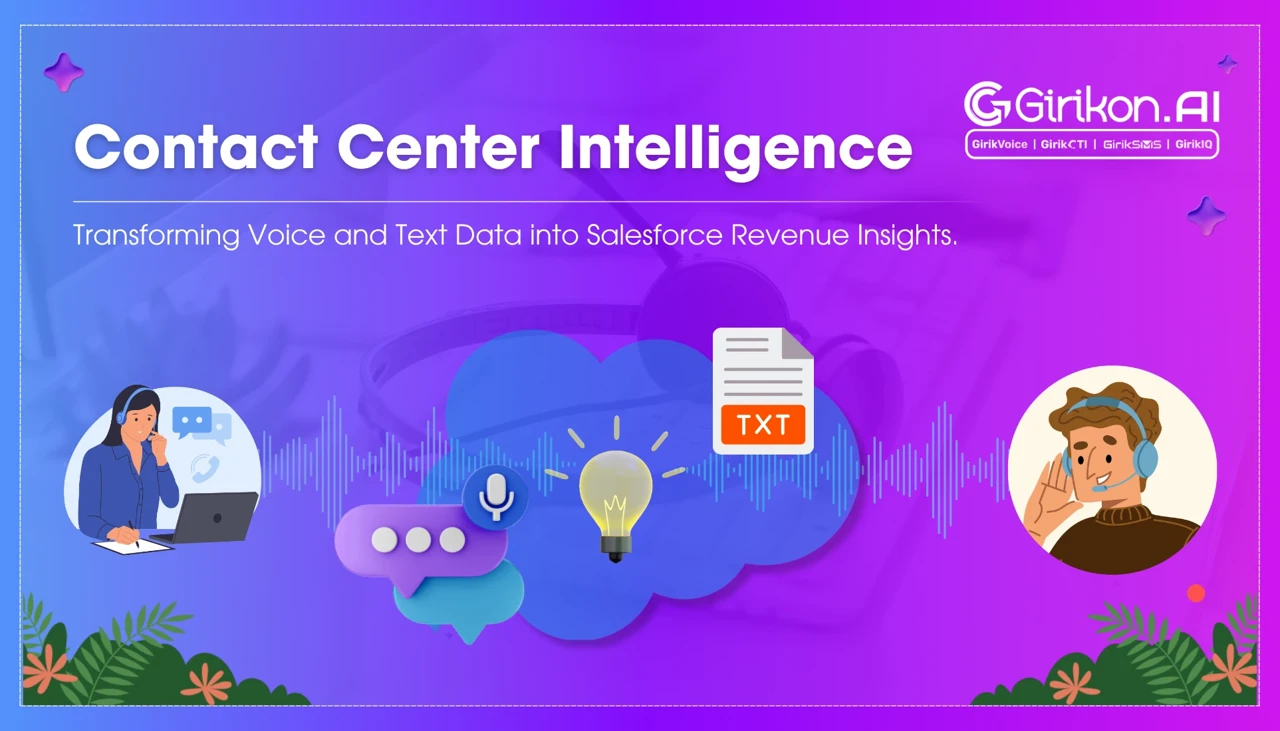
Discover how contact center conversations become actionable revenue insights inside Salesforce. Learn how AI, analytics, and CRM data connect customer interactions to sales outcomes, improve agent performance, and drive measurable business growth.
Contact Center Intelligence: How Conversation Data Becomes Revenue Data Inside Salesforce
A customer call often reveals more than the CRM records ever could. Frustration in the voice, hesitation before a purchase, or questions that they must keep repeating across different accounts until their query is resolved. Though close to negligible, these moments carry business value, but in most contact centers, they disappear once the call ends. The conversation is logged, and the case is closed, but the insights from the conversation are permanently lost.
For years, most of that intelligence stayed trapped inside conversations, heard once and never used again. As contact centers become more connected to CRM systems, businesses are finding ways to turn live conversations into usable intelligence. With conversation intelligence in Salesforce, businesses are already utilizing every call to capture signals that can be connected to customer records. They expose buying intent, service risks, and revenue signals that were previously hidden inside everyday customer conversations.
What is Contact Center Intelligence and What Powers It?
Contact center intelligence is the layer that turns customer conversations into usable business insight. It goes beyond recording calls or measuring call duration. The purpose is to understand what was said, the intent behind it, and how it can be made meaningful for the business.
Modern call analytics platforms do this by recording live conversation and then breaking down the entire interaction into data in the form of documented notes. A pricing question may reveal buying intent. Repeated concerns around delivery can expose operational friction. A shift in tone may signal churn risk before it appears in the CRM. A few connected components power that process:
- Speech-to-text transcription to turn calls into documented records
- Sentiment analysis to support voice of customer analytics and measure customer emotion
- Intent detection to surface conversation insights around needs, objections, and expectations
- Call transcript analytics to identify recurring keywords, objections, and behavioral patterns
- CRM integration to connect those signals to pipeline stages, cases, and account history
In Salesforce systems, these layers become highly actionable since each of these signals is linked to individual customers' records. That is where the conversation changes from an individual experience to revenue intelligence by identifying opportunities, risks, and various trends within the call that might not be noticeable otherwise.
How Conversation Data Inside Salesforce Becomes Revenue Data for Contact Centers
Contact centers turn conversation data into revenue data by connecting customer intent, buying signals, objections, and product feedback directly to Salesforce pipeline activity. What begins as unstructured voice data becomes far more valuable once it is organized into measurable signals tied to customer records. This is where conversations stop being service history and start becoming revenue intelligence.
-
1Capturing Revenue Intent from Customer Conversations
Revenue intent often appears long before it reaches the pipeline. It shows up in pricing questions, urgency around implementation timelines, competitor comparisons, and repeated product concerns. These are not just conversation details. They are early indicators of deal readiness.
With conversation intelligence in Salesforce, those signals can be captured and structured instead of staying buried inside recordings. That gives teams a clearer view of where customer interest is building and which conversations are moving closer to revenue.
-
2Responding to Revenue Signals While They Are Active
Revenue triggers have more significance when action is taken while the customer is still engaged. The act of purchasing, any hesitation, or even a complaint about a service can determine the outcome of a business deal.
This is where the operational edge of AI conversation insights is most advantageous. Einstein AI can provide the next best actions, direct high intent leads to the right team, push offers or discounts for customers or even start retention workflows when customer dissatisfaction arises. This way, businesses can take action on an opportunity while it's still open, rather than react afterwards.
-
3Using Conversation Analytics to Spot Revenue Patterns
One conversation can reveal intent. Hundreds of conversations reveal patterns. This is where analytics start exposing the larger picture. Disagreement on pricing, product queries, churn-prone language, and buyer behavior varying across accounts can also provide insight into factors affecting revenue, which usually go unnoticed in conventional CRM analytics because they reside in the conversation itself.
That is where conversation intelligence in Salesforce becomes more valuable. It helps teams identify what is consistently helping or slowing revenue across the pipeline.
-
4Making Revenue Intelligence Part of Daily Salesforce Operations
The significance of revenue intelligence increases as we shift our focus away from reporting and towards embedding the conversation signals into business workflows inside the Salesforce CRM.
This turns contact centers into an active part of revenue operations instead of a separate service layer. At that point, conversations stop being records of what has already happened. They become live business signals that influence what happens next.
The Role of Conversation Data in Revenue Growth
Revenue growth is often shaped by signals that do not appear in reports until much later. A customer asking deeper product questions, comparing options, or raising repeated concerns can reveal where revenue is building or where it may be slipping.
Conversation data brings those signals forward. It helps the sales team recognize customer intent early on, the support team anticipate churn signals before renewal cycles, and management to understand the factors impacting deal progression. The value is not in the conversation itself. The real value lies in how early that conversation reveals what the business needs to act on.
Conclusion
Customer conversations are one of the richest sources of business intelligence for modern organizations in the present day. There is no doubt that each conversation brings signals about customer expectations, demands, and purchase intent. The difference is that now it is possible to capture those signals and connect them directly to revenue decisions within Salesforce. With the increasing prevalence of data in contact centers, success will not be achieved simply through collecting more customer data but by understanding the conversations.