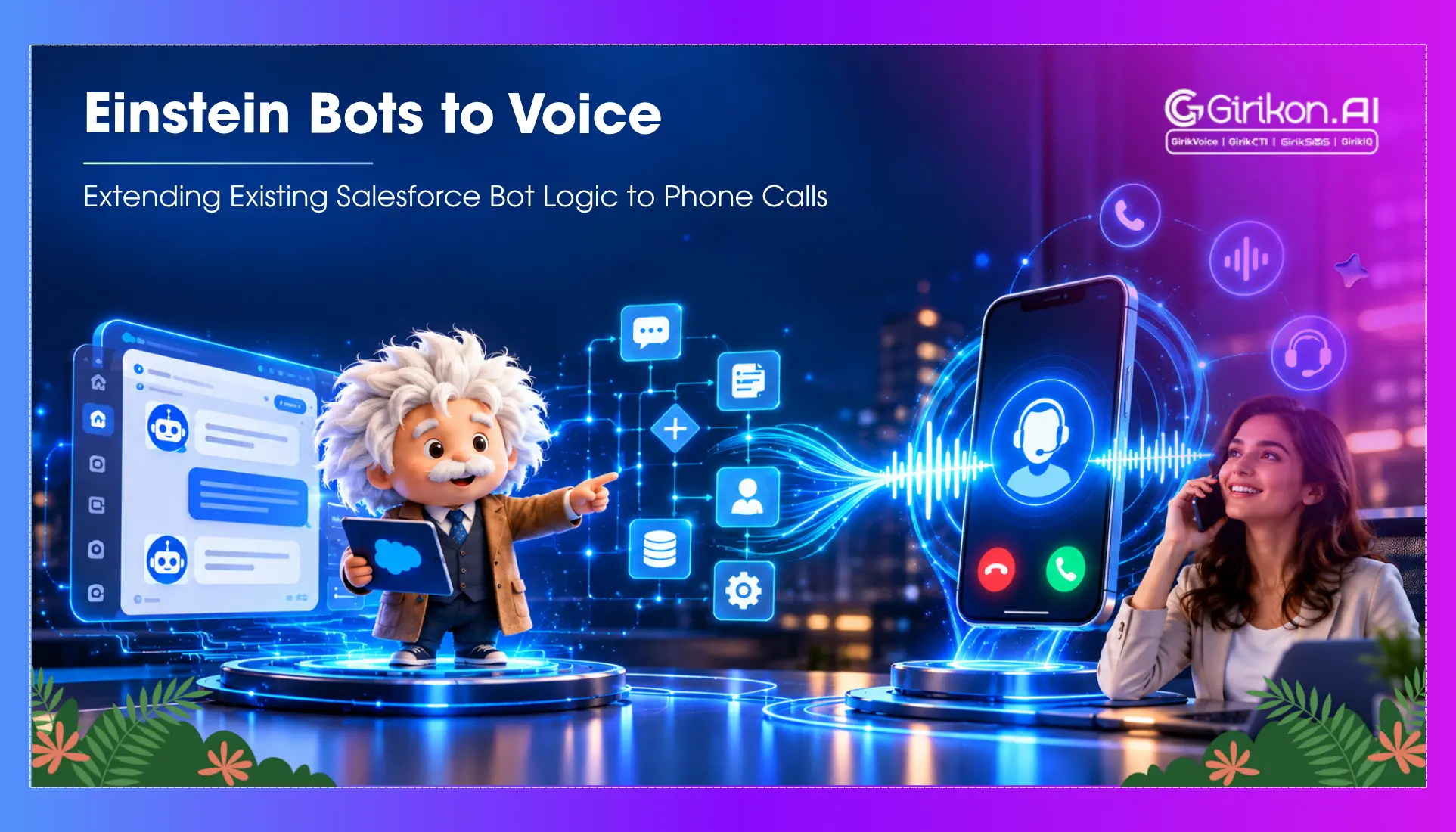
This blog explains how Einstein Bots Voice helps businesses use their existing Salesforce bots to handle phone calls. It covers how it works, its main features, and how it helps customers get quick answers and connect with human agents when needed.
For years, customer conversations followed a straightforward pattern: customers typed a query, and bots handled the response. What once seemed impossible — having an AI agent understand what a customer needs and respond instantly is now a reality.
The way customers interact with these AI experiences has evolved. Business conversations are no longer limited to text; similar experiences have now extended to phone calls —allowing customers to interact faster and more naturally with AI voice agents.
But moving from chat to voice does not necessarily mean starting over. Businesses already using Einstein Bots in Salesforce can extend that existing experience to phone conversations with Einstein bots voice.
By carrying existing Salesforce data, actions, and conversational logic, businesses can reuse bot logic for voice instead of rebuilding the same customer workflows from scratch.
What Is Einstein Bots Voice and How Does It Work?
Einstein Bots voice refers to extending Salesforce bot-based conversations from chat to phone. Instead of typing a request, businesses can extend an Einstein Bot phone by bringing relevant bot logic, Salesforce data, and actions into a voice experience, allowing customers to interact through speech instead of text.
It works by:
- Understanding the request: The AI identifies what the customer needs from the conversation.
- Using Salesforce context: Relevant customer information and existing business logic can inform the response.
- Taking action: Connected Salesforce actions can help complete tasks such as checking information or updating records.
- Continuing the conversation: The consumer receives a spoken response, enabling the conversation to continue normally.
- Escalation when required: Complicated requests are referred to human operators with contextual information.
Reuse Bot Logic: From Chat to Voice
The value of moving Einstein Bot experiences to voice is not simply adding another channel. It is being able to reuse bot logic for voice instead of rebuilding the same customer workflows around phone conversations.
The parts that can carry into a voice experience include:
- Conversation logic: Existing intents and conversation paths can guide how the AI handles common requests.
- Salesforce context: Customer records and relevant data can inform the conversation instead of starting with a blank slate.
- Business actions: Existing actions, such as checking information or updating a record, can become part of the voice interaction.
- Escalation paths: When a request needs human involvement, the conversation can move to an agent with the relevant context.
The key difference is the interaction itself. The logic can remain familiar while the customer moves from typing to speaking.
Einstein Bot Voice Channel: The Architecture Behind It
Reusing existing bot logic is only part of the transition. A phone experience also needs a voice layer that connects the customer’s call with the AI and Salesforce workflows behind the conversation.
Voice and Telephony Layer
The incoming call needs to reach the AI voice experience, which acts as the bridge between the phone conversation and the Salesforce environment.
Speech Processing
Unlike chat, voice requires the system to understand spoken requests and turn AI-generated responses back into natural speech. This allows existing conversational logic to work through a spoken interaction.
Salesforce Integration
The voice experience needs access to the Salesforce data and actions that support the existing bot workflow. This allows the conversation to move beyond answering questions and complete relevant tasks.
Call Routing and Handoff
Not every conversation should remain with AI. Routing logic can determine when a request should continue with the voice agent and when it should move to a human agent with the relevant context.
Top 5 Use Cases of Einstein Bot Voice
Extending an Einstein Bot to phone makes sense when customers already rely on chat for routine interactions but still prefer calling for certain requests. The strongest use case scenarios are conversations— following a defined process and can be supported by existing Salesforce workflows.
Appointment Scheduling and Booking
The customer can schedule, change, and even cancel appointments — without going through a maze of telephone menus to talk to an agent. Voice can reuse existing bot logic for voice interaction, gather all necessary information, and initiate the proper Salesforce function.
Customer and Order Status
Calls about order status, service appointments, deliveries, or account information often follow predictable workflows. An Einstein Bot voice experience can handle these requests using the customer information and processes already available in Salesforce.
FAQs and Routine Requests
Many customer calls involve questions that follow familiar patterns. Moving these conversations to an Einstein Bot voice channel gives customers a faster way to get answers — while reducing the need for agents to handle repetitive requests.
Service and Support Calls
For common service requests, the voice agent can gather initial details, identify the nature of the issue, and move the request into the appropriate Salesforce workflow. This is particularly useful when the first part of a support call follows a consistent process.
Human Agent Escalation
Not every conversation should stay with AI. When a request requires human involvement, the voice experience can hand off the call with relevant context, so the customer does not have to repeat the conversation from the beginning.
Conclusion
Moving from Einstein Bots to voice does not mean rebuilding customer conversations from the ground up. Businesses can extend an Einstein Bot to phone by bringing existing conversational logic, Salesforce data, and business actions into a voice experience.
The goal is not simply to make a bot speak. It is to make existing Salesforce-powered customer workflows accessible through natural phone conversations, while giving customers another way to get help, complete routine requests, and reach a human agent when needed.