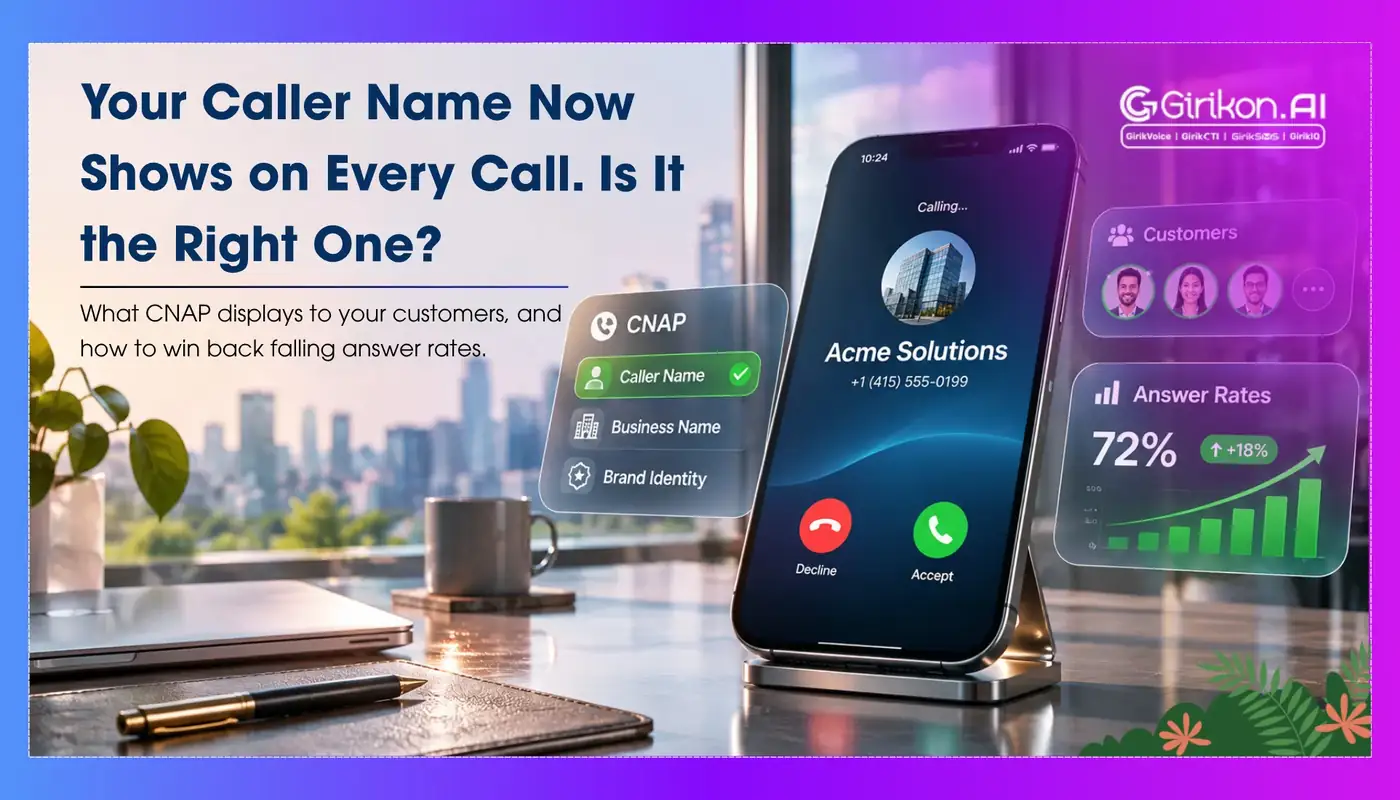
CNAP now shows your registered name on every outbound call in India. See why answer rates may drop and the five checks to fix how your business appears.
From November 1, 2026, telecom companies have been asked to support Calling Name Presentation on 4G and newer networks. If the caller is not registered, the recipient's screen now displays his/her registered name next to the called number. The impact becomes most noticeable for businesses who rely on outbound calls. These calls can be about sales and support, for collecting payments, reminders, and notifications on different services. So, if a name is the first thing customers read, and if it could make an impact on whether they respond or not, it becomes important for businesses to comply with CNAP. Should your answer rates have slipped lately, start by looking at how your calling numbers appear under the new system. Because if it's a name, customer doesn’t associate with your business, it’s causing confusion and costing you answered calls.
How the CNAP Caller Name Display for Business Calls Works
CNAP stands for Calling Name Presentation. It shows the caller’s name on the recipient’s screen along with the number. Unlike third-party caller ID apps, CNAP pulls subscriber records kept by telecom operators.
As per the department of Telecommunications (DoT) directive dated 13 October 2026, CNAP is by default part of 4G and the later generation wireless networks, from 1 November 2026.
Caller information differs based on the type of call. If the number is saved, the recipient’s own contact name comes first. For an unsaved domestic number, the screen shows the name held in the originating operator’s subscriber database. Calls placed from outside India appear as “International Call.”
Telecom databases link subscriber names to assigned numbers, and the receiving operator fetches the calling name when a call comes in. For a business, this matters because a customer who hasn’t saved your number may see the name tied to your telecom connection, not the brand name on your website or the identity customers knows you by.
Why CNAP Can Change Answer Rates for Businesses
Prior to CNAP, a customer who received an unknown business call lacked much information besides the number from which the phone call came. They could either answer it, let it ring, or, or use a third-party caller identification app. CNAP adds an identity signal to that choice. Picture a customer waiting for a service update from your company. The screen shows a person’s name, an outdated business name, or a registered name the customer doesn’t know. Hesitation is likely.
Outbound teams may face these problems:
- Customers can't identify the name that is linked with your business
- An alternative or misspelled name might reduce brand awareness
- An inconsistent naming in the calls, emails and messages can cause confusion
- Multiple outbound numbers can make caller identity harder to manage
CNAP doesn’t mark a call as spam, and it doesn’t promise better answer rates. It supplies caller identity. That identity now forms part of how customers judge an incoming call.
5 Steps to Take When Answer Rates Fall
A change in caller identification is a reason to review your outbound setup. Before raising call, volumes or redialing unanswered numbers, check out what customers actually see.
1. Audit Your Registered Calling Numbers
Users can see the name associated with a number when receiving a call. Outbound customers may experience variable caller ID names if the numbers are registered under different names. This makes it difficult for them to recognize your business and trust any calls from you.
2. Check Preferred-Name Eligibility
A lot of companies run under a customer-facing brand that differs from what's linked to their phone numbers legally. So, confirm the caller identity you prefer matches the names and identification that customers are familiar with.
3. Verify Numbers Across Operators
Companies often have several telecom providers. As callers begin to receive your calls from different providers over time, names may change between operators, which can result in an inconsistent customer experience. This can have a poor impact on brand trust when customers call in.
4. Track Answer Rates After the Rollout
Compare answered calls, unanswered calls, callbacks and completed customer connection for call made/received, segmented by number, operator, team and (where available) campaign level. This is meant to ensure a caller identification issue is identified from other factors like the calling schedules, audience quality, or changes in campaigns.
5. Review Your Outbound Infrastructure
How called information is shown can be impacted by calling platforms, cloud telephony systems, and CRM based dialers. Reviewing the set up can help identify technical issues that could cause CNAP information to not appear as expected.
What Businesses Should Know About CNAP on Airtel, Jio and Vi
No single operator owns a CNAP. It’s a nationwide telecom initiative, and CNAP Airtel rollout is one part of an implementation that also takes in Reliance Jio and Vodafone Idea (Vi). The DoT directive binds providers of 4G and higher-generation wireless networks in all service areas.
What matters for a business is the name attached to each outbound connection.
Under the DoT framework, eligible business and bulk-connection subscribers can ask for a preferred name in place of the one in their standard subscriber record. Verification applies. A preferred name qualifies only if it’s a trademark registered in the business name or a trade name registered on the GST portal. The operator verifies the supporting documents before it updates the record. Existing business connections can apply through the mechanism their operator provides.
A business may therefore be able to bring its displayed name in line with a recognized brand, provided the operator approves.
Conclusion: Caller Identity Now Needs Operational Attention
Subscriber records now drive caller identification; a business needs the names on its connections to describe it accurately. If your organization has a large number of calls, then you must bring in together your telecom providers, the IT staff, and customer-facing departments. A consistent name helps customers recognize genuine business calls and decide whether to answer. CNAP alone can’t promise better answer rates. Fixing registration discrepancies is a smart move to remove unnecessary confusion among customers. Also, check calling numbers, ask your operator which number is in the display, and observe your customers' responses. CNAP is becoming a normal part of calling, so accurate caller identification will remain relevant to business communication.