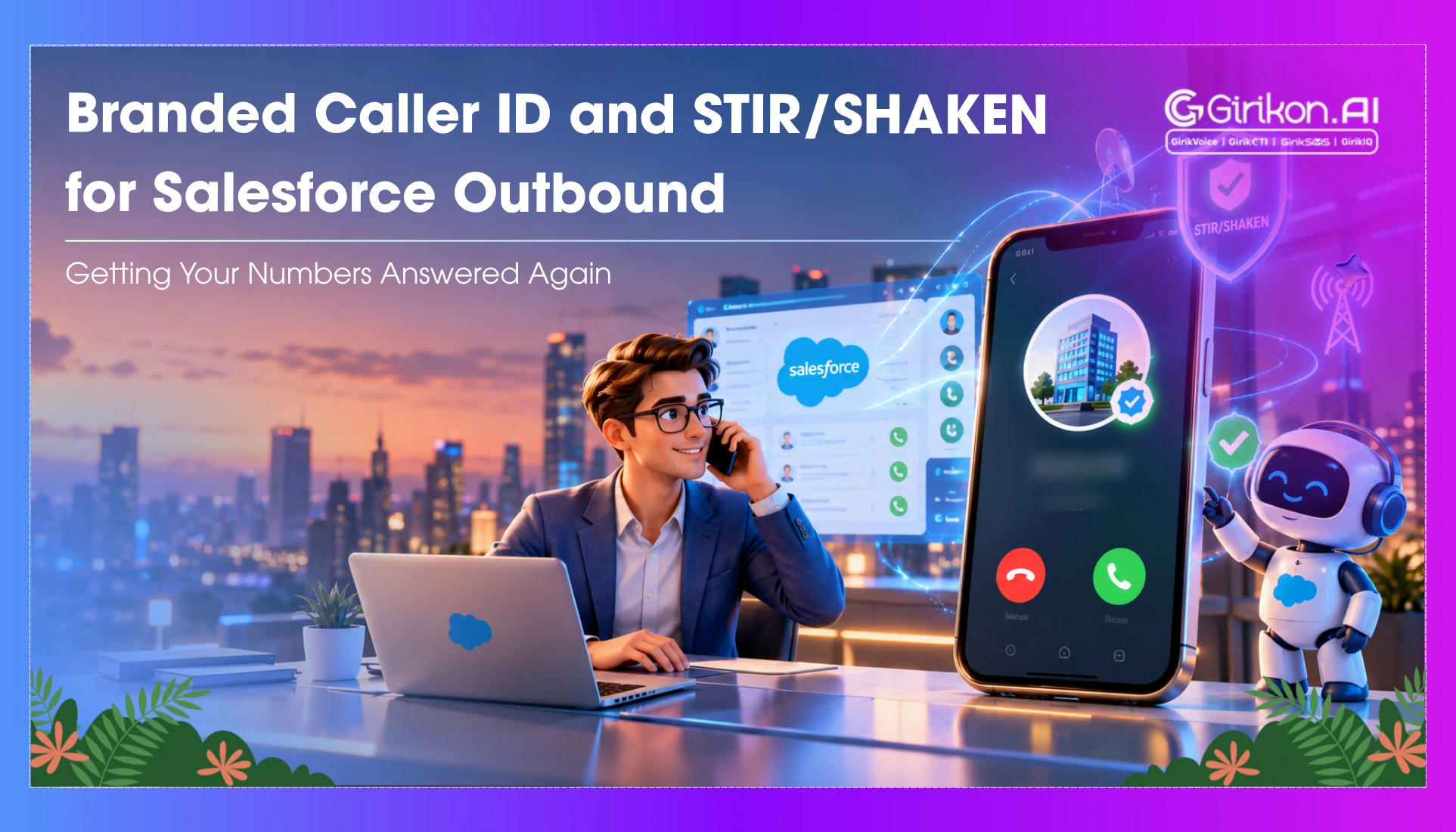
Learn how to stop Salesforce calls from being labeled as spam with Branded Caller ID and STIR/SHAKEN. This guide explains how caller authentication, business identity, and reputation work together to improve call trust, reduce spam labeling, and increase answer rates for Salesforce-powered outbound calls.
Mobile carriers and caller ID analytics providers often label calls as Spam Likely or Potential Spam when outbound calls are placed through Salesforce. Such tags reduce answer rates, interrupt sales conversations, and lead to weakening customer confidence in business communication that is legit. The issue is not limited to the Salesforce configuration. Carriers assess call frequency, unanswered attempts, complaint history, number reuse, and authentication data before assigning reputation. Numbers previously tied to other businesses may also inherit negative status.
For outbound teams, this creates a gap between Salesforce’s automation and actual customer reach when using Salesforce outbound calling. Dialing, logging, and follow‑ups cannot establish trust across networks. Restoring caller ID reputation requires remediation, STIR/SHAKEN authentication, and branded caller ID. Let's explore why Salesforce calls are flagged and how enterprises can fix spam risk numbers, secure Level A attestation, and strengthen outbound caller ID.
What is a Branded Caller ID?
Branded caller ID is an inbound display service that ties outbound calls to a verified business identity, allowing recipients to clearly recognize the organization contacting them. It also shows a business name, logo, or call reason (depending on the provider and the supported network) in addition to the phone number.
For Salesforce outbound operations, branded caller ID connects business identity with the telephone numbers used by sales, service, and automated calling workflows. Its implementation typically involves the telecommunications provider, caller name registration, authentication, and, where supported, branded calling services, along with Salesforce telephony integration to streamline and manage business communications.
To achieve trusted outbound calling, there are 3 key elements of consideration:
- Caller authentication: STIR/SHAKEN supports the authentication of the calling number.
- Caller Identification (CNAM): The registration of a telephone number to a registered business name.
- Reputation management: Carrier and third-party analytics systems assess number history and calling behavior.
CNAM vs Branded Caller ID: What’s the Difference?
CNAM depends on static carrier records and varies across networks, while branded caller ID uses STIR/SHAKEN to confirm business identity and ensure consistent display. CNAM offers limited trust, but branded caller ID adds logos and trust marks that strengthen credibility. Generic CNAM lowers pickup rates; branded entries improve them through recognizable branding.
What are STIR/SHAKEN Attestation Levels?
The FCC Framework
STIR/SHAKEN is the cryptographic standard mandated across U.S. telecommunications networks to combat caller ID spoofing, making it an important consideration for Salesforce CTI security and compliance. It offers 3 attestation levels that each outbound call receives, showing the degree of trust in the caller’s identity:
- Level A (Full Attestation): Caller identity and number are verified, giving enterprises the strongest safeguard for Salesforce caller ID reputation.
- Level B (Partial Attestation): The customer is recognized, but the number is not validated, which lowers trust scores
- Level C (Gateway Attestation): Only the network entry is confirmed, with no identity checks, making these calls likely to be flagged.
Why STIR/SHAKEN Matters for Salesforce
Achieving Level A attestation STIR/SHAKEN Salesforce ensures outbound numbers are recognized as legitimate, reducing the chance of spam likely labels and supporting branded caller ID display. Lower attestation levels increase the risk of misclassification and undermine caller ID reputation.
| Attestation Level | Cryptographic Status | Carrier Trust Impact | Outcome on Prospect Phone |
|---|---|---|---|
| Level A (Full) | Provider confirms caller identity and checks if the phone number is authorized for use. | High Trust | Normal call display / Verified Branded Identity. |
| Level B (Partial) | Provider verifies caller identity but cannot verify authorization for the exact number. | Medium / Conditional Trust | Increased risk of "Spam Likely" tag during high-volume dialing. |
| Level C (Gateway) | Originating point is unverified (international hop or legacy gateway). | Low Trust | High probability of "Spam / Scam Risk" label or call blocking. |
How to Get STIR/SHAKEN 'Level A' Attestation and Restore Salesforce Outbound Caller ID Reputation
To understand how to get level A attestation STIR SHAKEN Salesforce, organizations should:
- Determine the call's carrier: Identify the telephony provider from which Salesforce receives calls to the public telephone network, specifically in relation to Salesforce telephony.
- Verify number ownership: You will want to make sure that the business is properly authorized to use each outbound caller ID number.
- Submit business verification: Provide the carrier with the required legal business details, number of inventories, and supporting documentation.
- Request authentication: Ask the originating provider to assess eligibility for Level A attestation and configure call signing.
- Verify call authentication: Work with the provider to confirm the attestation level applied to outbound calls.
Salesforce's Trusted Calling guidance supports number registration and STIR/SHAKEN-related processes for eligible Sales Dialer configurations. For other telephony deployments, authentication depends on the integrated carrier or voice provider.
Attestation requirements and availability vary by provider and market. Level A improves identity assurance but does not guarantee that receiving networks will classify calls as trusted.
5 Steps to Restore Caller ID Reputation in Salesforce
Step 1: Audit Outbound Patterns
Salesforce outbound caller ID reputation suffers when campaigns rely on excessive retries, unanswered attempts, or poor consent management. Reviewing these behaviors explains why Salesforce calls show spam likely and allows teams to recalibrate pacing, improving trust and reducing the risk of spam flags.
Step 2: Register and Authenticate Numbers
Legitimacy begins with verified ownership. Register Salesforce dialer numbers with the Free Caller Registry and carrier databases, then apply STIR SHAKEN authentication. Enterprises seeking Level A attestation STIR SHAKEN Salesforce must demonstrate identity consistency, ensuring outbound calls are recognized as trusted across receiving networks.
Step 3: Align Caller Identity Records
Static CNAM entries often fail to inspire confidence. By contrast, branded caller ID vs CNAM display highlights verified logos and business names. Align CNAM, branded caller ID, and provider records to ensure Salesforce outbound caller ID remains consistent, authenticated, and less vulnerable to misclassification.
Step 4: Remediate Spam Labels
When numbers are flagged, remediation requires direct engagement with analytics providers such as Hiya, First Orion, or TNS. Coordinated requests, backed by branded caller ID and STIR SHAKEN attestation, provide the path to remove spam flag from Salesforce dialer numbers and restore outbound credibility.
Step 5: Monitor and Govern Reputation
Caller ID reputation is not static. Maintain a centralized inventory of registered numbers, attestation status, CNAM details, remediation history, and Salesforce Call monitoring. Integrated with Salesforce native CTI with branded caller ID, this oversight ensures outbound performance remains visible, compliant, and trusted over time. ID reputation is not static. Maintain a centralized inventory of registered numbers, attestation status, CNAM details, and remediation history. Integrated with Salesforce native CTI with branded caller ID, this oversight ensures outbound performance remains visible, compliant, and trusted over time.
Conclusion
There are no doubt declining answer rates and spam labels to limit Salesforce outbound effectiveness. This is why your business needs branded caller ID, STIR/SHAKEN authentication, accurate name registration, and proactive reputation management to maintain consistent caller identity and compliant practices. When combined with a reliable Salesforce CTI solution, these best practices can further strengthen outbound communication and improve caller recognition. Hopefully, this blog has given you insight into the importance of having a structured plan to strengthen trust and improve recognition. In addition, the best practices we share will help you build a reliable outbound communication strategy across supported networks.