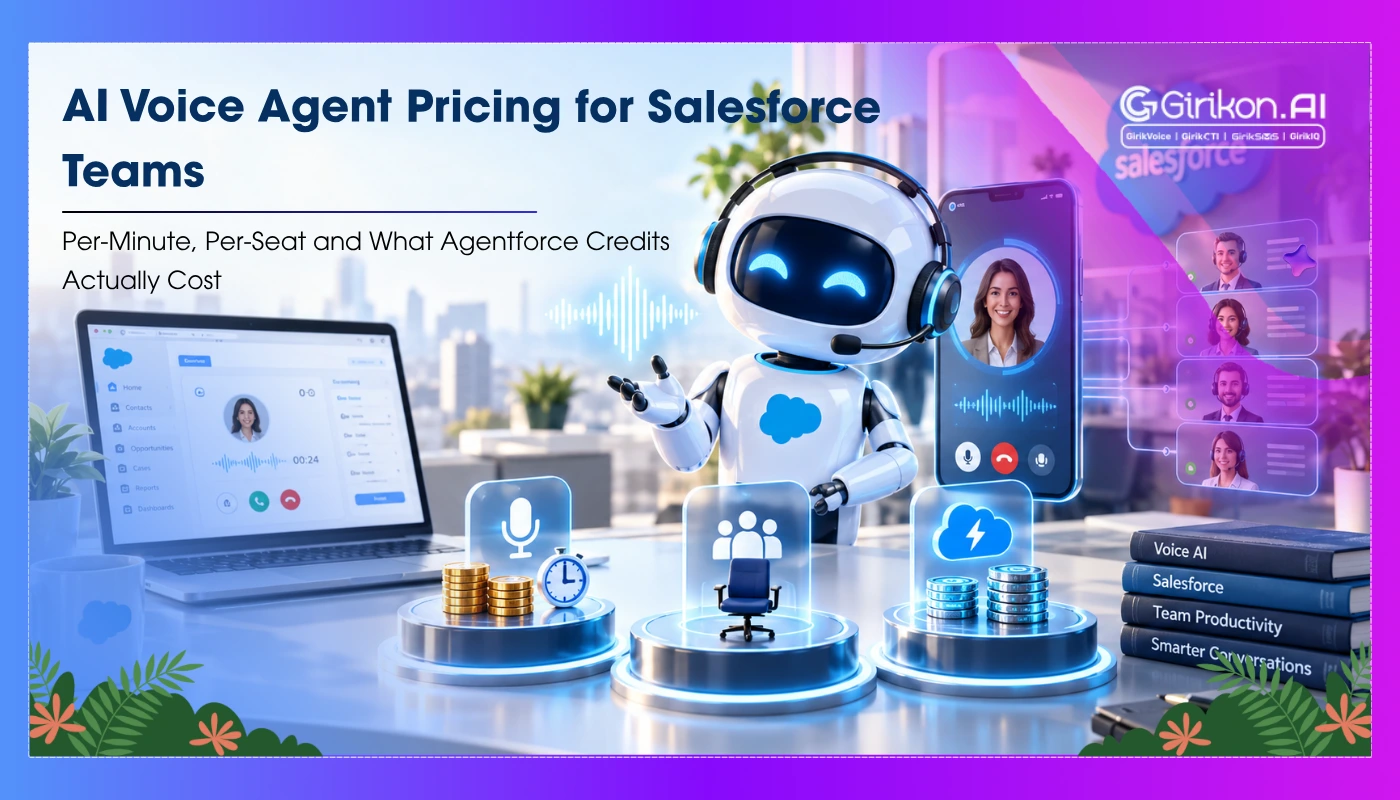
In this blog, we explore the agentforce credit pricing structures, explain what answering service costs actually measure. Additionally, we’ll also show different ways Salesforce teams can evaluate virtual receptionist cost against traditional answering service pricing without confusing minutes, seats, conversations, and AI actions.
For Salesforce teams, voice automation pricing isn’t about just paying for call minutes. Costs can span telephony, user licenses, AI usage, CRM integration, and contact-center capabilities. Choosing an AI voice agent platform without separating these components can make an apparently low-cost solution more expensive at scale. So, how do you decide your budget if you don’t know answering service pricing comparisons? When a conventional answering service may be charged by the minute. A virtual receptionist may use monthly plans or usage tiers. Salesforce Agentforce introduces consumption-based Flex Credits, while Salesforce contact-center products can add per-user licensing.
In this blog, we explore the agentforce credit pricing structures, explain what answering service costs actually measure. Additionally, we’ll also show different ways Salesforce teams can evaluate virtual receptionist cost against traditional answering service pricing without confusing minutes, seats, conversations, and AI actions.
How Much Does Answering Service Cost?
To determine average costs, teams must evaluate three distinct market options based on call volume and functionality:
- Basic Answering Services: Typically range from $1.00 to $1.50 per minute (or $150–$500/month for low-volume packages). Best for simple message-taking.
- Virtual Receptionist Cost: Priced between $250 to $1,500 per month, it can be more, if you need advanced features like appointment scheduling.
- AI Voice Automation: Priced between $250 to $1,500 per month, it can be more, if you need advanced features like appointment scheduling.
Virtual Receptionist Cost vs Answering Service Pricing
The right model depends on the type of calls your team handles, how deeply the system needs to interact with Salesforce, and how much automation you require.
Choose Agentforce/AI Voice if:
- Calls require instant read/write access to Salesforce CRM records.
- You need 24/7 coverage with zero queue wait times.
- You handle high-volume routine tasks like appointment scheduling or case updates.
Choose a Traditional Answering Service if:
- Inquiries require high human empathy or nuanced negotiation.
- Call volumes are low in numbers to justify the setup effort or the added requirement of CRM integration.
Is Agentforce Priced Per Seat, Per Conversation, Or Per Action?
Agentforce supports multiple commercial models. Salesforce currently lists Flex Credits at $500 per 100,000 credits, Conversations at $2 per conversation, and an Agentforce User License at $5 per user per month that requires Flex Credits.
| Pricing Model | What You Pay For | Budgeting Lens | Main Financial Risk |
|---|---|---|---|
| Per-minute | Voice duration | Monthly call minutes | Extended hold times and long transfers increase bill |
| Per-seat | Licensed users | Number of users | Underutilized user seats waste fixed budget |
| Per-conversation | Conversations | Interaction volume | Multi-turn calls can trigger extra conversation fees |
| Flex Credits | Agent actions | Actions per interaction | Harder to predict burn without workflow mapping |
Note: A per-seat license creates predictable access costs, while consumption billing rises with automation volume. Flex Credits can be used across teams and supported use cases.
What Does Agentforce Credit Pricing Actually Mean for Voice Automation?
Salesforce Flex Credits are priced at $500 for 100,000 credits ($0.005 per credit), with consumption determined by the specific task performed:
- Standard Agentforce Action: Consumes 20 Flex Credits ($0.10 per action)
- Agentforce Voice Action: Consumes 30 Flex Credits ($0.15 per production action)
Why This Isn't a Per-Minute Rate
An Agentforce Voice action is a metered AI action performed by the agent. Salesforce's rate card separately lists speech-to-text and text-to-speech usage under Speech Foundations.
For example, a five-minute call doesn’t automatically translate into five billed minutes of Agentforce usage. Teams need to understand how actions and supporting voice services are metered under their specific Salesforce configuration and contract.
How Should Salesforce Teams Compare Agentforce with Answering Services?
Comparing the models becomes easier when each option is calculated against the same workload assumptions.
- Traditional Answering Service Calculation: For an answering service cost, calculate monthly calls × average duration × applicable rate, then add setup, overflow, scheduling, or other fees. This produces a practical answering service cost.
- Virtual Receptionist Calculation: For a virtual receptionist, compare the subscription or usage allowance with calls and tasks handled. Virtual receptionist pricing can appear attractive when volume is predictable, but overage rules and included capabilities affect the effective rate.
-
Agentforce Calculation:
For Agentforce, map the customer journey into action. A voice interaction might require authentication, customer-record retrieval, knowledge retrieval, case creation, or appointment handling. Each metered action can affect Flex Credit consumption.
This makes answering service pricing comparison with AI voice pricing differently. The first emphasizes minutes or service capacity. The second can emphasize automated actions and platform consumption.
Understanding Salesforce Agentforce & Contact Center Pricing
Agentforce usage is only one part of a Salesforce voice budget. Dedicated contact-center products introduce additional per-user licensing:
- Salesforce currently lists Agentforce Contact Centre at $125 per user per month.
- Contact Centre Plus at $250 per user per month.
- Agentforce Contact Centre Voice at $75 per user per month for eligible Agentforce 1 editions.
- Partner contact-center options start at $50 per user per month, with some Amazon Connect packages including defined monthly minute allowances.
Teams should separate four cost layers:
- Salesforce Base/Service Cloud Licensing: Core CRM user seats.
- Contact Center/Telephony Licensing: Agent seats and minute packages.
- Agentforce Consumption: Flex Credits and Conversation allowances.
- Additional Costs: Include other costs related to CRM integrations, call routing, authentication, escalation, analytics, and compliance controls.
5 Tips to Evaluate AI Receptionist Pricing Against Salesforce Costs
-
Workload Mapping
Answering service pricing comparison should start with workload assumptions. Monthly call volume, average duration, and tasks per interaction reveal whether answering service cost or virtual receptionist cost reflects true usage rather than headline rates. -
Consumption vs Access Costs
Agentforce credit pricing adds variable consumption to predictable access fees. Comparing answering service pricing with virtual receptionist pricing shows whether stable licensing or usage‑based billing better suits demand, avoiding surprises when automation scales across customer journeys. -
Integration and System Dependencies
Virtual receptionist cost often excludes CRM or telephony integration. AI receptionist pricing may include automation and connectors, while Agentforce credit pricing bundles consumption with Salesforce integration. Evaluating scope clarifies whether bundled features offset external expenses or add overhead. -
Hidden and Overhead Costs
Advertised answering service pricing can mask setup fees, overflow charges, or escalation costs. Virtual receptionist pricing may involve compliance overhead. Agentforce credit pricing requires monitoring of consumption. Teams should assess hidden layers to ensure total operating cost remains transparent. -
Comparative Operating Models
Answering service cost emphasizes minutes; virtual receptionist pricing emphasizes subscriptions, and Agentforce credit pricing emphasizes consumption‑based actions. Comparing these models under identical workload assumptions highlights alignment with business priorities and ensures evaluation focuses on total monthly operating cost.
Conclusion
For Salesforce teams, AI voice agent pricing should be evaluated as a complete operating cost. Traditional answering services emphasize minutes or labor capacity. Virtual receptionist models emphasize subscriptions and usage allowances. Agentforce combines Salesforce licensing with consumption-based AI actions and voice-specific usage. Understanding answering service pricing comparisons makes a difference not just to your budget decision making but also deployment. Knowing the right virtual receptionist pricing structure prevents credit-burning workflow architectures, right-sizes human user licensing, and ensures your business rollout stays on track from day one.