Top 10 AI Voice Agent Platform Guide 2026
A few missed calls don’t seem like much until they start piling up. Then there are the hours spent answering the same questions again and again, leads that never make it through, and customers who give up somewhere between IVR options. Then comes the realization: perhaps an AI voice agent could handle many of these calls without adding yet another person in the process. This is where the easy part ends.
Once you start looking for an AI voice agent platform , one choice becomes difficult to separate from another. One promises developer-level control, another makes deployment almost effortless, one is built for enterprise contact centers, while another platform puts remarkably natural voices at the center of the experience.
So, can you simply pick any platform from the top of the market and expect similar results? Not really. The platform determines far more than how your AI sounds. It shapes real outcomes: how well the agent understands customers, whether interruptions get handled naturally, how deep it reaches into your other tools, what the bill looks like at scale, and how far it can stretch past the first use case. That makes choosing the platform a decision worth getting right.
What is an AI Voice Agent?
An AI voice agent is an autonomous software capable of natural spoken conversations over the phone or through a web interface, interpreting what the caller wants, and taking it from there. It can proceed with appropriate actions, gather data from related systems, and respond accordingly, all without requiring any human intervention. That sounds like one capability, but in practice, several pieces of technology are working together:
- Speech-to-text (ASR): It turns the caller’s spoken words into text that the agent can interpret and work with.
- Intent Understanding & Reasoning (NLU/LLM): It helps the agent understand the caller and perform the best next steps as the context aligns.
- Conversation Orchestration: Tracks and orchestrates the conversation, keeping track of context across many turns.
- Tools & Integrations: Integrating the AI agent with your existing systems allows smoother flow of information across multiple platforms with minimal disruption.
- Text-to-Speech (TTS): Once the response is ready, it produces the audio response for the caller.
- Guardrails & Monitoring: Define what the agent can access, respond to, and act on to keep track of best practices.
How all these pieces are integrated and how much control the business has is dependent on the agent platform. Some platforms provide most of the stack as a managed service. Others allow teams to choose models, telephony providers, voices, integrations, and orchestration logic independently. Those differences become important once the goal moves from testing a voice experience to running it in production.
How We Evaluated the Top 10 AI Voice Agent Platforms
A voice agent can sound impressive in a demo and still struggle in production. We examined these AI voice agent platforms in terms of the characteristics affecting their implementation, handling, integration, cost, and control.
- Latency: We analyzed the response time, which includes the time it takes for the agent to start responding after the caller stops talking. Lower latency implies smoother turn-taking.
- Telephony integration: We considered how deeply each platform handles telephony, from native carrier connectivity to BYOT, SIP, and trunking options.
- Model and voice flexibility: We assessed whether teams can choose or change their LLM, ASR, TTS, and voice providers, or remain tied to the platform’s stack.
- Compliance: We examined available compliance certifications and controls, including SOC 2, HIPAA, and PCI, along with where those controls apply.
- Deployment: We compared no-code builders, API-first platforms, and fully managed deployment models based on the technical involvement they require.
- Pricing and total cost: We looked at platform fees, usage-based costs, telephony, model usage, and other expenses that can affect the actual cost of running agents at scale.
- CRM and backend integrations: We considered whether the agent can retrieve information and take actions in business systems rather than simply conduct a conversation.
- Governance and observability: We assessed the controls available for monitoring conversations, reviewing agent actions, enforcing guardrails, troubleshooting failures, and maintaining operational visibility.
Top 10 AI Voice Agent Platforms for 2026
GirikVoice
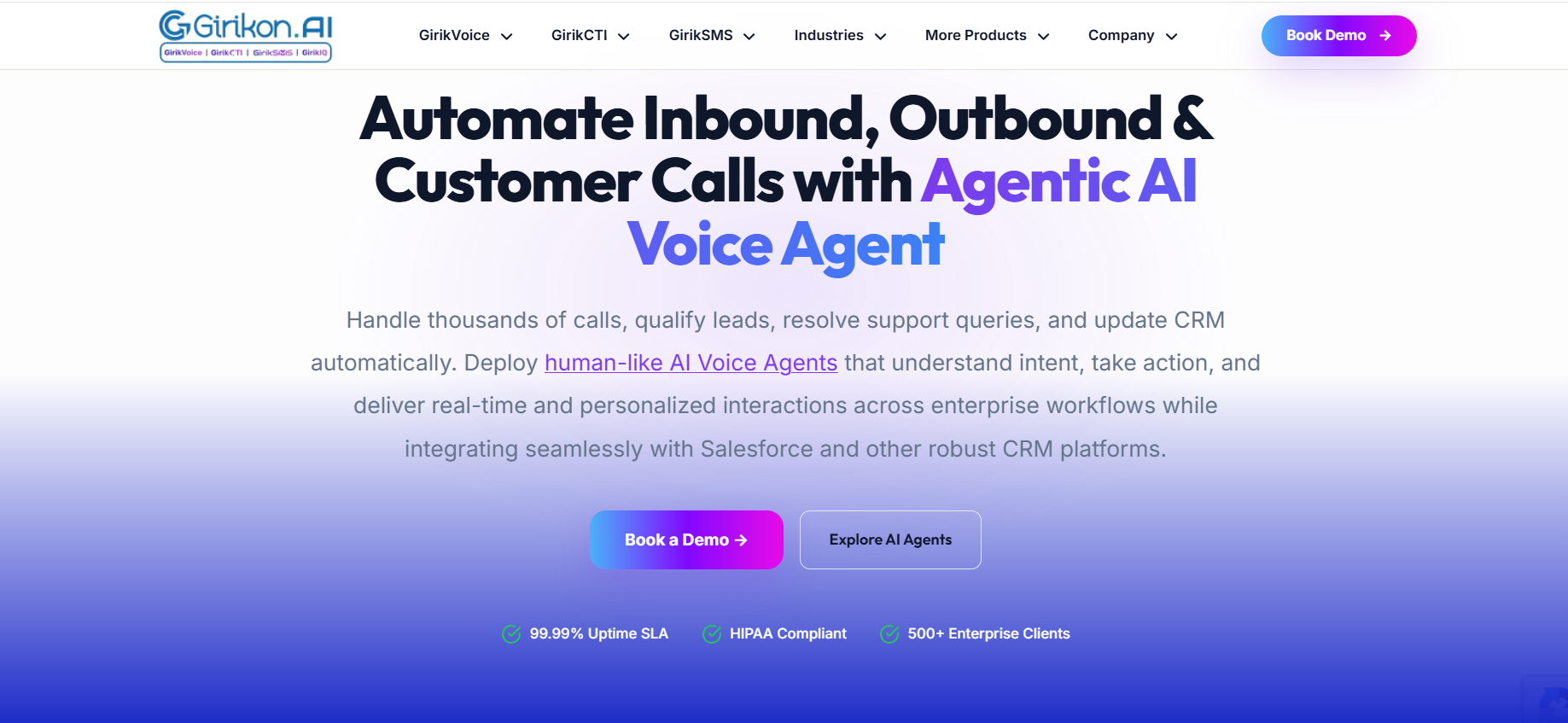
GirikVoice is Girikon’s enterprise voice AI platform for automating inbound, outbound, and customer calls. The platform is built around a simple operational idea: the conversation should not have to sit apart from the systems that contain the customer's information or the workflows that need to happen next. In a Salesforce deployment, for example, the agent can work with CRM records during the call, qualify a lead, update information, trigger a Flow, log the interaction, and prepare context for a human agent if the call needs to be transferred. That gives the voice layer a direct role in the business process rather than limiting it to answering questions. Beyond Salesforce and HubSpot, GirikVoice supports no-code call flows, multilingual voice interactions, transcription and summaries, SIP trunking, BYOC/BYOP, and enterprise telephony configurations. It also supports 100+ languages, DNC controls, and SMS and WhatsApp follow-up on applicable plans.
Key Features:
- No-code visual call-flow designer for building and changing voice workflows
- Salesforce-native calling through the standard softphone environment
- Live access to Salesforce records and standard or custom objects during calls
- Salesforce Flow and workflow triggers based on call outcomes
- Automatic transcription, summaries, intent capture, and activity logging
- Inbound and outbound calling for sales, service, qualification, and follow-up workflows
- Real-time language detection with support for 100+ languages
- SIP trunking, BYOC/BYOP, and enterprise telephony options
- Native TCPA and Do Not Call scrubbing before outbound calls
- HIPAA, GDPR, and other enterprise compliance controls
Retell AI
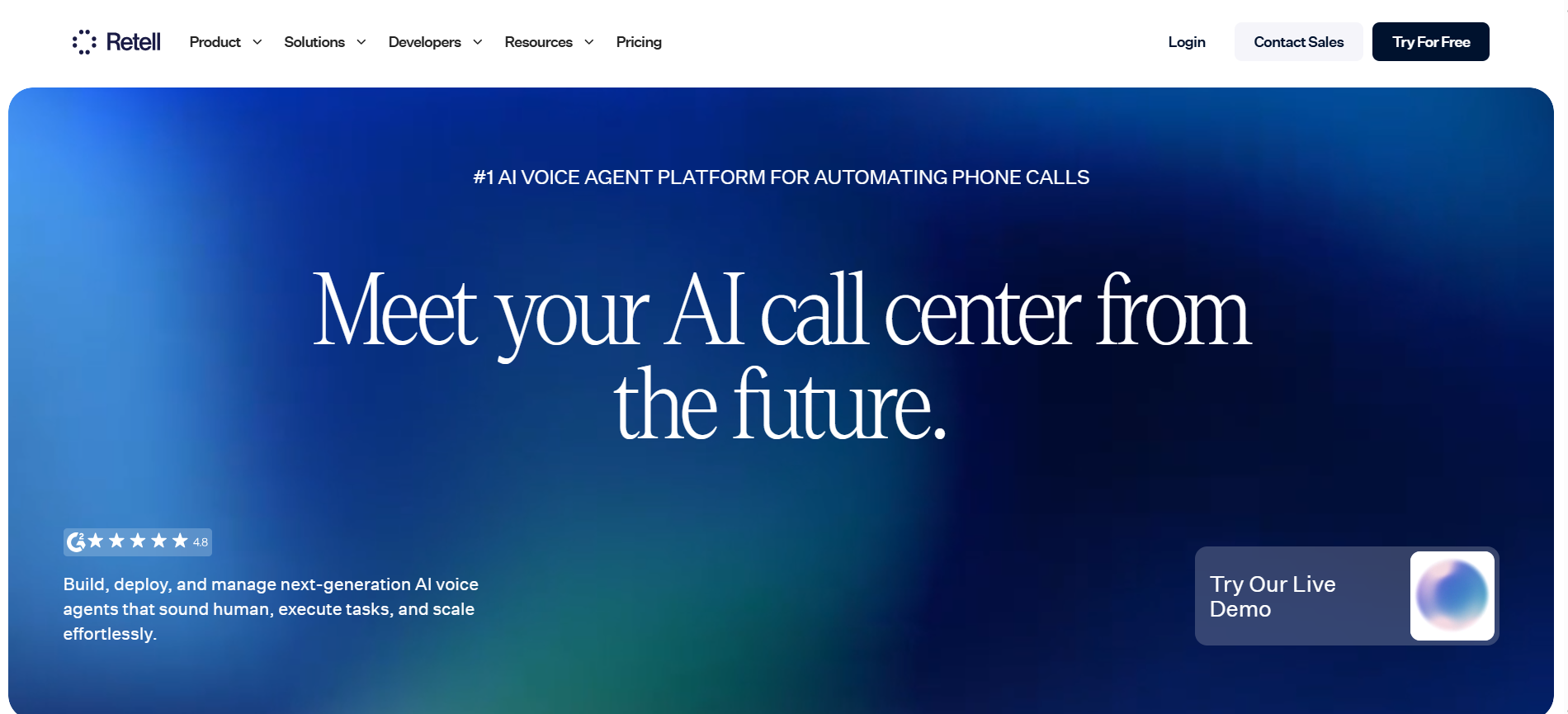
Retell AI is a developer-first AI voice agent platform that offers complete control over a voice agent to developers. The platform handles real-time orchestration, speech recognition, response timing, and speech generation, while giving teams a choice of models, including GPT, Gemini, and Claude. Developers can also configure different voice and telephony providers. Pricing is usage-based, with the different components contributing to the final per-minute cost.
Key Features:
- Modular per-minute pricing across voice, language model, and telephony components
- Multiple LLM provider options, including a Fast Tier for lower-latency responses
- HIPAA compliance with GDPR, SOC 2 Type II, ISO 27001
- 20 free concurrent call slots on new accounts, with additional lines billed monthly
- Native integrations for CRM and workflow tools via webhook and API
- Detailed call analytics and transcript logging
Vapi
Vapi is built for technical teams who wish to construct their own voice agent using various independent components rather than being tied to a predefined voice stack. Teams can pick different providers for those components or bring their own models. Provider charges are passed through separately, alongside Vapi's own usage fee. The result is an infrastructure layer that gives developers control over how the voice agent is assembled.
Key Features:
- API-first orchestration across speech, language model, voice, and telephony providers
- Bring-your-own provider keys for direct billing and cost control
- WebRTC streaming for low-latency audio
- Enterprise tier with SSO and role-based access control
- Startup grant program offering free minutes for qualifying teams
- Concurrency-based scaling with per-line pricing beyond the included tier
Voiceflow
Voiceflow brings voice and digital conversations into the same development environment. Teams can design flows visually, connect APIs and knowledge sources, test agents, and move them into production from one workspace. Designers can work on the conversation flow while developers handle integrations and application logic in the same environment. It supports GPT, Claude, and Gemini models, with usage billed through a shared credit system across channels.
Key Features:
- Shared visual canvas for both design and engineering teams
- Multi-channel deployment across voice, web chat, SMS, and WhatsApp from one build
- Credit-based billing that meters chat messages, voice minutes, and model tokens together
- Teams get version history, comments, and real-time collaboration
- Agency tooling for managing multiple client workspaces under one account
Synthflow
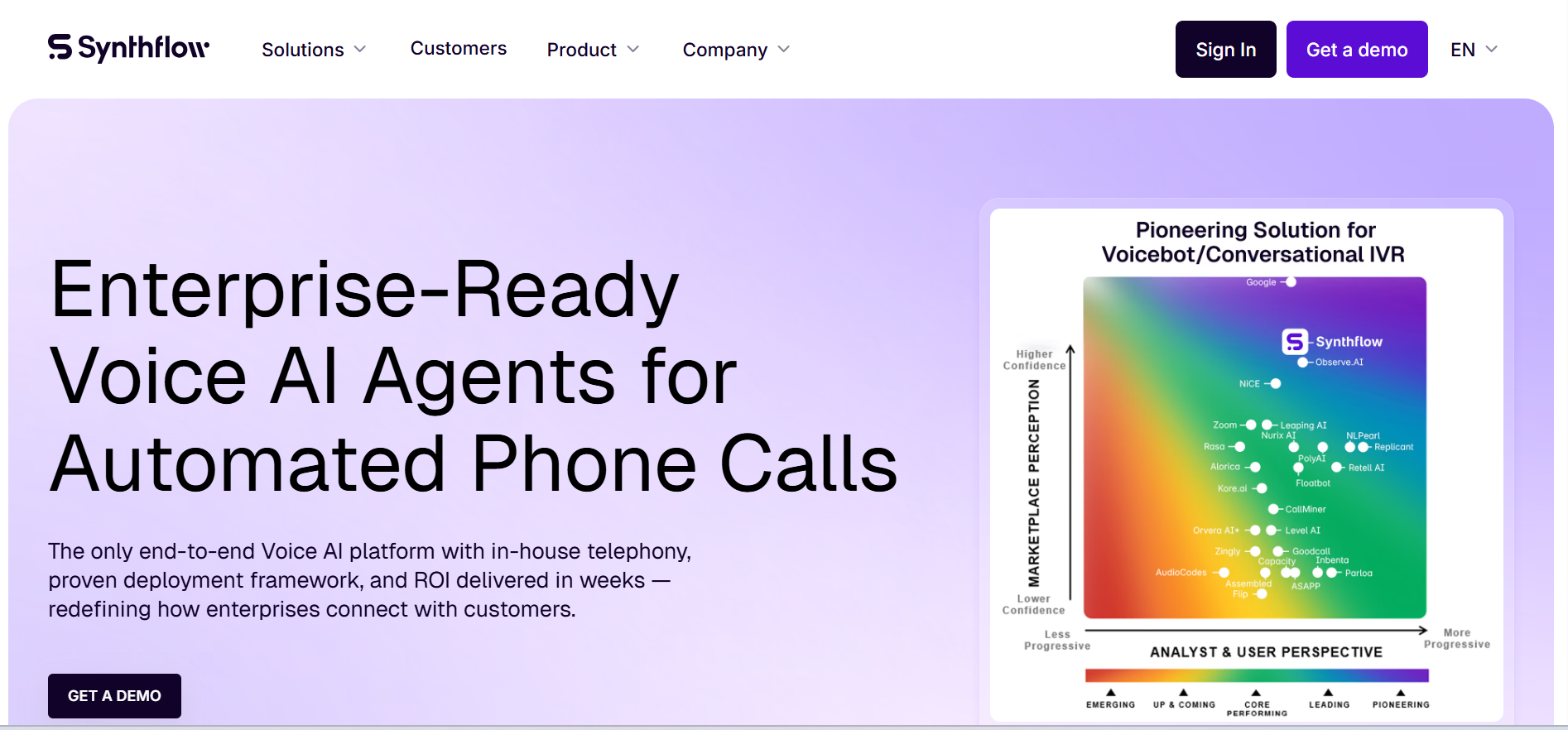
Synthflow is a no-code AI voice agent platform with a visual flow designer for teams that want to build phone agents without writing code or managing the underlying infrastructure. It provides its own telephony, industry templates for healthcare, legal, and real estate, plus SIP trunking. The platform also supports businesses, agencies, and teams managing voice agents across multiple clients.
Key Features:
- Drag-and-drop visual flow builder with prebuilt industry templates
- In-house telephony with SIP trunking
- Multi-agent subflows for complex call logic
- White-label and multi-client agency tooling
- Multilingual voice support
Bland AI
Bland AI operates on a proprietary infrastructure, using its own speech, LLM, and TTS infrastructure instead of relying on separate third-party AI providers. The platform combines these models with telephony, conversational pathways, knowledge bases, and business integrations. This gives teams control over the voice stack and where it runs, including VPC and on-premises deployments. Bland AI positions this setup for high-volume phone workflows, including regulated use cases where data handling, deployment control, and compliance requirements matter.
Key Features:
- Proprietary voice models built in-house rather than assembled from third-party
- LLMs Fixed-rate subscription tiers for predictable cost forecasting
- Maintains context across long conversations with multiple changes in direction 40-plus language support
- Sub-one-second latency on the company's own published benchmarks
ElevenLabs
ElevenLabs began as a text-to-speech company and has since expanded into a full conversational agent product, though voice quality remains its core differentiator. Its agents are commonly paired with orchestration platforms like Vapi, Retell, LiveKit, and Pipecat as the voice layer, or used directly through ElevenLabs' own Conversational AI product for teams that want its speech technology end-to-end. Positioned this way, it functions as an AI Voice Agent for Business wherever caller-facing voice quality is the deciding factor.
Key Features:
- Text-to-speech and voice cloning technology widely recognized across industries
- Conversational agents billed separately from telephony and language model usage
- Native integrations with major orchestration platforms as a drop-in voice layer
- HIPAA-eligible Business Associate Agreements available on higher tiers
- Six pricing tiers from a free plan through custom
- Enterprise Broad language and voice library, including custom and cloned voices
NiCE Cognigy
Cognigy, now operating as NiCE Cognigy, is a conversational AI platform designed for large-scale contact centers and not as a quick self-service setup. NiCE Cognigy’s Voice Gateway manages telephony at large scale, while its Agent Copilot enables human-AI cooperation for assisted but not replaced live agents.
Key Features:
- Low-code interface for building and managing complex contact center flows
- Voice Gateway rated for tens of thousands of concurrent sessions
- Agent Copilot that helps human agents in real-time during their calls
- Prebuilt connectors for most used enterprise software such as Salesforce, ServiceNow and many others
- Integration capabilities in cloud, on-premise, and hybrid enterprise environments
- Unified automation layer in voice, chat, and messaging channels
PolyAI
PolyAI works as an AI voice agent for business built around one thing: how natural and realistic the conversation sounds. It stays on voice and skips broad omnichannel automation. In many deployments, PolyAI's own team builds and runs the assistant for the client, so no self-serve builder is handed over to manage.
Key Features:
- Voice-first product focus rather than a general-purpose conversational AI suite
- Managed build-and-operate model available for enterprise deployments
- for large-scale, multilingual contact center environments
- Enterprise-grade reliability for brand-sensitive, high-volume voice lines
- Live caller interaction design as a core specialty, not an add-on
- Integration support for existing enterprise contact center infrastructure
Kore.ai
Kore.ai is an enterprise AI solution which addresses customer service, IT, HR, banking, healthcare and other business functions. Voice agents operate together with chat and digital channels and are able to connect to enterprise applications and perform multi-step tasks that do not simply stop at answering questions. That broader scope makes Kore.ai relevant when voice automation is part of a wider enterprise agent strategy.
Key Features:
- Customer service, IT, HR, banking, healthcare, and other enterprise use case AI agents
- Voice, chat, web, Slack, Microsoft Teams, and other channel support
- Over 100+ custom integration solutions for agent connectivity with enterprise systems
- Integrations with Salesforce, ServiceNow, SAP, Workday, Genesys, Five9 and many other business platforms
- Multi-agent orchestration for complex processes requiring specialized agents and deterministic processes
- Native, customizable voice infrastructure designed for high-volume deployments
- Agent testing, observability, analytics, audit logs, access controls, and guardrails
- Support for workflows that span multiple systems, departments, and channels
- Cloud, hybrid, and other enterprise deployment options depending on the product and deployment requirements.
AI Voice Agent Platforms: A Quick Comparison
| Platform | Best For | Starting Price | Deployment Type | Notable Compliance |
|---|---|---|---|---|
| GirikVoice | Salesforce-native voice automation | Custom / plan-based | No-code + API | HIPAA, GDPR, SOC 2 Type II, PCI DSS |
| Retell AI | Engineering-led teams | $0.07/min | API + managed infrastructure | HIPAA, GDPR, SOC 2 Type II, CCPA |
| Vapi | Technical teams building custom voice stacks | $0.05/min platform fee | API-first | SOC 2 Type II, GDPR, PCI DSS; HIPAA |
| Voiceflow | Teams building voice and chat together | Free evaluation tier | Visual + API | SOC 2 Type II, ISO/IEC, GDPR, HIPAA |
| Synthflow | Non-technical teams and agencies | $30,000/year+ | No-code + managed | ISO, GDPR, HIPAA, PCI DSS |
| Bland AI | High-volume outbound and longer inbound calls | $0.11/min + platform fee | Managed + enterprise | SOC 2 Type I & Type II |
| ElevenLabs | Voice-quality-focused experiences | ~$0.08–$0.10/min* | Platform + API / voice layer | HIPAA-eligible BAA support on higher plans |
| NiCE Cognigy | Large enterprise contact centers | Six-figure annual contracts | Cloud / on-premises / hybrid | FedRAMP, HITRUST, ISO and more |
| PolyAI | Large-scale multilingual voice solutions | Six-figure annual contracts | Managed enterprise | ISO/IEC and industry security standards |
| Kore.ai | Enterprise-wide multi-agent automation | Custom enterprise pricing | Cloud / hybrid / enterprise | FedRAMP Moderate, HITRUST and other standards |
** Excluding language-model and telephony costs.
Pricing & Total Cost of Ownership
The price per minute calculation can be helpful in comparing platforms, but it is just one of many factors that determine the price of an AI voice agent. The first distinction is what that minute actually includes. One vendor may bundle speech processing and orchestration into its voice-engine rate. Another may charge separately for the LLM, telephony, voice generation, or premium features. That creates several cost layers to examine before comparing two platforms:
- Platform or orchestration fees: These determine what you are actually getting for the base subscription and which capabilities sit behind higher tiers. A low entry price may offer limited room for production requirements.
- AI usage: LLM, speech recognition, and voice generation costs can be bundled or metered separately. For buyers, this affects how predictable the bill remains as conversations become longer or require more processing.
- Telephony: Phone numbers, carrier minutes, SIP connectivity, recording, and transfers can sit outside the headline platform rate. At higher call volumes, these charges can materially change the economics.
- Concurrency: A platform may support your expected monthly call volume while still becoming expensive at peak periods. Additional simultaneous calls, lines, or capacity can introduce another layer of cost.
- Integrations: A basic CRM connection may be included, while deeper API or workflow access requires another plan. The difference matters if the agent needs to read records, update them, or trigger actions during a call.
- Enterprise requirements: Larger deployments often come with requirements around SSO, access controls, data residency, retention, infrastructure, and compliance. Those requirements can move a deployment into a different pricing tier.
- Implementation and maintenance: Building flows, connecting systems, testing edge cases, monitoring calls, and updating the agent all require ongoing effort. A platform with a higher subscription cost can still have a lower total cost if it reduces this workload.
- This matters because two platforms charging $0.10 per minute can produce very different monthly bills. One might include telephony and core AI processing. Another might add those costs separately. Even current public pricing comparisons show a substantial gap between advertised platform rates and estimated all-in production rates. For an AI voice agent for businesses, the practical calculation should therefore include platform usage, AI and telephony consumption, integration requirements, implementation effort, and ongoing operational costs. A pilot should measure those numbers against the actual outcome the agent is expected to deliver.
What to Test Before Choosing a Platform
Demos are built to succeed, so the useful evidence comes from your own calls. Shortlist the platforms and make sure the test uses the same script calls for each in recorded calls and real-life cases when available. Running a pilot of two to four weeks with a sample of your live traffic will tell you more than testing in the sandbox ever will.
Five checks carry most of the weight:
- Latency under load: Measure response time with several calls running at once, ideally at two or three times your expected peak, since single-call figures flatter every platform.
- Task completion: Confirm the call did its job. The right record was found and updated in the CRM, and the follow-up workflow started without anyone fixing it by hand.
- Messy conversations: Add interruptions, accents, noise, and a caller changing their requests midway during the call.
- Handoff quality: Transfer a live call to a human and check whether the transcript, detected intent, and customer record arrive with it.
- Failure behavior: Take a downstream system offline and listen to what the agent tells the caller.
- Compliance belongs in the same pilot. Check data retention, call recording, and redaction settings before real customer data flows through, since changing them afterward can mean rebuilding parts of the flow. Track cost per resolved call alongside cost per minute. A cheaper platform that resolves fewer calls without a human can end up costing more once escalations are counted.
Conclusion
Ten platforms, each built for different sets of buyers, and no single ranking absolutely resolves which one best suits your organization. A good choice and an expensive one are very easy to distinguish even before signing the contract, but the right one matches your call ecosystem and demonstrates true total cost of ownership at your volume, while the others only look strong in the demo. Teams whose work lives in Salesforce, HubSpot, or Zoho can put GirikVoice through the tests above during its 7-day free trial and see the CRM-native approach on their own data. Whichever platforms make your shortlist, let your own calls make the final decision.
FAQs
Do I need a developer to launch an AI voice agent?
No-code platforms, like GirikVoice, are available for non-technical teams that help create call flows without coding, but those that follow the API-first principle, like Vapi, require technical support during the deployment and maintenance phase. Whether you use a no-code platform or not, somebody will be responsible for testing, CRM field mapping, and all post-launch modifications.
How long does it take to go live?
Self-serve no-code tools can produce a first working agent within days, though genuine production readiness usually takes a few weeks of real testing against live calls. Enterprise platforms such as NiCE Cognigy commonly take months to deploy, mostly due to integration and governance requirements. Running your own pilot early gives a far more reliable timeline than any vendor estimate.
Can an AI voice agent handle regulated calls, such as healthcare?
Yes, on platforms built to support the required safeguards. Retell AI and GirikVoice, among other solutions, provide products with HIPAA-compliance certification. Moreover, there are vendors who agree to sign a business associate agreement if required. Make sure that HIPAA compliance is covered in your solution package or is provided as an additional feature. Also, make sure that all recording, storage, and redaction parameters are set correctly.
What should the voice agent do in case it cannot resolve a query?
It should transfer to a human agent along with the conversation so far and the relevant customer record already attached. Some platforms pass along only the raw phone connection, which leaves the caller repeating everything they already explained. Test a live transfer during your pilot specifically, since this is where a poorly designed handoff becomes most obvious to a real caller.
What AI voice platform works for teams operating on Salesforce or HubSpot?
A CRM-native platform is usually the best choice here. GirikVoice runs directly inside Salesforce, triggers Flows, and updates records mid-call, while also connecting to HubSpot and Zoho out of the box. General-purpose platforms like Retell AI and Vapi can still reach a CRM through webhooks and APIs, but your own team ends up building and maintaining that connection long-term.
What does an AI voice agent typically cost per month?
It depends heavily on billing model. Usage-based platforms like Vapi and Retell AI can run anywhere from a few hundred to tens of thousands of dollars a month depending purely on call volume, while plan-based options like GirikVoice offer more predictable tiers. Any real AI Voice Agent for Business should be budgeted on realistic all-in cost per minute, not the advertised headline rate alone.
Can an AI voice agent handle outbound calls, not just inbound?
Yes, but with some variation in platform-specific capabilities. Most AI voice agents are geared toward outbound calling, while other platforms listed are outbound enabled, but more oriented toward inbound sales and customer service calls. Make sure you understand concurrent outbound dialing limitations during your proof of concept test if call volumes are an important criterion.