Learn how Agentforce voice agent integration connects real-time conversations with Salesforce, enabling faster case resolution, automated data updates, and seamless handoffs.
- 1Integrate Agentforce with AI voice agents to achieve real-time synchronization and automated handoffs with Salesforce, eliminating data gaps and manual logging.
- 2Leverage Agentforce's four-layer architecture, including bi-directional APIs and data flow, for near-zero latency voice data synchronization with CRM records.
- 3Implement structured handoff protocols within Agentforce to seamlessly transfer live transcripts, sentiment scores, and intent states to human agents, ensuring conversational continuity.
- 4Accelerate case resolution and improve customer experience by enabling agents to skip repetitive questions and providing a unified conversational flow across interactions.
- 5Enhance pipeline velocity and forecasting accuracy by utilizing real-time data updates from AI voice agents to inform sales and support actions immediately after calls.
Agentforce Voice Agent Integration: The Fast Track to Real-Time Sync & Automated Handoffs
Voice interactions often expose gaps in Salesforce workflows. Customer details may exist in the CRM, yet agents still begin conversations without immediate context. Case notes, account history, and product information are not surfaced automatically, compelling staff to reconstruct data mid-call. When the conversation ends, manual logging adds further delay. These inefficiencies extend beyond a single interaction, slowing follow-ups and creating downstream friction in processes that depend on timely, accurate information. Agentforce voice agent integration is an apt solution for these challenges.
With proper integration, the platform connects live conversation streams with Salesforce context and downstream workflows. This ensures information moves in real time. Customers avoid repeating details; agents gain immediate visibility, and handoffs carry complete context. There are more advantages to using Agentforce AI voice architecture. Let's understand them in detail. In this blog, we explore how the architecture works and what occurs during a voice agent to Agentforce transfer, and key factors organizations should confirm before deploying the system at scale.
Why Native Salesforce Voice Falls Short
Native voice tools inside Salesforce were built as an extension of existing CRM functionality, not as dedicated voice infrastructure. That distinction matters once call volume or conversational complexity increases. These aren't minor gaps. For teams handling high call volumes or complex service scenarios, they become operational friction.
- Real-time speech-to-text accuracy suffers under inconsistent call quality
- Interruptions and multi-turn conversations aren't handled well
- Customization for industry-specific call flows is limited
- Telephony setup requires extra configuration the platform doesn't provide natively
- Latency increases when bridging live audio with Salesforce records
How Agentforce AI Voice Architecture Works
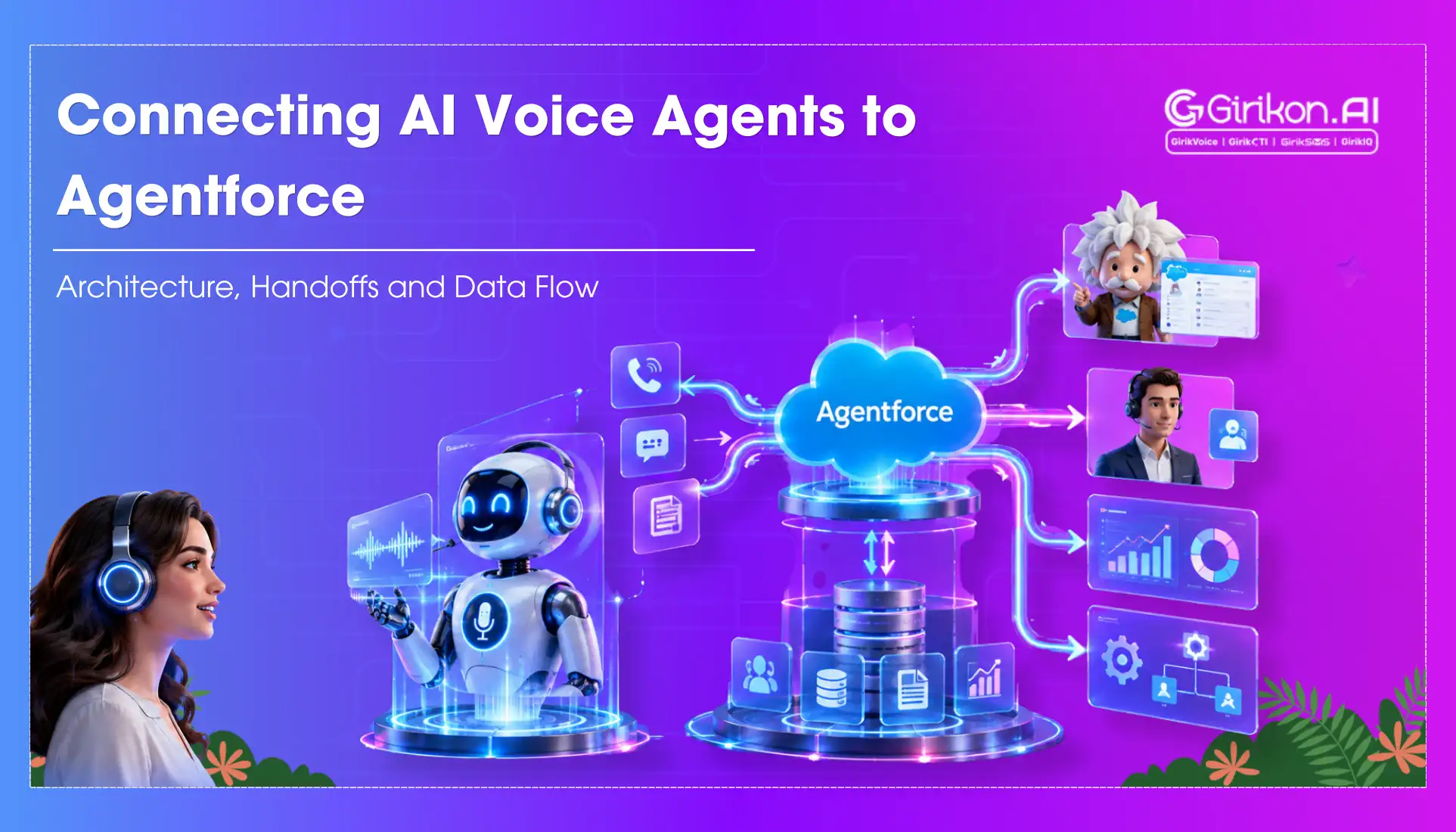
The architecture runs across these layers, each responsible for a distinct part of the conversation. Together, they form the backbone of Agentforce voice agent integration architecture, a flow, not a single tool.
- Real-Time Telephony & CRM Data Bridge Bi-directional APIs connect live voice streams directly to Data Cloud and Salesforce records, keeping latency close to zero. This is what makes AI voice agent Salesforce integration functional in practice rather than theoretical; the voice layer and the CRM stay synchronized throughout the call, not just after it ends.
- Bi-Directional Voice Data Flow AI agents fetch relevant CRM details before responding to a question, then update record fields dynamically as the conversation progresses. Agentforce voice data moves in both directions here, pulled in to inform the response, pushed back out to keep Salesforce current.
- Contextual Voice Agent to Agentforce Handoffs Structured handoff protocols transfer live transcripts, sentiment scores, and intent states to human reps or secondary agents without any manual re-entry. This is the mechanism that makes the voice agent to Agentforce handoff seamless rather than disrupting continuity in customer interaction.
Benefits of Using Agentforce AI Voice Architecture
- Faster Case Resolution Context flows directly through the Agentforce voice data pipeline, allowing agents to skip repetitive discovery questions and move straight to problem-solving. Handle time decreases, throughput improves, and customers receive faster, more accurate responses without unnecessary delays or redundant exchanges across the support process.
- Reduced Manual Data Entry Notification of conversation details get updated to Salesforce records in real-time, removing the need for agents to write post call summaries. This automation helps free up measurable capacity throughout teams to work on more critical tasks. Also, provide you with complete, audit trackable information that's accessible instantly to supervisory/managerial staff.
- Improved Customer Experience Customers no longer repeat account information during transfers. Context transit smoothly between each handoff, ensuring continuity from start to finish. Therefore, conversations remain consistent, interactive, and professional, with the customer experiencing a unified conversation rather than fragmented exchanges spread across multiple agents or disconnected systems.
- Better Pipeline Velocity Real-time updates through Agentforce voice data flow ensure sales and support teams act on current information immediately after each call. The AI voice agent Salesforce integration eliminates delays from manual logging, accelerating pipeline velocity and strengthening forecasting accuracy across Service Cloud and Agentforce voice agent integration architecture.
Deployment Readiness Tips for Agentforce Voice Architecture
- CRM Data Hygiene & Context Grounding Accurate account and case records are essential before deployment. The voice agent draws directly from Salesforce CRM, so outdated or duplicate entries immediately surface in live conversations. A thorough audit ensures responses remain precise and context-aware. Addressing data quality in advance prevents costly errors during calls and establishes a reliable foundation for customer interactions.
- Telephony Latency & Real-Time Sync Network and SIP infrastructure must be validated under realistic call loads to confirm they can sustain sub-second bidirectional data flow. Latency that appears acceptable in controlled testing often becomes disruptive at production scale. Early verification of throughput and synchronization ensures smooth exchanges, protecting both customer confidence and agent efficiency once traffic increases.
- Compliance, Consent & PII Safety Guardrails for TCPA and GDPR must be fully operational before transcripts reach the CRM. Real-time masking of sensitive fields, documented consent capture, and audit-ready logs are safeguards that are expected. These controls need to function correctly from the first live call. Attempting to retrofit compliance after launch introduces unnecessary risk and complicates remediation efforts.
Conclusion
Agentforce voice agent integration offers a structured connection between live conversation, Salesforce CRM, and downstream workflows. When done correctly, the architecture becomes a reliable structure for voice data flow in real-time and a smoother handoff between call center agents. The results are tangible: quicker turnaround, lower admin workload, enhanced compliance, and increased efficiency.
Hopefully, this blog has given you an understanding of the benefits of using this architecture, and some of the prerequisites you need to take into consideration before deploying it. Also to fully realize the architectures potential, your business needs a robust Voice AI platform, built on a resilient architecture that extends Salesforce capabilities with precision and reliability. To explore how a dedicated Voice AI platform, built on resilient architecture, can accelerate operations, schedule a free demo.