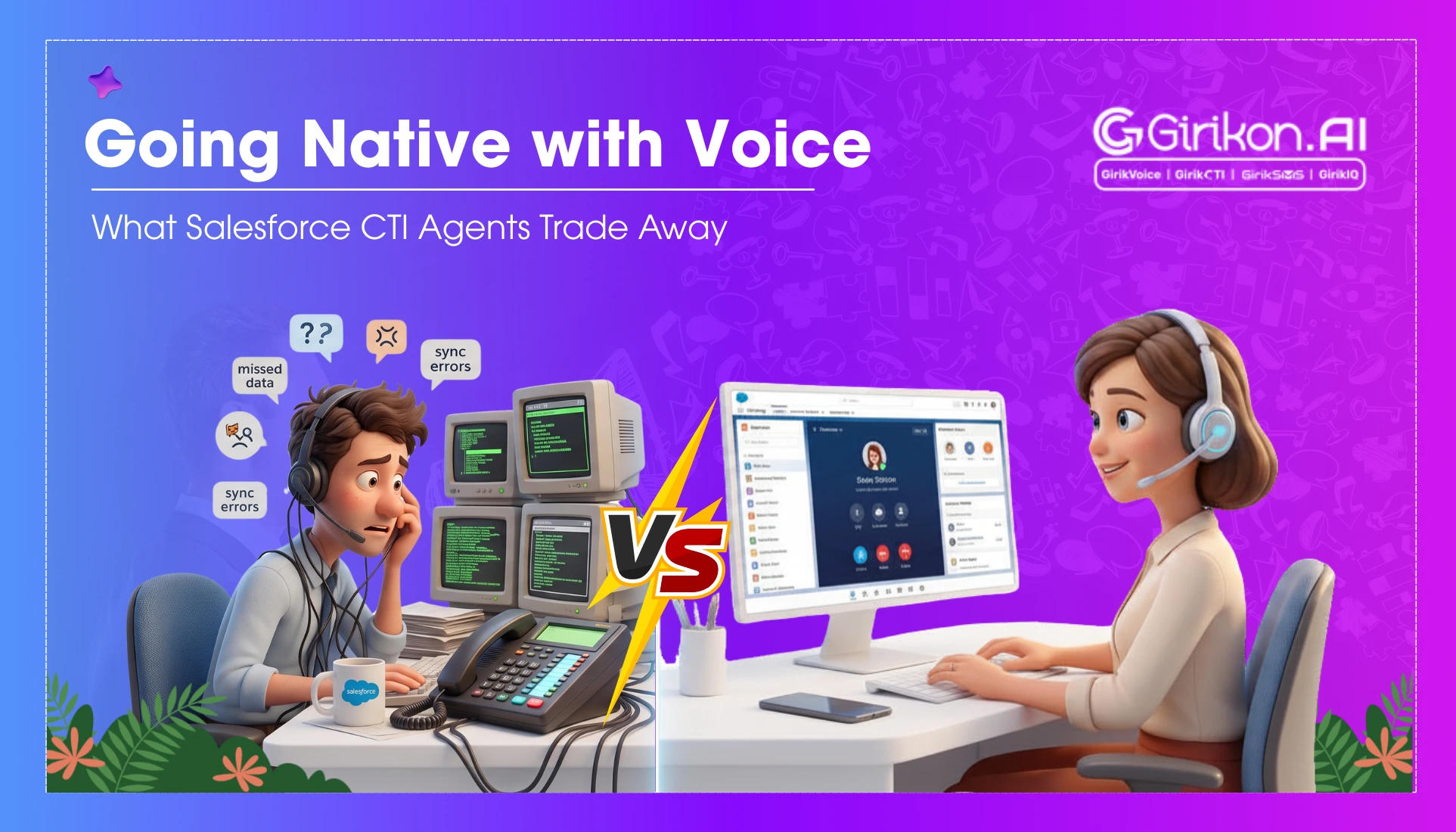
Going fully native with Agentforce Contact Center promises a simpler, more tightly integrated voice experience—but that simplicity comes with trade-offs. Salesforce now owns the voice layer, while traditional CTI models let organizations retain greater control over their existing telephony stack and customization. This short explores what businesses actually give up when they move from Salesforce CTI to native voice: telephony flexibility, vendor choice, customization, migration freedom, and control over the underlying voice infrastructure. With Open CTI now in maintenance mode and scheduled for retirement in 2028, the decision is no longer simply about integration—it is about deciding how much of the contact center you want Salesforce to own.
Going native sounds like an obvious move. One platform, one vendor, and fewer integrations to manage!
When Agentforce Contact Center ventured into the market, several Salesforce-first teams doubted the necessity for a separate CTI solution. However, the truth is far from real. A native contact center might not suffice to the growing needs of an evolving business.
Native voice gives businesses a more streamlined Salesforce experience, whereas traditional Salesforce CTI gives businesses control, flexibility, and sometimes—capabilities that a native setup simply can't match.
Salesforce's own research puts it plainly: 88% of customers say the experience a company provides matters as much as the product itself. That kind of pressure leaves no room for choosing a voice setup based on convenience only.
This guide breaks down the Agentforce contact center vs CTI decision from a practical standpoint, focusing on the trade-offs that matter most to contact center teams.
The Trade-Offs of a Native Contact Center
When voice becomes fully native, here's what changes:
- Higher simplicity, lower adaptability Native solution results in reduced integration complexity but limits the choices of telephony providers and third-party platforms.
- Unified experience, fewer customization options Supporting everything from Salesforce delivers a consistent experience, but organizations with particularly unique processes are likely to experience reduced ease of customization as compared to conventional CTI solutions.
- Rapid implementation, but dependency on the platform increases Native solutions may be easier to roll out, but subsequent updates and voice features depend on the platform itself.
- Integrated AI, but not necessarily advanced call center functionality AI-based solutions increase productivity; however, companies with complicated routing or telephony needs may still lack functions available in non-native solutions.
- Simplified management, different long-term considerations As business needs change, some organizations are beginning to consider an Agentforce contact center alternative that is more flexible, without losing their investment in Salesforce.
None of these tradeoffs are inherently good or bad. It depends on what you need: a contact center of moderate complexity and some control over the voice solutions or a fully integrated system with end-to-end control.
Agentforce Contact Center vs Salesforce CTI Agents: Key Difference
Both Agentforce Contact Center and Salesforce CTI solutions aim to introduce voice into Salesforce, but in completely different ways.
One of them provides a comprehensive contact center solution, deeply integrated with the Salesforce environment; the other focuses on flexibility and the ability to connect Salesforce with enterprise telephony systems.
Voice Architecture & Telephony Flexibility
Designed as a native Salesforce experience, Agentforce Contact Center integrates voice into the Salesforce platform, making it simpler to administer and easier to deploy because there's less to integrate and it offers a more connected experience for users who want to work within one ecosystem.
CTI solutions enable companies to connect external telephony systems to Salesforce, and because of this, they offer greater flexibility in choosing a preferred supplier and wider options in terms of voice infrastructure. This is particularly valuable in multinational companies where there may be a need for different voice systems across different regions or where the company may wish to change its telephony strategy over time.
Salesforce vs Contact Center Platform
Read the full guide on salesforce vs contact center platform.
Salesforce vs Contact Center Platform
Read the full guide on salesforce vs contact center platform.
Customization & Workflow Control
A native platform offers standardized processes that are easier to implement and scale, which can be a great advantage for companies that have a streamlined customer service operation.
Using a CTI, organizations can customize their Salesforce call routing, screen pops, IVR, agent process, and Salesforce automation to fit a particular business process, which is often crucial for more complex industries.
Salesforce Cti Agents
Read the full guide on salesforce cti agents.
Salesforce Cti Agents
Read the full guide on salesforce cti agents.
AI Experience & Agent Productivity
Agentforce Contact Center is designed to bring AI deeper into the agent's workflow by enhancing the agent's ability to act based on real-time assistance, conversation summaries, and AI-powered recommendations. For companies that are already investing in Salesforce AI, this is a key enabler of a fully integrated customer experience powered by AI across the customer journey.
A Salesforce CTI solution also unlocks the opportunity to adopt AI technologies beyond just one unified platform. Salesforce CTI gives contact centers the flexibility to use best-in-breed AI solutions for their telephony system, be it Salesforce AI or another voice intelligence platform.
Non Contact Center Telephony
Read the full guide on non contact center telephony.
Non Contact Center Telephony
Read the full guide on non contact center telephony.
Scalability for Enterprise Contact Centers
For companies that have contact center operations of a relatively simple nature, a native contact center solution can make good sense. It allows agents to focus on the task without getting bogged down in administrative tasks or having to navigate numerous disparate technologies.
Most enterprise contact centers have multiple sites, lines of business, channels, and thousands of customers generating thousands of interactions per day. CTI solutions from Salesforce are built to work with enterprise telecom systems of all shapes and sizes. That means companies can now meet the challenges of multi-regional deployments, complex routing scenarios, regulatory requirements, and high call volume with the ability to offer customers a unified experience through their preferred interface -- the familiar Salesforce environment.
Long-Term Flexibility & Future Growth
Choosing Agentforce Contact Center helps to better adhere to the Salesforce roadmaps, as they unveil new AI features and contact center developments and let organizations use these innovations in a unified environment. It also allows companies that want to build an application development strategy around Salesforce to avoid unnecessary complexity.
A CTI solution ensures the voice layer's independence while providing an extremely deep integration with Salesforce. That gives businesses freedom over which voice provider they use, access to new communication platforms, and means of addressing new market opportunities -- all while preserving their CRM processes.
Which Option Makes Sense for Your Business
The choice between the native voice vs CTI agent decision depends on the company's specific needs. Agentforce Contact Center is ideal for businesses that prioritize a simple solution with a Salesforce-first experience.
In contrast, an organization that requires extensive telephony features and scalability options should consider a Salesforce CCaaS alternative.