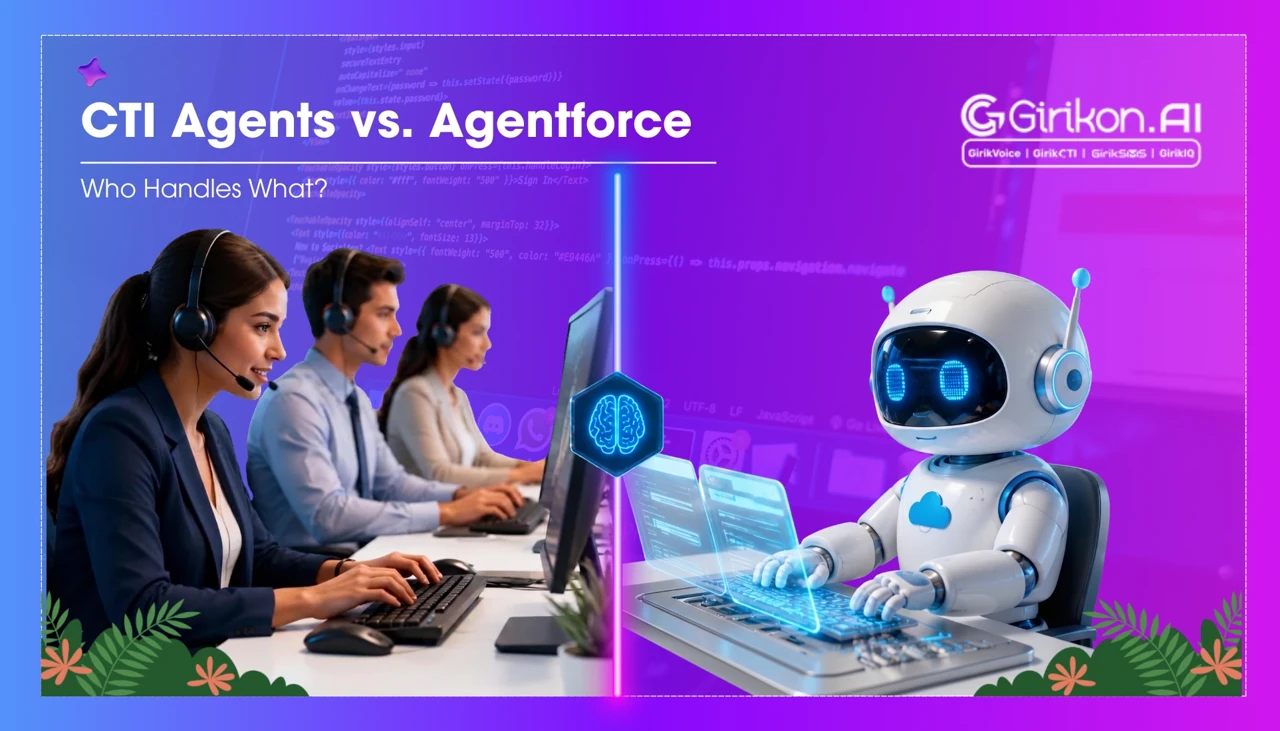
Salesforce CTI Agents and Agentforce Service Agents both help service teams automate customer interactions, but they solve different parts of the service journey. CTI Agents focus on voice-based customer engagement and call handling, while Agentforce Service Agents are designed to resolve service requests autonomously across channels. Understanding the difference can help businesses choose the right solution—or use both together for a more complete customer service experience.
- 1Integrate Salesforce CTI agents to connect phone systems, enabling agents to access customer data, manage calls directly within Salesforce, and trigger workflows based on call outcomes.
- 2Deploy Agentforce Service Agents to autonomously handle routine customer inquiries, troubleshoot issues, and perform eligible service tasks, freeing up human agents for complex issues.
- 3Utilize CTI for inbound and outbound customer calls, facilitating quick access to customer history and enabling efficient call transfers based on defined parameters.
- 4Leverage AI features within CTI for call transcription and summarization, providing valuable insights from voice interactions.
- 5Combine CTI and Agentforce to build a comprehensive and efficient Salesforce service operation that automates repetitive tasks and enhances human agent capabilities.
A customer calls with an urgent issue, another asks a routine question through chat, and the third wants an update that could be provided in seconds. As these interactions multiply, a CRM can no longer be limited to simply storing customer information– it must act as an intelligent system that can understand customer intent, automate repetitive work, and connect every interaction to the right customer record.
This is where Salesforce CTI Agents and Agentforce Service Agents make customer service smarter. While CTI connects phone conversations with routing, CRM data, and human agent workflows, Agentforce Service agents independently understand customer requests, answer queries, retrieve information, and complete eligible service tasks.
So, which one should a business use? And when does CTI and Agentforce make more sense? Let's break down where each fits and how businesses can use both to build a more efficient Salesforce service operation.
What is a Salesforce CTI Agent?
Salesforce CTI Agent through Computer Telephony Integration connects the traditional phone systems of businesses to Salesforce, making it accessible for the service team to receive and dial calls and retrieve any customer information instantly.
For instance, if the customer is calling with a concern, the CTI identifies the caller and provides their details thus allowing the agent to stay central to the conversation while accessing the past interactions. With a CTI solution, human agents can:
- Dial and pick up call directly from Salesforce
- Transfer or conference calls
- Identify callers and open their relevant records
- Trigger workflows based on call outcomes
- Use Salesforce IVR to guide customers through call flows.
- Prefer AI for call transcription, insights, and summaries.
What are Agentforce Service Agents?
Agentforce's AI agents for Salesforce autonomously engage with customers, retrieve relevant information, identify the purpose of their requests, and conduct supported actions based on the organization's configured permissions and processes.
For instance, consider that there is a situation when a customer asks: "What is my order status?" At this moment, AI will pick up this question and access the data from the Salesforce customer relationship management (CRM) program to create the appropriate answer for the user. Depending on how the Agentforce AI is configured, it can perform many functions, including:
- Resolving common customer inquiries
- Helping customers troubleshoot issues
- Creating or updating service records
- Providing personalized information
- Supporting service interactions outside traditional business hours
- Guiding customers through service processes
Salesforce CTI Agent vs. Service Agent: What's the Difference?
| Capability | Salesforce CTI Agents | Agentforce Service Agents |
|---|---|---|
| Main Purpose | Connect telephony with Salesforce | Automate customer servic conversations |
| Interaction Model | Voice calls | AI-driven customer interactions |
| Call Routing | Yes | Not the primary purpose |
| Caller Identification | Yes | Depends on implementation |
| Customer Questions | Help human agents answer | Can answers autonomously |
| Escalation | Route calls to humans | Escalates when assistance is needed |
| Human agent involvement | Usually central | Can operate autonomously for supported tasks |
Which Tasks Should Salesforce CTI Handle?
Salesforce CTI is useful when voice communication remains an important part of the service journey or the customer needs to speak with a person.
Handling Inbound Customer Calls
CTI connects the incoming call with Salesforce, letting agents access the caller details such as open cases, previous cases, recent activities, and account information without interrupting the interaction. Thus, ensuring a more informed conversation while eliminating the need to seek the same information again.
Managing Outbound Calls
Besides providing support for inbound calls, Salesforce CTI makes outbound easier and more convenient. The click and call option allows the agents to call anyone by clicking the number in the Salesforce profile. The feature is great for conducting sales calls, looking for open cases, and following up with customers and leads.
Transferring Calls to the Appropriate Agent
A technical problem may require talking to a dedicated support agent, whereas a question about billing should be directed to the finance department. According to parameters such as IVR choices, number of agents available, customer segment, caller data, call importance, etc., CTI manages the calls thus reducing unnecessary transfers and allows customers to reach the best-suited person faster.
Transcribing and Summarizing Calls
AI-powered CTI solutions support AI-powered call transcription for Salesforce, along with summarization and conversation analysis. This eliminates the need to manually capture post-call documentation like:
- Actions taken
- Next steps
- Customer's primary concern
- Follow-up requirements
- Customer sentiment or intent
Thus, helping keep Salesforce records more consistent.
Capturing Contact Center Performance
Depending on the telecommunication arrangement and settings, CTI is capable of saving such information as call length, date and time of the call, caller data, results of the call, and agent involved in the communication. The information accumulated can also provide supervisors a broader view of contact center performance with Salesforce contact center performance metrics, such as:
- Call volume
- Missed calls
- Queue performance
- Agent activity
- Answer rates
Which Tasks Should Agentforce Service Agents Handle?
Unlike CTI technology, AI agents for Salesforce calls can conduct eligible customer service interactions autonomously– making them particularly useful for repetitive requests that do not always require human intervention.
Answering Routing Customer Question
Instead of sending every question to a human representative, an Agentforce service agent provides appropriate responses to customers' questions that are simple but repetitive, including;
- Where is my order?
- What services do you offer?
- When is my appointment?
- What is the status of my case?
The approach helps operators to dedicate more time to those communications that require empathy, judgment, or special knowledge.
Providing Support Beyond Business Hours
A customer may need assistance late at night, during a weekend, or early in the morning; AI agents for Salesforce can provide support for eligible interactions beyond standard business hours. This creates a more continuous service experience while reducing the pressure on the human team to provide 24/7 support.
Taking Action, Not Just Answering
This is the main difference between Agentforce service and traditional chatbots. While a basic chatbot provides a predefined response after recognizing a keyword, an Agentforce service agent moves the interaction forward after identifying the required data.
For example:
Customer: "I want to return my order."
Basic chatbot: "Here is our returns policy."
Agentforce: Understands the request– retrieves relevant order information, determines applicable process, performs action– confirms the next step.
Personalizing Service
With access to the appropriate data and customer context, an Agentforce service agent provides a more relevant response instead of giving a generic explanation. As a result, this makes automated interactions seem to resemble conversation connected to the customer's actual relationship with the business.
Knowing When to Bring in a Human
AI voice agents know when not to automate further and move to a human representative. In situations where the interaction becomes confusing, complicated, sensitive, or transcends the tech capabilities of the AI Chatbot, the AI can identify the need for human intervention and move the conversation accordingly.
Conclusion
Salesforce CTI agents and Agentforce service agents tackle different customer service tasks. Nevertheless, choosing the best option depends on the right approach, what customers need, where human involvement adds the most value, and which interaction should be utilized. For businesses looking to enhance their Salesforce communication capabilities, Girikcti for Salesforce can help streamline customer interactions and improve agent efficiency.
Defining these boundaries helps you determine whether you must need Agentforce to automate repetitive service interactions or CTI to strengthen human-led call operations. With Girikon.ai, businesses can support both sides of the customer service journey through GirikCTI and GirikVoice. The services these solutions provide allow companies to create a strong service experience for customers. Book a consultation today to learn more.