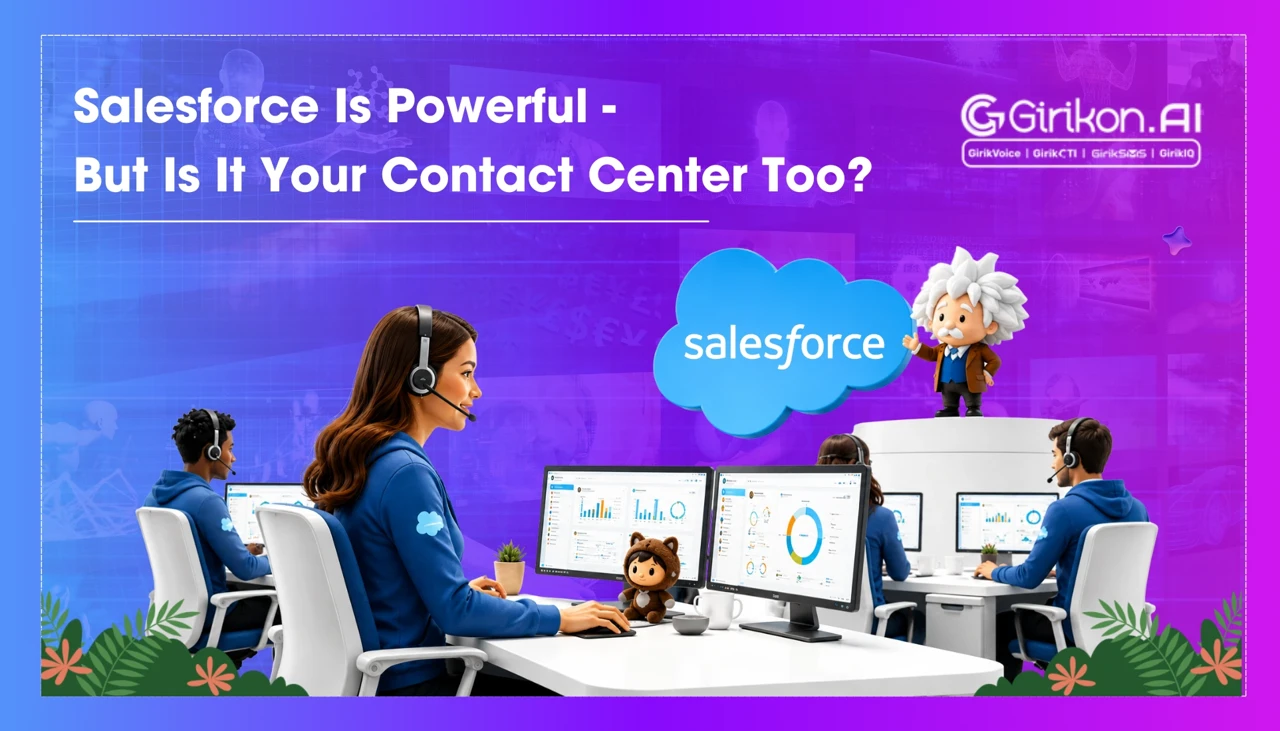
If your business already runs on Salesforce, you might wonder whether you really need a separate contact center platform. The answer depends on your customer service goals, call volume, integrations, and the level of functionality your support team needs. In this blog, we explore where Salesforce shines, where a dedicated contact center solution can add value, and how to decide which approach is right for your business.
- 1Evaluate business needs to determine if a separate contact center platform is still necessary alongside Salesforce, considering system fragmentation and agent workflow.
- 2Recognize that dedicated contact center platforms offer advanced, specialized features like omnichannel routing, workforce management, and predictive dialing that Salesforce may not natively provide.
- 3Acknowledge Salesforce's advancements in contact center capabilities, such as Salesforce Voice and Omni-Channel, which integrate communication directly into the CRM and may suffice for some operations.
- 4Consider consolidating contact center functions within Salesforce if its existing and AppExchange capabilities meet the specific needs of your operation without sacrificing crucial specialized functions.
- 5Maintain a separate contact center platform when operations require highly complex workforce management or other specialized capabilities that are difficult to replicate within a Salesforce-only environment.
A question gets asked more often than people admit: If Salesforce already powers customer service operations, would a business actually need a separate contact center platform? It is reasonable to question the potential. Salesforce can handle customer records, workflows, cases, reports, and many more interactions with customers. So, why add another platform? Because CRM and contact center technology solve different parts of the customer service operation.
The question is whether those capabilities still need to exist across separate systems as Salesforce expands its role in customer engagement. For some businesses, a dedicated contact center platform may remain important. For others, bringing the contact center into Salesforce can reduce system fragmentation and simplify how agents work. The real Salesforce vs contact center platform decision comes down to what the business operations need, where its existing capabilities sit, and whether another platform still adds enough value to justify the complexity.
What a Dedicated Contact Center Platform Actually Does That Salesforce Does Not Natively
A dedicated contact center platform is designed to meet high-volume customer communication demands. Whereas Salesforce can handle customer information and the workflow for support, a dedicated platform often offers more control of the contact center than Salesforce natively.
These capabilities can include:
- Omnichannel routing A dedicated platform can route each communication based on the expertise of the agent and their availability, as well as the priority of the customer.
- Workforce management The platform can predict communication volumes, schedule agents, and perform staffing based on demand.
- Real-time monitoring Having a platform dedicated specifically to communication allows for Salesforce CTI real-time monitoring of the queue, agents, and communications, helping teams track call activity and respond quickly to changing customer needs.
- Quality management A dedicated platform can record communications, measure the performance of agents, and implement quality management initiatives across the contact center.
- Predictive dialing Predictive dialing for high-volume outbound teams increases productivity for outbound communication centers.
This is why CCaaS vs. Salesforce native is not simply a feature checklist. A dedicated platform can provide operational depth that matters for large, specialized contact centers, including advanced capabilities often expected from a Salesforce call recording platform. For some organizations, those capabilities justify maintaining a separate platform rather than trying to replace contact center software with Salesforce alone.
Where Salesforce Has Closed the Gap
Salesforce has been constantly advancing its contact center capabilities, where Salesforce Voice integrates voice communication within the CRM environment and linking them directly to customer records, cases, and service workflows. Omni-Channel allows communication routing via voice and digital channels, while Salesforce's Conversation Intelligence analyzes conversations and offers insights. Command Center for Service also gives supervisors visibility into queues, agents, and active interactions.
The AppExchange extends this further by giving businesses access to additional communication, recording, analytics, workforce, and contact center capabilities. This changes the Salesforce vs contact center platform comparison for certain operations. A support team that mainly needs customer context, case management, voice, routing, and interaction insights may be able to bring more of its contact center operation into Salesforce.
The question is therefore not whether Salesforce can replace every dedicated contact center capability. It is whether the capabilities a specific operation needs can now be delivered within Salesforce without giving up the specialized functions that matter most to its teams. For some businesses, that makes the case for consolidate contact center CRM worth evaluating.
The Operations Where a Separate Platform Still Makes Sense
Bringing more contact center capabilities into Salesforce does not automatically make consolidation the right decision. Some operations depend on specialized capabilities that sit well beyond customer records, case management, and interaction handling.
- Complex workforce management Complex workforce management is one example. When workforce management is this complex, a dedicated contact center platform is essential because these specialized capabilities can be difficult to replicate within a Salesforce-based setup without adding additional tools and integrations.
- High-volume outbound operations High-volume outbound operations can also justify a separate platform. Sales and service teams running large dialing programs may depend on advanced predictive dialing, pacing controls, campaign management, and outbound performance tools built specifically for that environment.
- Highly regulated operations Highly regulated operations present another consideration. Financial services, healthcare, and other regulated industries may have specific requirements around call recording, retention, access controls, audit trails, and compliance monitoring. A dedicated platform with established controls for these requirements may remain preferable to rebuilding those capabilities elsewhere.
The objective of consolidation is not simply to have fewer platforms in place. Should specific contact center functions impact any aspect of staffing, regulatory issues, and revenue generation, retaining a dedicated platform is the most practical approach. Consolidation makes sense only when it simplifies the operation without compromising the capabilities that keep it running effectively.
The Case for Consolidating Contact Center into Salesforce
For operations with less specialized contact center requirements, consolidation can solve problems that adding another platform cannot. If customer files, cases, communication tools, and agent workflows are distributed among different systems, the agents will have to change interfaces, leading to time delays or loss of context because of data synchronization. Bringing these functions closer together gives agents a more continuous view of the customer and reduces the number of systems they need to work across.
This is where the Salesforce vs. contact center platform comparison is less about platform features and more about architecture decisions that create less operational friction. For teams already running their service operation in Salesforce, the ability to replace contact center software Salesforce teams currently use can also reduce integration dependencies, simplify administration, and streamline Salesforce CTI integration.
In the case when an enterprise needs basic contact center features such as voice, routing, customer context, service workflow, and interaction intelligence instead of sophisticated contact center functionality, then consolidation can simplify the technology stack.
Conclusion
So, do Salesforce users still need a dedicated contact center platform? Start with the capabilities your operation depends on most. Consider which functions require specialized technology, where Salesforce already meets those needs, and what maintaining separate systems adds or costs, including the Salesforce CTI integration cost. That assessment provides a clearer answer than choosing based on platform capabilities alone.