When someone calls your business at 9 PM, voicemail may be the difference between winning a customer and losing one. After-hours missed calls can lead to lost leads, delayed responses, and frustrated customers. This guide explores how after-hours AI phone answering and 24/7 AI phone answering can help businesses handle calls, capture customer intent, and provide a better experience even when the team is offline.
- 1Acknowledge that missed calls after business hours can lead to lost leads and erode customer trust.
- 2Understand that customers calling after hours are often in a moment of urgency and may not wait for a callback.
- 3Recognize that traditional after-hours solutions have limitations, such as cost or caller friction.
- 4Evaluate conversational AI as a viable solution for handling initial layers of after-hours calls, improving caller experience and coverage.
- 5Implement AI for common after-hours inquiries like appointment scheduling or basic FAQs to ensure callers feel heard and not ignored.
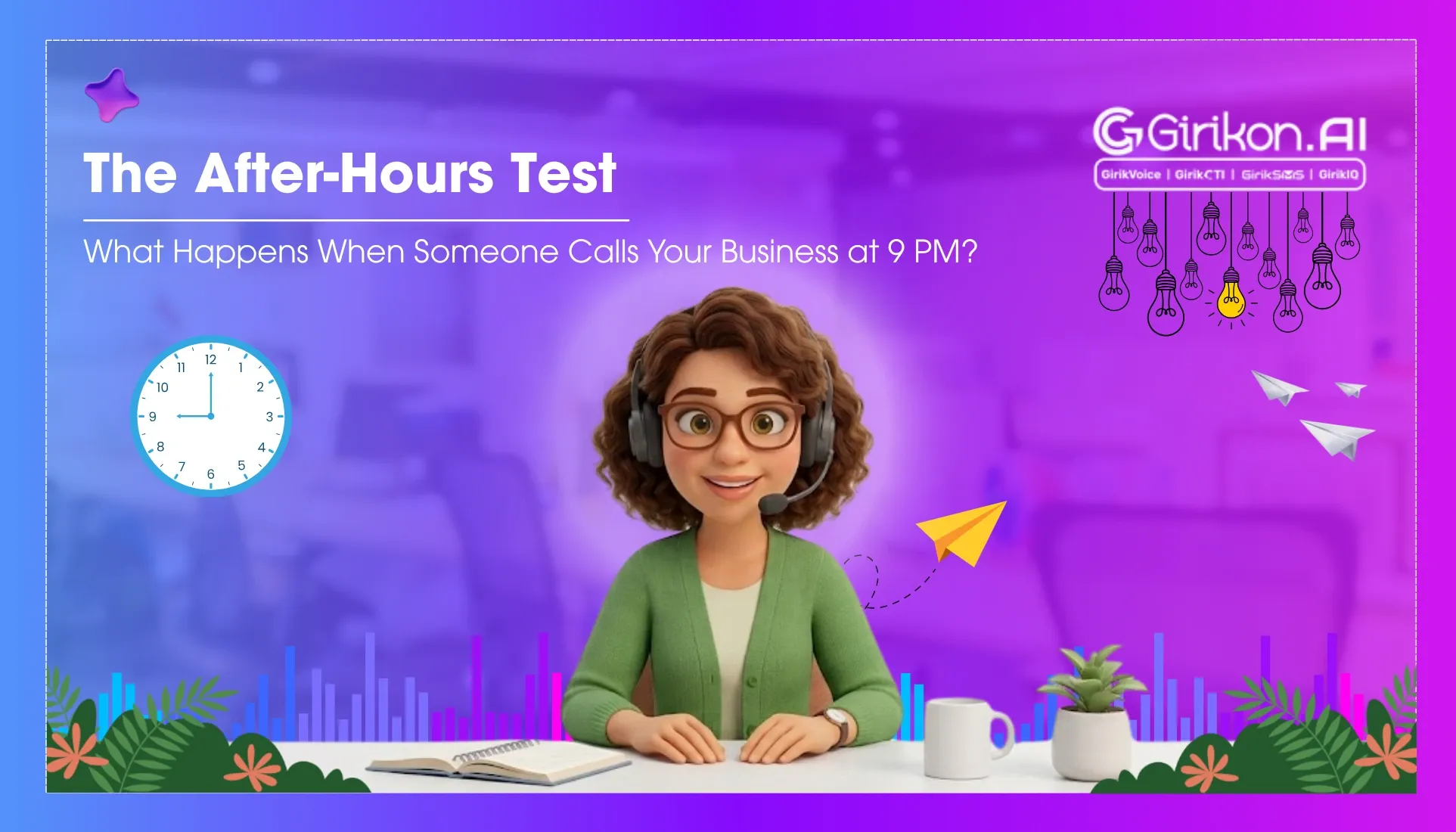
The After-Hours Test: What Happens When Someone Calls Your Business at 9 PM?
There is a version of your business that most of your customers never see during business hours. They see the polished version - the one with staff, responsiveness, and a live human ready to handle whatever comes through the door. But then someone calls at 9 PM on a Tuesday, and missed calls after hours start piling up in a voicemail box that, let's be honest, probably won't get touched until sometime the next morning. That gap - the one between when customers actually need something and when a business is around to answer - has been quietly creating friction for years. Longer than most businesses want to admit.
Worth thinking about what actually happens during that gap. Not in a theoretical way, but practically - what does a caller experience, what do they do next, and what does it cost the business on the other end of that unanswered ring?
The Caller's Journey After the Voicemail Beep
Here is what most businesses tell themselves: that a customer who calls after hours will leave a message, wait patiently, and follow up the next day feeling perfectly fine about the whole thing. That sequence happens less often than businesses tend to believe.
A caller who reaches voicemail at 9 PM on a Tuesday is often not a casual browser. They are someone who made a decision to pick up the phone - which, in 2025, is a more deliberate act than it used to be. They tried the synchronous route instead of email or chat because they wanted an answer in real time. When they hit voicemail, a meaningful portion of them do not leave a message at all. They hang up. And then a fair percentage of those hang-ups go directly to a competitor who happens to have better coverage.
To be fair, this is not universal across every industry. A dental office fielding appointment inquiries after hours sits in a different position than a 24-hour plumbing service. But the pattern, depending on how urgently the caller needed something, tends to hold: unanswered calls in the evening often convert less reliably the next day when you finally call back, because the moment of intent has passed.
Missed Inbound Calls Salesforce
Read the full guide on missed inbound calls salesforce.
What a Business Actually Loses in Those Overnight Hours
The easy answer is leads. That is true, and it is real, but it understates the broader cost.
There is a trust signal embedded in how a business handles off-hours contact. When someone calls and gets nothing - no acknowledgment, no path forward, no indication that their call mattered - it shapes their perception of the business before any human relationship has even formed. Customers do not always articulate this consciously. They just feel a vague sense that the business is harder to reach than they would like, and that feeling sticks.
Then there are the existing customers who call after hours with something urgent. A current client with a billing question, a patient with a medication concern, a homeowner with an emergency repair situation. And for those callers - yeah, the voicemail box is not some neutral outcome they shrug off. It chips away at something. Small erosion, maybe, but it adds up.
The Case for After Hours Call Answering AI
Worth saying plainly: the argument for using this technology is not primarily a technology argument. It is a coverage argument. The core problem is that businesses close and customers do not, and the gap between those two realities has always needed some kind of bridge.
Traditional solutions - answering services with live operators, forwarding to a personal cell phone, elaborate voicemail trees - all have their versions of the same limitation. They are either expensive enough that small businesses cannot sustain them at scale, or they are friction-heavy enough that callers still feel like they have not actually been helped.
What has shifted in the last couple of years is that conversational AI has gotten genuinely good at handling the first layer of a phone call - good enough that most callers don't immediately clock it as a robot. Not perfect, though. Worth being upfront about that before anyone gets too far down the excitement spiral. There are still edge cases where it fumbles - highly emotional callers, requests that require genuine nuance, situations where the caller is elderly or has an accent the model was not tuned for. Real limitations. They matter.
But for a meaningful range of call types - appointment scheduling, basic FAQs, service area questions, hours and pricing, callback collection - a well-deployed AI phone system can handle the call at 9 PM in a way that leaves the caller feeling heard rather than ignored.
| Scenario | Voicemail Only | Live Answering Service | AI Phone System |
|---|---|---|---|
| After-hours appointment request | Lost unless caller leaves message | Handled, but expensive per call | Handled at scale, lower cost |
| Urgent existing customer issue | Caller must wait until morning | Handled if escalation path exists | Can triage and escalate or log |
| Basic info request (hours, pricing) | Usually just hangs up | Handled but variable quality | Consistent handling, 24/7 |
| Complex or emotional call | Always loses the caller | Best handled by humans | Needs human escalation option |
| High-volume nights or weekends | All calls missed | Staff costs increase significantly | Volume handled without scaling cost |
What Good After-Hours Coverage Actually Needs to Do
A common mistake businesses make when evaluating this space is treating after-hours coverage as a single-use case. It is not. What a caller at 9 PM actually needs is highly variable, and the system handling those calls needs to be built for more than one outcome.
- Collect intent accurately - The system needs to understand why the person called, not just log that they called. A message that says "someone called at 9:14 PM" tells the business almost nothing the next morning. A message that says "caller asked about pricing for your commercial cleaning service in the northeast, preferred callback before 11 AM" is actually actionable.
- Escalate appropriately when the call is urgent - This is where a lot of systems fall down, honestly. There is a meaningful difference between a call that can wait until morning and one that genuinely cannot. The AI needs some logic for distinguishing between them, and that logic should be configured by someone who understands how the business actually operates, not left at default.
- Sound like the business it is representing - A generic, cold-sounding AI response at 9 PM can do almost as much damage to perception as hitting voicemail. The voice, tone, and scripting need to match what callers would expect from that business specifically. This is where a lot of low-budget implementations fail - they are deployed once and never refined.
- Ensure a clean AI-to-human handoff the next morning - The overnight record needs to integrate with whatever the business uses for follow-up. CRM entries, calendar blocks, internal notifications. If that handoff ends up as a PDF sitting in some general inbox at 6 AM that nobody actually opens until 9:30 - technically the coverage existed, but practically it fell apart somewhere in the middle.
A Quick Framework for Deciding If You Need This
Not every business has a compelling case for after-hours AI call handling. Honestly, a freelancer who gets two calls a month probably does not need this infrastructure. But for a growing company considering an AI voice agent for small business, there are some fairly reliable indicators that the gap is costing real revenue.
- Your Google Business profile shows business hours, and your calls drop off sharply after 5 PM even on days when demand should be consistent
- You are regularly calling people back on messages left the night before and finding they have already moved on or booked elsewhere
- You operate in a service vertical where urgency is common - healthcare, home services, legal intake, real estate - and your after-hours behavior does not match that urgency
- You have a 24/7 AI phone answering system available but it is deployed only as a voicemail alternative rather than as an actual interaction layer
Worth noting that this last point - deployment depth - is where businesses often underinvest. The technology itself is only half of it, really. The configuration, the scripting, how it all connects to the rest of what the business does on a daily basis - that stuff is what actually determines whether the caller at 9 PM walked away feeling like something happened, or just got a fancier version of the same dead end.
Tip: Run the after-hours test on your own business. Call your own number at 8 PM on a weeknight. Whatever you experience as a caller is exactly what your prospects and customers experience. That is the honest baseline.
The Bigger Picture That Does Not Quite Resolve
The fundamental tension for businesses using any kind of AI answering service for business is the same tension running through every automation decision right now: at what point does removing the human from an interaction start to affect the relationship rather than improve the service?
For after-hours calls specifically, the bar is lower than people assume. A caller who gets a warm, competent AI response at 9 PM is not comparing it to speaking with a brilliant human - they are comparing it to voicemail. Against that benchmark, well-implemented AI coverage wins most of the time.
But the moment a business starts leaning on AI handling to replace daytime human contact, or uses it as an excuse not to staff adequately during hours when customers reasonably expect a human - that is where the calculus shifts. Whether the industry finds a stable equilibrium on that line, or whether we spend the next several years watching businesses push coverage automation further than customers are comfortable with, is something that is genuinely still playing out.