What Is an AI Receptionist? How It Works and Why Businesses Are Switching
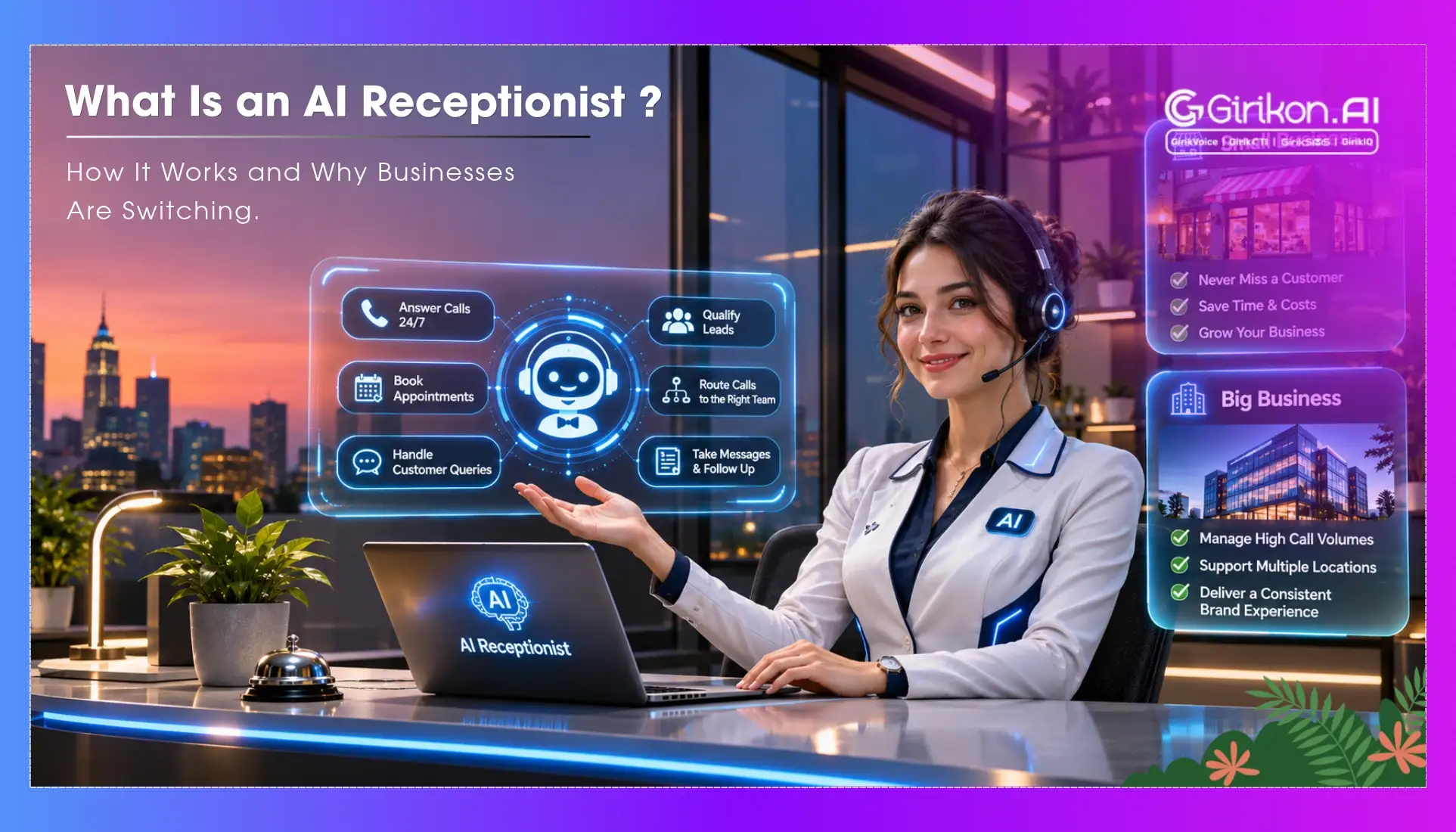
The Reality of the Front Desk
Most businesses fail to recognise the amount of damage that can occur when your front desk is not covered. No one wants to admit that lunch breaks are causing conversations to be missed, after-hours calls going into voicemail (which might be addressed Tuesday), and potential customers losing interest after waiting too long for their call to be answered. As a result, many businesses have accepted that the traditional front desk is a bottleneck and will cause issues. Using an AI voice agent has revolutionised what can be achieved.
Not only have tools been developed to address these issues, but they have matured quicker than most people realise. Many businesses that wouldn’t dream of being early adopters are using AI technology. Dental practices, law firms, real estate agencies and E-Commerce businesses all use AI tools. One example is a one-off physiotherapy clinic that found that 1/3 of their calls were coming in during treatment hours. This meant the receptionist wasn’t available to answer calls; they were going to voicemail. There was no chance of those calls being returned on the same day. We found that this resulted in a huge dip in new patient bookings. Once we had set up the AI tool, we found the calls had almost perfectly aligned with the decrease in new patient bookings that month. This was something we had blamed on seasonality for far longer than we would like to admit. The calls were also creating a backlog, meaning someone had to spend time going through the calls each morning. It is also worth saying that none of this is unusual. Most front desks are set up around the hours the staff work, rather than the hours customers actually pick up the phone. Early mornings, evenings and the lunch break are exactly when people who have jobs of their own get a chance to call, and those are the times when nobody is there.
What Happens When There’s No Coverage
To start with, it’s important to understand what will actually happen without coverage.
Whilst it is the obvious issue that calls will be missed, it is the inconsistencies, delays, and human element that cause real problems. Often the same person will be answering your calls on a Tuesday morning with patience and care and rushing to answer a call on Friday afternoon. This is not due to a lack of effort from the person answering; it’s just how things can change. If your business relies on the first interaction your clients have with you to set the tone, this can cause issues further down the line. There is also a cost that never gets mentioned. Someone who reaches voicemail will rarely leave a message, and they will rarely call back. They will simply ring the next business on the list. You never find out how many of these there were, which is why the problem is so easy to ignore.
If you are a sole practitioner or only have a small team of 5, it’s not realistic to employ someone to be a receptionist at night. This means you will miss out on the contact.
How an AI Receptionist Works
You don’t need any technical knowledge to understand how AI Receptionists work. Modern voice assistants have evolved to be nothing like the old phone trees we used to use where everyone would press zero. It is not an improved phone tree; it is based completely on a different principle.
There are a few components to consider. Firstly, there is the speech recognition. This simply turns the audio into text. Next, the language model takes the text and identifies what the caller is trying to achieve. It will also provide the response. The text is then converted back into audio using text-to-speech. If this is done well, it is difficult to tell it’s a machine providing the response. Finally, we have the integration. This will look into your calendar, CRM, Booking System, or FAQ pages and pull out the required information. Each component has improved greatly in recent years. The main factor now is speed. Everything is fast, which means you are able to have a conversation with no delays. There are no awkward pauses.
The main benefit of the AI is understanding the caller. This can be surprising. With old phone menus, you would be prompted to press 1, 2, etc. Often you would have to listen to all 4 options again as you had drifted off. If you were calling a dental practice and said you had an extraction, you would want to book an appointment. A more modern system will understand the general idea and prompt you to book an appointment. It will not ask you to repeat yourself. Understanding accents and colloquial language has also improved. There is also the matter of how people actually speak on the phone. Callers ramble, change their mind halfway through a sentence and ask two things at once. A good system copes with this reasonably well, whereas the old menus simply could not. That alone removes a lot of the frustration people associate with automated calls.
The main issue here is the integration. If your voice cannot see into your calendar it won’t really help. It will sound better than voicemail, but that’s about it. The ones that are worth investing in will be integrated into live data. This means they can book the appointment for you and tell you which appointment times are available. They can also capture a lead. If the call goes off script, the best ones will divert to a person.
Why Businesses Are Moving
The obvious reason is the cost. Having a 24/7 receptionist is expensive, and most businesses will struggle to justify this. However, if it were purely based on cost, they would have gone for an offshore answering service, as they are cheaper. There is another reason.
The biggest factor is consistency. A well set-up AI front desk will always be consistent. There are no bad days, and a well set-up system will not mumble through the response whilst looking for the correct screen. No one will be put on hold whilst they work out who to send the call to. If your front desk is mainly for volume (booking, simple questions, lead capture and routing), then this can often be more valuable than saving a small amount per call. One multi-site dental group found that having standardised responses helped avoid confusion with patients about pricing bands and insurance. There is a practical side to this as well. When a new member of staff joins, it takes weeks before they answer questions the same way as everyone else. The AI gives the same answer on its first day as it does on its hundredth, so changes to pricing or opening hours only need to be made once, in one place.
Every interaction is recorded. This can be very useful. You will know what questions are being asked the most, where the issues are arising, peak times, what type of inquiry, and what is being converted. Even the best human receptionist won’t leave you with this level of structure. Once you can see this, you can make much more informed decisions about staffing, marketing and which services to provide. A small example is the question of opening times over a bank holiday. If you see it come up twenty times in a week, you know it belongs on your website. Nobody would have noticed this from a pile of voicemails, but it is obvious from a list of transcripts.
Limitations
Anything that requires emotional intelligence or is complicated can be tricky. If someone is upset, confused, or has a unique situation, they require something that most AI reception systems can’t provide. A good system will identify this and divert; however, poor systems will try.
Accents and dialects have improved a lot but aren’t consistent. If you have trained your system on a certain type of English, you may find it struggles with regional accents and people who don’t speak English as their first language. This can cause issues. It is also worth remembering that background noise matters. A caller on a busy street or in a car will be harder to understand, and the system may need to ask them to repeat something, which can feel clumsy if it happens more than once.
| Capability | Current AI Reception Strength | Where Gaps Still Exist |
|---|---|---|
| Appointment scheduling. | Strong - integrates with live calendars. | Complex multi-step rescheduling. |
| FAQ handling. | Strong for defined topic sets. | Ambiguous or multi-part questions. |
| Lead capture. | Reliable for structured intake. | Nuanced qualification conversations. |
| Escalation to human. | Available in well-configured systems. | Timing of handoff can lag. |
| Emotional conversation handling. | Limited. | Upset or distressed callers. |
| After-hours coverage. | Consistent and cost-effective. | Jurisdiction-specific compliance nuance. |
Escalation can be an issue. There is a delay between knowing the call is outside of your scope and diverting. This can be frustrating for the caller. It can be improved but will require some setup. You will need to set this up and then regularly tweak it.
What to Consider
Most businesses will not be trying to replace a large reception team. They will be filling the gaps. After-hours coverage that they couldn’t afford to pay for and volume. Many areas won’t have had proper resources for intake. How you look at this will determine what you will be measuring. If you are filling a gap, then you are simply looking to see if your 9 pm calls are being answered. If you are replacing something that was working, then the standard is much higher.
Considerations
- Understand the types of calls you receive, how many and when. Most of the value will come from a few high volume, simple interactions. Knowing exactly what these are within your call types will give you more information than comparing vendors.
- Know where you want to escalate and set this up. Almost always the businesses that have issues with this have not considered this and left it as an afterthought.
- Run the AI alongside whatever you currently have for a period of time. This will give you genuine data. Usually within the first few weeks you will learn things about your call patterns that you wouldn’t have known.
- Regularly update your script and intent. These are not a set and forget tool. As your business evolves, new questions will arise and you will need to update the logic.
Tip: The businesses who will get the most out of this are almost always those who use the interaction log as a feedback loop. If no one is looking at the transcripts then you won’t be using the tool to its full potential.
Who is Winning
The most obvious winners are those who have a high-volume front desk with mostly transactional interactions. The cost of missing out on contact can also be measured. Healthcare-related businesses such as Dental Practices, Physio Clinics and Optometrists all fall into this category. Real Estate teams with high levels of inquiry and Professional Services businesses have always known that after-hours lead capture was an issue but have accepted this.
Many businesses will use this as a supplement to their current setup. Having an automated front desk alongside a part-time receptionist usually provides the best results. The AI will handle the volume and after-hours calls, whilst the human will handle the messy calls. Most businesses will likely use some variation of this for a while. The balance will continue to change as the technology evolves. In practice, this tends to work because each side is doing what it is best at. The receptionist is no longer tied to the phone and can spend time with the people actually standing in front of them, and the callers with more difficult needs get a person who has the time to listen.
Businesses that completely rule this out due to the slightly robotic voice or a bad experience with an old IVR system may be making a decision that will not stand the test of time. There is a huge difference between what felt robotic 18 months ago and what feels natural now. The question is whether the use case you require is covered by the current capabilities.
Many businesses will already have the answer as yes. However, they will just have a feeling it isn’t. A quick check would be to list the top 10 reasons people call your front desk. Go through and be honest with yourself about how many of these actually require a human. Most of the time, appointment rescheduling, directions, opening times, and availability won’t. If the answer is that most of them do not, then the question changes from whether it can work to how quickly you can set it up. If the answer is that most of them do, then you have learned something useful about where the technology is not yet ready for your business.
The front desk has always been a function and indicator. It tells people something about how your business runs before they even speak to you. Whether this will be an issue with an AI-generated voice, and whether people will stop caring about this, is something the industry has not fully resolved.