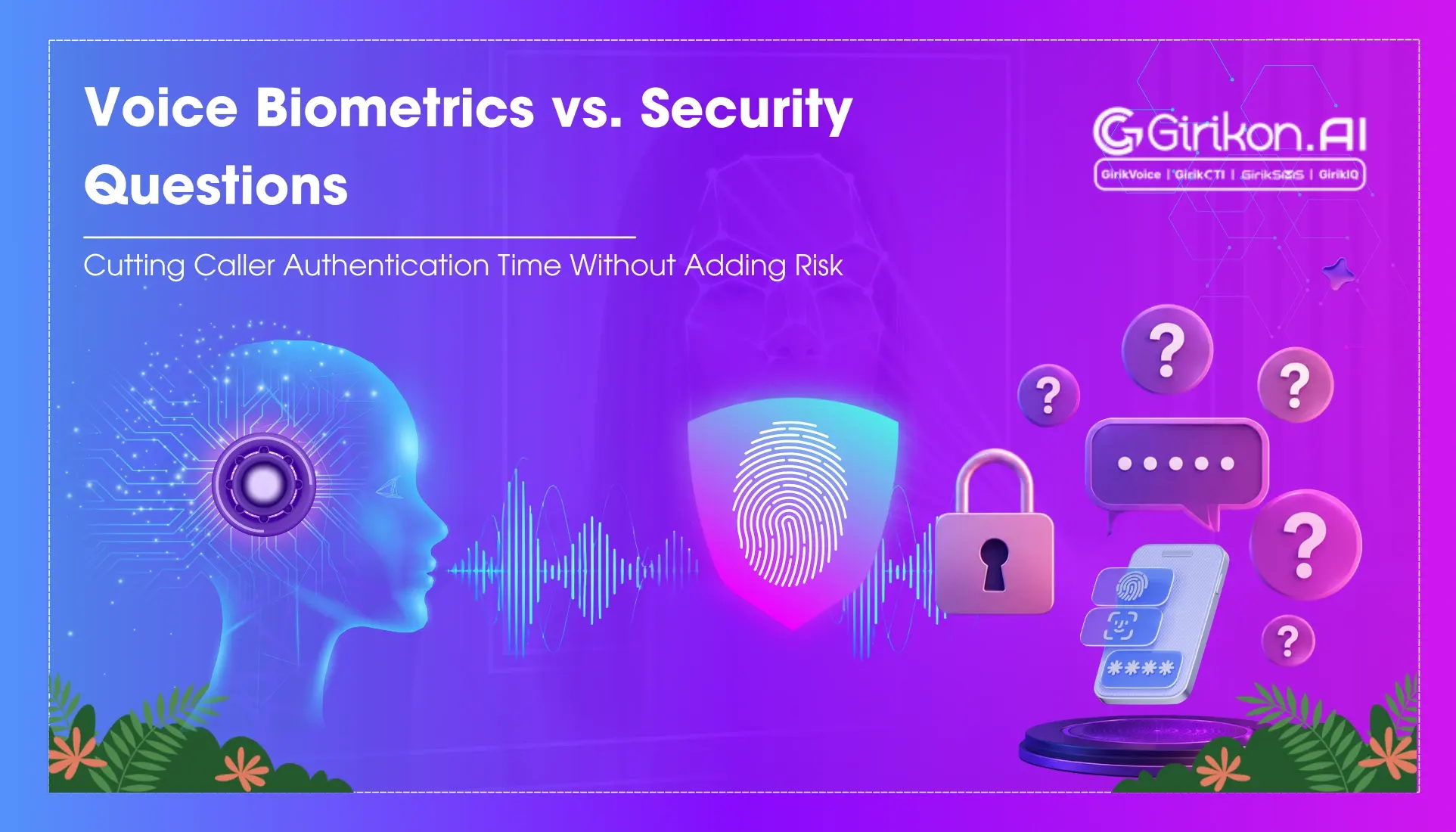
Voice authentication can make caller verification faster and less frustrating by reducing reliance on repetitive security questions. Learn how voice biometrics works, how it compares with traditional authentication, the security risks businesses need to address, and how AI voice agents can support risk-based caller verification.
- 1Implement voice biometrics to authenticate callers by analyzing vocal patterns, reducing reliance on potentially compromised security questions.
- 2Streamline caller authentication by allowing voice verification to occur naturally during conversation, thereby cutting down on call handling times.
- 3Utilize voice biometrics to lower agent workload and reduce unnecessary call transfers by speeding up the identity verification process.
- 4Mitigate the risks associated with voice biometrics, such as voice cloning, by integrating liveness detection and deepfake voice analysis into authentication systems.
- 5Transition from traditional knowledge-based authentication to voice biometrics to enhance customer experience and improve operational efficiency in contact centers.
Voice Biometrics vs. Security Questions: Cutting Caller Authentication Time Without Adding Risk
The customer contact center receives a call from someone facing a complicated problem related to their account. Before the support staff can offer assistance, they require information such as the customer’s name, ZIP code, date of birth, account number, and an answer to the security question from the customer.
This process is cumbersome for the legitimate caller. Moreover, operators have to cope with call complications, increased workload, and longer call handling times.
But what if the caller could be verified while they were speaking, rather than answering a series of questions? This is where voice biometric authentication comes in. Instead of relying entirely on information a caller knows, voice biometrics analyze unique characteristics of their voice to help verify their identity. Now, let’s understand the functioning of this process, the degree of its security, and how it is going to benefit the caller.
What are Security Questions?
Agents often need to verify customers' identity before giving them access to account information. For that purpose, they ask traditional form of knowledge-based authentication, including:
- Can you please give me your billing ZIP code?”
- “What was your first school?”
- What was your previous address?
- Can you provide your account number?
- Who was your mother’s maiden name?
These are basically security questions. However, much of this information is no longer a secret and can be exposed through social media profiles, data breaches, and phishing attacks. Also, the process becomes frustrating for both agents and customers, especially when callers forget an answer or have to respond to multiple questions before getting help, making it all clear why voiceprint authentication is essential.
How does Voice Biometric Authentication Work?
Rather than relying primarily on something a caller knows, the system analyzes characteristics of how they speak, such as:
- Vocal patterns
- Rhythm and cadence
- Speech characteristics
- Pronunciation
- Other acoustic features
It creates a voiceprint or biometric template of a customer’s voice during enrollment. So, when a subsequent interaction happens, the caller’s voice is compared against the stored voice print to determine whether it matches the enrolled profile.
Without requiring customers to stop and answer a series of questions, the authentication process can take place and help verify their identities.
Voice Biometrics vs. Security Questions: What’s the Difference?
While both methods are used for caller verification, they differ in several factors, including customer effort, speed, agent involvement, and security.
| Factor | Voice Biometrics | Security Questions |
|---|---|---|
| Authentication experience | Can happen during conversation | Require explicitly questioning |
| Speed | Potentially faster | Often slower |
| Customer effort | Low | Moderate to High |
| Accessibility | No information needs to be remembered | Caller must remember answers |
| Vulnerability | Voice spoofing and replay attacks | Information theft and social engineering |
| Primary factor | Voice characteristics | Knowledge |
| Agent involvement | Can be highly automated | Usually requires agent interaction |
| Best use | Low friction identify verification | Additional authentication or fallback |
How Can Voice Biometrics Reduce Authentication Time
In traditional authentication setup, a simplified interaction could look like:
Caller— Agent—- Multiple security questions—- identity verification—-- account assistance
At first, it may seem like a small part of a customer service call, but in reality, it is not. Every additional authentication question extends the call and takes up valuable agent time that must be invested in resolving urgent issues.
However, in voice biometric authentication, the process can become more seamless:
Caller — Voice Verification—- identify verification —- account assistance
As the voice is verified during the interaction without any halt, the time spent on identity verification can be reduced, allowing agents to resolve customer requests faster and create a smoother caller experience. Also, with fewer explicit verification steps, businesses can also ensure lower repetitive workload for agents, faster access to account information, and fewer unnecessary transfers.
Does Voice Biometrics Create New Security Risks?
Yes,
Voice biometrics is not risk free
As voice is a biometric identifier, organizations need to think about what will happen if the person tries to replay, impersonate, manipulate or generate voice. With growing risks around voice cloning and caller data security, modern voice authentication systems may incorporate controls designed to identify suspicious or artificial audio such as:
1. Liveness Detection
Evaluate whether the audio appears to come from a recording, a live person, or other additional sources.
2. Deepfake Voice Analysis
Analyze whether the characteristics of the audio are associated with voice cloned or AI-generated speech.
3. Step-up Authentication
Perform an additional verification factor for sensitive actions, even if the voice match is successful.
This is where AI voice agents can add another layer of intelligence to the caller verification process. Rather than using the same approach, the AI system can analyze the caller’s purpose and follow the needed verification steps. In case of simple questions, it may quicken the verification process and continue the conversation. However, for sensitive requests, it may redirect the call to a human agent.
Uses of Voice Biometrics in Different Industries
1. Banking & Financial Services
There are many calls from customers asking about their cards, payments, balance, transactions, and account management. In those cases, voice biometrics verify the customer easily while in the case of transfer and payment change other verification methods are needed.
2. Telecommunications
Support teams usually handle high call volumes and repetitive account related requests, where faster caller verification reduces authentication time, eases agent workload, and helps customers get their issues resolved faster.
3. Insurance
Policyholders may ask about claims, policies, payments, and personal information without having to answer repetitive identity questions. This streamlined verification allows the caller verification contact center to access the appropriate customer records faster and focus on resolving the request.
Conclusion
Voice recognition technology in the field of authentication will help call center employees verify callers in a much easier way. However, the implementation of voice biometrics technology entails applying risk-based verification processes and appropriate security measures.
This is where AI-powered voice agents of GirikVoice can help understand caller intent and automate routine voice interactions. Consider booking a free trial with GirikVoice if you want to replace security questions calls with a modern contact center.
Ready to Transform Your Voice Operations?
Deploy human-like AI voice agents that automate inbound, outbound, and customer calls at enterprise scale.