AI voice agent data privacy matters when customer conversations contain sensitive information. Learn the key questions to ask AI voice vendors about data storage, access, security, and deletion before deployment.
- 1Prioritize asking AI voice vendors data privacy questions early in the selection process, moving beyond basic functionality.
- 2Understand where customer call data is stored and processed to ensure compliance with relevant laws and business requirements.
- 3Clarify vendor policies on recording, storing, and accessing AI-handled customer conversations, including options to disable recording.
- 4Inquire about how customer conversations are used for AI training and ensure data is isolated to prevent unauthorized use in shared systems.
- 5Verify how data is protected throughout the entire conversation lifecycle, from recognition to storage, through encryption and access controls.
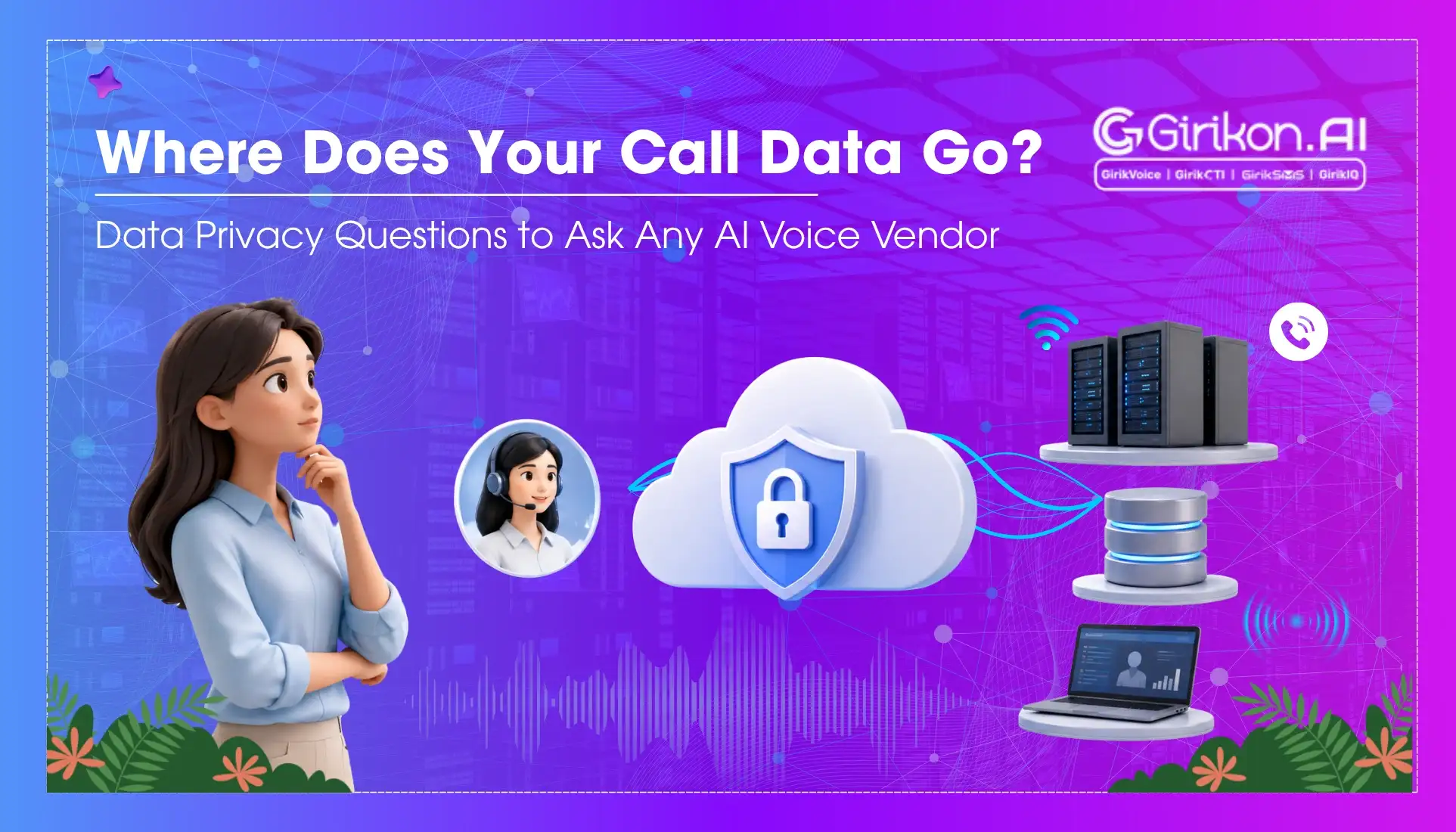
Where Does Your Call Data Go? Data Privacy Questions to Ask Any AI Voice Vendor
The first questions businesses ask an AI voice vendor are usually the easiest to answer. Can it automate calls? Does it integrate with Salesforce ? How accurate are the conversations? Can it scale as call volumes grow?
The more difficult questions often come later, sometimes after the platform has already been shortlisted. Where does every customer's conversation go after it ends? Who has access to that data? Can it be retained, transferred, or used beyond the interaction itself?
Those are the questions that concern AI voice agent data privacy. As AI voice is becoming a part of everyday customer communication, understanding what happens behind each conversation and where that conversation resides is just as important as understanding what happens during it.
Why Does Data Privacy Matter in AI Voice
Customer conversations tend to reveal information that businesses would never collect through a form alone. As AI begins handling those conversations, questions around data privacy naturally become harder to ignore. Customer conversations happen in the same way; customers naturally share situations, ask follow-up questions, share concerns, and provide context that would otherwise never be documented. That makes every conversation a richer source of business data.
As organizations adopt AI voice across sales, service, and support, protecting those conversations becomes just as important as protecting customer records. AI voice agent data privacy is not just about protection against any breach. It involves understanding how conversations are analyzed, where they are stored, which individuals have access to, and whether the business itself is always in control of its data.
This is why concerns about voice AI data residency are increasingly entering into the assessment criteria along with performance, integration, and automation capabilities. Organizations are no longer judging just the speech skills of AI agents alone. They are also evaluating how responsibly it handles every conversation after the call ends.
7 Data Privacy Questions to Ask Your AI Voice Vendor
Most vendors can walk you through conversation quality, automation capabilities, and integrations in a demo. AI voice agent data privacy is harder to see. It lives in documentation, security policies, and architectural decisions that rarely come up until something goes wrong. These questions bring it into the conversation earlier.
1. Where is your customer data stored?
Customer interactions go through a variety of channels before they are stored or deleted. Voice AI data residency provides businesses with clarity on where this data lives, what laws apply, and whether customer data is stored within approved geographic territories. A reliable vendor should provide clear insight on where voice data is processed and stored and whether businesses have control over where this data is hosted.
2. Are the AI calls recorded and stored?
The answer to ‘Are AI calls recorded and stored?’ should never be assumed. Some platforms record everything automatically. Others give businesses the freedom to develop their own policies. Before coming to any conclusion, find out how the recordings are made, how long the recordings can be stored for, who can access the recordings, and whether it can be disabled or switched off at the time of sensitive interactions.
3. Will the customer conversations be used to train AI?
Not every AI platform handles training data the same way. Businesses should ask direct questions about LLM training on customer calls, whether customer conversations are isolated from foundation models, and whether data is ever used to improve shared AI systems. Vendors should provide clear answers about consent, ownership, and how customer information is separated from model development.
4. How is the data protected throughout the conversation?
Protecting voice data goes beyond storing it securely. Conversations pass through recognition engines, business workflows, integrations, and storage services before the interaction is complete. Vendors should explain how customer information is protected during every stage of that journey through encryption, secure transmission, access controls, and continuous monitoring.
5. Who can access the customer conversations?
Privacy is determined not only by whether you have control of who sees the conversation records; it is important to know how the conversations are accessed and how every interaction is audited. An ideal vendor should be able to give detailed information about everyone who has access to recordings, transcripts, and any other customer information.
6. Can you delete customer data when you need to?
More and more privacy laws require businesses to be able to delete customer information upon request. Therefore, AI voice vendors should clearly explain how conversation records can be deleted, as well as whether it applies to backups. Businesses should remain in control of how long customer conversations continue to exist within the platform.
7. What happens during a security incident?
No system is entirely immune to security issues. What may make a big difference is how fast the vendor detects the problem, informs the customers, and reacts to the issue. Businesses need to know the vendor's incident reaction procedure, notification timeline, recovery process, and customer responsibility. These are some of the voice AI security questions that will help you assess the readiness of a vendor to deal with unexpected situations to minimize the impact on customer data and business operations.
Conclusion
The capabilities of an AI voice platform may shape the buying decision, but the way it handles customer data will shape long-term trust. Raising the right questions before deployment allows businesses to avoid making false assumptions that only prove challenging to fix later on. It also offers transparency in how customer conversations are being managed during their entire lifecycle.
Every organization has its own set of needs when it comes to operations, regulations, and security, which is why data privacy should be considered equally as much as automation, integration, and performance. In the end, AI voice agent data privacy is not simply about compliance. It is about choosing a platform that gives your business the same level of confidence in protecting customer conversations as it does in automating them.