The question tends to surface when something goes wrong - a caller complaint, an internal audit flag, or a vendor contract that suddenly includes a paragraph about Illinois law that nobody on the procurement team even remembers seeing, let alone agreeing to. Is a voiceprint biometric data under U.S. law? Here is the short version: in most of the frameworks that actually carry enforcement weight, yes it is - and the compliance architecture that gets built around that answer is messier, more state-specific, and more operationally expensive than most contact center operators expect when they first start threading voice authentication into their call flows.
The question tends to surface when something goes wrong - a caller complaint, an internal audit flag, or a vendor contract that suddenly includes a paragraph about Illinois law that nobody on the procurement team even remembers seeing, let alone agreeing to. Is a voiceprint biometric data under U.S. law? Here is the short version: in most of the frameworks that actually carry enforcement weight, yes it is - and the compliance architecture that gets built around that answer is messier, more state-specific, and more operationally expensive than most contact center operators expect when they first start threading voice authentication into their call flows.
The Illinois Framework That Became Everyone's Problem
BIPA - the Biometric Information Privacy Act - passed in Illinois in 2008 and spent about a decade being largely ignored outside the state. Then the class action lawsuits started accumulating. The critical thing to understand about BIPA is not just that it requires consent, but that it creates a private right of action with statutory damages attached. That combination - individual claims, no requirement to prove actual harm, statutory damages ranging from one thousand to five thousand dollars per violation - turned what could have been a regulatory inconvenience into something with serious financial exposure.
The BIPA voiceprint provisions matter specifically because many contact centers running voice authentication assumed their existing call recording disclosures covered them. That assumption is usually wrong. Recording a call is a genuinely different legal act from collecting a voiceprint, enrolling it in a database, comparing it against future utterances, and retaining the resulting biometric template - and BIPA treats each of those steps as needing its own written consent, its own documented retention policy, its own destruction schedule. Operations that checked their compliance posture once at implementation and never went back are frequently the ones caught off guard when the regulatory ground beneath them has quietly shifted.
Worth noting: the Illinois Supreme Court's 2023 ruling in Cothron v. White Castle found that each individual scan or transmission of biometric data could constitute a separate violation. That holding - still contested in its practical implications - means the per-call math on potential exposure gets uncomfortable very quickly for high-volume contact centers.
CUBI, Washington, and the State Patchwork That Followed
Honestly, if BIPA were the only framework in play, the compliance picture would at least be navigable. What makes this genuinely difficult is that other states have built parallel structures with their own definitions, thresholds, and carve-outs.
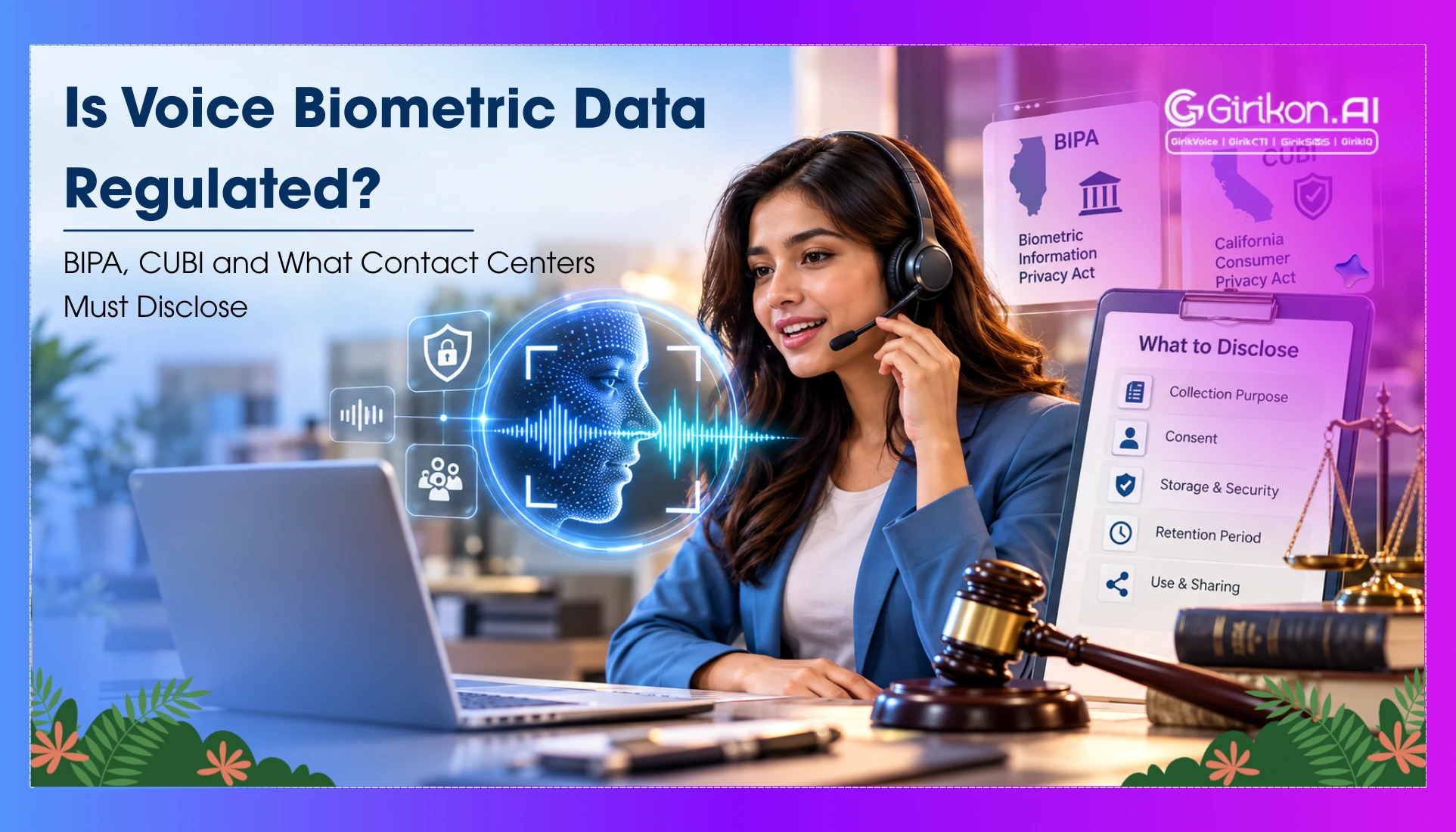
Colorado's biometric law and Washington's My Health MY Data Act introduce additional terrain. But the one getting more operational attention from contact centers recently is Texas's Capture or Use of Biometric Identifier (CUBI) statute. Like BIPA, CUBI prohibits capturing biometric identifiers - voiceprints included - without prior notice and consent. Unlike BIPA, it does not include a private right of action, which means enforcement runs through the state attorney general rather than plaintiffs' lawyers. Whether that distinction makes CUBI "softer" in practice depends on how aggressively the AG's office chooses to move, and that's still an open question.
| Statute | State | Private Right of Action | Consent Required | Destruction Policy Required |
|---|---|---|---|---|
| BIPA | Illinois | Yes | Yes - written | Yes |
| CUBI | Texas | No | Yes | Yes |
| WA HB 1493 | Washington | Limited | Yes | Yes |
| Colorado HB 23-1058 | Colorado | No | Yes | Yes |
The Washington framework, it is worth saying explicitly, came into effect with scope questions that practitioners are still working through - particularly around what counts as "biometric data" when the processing pipeline involves third-party vendors doing the enrollment and matching on the contact center's behalf. Vendor contracts matter here in ways that are not always obvious at procurement time.
What "Consent" Actually Means When Someone Calls In
Here is the thing - biometric consent calls create a workflow problem that most compliance teams underestimate until they are actually trying to implement it. To satisfy BIPA at minimum, the caller needs to be told the specific purpose for collecting the voiceprint, how long it will be kept, and who it might be shared with - and all of that has to happen before collection starts, not during or after. The caller then has to affirmatively agree. Not just fail to hang up. Actually agree.
In practice, that means the agent delivers something like a ninety-second disclosure before authentication can proceed, and the caller either agrees, disagrees, or hangs up. For inbound contact centers averaging a few thousand calls per day, the timing math on that friction compounds fast. Some operations have moved consent to the enrollment stage - a separate, pre-call digital interaction where the caller opts in before ever speaking to an agent. That sidesteps the in-call disclosure awkwardness but creates its own enrollment fallout rate and identity verification questions.
A few things worth getting right in the disclosure design:
- Who owns the delivery of the disclosure matters. If an automated IVR delivers it and the caller presses one to continue, the documentation of that interaction needs to survive a litigation hold.
- Retention policies cannot be vague. A specific schedule, tied to defined business purpose timelines, is required.
- Third-party vendors storing the biometric templates on behalf of the contact center are generally covered under the same obligations, and some courts have held that both parties share exposure.
- State-of-domicile questions are unsettled enough that running a caller through Illinois while your contact center is domiciled in Texas probably still triggers BIPA, depending on where the collection technically occurs.
Voice Biometric Privacy Law and the Federal Gap
There is no comprehensive federal biometric privacy statute in the United States right now. The American Data Privacy and Protection Act (ADPPA) cleared committee in 2022 and again in 2023 - and then stalled. What sits at the federal level instead is a loose collection of partial coverage: HIPAA handles biometric data in healthcare settings, the FTC has pushed back on certain practices through its general unfair practices authority, and financial services firms operate under GLBA on top of everything else. For the general contact center operating outside those regulated verticals, though, federal protection is genuinely thin.
That gap is what creates the patchwork condition that makes compliance hard to operationalize at scale. A contact center taking calls from consumers across thirty states needs to track which callers are governed by which state's biometric statute, maintain different consent and retention workflows for each, and update those workflows as new state laws come into effect. The alternative - applying the strictest framework uniformly - is more defensible legally but more expensive operationally.
What Disclosure Infrastructure Actually Needs to Cover
Treating disclosure as a script problem rather than an infrastructure problem is where a lot of contact center operations go wrong. The disclosure itself is the easy part. What survives an audit or a class action is the evidence that the disclosure was delivered, the consent was affirmatively captured, the voiceprint was retained only for the stated period, and the destruction actually happened on schedule. Logging the consent event, tying it to a caller identity record, retaining that log separate from the biometric template, and triggering a destruction workflow at the end of the retention period - that is the architecture underneath the disclosure, and it is the part that is still inconsistent across the industry.
Whether most organizations have built that kind of real-time, state-aware consent infrastructure is still, honestly, an open question. The technology to do it exists. The operational will to prioritize it before a lawsuit or enforcement action materializes is a different matter entirely, and that gap is probably where the next wave of biometric litigation is already being seeded.