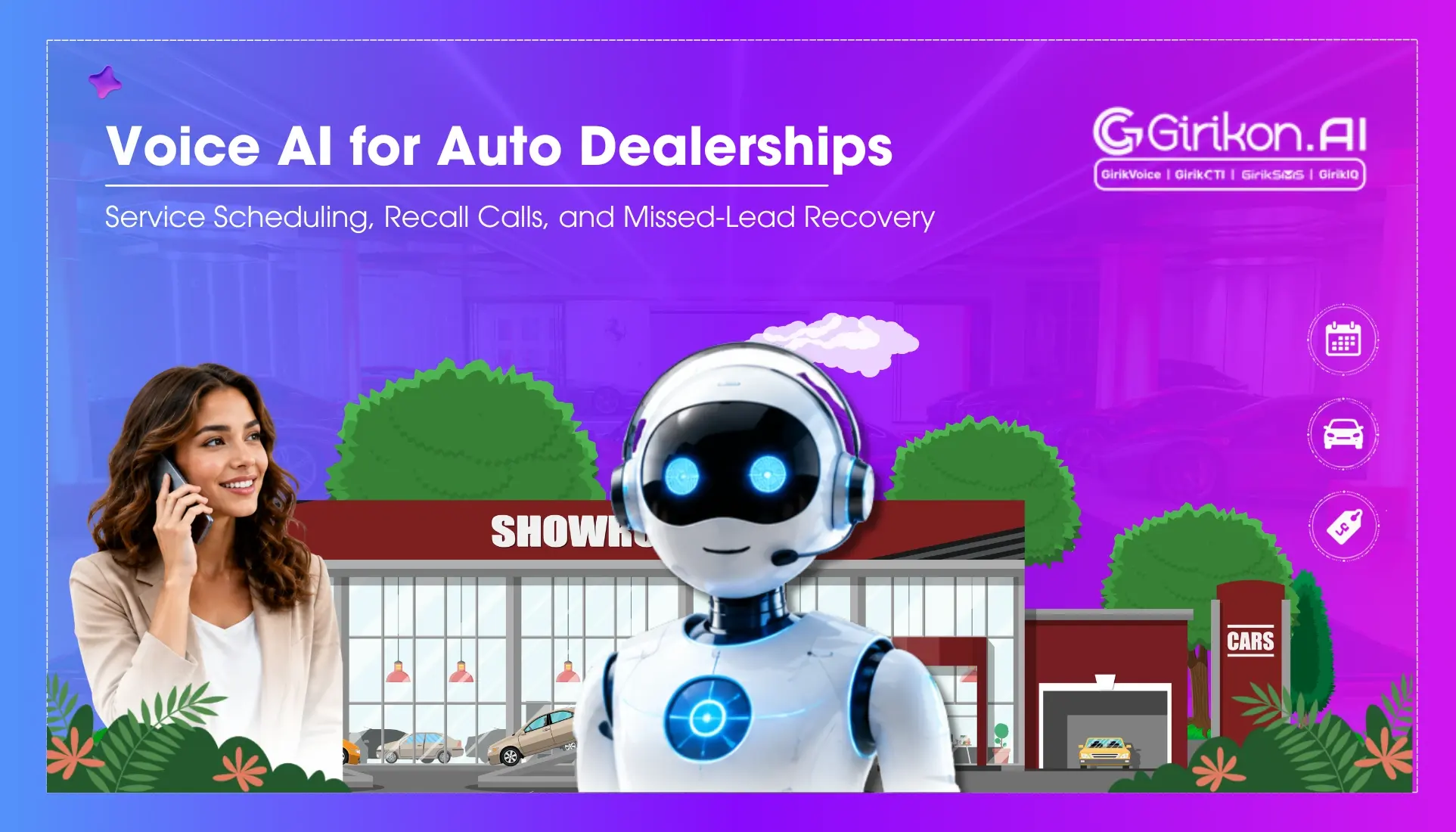
AI voice agents for car dealerships help automate service scheduling, recover missed leads, and handle recall calls while reducing the workload on sales and service teams.
- 1Automate service scheduling and recall notifications with AI voice agents to improve efficiency and customer experience.
- 2Recover missed leads by using AI to initiate faster, automated follow-up calls, preventing lost opportunities.
- 3Provide 24/7 customer support for service inquiries and appointment booking, ensuring accessibility beyond business hours.
- 4Reduce staff workload by allowing AI to handle routine calls, freeing up human agents for complex customer needs.
- 5Integrate AI voice technology with dealership systems to enable intelligent two-way customer interactions and streamline workflows.
Voice AI for Auto Dealerships: Service Scheduling, Missed-Lead Recovery and Recall Calls
How would you feel if you were put on a long hold when you called to book a service appointment with an automotive dealer? Intimidating ...right? Would you prefer waiting on hold or prefer reaching out to another dealer if the wait time was too long. For dealerships, these apparently routine calls represent opportunities that generate revenue, augment service-lane efficiency, retain customers and fortify relationships.
This is where AI voice agents for car dealerships are gaining traction. Rather than depending completely on employees to answer each call, conversational AI tackles inbound, as well as outbound interactions, book appointments, follow up with leads, and escalate complex issues to a human agent.
Research done revealed that AI adoption in 2025 emerged as a crucial differentiator for dealers, while users who engaged with chatbots reported a significant improvement in their experience.
Automotive Voice AI: All You Require Knowing
Automotive voice AI brings NLP, speech recognition, conversational AI, and dealership system integrations to allow two-way interactions with customers. Unlike traditional IVR systems that need callers to “Dial1” or “Dial 2,” AI voice agents can comprehend and reply to ordinary requests.
For instance, a customer might say, “My car engine is making a weird sound, so i need to bring it around Friday afternoon. Rather than browsing through a rigid phone menu, the AI agent can identify the customer’s intent, gather the crucial details, check the availability for service appointments, and, when integrated with the scheduling system, schedule the visit.
Automotive voice AI can also manage outbound calls. Dealerships can use AI calls for auto service to send reminders, follow up on inquiries that aren’t resolved, reconnect with missed leads, or inform available customers about recalls. This allows dealerships to handle mundane conversations on a scale while offering more time to focus on complex client needs.
The objective isn’t just to replace dealership employees. Rather, voice AI can absorb recurring interactions and enable service advisors, sales teams etc. to focus on queries that need human judgment.
- Service Scheduling Appointment Manage redundant service calls, including brake inspections, tire rotations, recalls, and more. An AI voice agent can understand the request of customers, gather vehicle details, check availability via connected dealership systems, raise complex issues to service advisors and more. By turning interactions into accomplished actions, voice AI can reduce staff workload while optimizing client experience.
- Round-the-clock Access to Service Department Dealership service departments function during fixed hours, but concerns w.r.t vehicles can arise anytime. An AI voice agent offers available channels for clients to book appointments, seek common queries, share vehicle details and request follow-up support. Rather than reaching voicemail after several hours, clients can receive instant help with assisted requests. This accessibility minimizes phone-menu dissatisfaction, optimizes response times, and ensures potential service opportunities are acquired beyond regular business hours.
- Faster Lead Follow-up: In the automotive industry speed is irreplaceable as prospects often connect with multiple dealerships at the same time. Delayed responses translated to losing valuable opportunities. Traditional follow-up includes lead identification and making calls manually - allowing prospects to slip through. Voice AI can automate this process by initiating outbound calls when new leads enter a lead management system. This follows outlined business rules and enabling faster and optimal engagement.
- Automating Recall Communications: Vehicle recalls create a communication challenge for dealerships. Getting in touch with affected customers, describing required service, and supporting appointment scheduling can use valued staff time, primarily with huge customer databases. Voice AI can modernize this process by streamlining recall outreach. An AI voice agent can get in touch with clients linked to a particular recall campaign, deliver allowed information, answer basic queries, and pave customers toward setting up the essential service appointment.
Why AI Calls for Auto Service Are Becoming Important
The value of AI calls for auto services goes beyond just answering client calls. A well-designed Voice AI solution can associate interactions with dealership systems and workflows. Besides detecting customer intent, gathering information, accessing service records, triggering follow-ups, and providing people with context when rise is required. This reduces redundant administrative tasks, augments consistency, and provides dealerships with better visibility into call outcomes.
Voice AI Should Complement Instead of Replacing Dealership Teams
Effective Voice AI solutions are meant to support people rather than replace them. Apart from empathy, judgement and technical acumen, Automotive sales and services include situations also need negotiation or decision-making. Customers dealing with complex issues such as billing disputes, vehicle purchase negotiations, safety issues might require assistance from trained reps. Voice AI should include clear rules for escalation while handling routine requirements individually while handing off customers to employees when circumstances need human intervention.
For instance, an AI can manage routine appointment requests but hand off the customer when:
- If the client asks for a human
- Interaction is a complaint
- An issue related to safety is reported
- The request falls beyond approved data
- A complex issue w.r.t billing arises
- The client needs specialized assistance
This hybrid model allows AI to manage volume while employees take care of complexity.
What is the Future of Voice AI in Retail Automotive?
As technology behind dealerships becomes ever more connected, Voice AI moves beyond basic call answering. Future applications may amalgamate voice interactions with CRM data, client history, service records, availability of appointment, marketing automation, and AI-powered analytics.
A client might eventually receive a proactive call depending on a specific event. The larger opportunity isn’t just automating phone calls. It creates a smart communication layer across the customer dealership journey. From the first sales query to routine maintenance and recall service, Voice AI can help workshops respond faster and ensure consistent engagement.
Final Words:
Voice AI helps dealerships provide faster and more convenient experiences while minimizing the pressure on sales and service teams. With dealership service scheduling automation, businesses can automate routine bookings, while missed-lead recovery helps rewire prospects. Automated recall phone calls can also augment outreach and service response. See how Voice AI can work for your dealership by handling routine interactions and improving customer responsiveness. When paired with human oversight, AI calls for auto service can take care of routine interactions while ensuring complex issues are raised to humans.