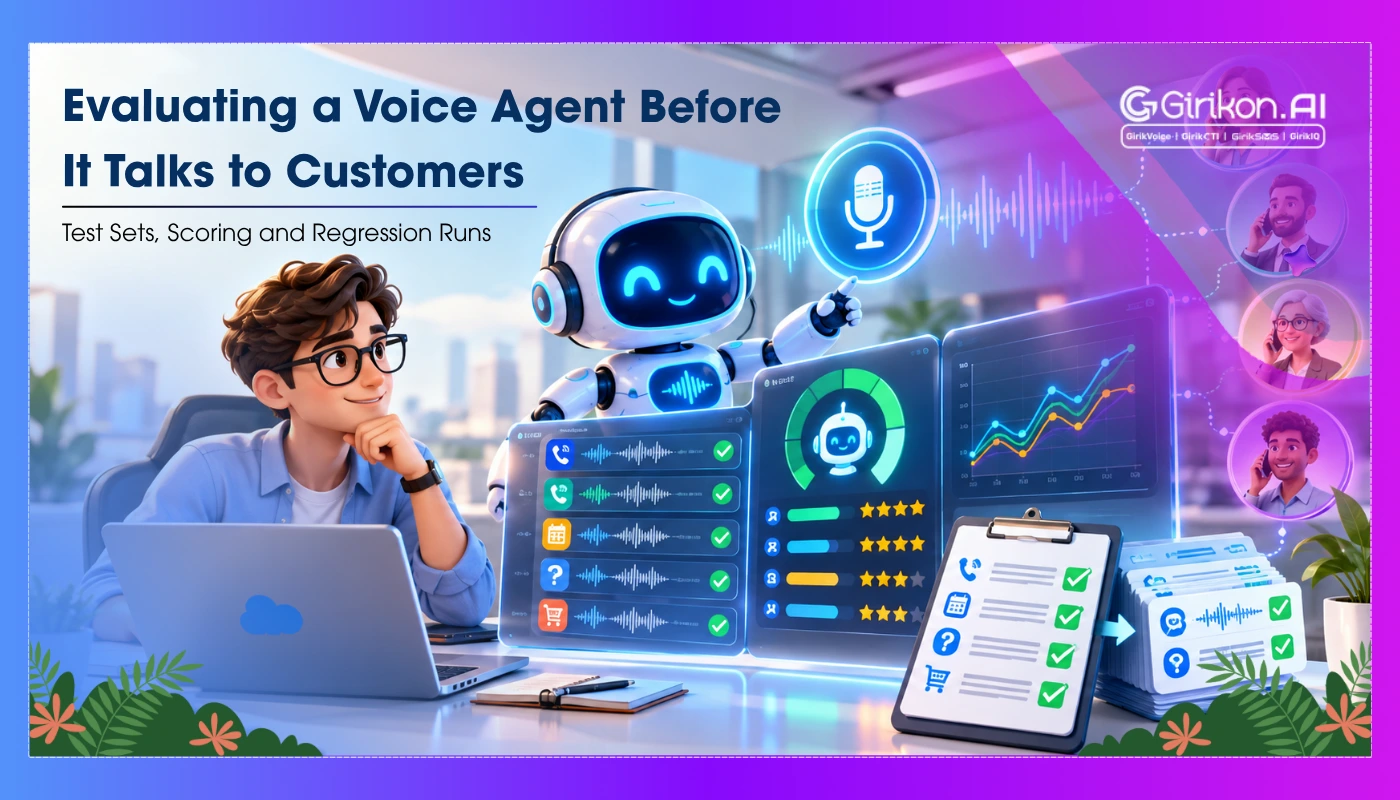
The discipline around voice agent testing has matured considerably over the last couple of years, partly because the failure modes are so much more visible than they are with a chatbot. A voice agent that stumbles on a misunderstood intent doesn't leave a text trace that someone can silently ignore. It leaves a caller sitting in confused silence, or worse, confidently receiving wrong information in a warm, reassuring tone.
Most teams building AI voice agents spend months fine-tuning the persona, the routing logic, the escalation triggers - and then do something like fifteen manual test calls before pushing to production. That's not quite as reckless as it sounds, but it's close. The discipline around voice agent testing has matured considerably over the last couple of years, partly because the failure modes are so much more visible than they are with a chatbot. An AI voice agent that stumbles on a misunderstood intent doesn't leave a text trace that someone can silently ignore. It leaves a caller sitting in confused silence, or worse, confidently receiving wrong information in a warm, reassuring tone.
Why the First Test Set You Build Is Probably Wrong
The instinct most teams follow is to write test cases based on what they expect callers to say. That's understandable - and also the problem, because what you end up with is a test set that's basically a mirror of whatever assumptions the team already had walking in. Real callers interrupt mid-sentence, use regional slang, mispronounce product names in ways that feel almost intentional, and sometimes ask two completely unrelated questions inside a single utterance. A test set built from clean, well-formed utterances is going to pass with flying colors and tell you almost nothing useful about production behavior.
Worth noting - this problem gets worse as the use case becomes more specialized. A voice agent handling insurance renewals or healthcare scheduling will encounter caller language that no internal team member would naturally generate during test design. The vocabulary that real callers use doesn't map neatly to the vocabulary the team used when writing intents.
It's not a complicated fix, honestly, but it requires some discipline that teams often skip. Seed your test set with real caller transcripts from legacy IVR logs, support call recordings, or pilot runs - even a small sample of authentic caller language, fifty or a hundred utterances, will expose gaps in intent coverage that a purely synthetic test set would never surface.
Building Evaluation Criteria That Actually Reflect the Conversation
Here's the thing about conversational AI testing: most of the metrics teams default to are borrowed from the text-bot world and don't translate cleanly to voice. Intent recognition accuracy is useful, but it's a snapshot metric. What actually matters in a voice interaction is whether the agent maintained coherence across the full turn sequence, handled an interruption gracefully, and recovered from a misunderstanding without making the caller feel interrogated - and those things are harder to capture.
A more complete framework layers evaluation across at least four dimensions.
- Intent resolution - the agent understood what the caller wanted, not just in the first turn but across the full dialogue. This matters more when the caller self-corrects mid-conversation, which happens constantly.
- Response appropriateness - the content of the response was correct, but also proportionate. An agent that delivers a ninety-second compliance disclaimer when a caller asks a simple billing question has technically responded, but has also probably lost the caller's patience and the interaction.
- Recovery from ambiguity - when the caller's input is unclear, does the agent ask a sensible clarifying question, or does it deflect to a generic "I didn't understand that" prompt? The failure rate on ambiguity recovery is usually much higher than teams expect.
- Escalation precision - the agent handed off to a human at the right moment and with the right context transferred. A miscalibrated escalation threshold either over-burdens live agents or leaves callers trapped in an automated loop they can't escape.
| Evaluation Dimension | Low Score Behavior | Target Behavior |
|---|---|---|
| Intent resolution | Misclassifies restatements as new intents | Tracks intent continuity across turns |
| Response appropriateness | Over-delivers compliance language | Matches response length to caller need |
| Ambiguity recovery | Generic fallback prompts | Targeted clarifying questions |
| Escalation precision | Escalates too early or too late | Transfers with full caller context |
The escalation precision row in the table above is the one that tends to generate the most internal disagreement, because "right moment" is partly a product decision, not purely a technical one.
AI Agent Evaluation - Scoring Models and Where Subjectivity Creeps In
The challenge with scoring voice agents specifically is that some of the most important quality signals resist automation. You can instrument intent recognition accuracy at scale. You can log fallback rates, average turn counts, task completion rates. But whether the agent's tone was appropriate when a caller disclosed a personal hardship - that requires a human reviewer, and human reviewers don't always agree.
This is where rubric design matters more than the scoring tool itself. Teams that use broad categories like "appropriate" and "inappropriate" get inconsistent scores. Teams that define specific behavioral anchors - "the agent acknowledged the caller's stated difficulty before proceeding with the transactional request" - get scores that are actually comparable across reviewers and across time.
LLM evaluation metrics enter the picture here in a genuinely useful way, though the limitation worth flagging is that LLM-based scoring is only as reliable as the rubric it's evaluating against. An LLM judge can score thousands of interactions that no human team could review, but if the rubric has gaps, the scoring inherits those gaps at scale. The volume of scoring can create a false sense of coverage.
Tip: Build your human review set and your automated scoring set as two separate artifacts. Use human review to calibrate the LLM scoring model, and revisit that calibration every time the agent's behavior changes significantly - not just when you push a new model version.
A practical minimum for production-readiness usually includes something like a held-out evaluation set of at least three hundred interactions spanning each major intent category, plus edge cases that represent the top fallback triggers from any prior pilot data available.
Running Regression Tests Without Making Them Purely Ceremonial
Regression runs are where a lot of teams lose the thread. The process gets established, the test set gets built, and then over time the regression becomes a checkbox exercise - something that's done before a release, results are reviewed quickly, and the team moves on. The problem is that voice agent behavior can drift in subtle ways that don't show up as dramatic regression failures but accumulate into a noticeably worse caller experience over time.
Simulated call testing is the layer that makes regression runs actually useful rather than performative. Running scripted dialogues through the full voice stack - including the ASR layer, not just the NLU layer - surfaces issues that text-only evaluation will consistently miss. Speech recognition errors compound in ways that aren't always obvious: a single misrecognized word early in a dialogue can knock the agent onto an entirely wrong intent path three turns later, and a text-only regression test won't catch that sequence at all.
A regression discipline that works in practice tends to look something like this:
- The core regression set is frozen and versioned alongside the agent build. When the regression set changes, that change is documented and reviewed, not quietly updated.
- Each regression run produces a comparison against the prior run, not just against an absolute threshold. A drop from 96% to 91% intent accuracy is worth investigating even if 91% clears the minimum bar.
- Any net-new intent category, or any change to escalation logic, triggers an expansion of the regression set before the change goes to production. Not after.
Honestly, the teams that execute this well are usually the ones who assigned clear ownership - one person or a small working group whose role includes the health of the evaluation infrastructure, not just the health of the agent itself.
The Part Nobody Talks About: Test Set Decay
Test sets go stale. Caller behavior shifts, product offerings change, and the language callers use to describe their problems evolves faster than most teams expect. A test set that accurately represented caller behavior eighteen months ago may now systematically undertest a whole category of interactions that have become common.
This is less about the evaluation tooling and more about building a feedback loop from production back into the test infrastructure. Some teams do this well by routing a sample of live interactions through a review queue specifically designated for test set enrichment - not for immediate quality scoring, but for identifying language patterns and topics that the existing test set doesn't cover.
The tension that never fully resolves is timing. By the time you've identified that your test set has a coverage gap, you've usually already deployed an agent into production that has that same gap. The regression runs are looking backward at a snapshot of behavior, and the production environment is already somewhere else. That lag is probably the most honest unsolved problem in this discipline, and tooling improvements alone aren't going to close it.
```