This article is about that exact situation: what decent observability infrastructure actually gives you when something goes sideways in a live voice agent, and why most teams are still assembling their debugging picture from pieces that were never designed to fit together.
There is a particular kind of dread that comes with a 3am Slack message that reads "customers are complaining the bot hung up on them." AI agent monitoring - in theory - is supposed to catch this before it reaches a Slack message at all, and yet here we are, staring at a wall of undifferentiated log data trying to figure out which call, which utterance, which handoff broke the chain. This article is about that exact situation: what decent observability infrastructure actually gives you when something goes sideways in a live voice agent, and why most teams are still assembling their debugging picture from pieces that were never designed to fit together.
Why Voice Is Harder to Debug Than You Probably Expect
Text-based chatbots have it comparatively easy. The input is discrete, the output is discrete, and the failure modes are usually visible at the application layer. Voice is messier in ways that matter at 2am - layered over speech-to-text accuracy issues, layered over intent classification errors, layered over latency spikes in the audio pipeline, layered over whatever the telephony carrier decided to do with jitter that particular evening. Each of those failure layers produces its own signal, and none of them are naturally correlated unless someone designed the system to correlate them.
The honest version of this situation is that most teams didn't design that correlation in from the start. They bolted in a logging library, maybe added some tracing middleware after a bad incident, and then built workarounds for the gaps. Which is fine - that is how real engineering happens - but it means that when the failure arrives, it arrives without a clean thread to pull.
What a Proper Call Trace Actually Contains
When something breaks in an AI voice agents conversation, the thing teams usually want is a replay of the full interaction: audio, the transcript the system was working from, the intent scores at each turn, and the system decisions that followed. What they usually have instead is some of that, spread across three or four places, with timestamps that almost match.
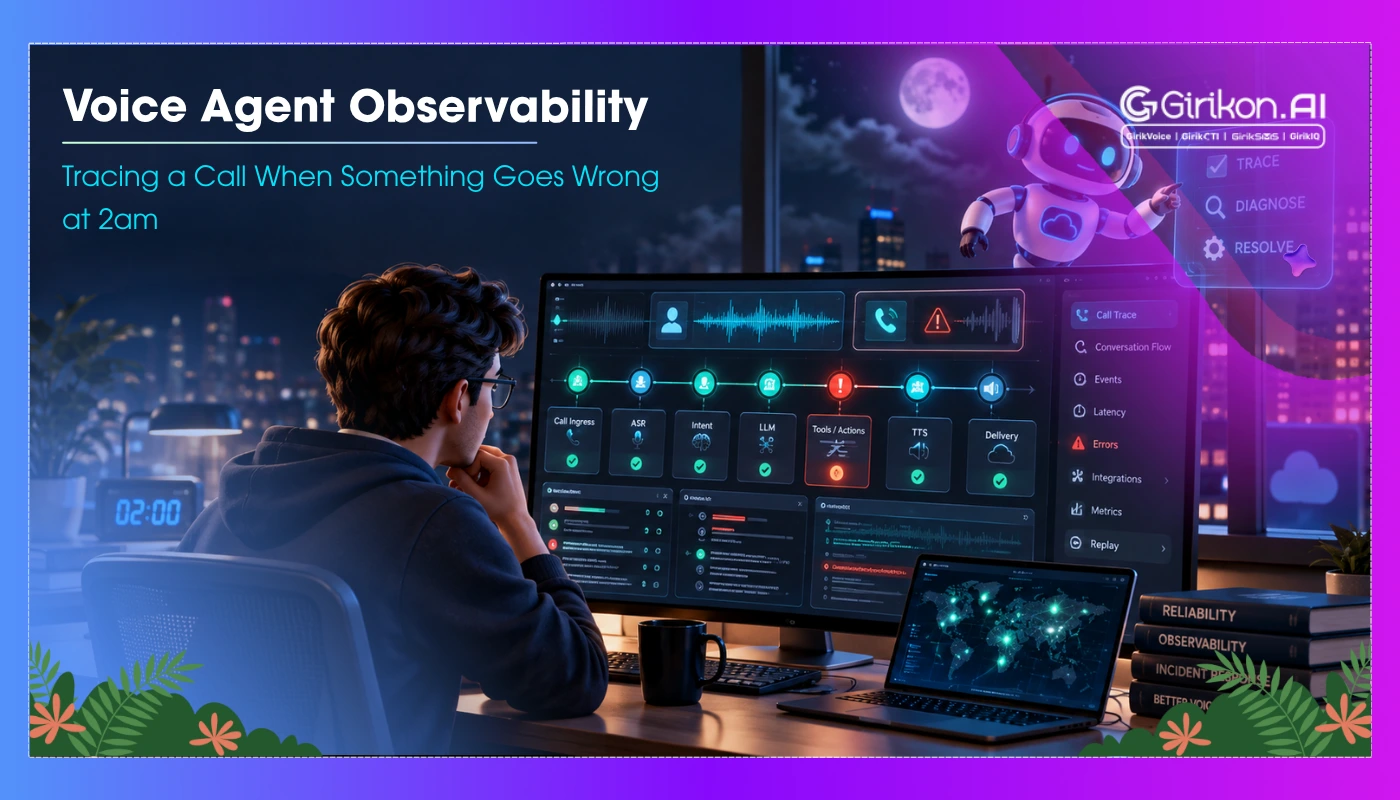
Voice agent logs are the piece most teams treat as sufficient - and that's the mistake. The logs show what the application decided, sure - but they won't tell you why the speech-to-text layer handed it a garbled transcript. Or whether model latency on turn six was what actually kicked off a timeout that quietly misrouted the call. Those are different failure modes and they sit in different places. A proper trace has to span the full audio-to-action path - telephony layer, ASR provider, NLU or LLM inference service, whatever downstream CRM or handoff API got invoked - all of it, connected. Not summarized, not sampled. Stitched.
Worth noting: the correlation ID is everything here. One consistent session identifier threading through every one of those layers is the difference between a thirty-minute debugging session and a three-hour one. Teams that get this in place before the first production incident - not scrambling to add it after - are the ones who actually sleep through the night when something minor breaks.
AI Agent Observability - The Architecture Behind the Visibility
This is where the category gets more interesting, and more contested. The conversation around this discipline has evolved from "did the agent respond" to something considerably more nuanced: did the agent respond with the right intent, in a reasonable latency window, without hallucinating a policy that doesn't exist, without cutting off the caller, and in a way that moved the conversation toward resolution rather than abandonment.
Those are different questions. They need different instrumentation. And instrumenting for all of them at once is not something any single vendor has fully solved - though several are trying.
The table below is a rough representation of what observability coverage tends to look like across different maturity levels:
| Observability Level | What Gets Captured | What Typically Gets Missed |
|---|---|---|
| Basic logging | Application decisions, errors | ASR errors, latency by layer |
| Intermediate tracing | Session IDs, turn-by-turn decisions | Audio quality, carrier signals |
| Full call trace | End-to-end with audio and transcript | Business outcome correlation |
| Mature observability | All of above plus failure pattern detection | Honestly, model drift over time |
The "mature observability" row is the one most teams are still working toward - and the gap between intermediate tracing and full call trace visibility is where most 2am incidents live.
How Tracing Works in Practice
Call trace debugging is not a single action. In reality it's a sequence - find the session, track down the correlated logs scattered across systems, rebuild the turn sequence, then work backward from wherever the thing broke. That's the loop. And it's rarely as clean in practice as any runbook makes it look.
A structured approach that works for most teams:
- Start with the outcome signal - the complaint, the drop, the misroute - and use the session ID to pull every log entry associated with that call. If your session IDs are inconsistent across layers, this step alone can take the majority of your time.
- Reconstruct the transcript as the system saw it, not as the caller said it. The gap between those two things is often the entire explanation - an ASR error on "cancel" that got read as "transfer" will look like an intent classification failure until you see the raw transcript.
- Check latency between turns, specifically at the inference and API layers. Timeouts that the system handled silently are some of the more reliably missed failure causes - the system moved on, the caller didn't.
- Look at what the agent returned just before the failure point. Opinion here: most teams stop at identifying the break and don't ask whether the preceding agent turn set up the failure - an unnecessarily long confirmation message, for example, will sometimes push a caller into speaking over the agent and creating an overlap event that the ASR reads incorrectly.
- Review the escalation or handoff signal if the call ended in transfer. Transfers that happened without the right context being passed downstream are a category of failure that only becomes visible when someone checks what arrived at the receiving end.
The Thing About Replaying Calls
Conversation replay tends to get described as a quality assurance feature, and it is - but framing it only as a QA tool undersells what it actually does for debugging. When a team can play back a call with the transcript, intent scores, and API call waterfall visible alongside the audio, the failure identification that used to take hours compresses significantly. Not to zero - there are still inference calls to make, context to reconstruct - but the cognitive work of figuring out what the system experienced is mostly done for you.
The caveat worth naming is that replay is only as useful as the completeness of what was captured. Teams that are capturing audio but not the ASR confidence scores are replaying an incomplete picture. Teams that have transcript and intent scores but no latency data are missing the performance dimension - the part that often explains why an intent got classified correctly and the response still bombed. Tooling around conversation replay has gotten noticeably better in the last couple of years, that's fair to say, but there's almost always at least one gap still sitting in the implementation somewhere.
Tip for teams setting this up: store the raw ASR output alongside the final transcript, not just the processed version. The difference between the two is diagnostic information - it disappears the moment you only keep the cleaned result, and you won't know you needed it until you do.
The Real Problem - Between the Layers
Honestly, the underlying issue is not that teams lack debugging tools. Most teams have logging. Many have tracing. The gap is almost always in the seams between systems - the place where the telephony layer hands off to the ASR provider, or where the LLM inference response has to arrive inside a latency window the audio pipeline doesn't know it's enforcing.
Those seams are where call failures are born, and they are also where conventional observability coverage tends to stop. The telephony carrier's telemetry lives in the telephony layer. The ASR confidence data lives in the ASR layer. The application logic lives in the application layer. Getting a coherent view across all three is a stitching problem more than a tooling problem - and the stitching requires deliberate architecture choices that most teams make too late.
The industry is gradually moving toward unified observability planes that span these layers, and there are platforms doing genuinely useful work in this space. But the adoption curve is slow, partly because voice AI is still a young enough discipline that the observability expectations haven't fully crystallized yet. Teams are still discovering what they need to be measuring by finding out - usually at 2am - what they should have been measuring all along.