The per-minute rate is only part of what an AI voice agent really costs. Discover the hidden expenses behind telephony, integrations, compliance, QA, maintenance, and escalation—and how to build a more accurate AI voice agent TCO model.
- 1Understand that per-minute pricing for AI voice agents is only a fraction (around 20%) of the total cost; account for hidden expenses.
- 2Factor in separate costs for telephony infrastructure, which can add 15-25% to the base AI rate.
- 3Budget for engineering resources for integration, as connecting to CRMs and other systems is often an engineering task, not just configuration.
- 4Recognize that the "cost per call" involves multiple stacked layers, including voice synthesis, speech recognition, and telephony gateways, each with its own costs.
- 5Include costs for escalation handling, fallback, quality assurance, prompt tuning, compliance, and security, as these are rarely included in initial per-minute quotes.
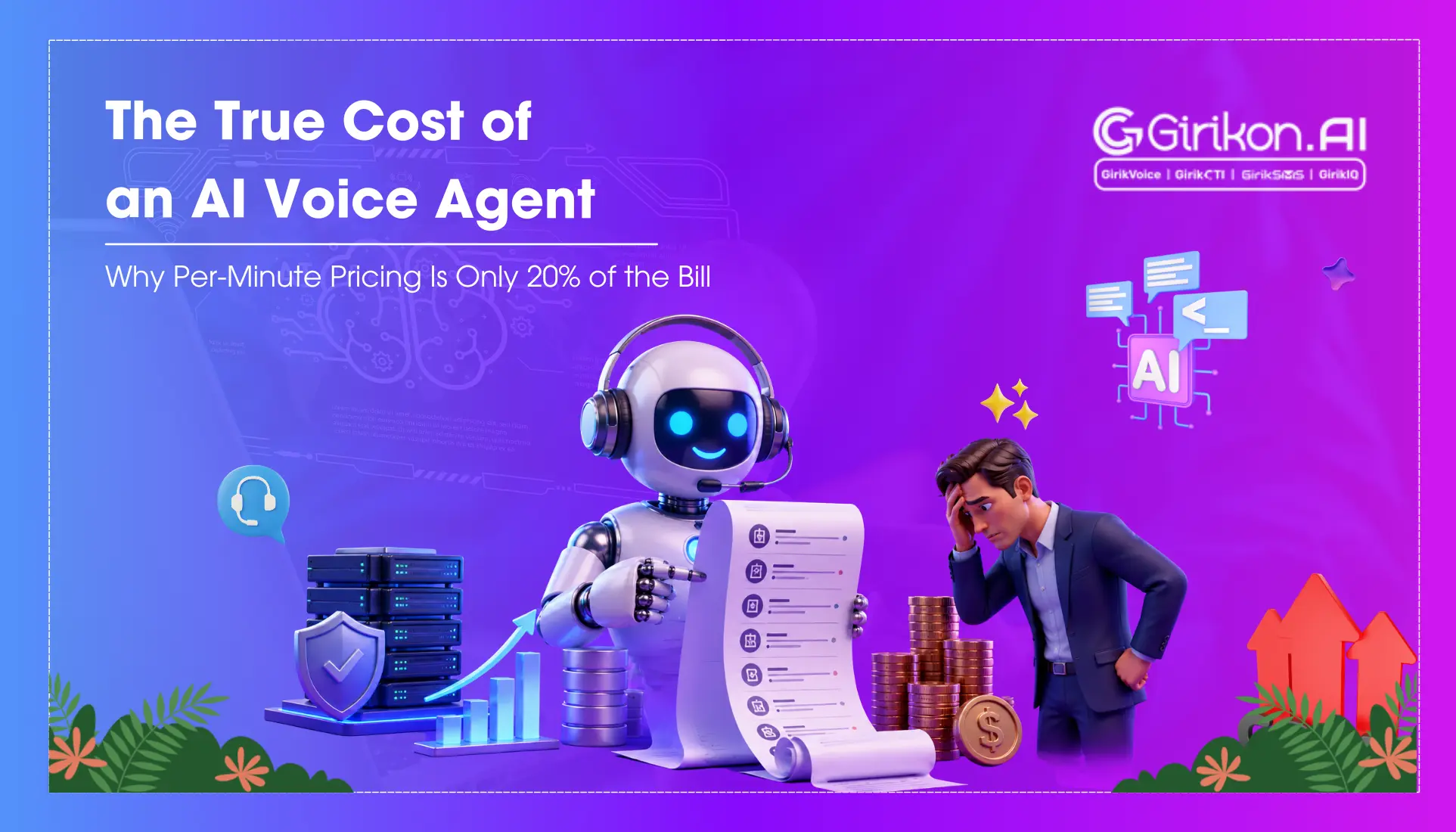
The True Cost of an AI Voice Agent: Why Per-Minute Pricing Is Only 20% of the Bill
Most conversations about voice AI pricing start and end at the per-minute rate. Which is understandable - it's the number vendors put on their pricing pages, it's the number that shows up in RFPs, and it's the number that gets dropped into spreadsheets during the buy vs. build debate. But the AI voice agent cost per call figure is almost never the number that determines whether a deployment is actually profitable. The organizations that discover this late - usually somewhere around month four or five of a live deployment - tend to describe the experience in fairly colorful terms.
Worth flagging early: this isn't a complaint about vendor transparency, exactly. It's more that the full cost picture is genuinely hard to communicate in a pricing page format. Several cost categories only become visible at scale, or after integration, or after the first compliance review. None of that is conspiracy. It's just the nature of a technology stack that sits at the intersection of telephony, AI inference, CRM integration, and regulatory obligation - all at once.
What Actually Drives AI Voice Agent Pricing Beyond the Rate Card
The per-minute rate tends to cover the AI inference layer and basic telephony access. Sometimes it includes voice synthesis. Occasionally it bundles in limited concurrent call capacity. But the rate card stops there.
Here's what typically doesn't make it onto the rate card.
Telephony infrastructure - the actual carrier layer underneath the AI platform - is almost always metered separately, or absorbed into a platform margin that isn't broken out. Depending on call volume and routing complexity, this can add fifteen to twenty-five percent on top of the stated AI rate before any other variables appear.
Then there's the integration layer. The failure mode most buyers walk into is assuming the CRM or ticketing system connection is a configuration task, not an engineering task. Honestly, for simple use cases on well-supported platforms, it sometimes is. But anything involving custom objects, authentication complexity, or real-time data writes tends to require engineering hours that weren't in the original estimate. That gap - between "API-connected" as a feature and "API-connected" as a working system - is where a lot of budget surprises live.
Latency and fallback handling matter here too. When the AI can't resolve a call, that call has to go somewhere. Building a well-designed escalation flow, which every serious deployment needs, isn't usually bundled into per-minute pricing. It's a workflow cost, a QA cost, and sometimes a staffing cost, layered over whatever the AI platform itself charges.
The Hidden Infrastructure Stack Behind Every Call
One of the uncomfortable patterns in voice AI hidden costs analysis is that every call actually passes through several billable or cost-bearing layers, not one. The AI platform sits at the top. Below it is a voice synthesis service (often licensed separately from the conversation AI), a speech recognition layer (ditto), a telephony gateway, and whatever data systems the AI needs to query mid-call. Each layer has its own cost structure, its own latency contribution, and its own failure mode.
What this means practically is that the "cost per call" a vendor quotes is usually describing one layer of a four-or-five-layer stack. The remaining layers are either charged through separately, bundled into a platform tier that comes with different usage limits, or handled by the buyer's own infrastructure - in which case the cost is real but invisible in the vendor invoice.
Roughly speaking (and these ranges vary substantially by vendor, use case, and call complexity), the per-minute AI rate often represents somewhere between fifteen and twenty-five percent of fully loaded call cost at realistic enterprise deployment scale. Which is where the "20% of the bill" framing in the title comes from. It is, genuinely, approximately right - though the exact figure shifts depending on how aggressively a buyer has negotiated carrier rates and whether integration was handled in-house or outsourced.
| Cost Category | Typical Share of Total Cost | Visibility in Standard Pricing |
|---|---|---|
| AI inference / per-minute rate | 15-25% | High - usually quoted |
| Voice synthesis and STT | 10-15% | Medium - sometimes bundled |
| Telephony / carrier layer | 15-25% | Low - often separate |
| Integration and orchestration | 15-20% | Very low - usually professional services |
| QA, monitoring, prompt tuning | 10-15% | Very low - usually internal cost |
| Compliance and security overhead | 5-10% | Rarely quoted |
| Escalation handling and fallback | 10-15% | Almost never quoted |
The integration row in that table tends to be the one that surprises teams most at the point-of-invoice. Not because it's the largest category, but because it was often treated as a one-time cost in the original plan, and then quietly became an ongoing cost as the deployment evolved.
Compliance, Security, and the Costs That Arrive Uninvited
There's a version of this conversation that skips regulatory cost entirely, which is a fine approach right up until it isn't. For deployments that handle customer PII, payment information, or anything touching healthcare data, the compliance overhead becomes a real and recurring cost category. Call recording consent management, data retention controls, audit logging - these aren't features that come standard on every AI voice platform at every tier.
In regulated industries, the cost of configuring and maintaining compliance controls can equal or exceed the ongoing AI inference cost, particularly in the first twelve months when the governance framework is still being built out. That's not a reason to avoid deployment. It's just a tension that a lot of initial ROI models underestimate, sometimes significantly.
The Prompt Tuning and Model Maintenance Reality
Something that rarely appears in vendor documentation is how much ongoing work goes into keeping a voice AI deployment performing well after launch. Prompt engineering isn't a one-time task. Conversation flows drift as product information changes, edge cases accumulate, and caller behavior shifts. The teams that treat deployment as a finish line tend to see performance erode within three to six months.
That maintenance work - ongoing prompt tuning, regular QA review, fallback audits - is a real cost. Whether it's borne by an internal team or outsourced to the vendor's professional services group, it belongs in the AI voice agent total cost of ownership calculation. Leaving it out doesn't make it go away. It just makes the annual cost look lower than it actually is until someone looks carefully at where the hours are going.
A Practical Framework for Building a Real TCO Model
For teams working through a deployment decision, a more complete cost model tends to look something like this.
- Start with the vendor's per-minute rate but treat it as a floor, not a number. Add carrier and telephony costs as a separate line item and get a real quote from the carrier layer - not an estimate from the AI vendor.
- Map every system the AI needs to touch mid-call. For each one, get an engineering estimate on integration work, then double it. This sounds cynical but is closer to accurate than the initial estimate will be.
- Build a compliance cost line based on the regulatory environment specific to the industry and geography. A retail deployment looks very different from a healthcare one, and the delta in compliance cost is substantial.
- Estimate ongoing maintenance at somewhere between ten and twenty percent of initial build cost per year. More if the use case is complex or the product/service information changes frequently.
- Include a real escalation cost. Every call that the AI doesn't fully resolve has a cost. Model that at realistic deflection rates rather than best-case ones.
Worth flagging here: vendors will sometimes include "expected deflection rate" figures in their ROI calculators. Those figures are based on their best-performing deployments, not median ones. Using them in an internal business case without adjustment creates a credibility problem when actuals come in.
What the Market Is Getting Wrong About This Category
The per-minute framing persists partly because it's convenient and partly because it benefits vendors in the evaluation phase - lower apparent cost makes the case for adoption easier. But it also persists because buyers haven't pushed hard enough for fully loaded cost disclosure during procurement. That's changing, slowly, as more organizations reach their second or third renewal cycle with an AI voice platform and have real actuals to compare against.
The organizations that have done this honestly - built a proper TCO model before deployment and revisited it after twelve months of actuals - tend to find that the technology still delivers positive ROI, but through different mechanisms than originally modeled. Deflection rates matter less than conversation quality in the long run. Integration depth matters more than call volume. The maintenance cost ends up being the number that determines whether the unit economics actually work at scale.
None of that makes AI voice a bad investment. It makes it a more complicated one than the rate card suggests - and whether the industry develops better cost transparency tooling or just keeps cycling through buyer surprise and vendor renegotiation is a genuinely open question right now.