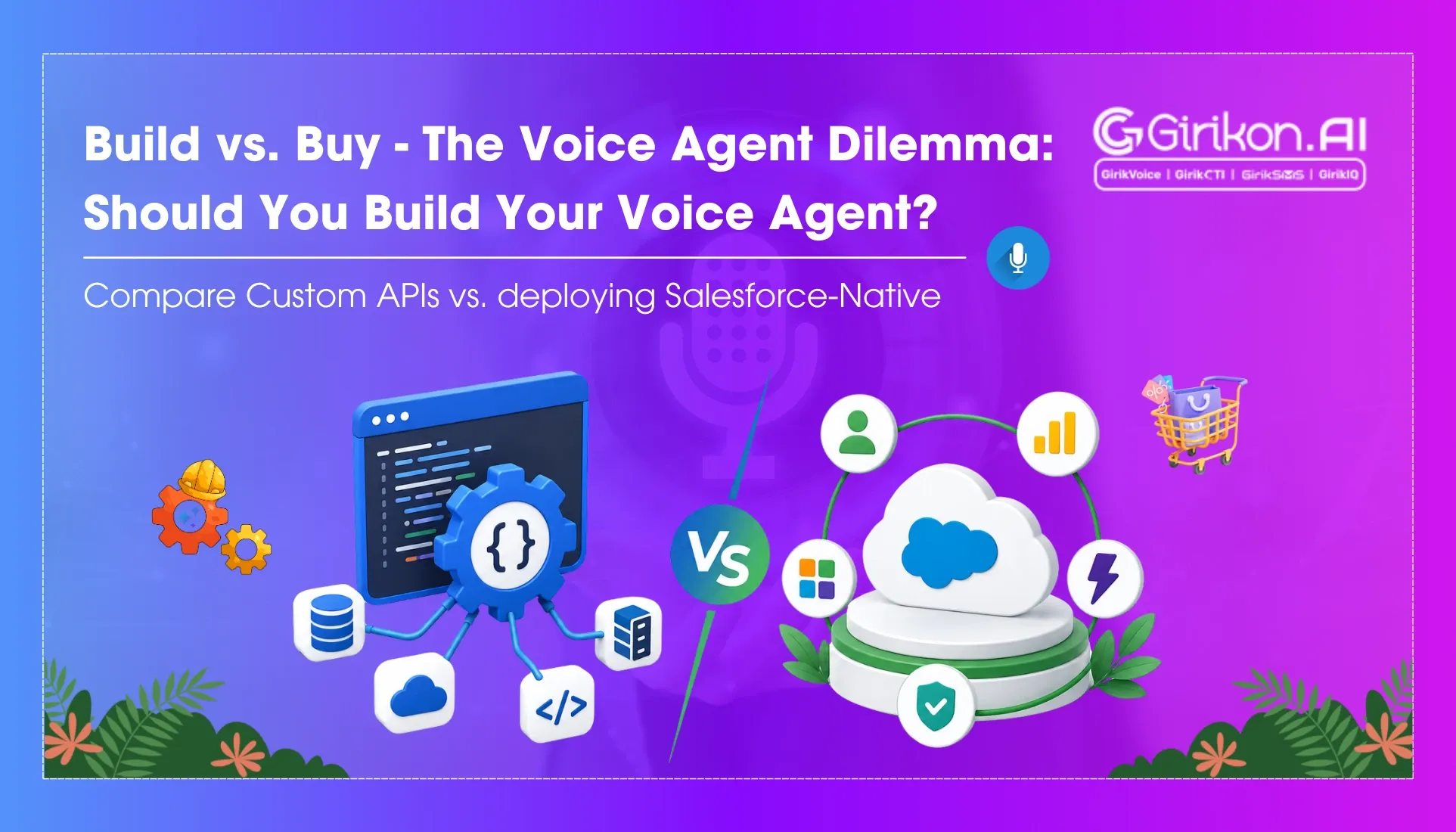
The build vs buy AI voice agent debate is becoming more important as businesses adopt conversational AI. Learn how Vapi vs managed voice AI compares in terms of flexibility, CRM intelligence, deployment, scalability, and custom voice agent development cost, so you can choose the best solution for your enterprise.
- 1Evaluate your business priorities, technical skills, and goals to decide between building a custom voice agent with Vapi/APIs or deploying a Salesforce-native solution.
- 2Choose to build with Vapi/APIs for maximum flexibility and control over conversation design and integrations, but be prepared for increased architectural and maintenance decisions.
- 3Opt for a Salesforce-native voice AI to leverage existing CRM data, streamline deployment, and reduce integration complexity by extending your current Salesforce ecosystem.
- 4Consider customization needs: building offers granular control over prompts and logic, while Salesforce-native provides configuration-driven flexibility within a governed framework.
- 5Prioritize data grounding by selecting Salesforce-native for inherent access to customer data and workflows, whereas building requires custom integrations to retrieve this context.
Build vs. Buy: Assemble a Voice Agent on Vapi/APIs or Deploy a Salesforce-Native Voice AI
The evolution and widespread adoption of AI voice agents have redefined how organizations approach their customers. Businesses are not just considering the usage of conversation AI; they're considering how to implement one. This is where the question build vs buy AI voice agent sparks the debate. Should your team assemble a custom solution using platforms like Vapi and multiple APIs, or should you deploy a Salesforce-native Voice AI solution that works directly within your CRM ecosystem?
The answer depends on your business priorities, internal technical skills, and business goals. Although developing your own voice AI gives you flexibility, opting for a Salesforce-native solution saves you time, effort, and money.
This guide explores both approaches, delving into various implications, and what to take into account when making an investment.
Understanding the Two Approaches Toward Voice AI Implementation
Organizations that are currently considering voice AI technology find themselves facing the same challenge – automating customer interactions without compromising on quality, reliability, and business relevance. The distinction is in the way they decide to do it.
Building a Voice Agent with Vapi and APIs
The build model provides organizations with the liberty of building a voice AI solution from scratch. A typical architecture would consist of the telephony service, speech-to-text functionality, text-to-speech functionality, large language models, the orchestration layer, and back-end integrations. Platforms such as Vapi make the process easier by offering the necessary infrastructure for the calls and agents, allowing for more time to be dedicated to the design of conversations and business logic.
Flexibility is one of the factors behind the growing discussion around Vapi vs managed voice AI. Organizations get the chance to use components as per their preferences, control the conversation flow themselves, and customize everything according to business needs. At the same time, this solution involves making more decisions regarding architecture, integration, and support.
Deploying a Salesforce-Native Voice AI
There is another way of approaching the implementation of a voice AI layer - deploying a voice AI solution that works directly inside the Salesforce ecosystem. Organizations do not need to build their own tech stack and choose to use native Salesforce solutions. All the relevant integrations already exist within the platform: customer data, automation, reporting, and communication channels. Thus, the voice AI layer becomes an extension of the existing setup.
This approach prioritizes operational alignment and faster deployment. Customer interactions, CRM data, and business workflows remain connected within the same environment, reducing integration complexity while avoiding many of the long-term uncertainties often associated with custom voice agent development costs.
Build vs Buy AI Voice Agent: Comparing the Two Approaches
Often, the decision to build vs buy AI voice agent rests on architecture, ownership, and operation issues. While both approaches create a successful voice AI experience, they also have significant differences across various areas as below.
| Comparison Area | Vapi / API-First (Build) | Salesforce-Native (Buy) |
|---|---|---|
| 1. Customization and Control | Gives direct control of prompts, conversation logic, calling tools, integrations, and workflow behavior. This lets teams create truly personalized services based on their specific business requirements. | Customization is largely configuration-driven through Salesforce tools, Flows, and platform capabilities. Organizations gain flexibility within a governed environment while reducing the engineering effort required to maintain custom conversational logic. |
| 2. Data Grounding and CRM Intelligence | Customer context must typically be retrieved through integrations with CRM systems, databases, and external applications. Accessing business information across different systems often requires custom development and system integrations, adding time and complexity. | Voice AI uses the customer data, service history, cases, and workflows already available in Salesforce. This minimizes integration work and ensures conversations stay connected to the latest CRM information. |
| 3. Telephony and Handoffs | Offers flexibility in selecting telephony providers and designing escalation logic. However, call routing, human handoffs, and support workflows generally require custom implementation and ongoing operational management. | Works alongside existing Salesforce service processes and routing frameworks. Escalations, transfers, and agent handoffs can remain connected to customer records and service workflows without extensive custom development. |
| 4. Development Time and Maintenance Burden | Initial deployment can move quickly, particularly for technically capable teams. Over time, monitoring, upgrades, provider changes, testing, and governance contribute to the broader custom voice agent development cost beyond the initial build. | Implementation needs proper platform preparation and configuration, but most of the infrastructure, governance, and workflow structure are already there. This tends to help save effort on maintenance associated with multiple technologies. |
| 5. Scalability and Operational Overhead | Scaling often involves coordinating additional integrations, monitoring systems, provider relationships, and infrastructure decisions. These considerations represent common API first voice AI tradeoffs as voice AI deployments expand. | Scalability benefits from operating within an established platform ecosystem. Administrative controls, reporting, security, and workflow management continue to be centralized, minimizing any additional complexities that might arise as adoption increases. |
Where Each Approach Makes More Sense
The factors that influence this decision extend beyond technology. Internal resources, ownership preferences, deployment timelines, and operational responsibilities often play an equally important role.
Consider building if:
-
You have a strong engineering team.
-
Highly customized conversational logic is required.
-
Voice AI is central to your product or service.
-
Complete architectural control is important.
-
You can manage the ongoing responsibilities that come with API first voice AI tradeoffs.
Consider buying if:
-
Salesforce is already your CRM.
-
Speed to deployment matters.
-
Lower operational overhead is a priority.
-
Your teams prefer configuration over coding.
-
Business users need to manage workflows independently.
Conclusion
The barriers to adopting voice AI are falling, but the decisions around its implementation choices are becoming more strategic. The discussion is now not about whether a voice-based AI agent can be built or bought but about how well it will fit into the existing workflows. Voice AI is becoming more and more sophisticated; the organizations that will benefit from it the most will be those that clearly understand what it needs to do.