Following a merger, managing multiple Salesforce orgs can create challenges around licensing, call routing, and customer interaction history. A well-defined multi-org strategy helps businesses streamline user access, optimize license utilization, maintain seamless call distribution, and ensure consistent visibility into customer conversations. Explore how to manage multiple Salesforce environments effectively while preserving operational efficiency, improving collaboration, and delivering a unified customer experience across merged organizations.
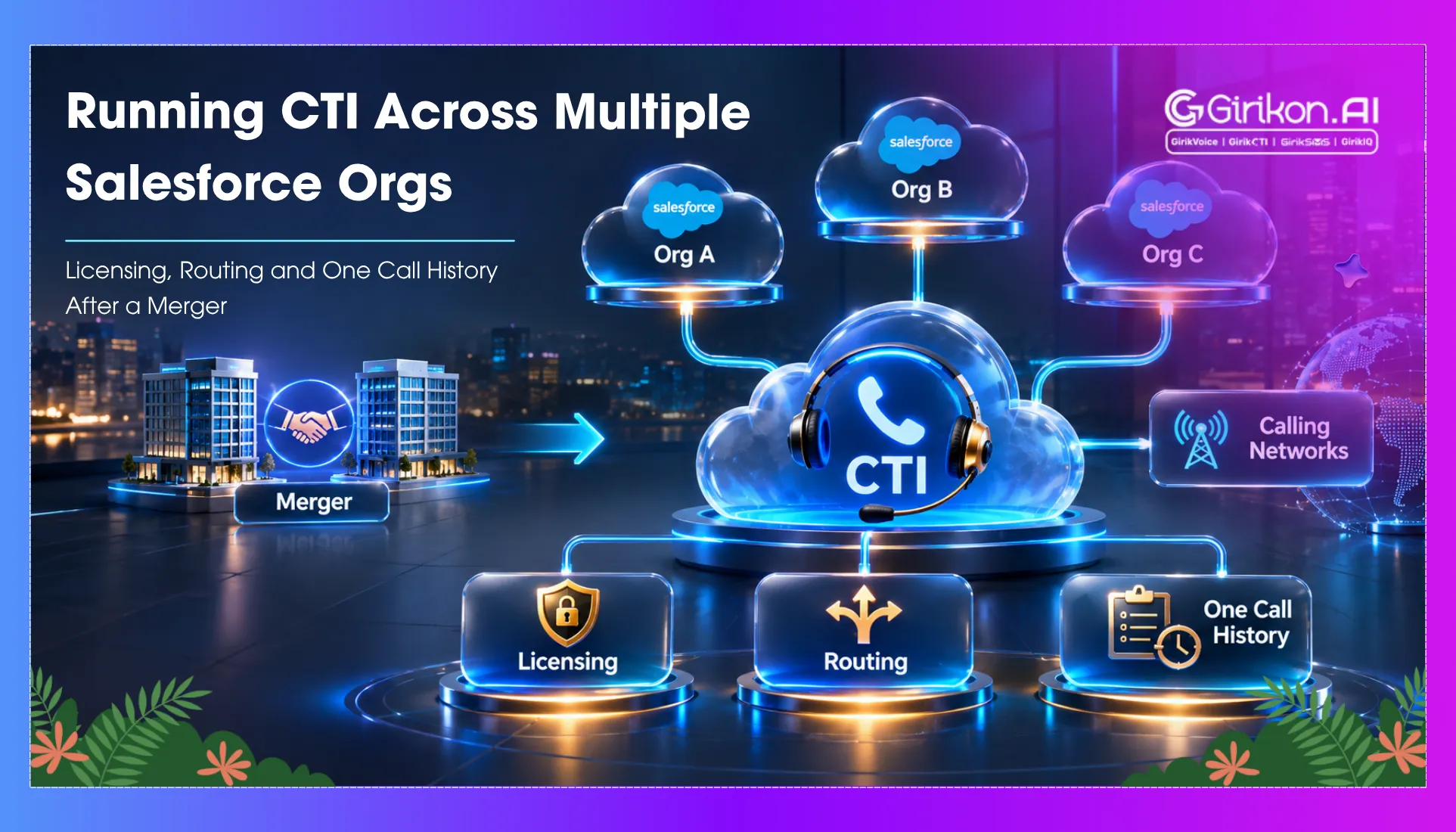
After a merger, organizations rarely operate from a single Salesforce environment. Typically, two to three still exist, each with their own telephone numbers, queuing and call history. This makes telephony data, routing rules, and call records become distributed across environments. It can affect how data is managed, CSAT, and if systems are compliant or not. A proper strategy helps reduce inconsistent call handling, reporting gaps, and bring full visibility into customer interactions. Therefore, with a Salesforce multi-org strategy you can establish consistent CTI operations across orgs while supporting unified reporting and governance.
In this blog, we'll explore how multiple CTI systems can exist after a merger and share tips on effectively managing Salesforce telephony integration during Salesforce org consolidation.
Why Do Multiple Salesforce Orgs Remain After a Merger?
The majority of acquisition companies retain their current Salesforce org for several years post mergers. Migration is both time and cost intensive. Sometimes, businesses also decide to keep separate orgs because their processes or customer bases differ. The data residency requirements in the region can also mandate records' geography.
These factors often leave organizations with multiple Salesforce environments that were never designed to operate as a single system. For example, when tracking a customer's calls, each call is stored in a different org, and not all teams have access to view the complete communication history. A salesforce multi org strategy helps address these operational gaps.
What CTI Problems Do Multi-Org Environments Create?
There are 4 pain points that arise in multi org CTI environments:
- Duplicated records: One user can be a contact in two orgs, each having its own call log, and no relationship between them.
- Separate routing: IVRs, queues, and call workflows are configured at the org level, making Salesforce call queue management challenging when callers need to reach teams responsible for their specific accounts.
- Incomplete reporting: Different parameters to measure customer engagement across business units when calls are part of multiple orgs.
- Licensing complexity: Each org has its own Salesforce and telephony licenses, and overlapping seats can significantly impact Salesforce CTI Pricing.
These issues can be addressed on time, once requirements for Salesforce org consolidation telephony are identified beforehand. It's easier to manage routing, licensing, and visibility when decisions are made early.
What Should You Check on Licensing Before Connecting Orgs?
- Salesforce licenses: User licenses are required per org, and an agent who has multiple orgs may need one seat per org license.
- User-based CTI licensing: Billing is agent-based; it works best for teams that remain in a single org.
- Org-based CTI licensing: Billing based on environments, may be right for larger teams that focus on a few orgs.
- Shared contact centers: Likely to work best when agents collaborate across multiple orgs through a Salesforce AI contact center without increasing overall costs.
- Scalability: If a plan is viable for 2 orgs, it may become too costly at 5, test it out first, and see.
- Unused seats: Inquiries should be made with finance teams to confirm how these are credited/assigned.
Licenses can be managed through one console via an enterprise CTI solution for Salesforce across multiple deployments. One thing organizations must consider is if their Salesforce org consolidation telephony solution can scale as they add more business units and Salesforce orgs.
What are the 5 Steps to Building a Salesforce Multi Org Strategy?
For telephony to operate regularly from business unit to business unit, organizations must have the right approach which includes aspects of ownership, visibility, routing, licensing and on-going administration. So, follow these steps:
Step 1: Assess the Existing Salesforce Environment
Understand your own Salesforce systems before starting the merger process. This will help you spot any duplicate processes, incorrect sequencing of call flow paths, lack of data ownership, and functional interdependency. Thus, record each of the Salesforce orgs, business units, numbers, integrations, and customer facing workflows in this assessment.
Step 2: Define Data Ownership and Access for Users
Determine Salesforce CTI data ownership by identifying where data is originally collected and deciding which types of data should be shared across different environments. When everyone knows who has what information available, there will be no repeat information, better reports, and data will be easily accessible to help support the customers.
Step 3: Design Routing Around Customer Needs
Organize routing rules around customer needs rather than organizational structure. Salesforce business hours routing helps ensure callers are connected to the right team, even when another Salesforce org manages their account. It'd be based on their skills, business units, or shared service queues. Many organizations use Salesforce telephony integration services to apply routing standards consistently across multiple Salesforce environments.
Step 4: Create a Shared Call History Framework
Define the conditions, formats, and different ways in which customers call records with another Salesforce org will be recorded, stored, and accessed. Overall, having a shared call history across orgs guarantees that each channel within your business– from sales to service to compliance– will have access to the same record of call data. In addition, consistent logging and clear data ownership rules help maintain reporting accuracy across business units.
Step 5: Set-Up a Governance and License Management
Delegate responsibility, standards, licensing decisions, and telephony management. Defining governance is a step that helps to achieve consistency across the orgs, that also eases consolidation plans in future without disrupting operations, control costs, etc.
Three Pitfalls to Avoid for Multi Org Strategy
- Multiple routing rules for the same number can create conflicting routing paths and inconsistent customer experiences. This is a common challenge in growing multi-org CTI implementations, where Salesforce call flow management standards are not reviewed and updated regularly.
- Keeping call logs isolated between orgs makes reporting difficult and prevents teams from accessing complete Salesforce call history, limiting their ability to understand users' interactions across the entire customer journey.
- Growth that is not managed properly and with the right licenses may lead to higher costs and administrative hassles as users start to work through various environments.
Conclusion
Businesses that opt for mergers leave organizations with more than one Salesforce org. It creates challenges for teams managing Salesforce inbound calling across different business units. This is because licensing, routing, and call history all need to work in sync. It helps team get the information they need for better customer support. Businesses must develop a Salesforce multi org strategy to bring structure to these areas and reduce unnecessary operational overhead. Whether a multi org CTI implementation remains in place for long term or changes over time, the underlying Salesforce org consolidation telephony approach should support both scenarios.