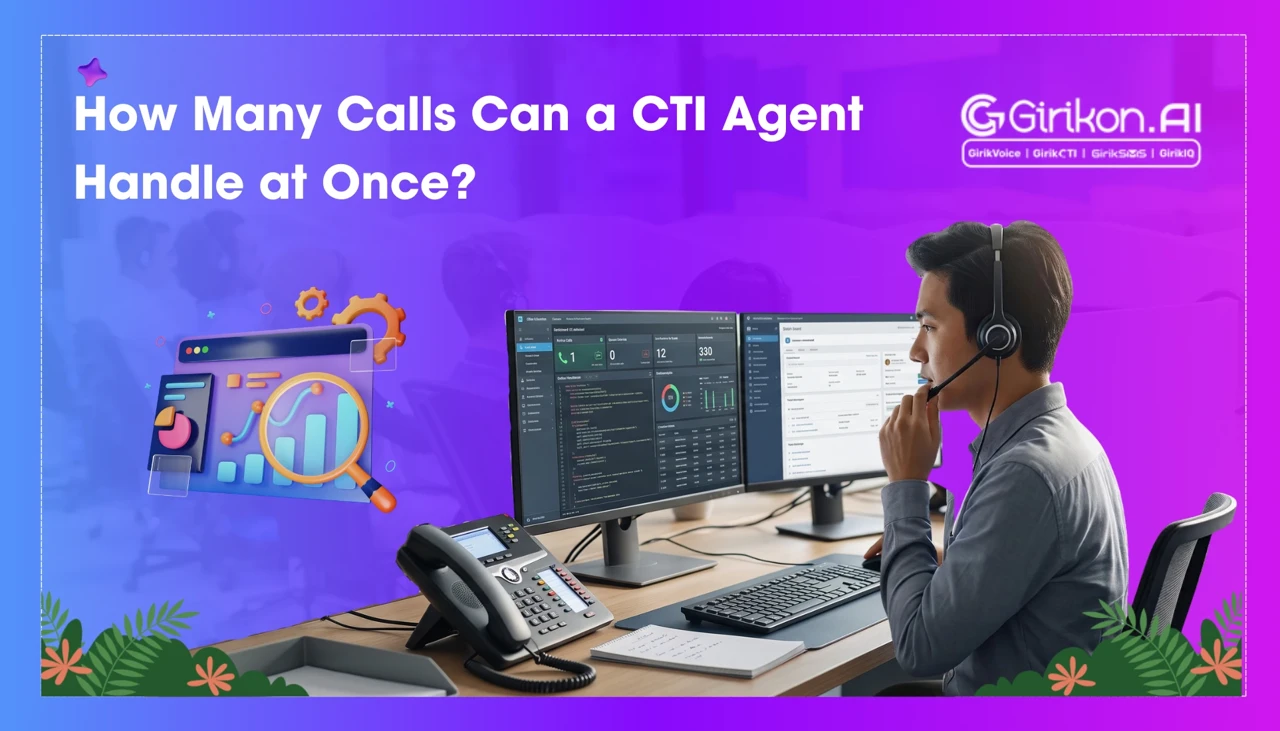
Discover how many calls a CTI agent can handle at once in Salesforce and what really determines call concurrency. This guide explains key concurrency limits, performance factors, and how to scale voice operations without sacrificing call quality or customer experience.
- 1Understand that AI CTI agent call concurrency isn't just about processing power but also conversation complexity, CRM interactions, and system architecture.
- 2Recognize that call concurrency measures the number of active customer conversations an AI system can process simultaneously while performing required tasks.
- 3Evaluate AI CTI solutions based on factors like cloud infrastructure scalability, speech recognition/response speed, CRM integration, workflow complexity, and escalation optimization.
- 4Acknowledge that for a single AI voice agent, the practical limit is one active voice call at a time, focusing on comprehensive interaction management.
- 5Prioritize AI concurrency that seamlessly carries forward conversations to directly impact customer experience, capacity, and the value of AI agent deployment.
There is a practical limit to how many conversations an individual can handle at the same time. The very same question is now being asked about the role of AI agents in the contact center. With all the capabilities like call answering, appointment bookings, lead qualification, and routine tasks, how many can an AI agent manage at once without compromising quality?
The answer doesn't just rely on processing power. Conversation complexity, workflow execution, CRM interactions, and system architecture all influence AI agent call concurrency. It is essential to know about them while evaluating AI-based CTI solutions, as in such cases, concurrency directly impacts customer experience, capacity, and the value delivered by each AI agent deployed.
What Does Call Concurrency Mean in a CTI Environment?
When people think of AI handling calls, the first question is whether it can answer the calls accurately. An equally important question is how many calls it can manage at the same time. That is what call concurrency measures.
In a CTI environment, concurrency refers to the number of active customer conversations an AI system can process simultaneously while continuing to perform the tasks each conversation requires. In a Salesforce AI contact center, those tasks extend beyond speaking with the caller. An AI agent may also need to recover CRM records, update cases, initiate workflows, schedule appointments, or transfer calls when necessary.
Every conversation is different. One interaction might end after getting an answer to a question; another might need to look for customer details, updating Salesforce records, or transferring the call to a different department. Therefore, call concurrency isn't calculated simply based on the number of calls an AI agent can handle. It is, however, defined by the ability of an AI agent to carry forward the conversation seamlessly.
What Determines How Many Calls an AI CTI Agent Can Handle?
There is no fixed number that defines AI agent call concurrency. Two AI platforms may support the same number of simultaneous calls on paper but deliver very different results in production. The difference often comes down to the AI voice agent architecture and everything the AI is expected to handle while the conversation is taking place.
1. Cloud Infrastructure
Every active conversation relies on computing resources running behind the platform. As more calls arrive, the infrastructure must continue processing conversations without introducing delays or affecting response quality. Scalable Salesforce calling infrastructure is one of the foundations of higher concurrency, helping platforms handle increasing call volumes while maintaining reliable performance and consistent response quality.
2. Speech Recognition and Response Speed
Speed matters in every conversation. An AI that acknowledges customer requests and responds quickly can keep interactions moving naturally and complete calls sooner. That creates more capacity for new customers without affecting the quality of ongoing conversations.
3. Salesforce and CRM Activity
Answering a customer is only one slice of the whole interaction. In some talks, it's not really about simply replying to their questions, it's more like digging around for records, adjusting existing cases, spin up new tasks, and a few other things too. These CRM workflows, driven by Salesforce call automation, can actually change how many calls Salesforce manages at the same time, kind of directly, almost immediately.
4. Workflow and Business Logic
Some conversations follow straightforward paths, while others require authentication, conditional routing, approvals, integrations, or multiple workflow decisions. As conversational logic becomes more complex, Salesforce call flow management becomes increasingly important, as each interaction consumes more platform capacity and can influence overall AI agent scale limits.
5. Escalation and Human Collaboration
Not every conversation ends with AI. Calls that require transfers to another agent, intervention by a supervisor, or collaboration with other enterprise systems also require coordination. The better these handoffs are optimized, the easier it becomes to ensure high concurrency without affecting the customer experience.
So, How Many Calls Does an AI CTI Agent Handle?
For a single AI voice agent, the answer is one active voice call at a time. Just like human representatives, an AI agent is supposed to listen, comprehend, respond, gather information, and perform actions to address a concern, all while concentrating on the call as well.
Handling one voice call, however, does not mean the AI is performing only one activity. A live conversation represents only a visible part of the interaction. Behind the scenes, the platform is running multiple business processes as part of the same interaction. The customer experiences a single conversation, while the platform continuously exchanges information, executes business logic, and coordinates actions needed to complete the request.
At the platform level, capacity is created by running many AI agents simultaneously rather than expecting one agent to manage multiple voice conversations. This is why organizations planning higher call volumes focus on deployment architecture, orchestration, and AI agent scale limits instead of the capabilities of an individual agent.
This also answers a common question: does Agentforce handle multiple calls? A single Agentforce agent is designed to manage one live voice conversation at a time. Multiple customer conversations can be handled by putting in place several AI agents, they work on their own, so the platform can scale, while still keeping a fairly steady level of service. This difference matters quite a lot if you're looking at Agentforce contact center vs Salesforce CTI, especially for orgs weighing AI voice features against more traditional contact center setups. You know, like that comparison question comes up more than people think, since one side feels more autonomous and the other more classic, yet both claim to help your call routing.
Best Practices for Scaling AI Agent Call Concurrency
Scaling AI agent call concurrency should focus more on efficiency than raising the number of calls per agent.
Optimize Conversation Design: Minimizing unnecessary prompts and keeping conversations concise with an AI voice agent ensures customers get results in the minimum time without extending call duration.
Reduce Unnecessary CRM Activity: Pull and update only the data each conversation actually needs. Excessive backend requests slow response times and add latency that compounds quickly at scale.
Use Intelligent Call Routing: Route customers to the right workflow from the start. Transfers, repeated questions, and avoidable escalations each add friction that accumulates across thousands of simultaneous conversations.
Load Test Before Deployment: Test for the expected call volumes before going live. Understanding the AI agent scale limits is far easier to address before customers experience it than after.
Conclusion
The more AI becomes an integral part of business processes, the more vital it will be to assess call concurrency alongside call quality. Businesses that can effectively manage capacity with the customer experience are best equipped to scale effectively and make use of AI-driven CTI as a scalable solution for the future.