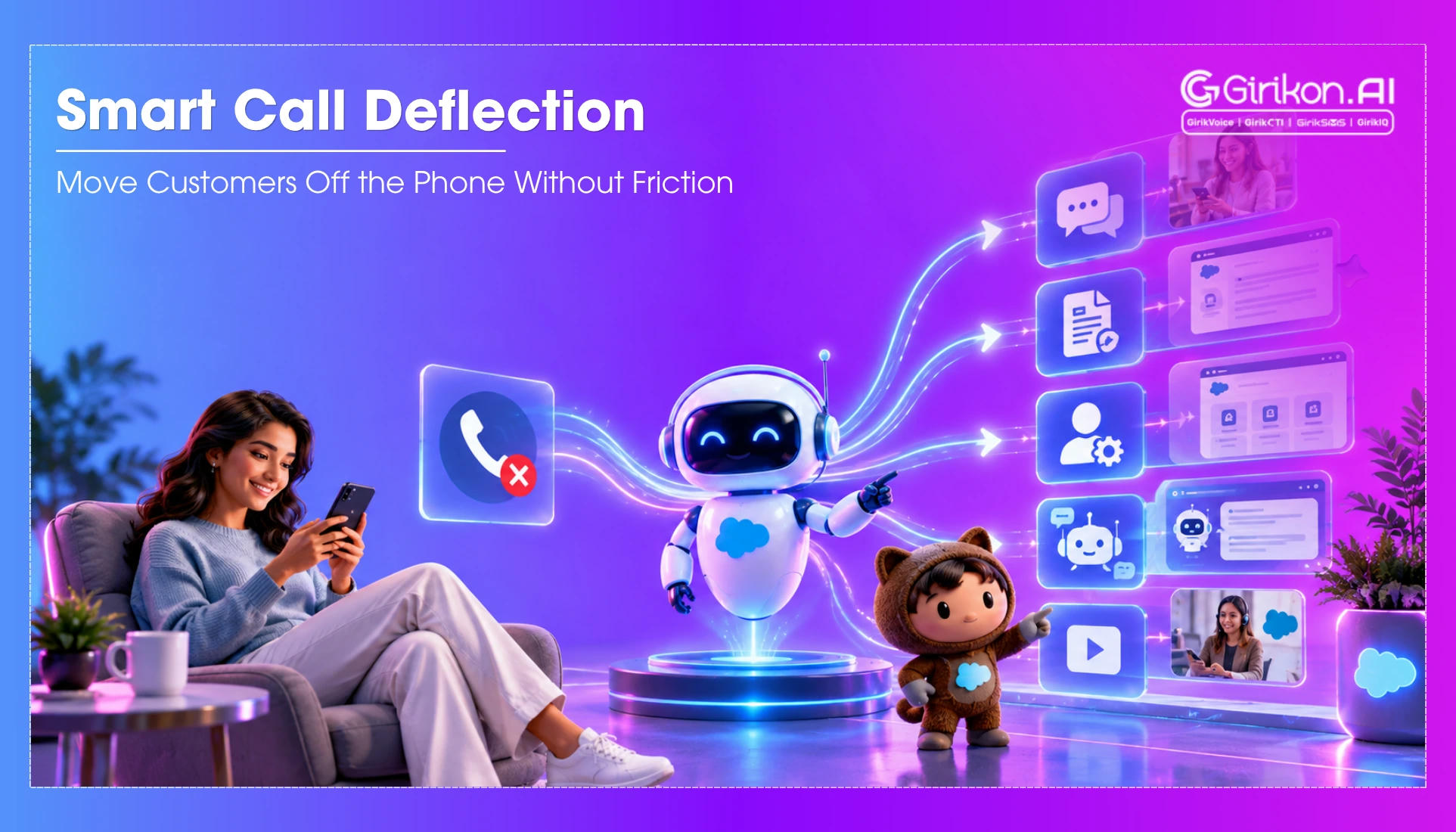
Call deflection in Salesforce helps organizations reduce unnecessary phone volume by guiding customers toward faster self-service options without compromising the customer experience. By combining automation, digital channels, knowledge, authentication, and agent workflows, businesses can resolve routine requests efficiently while ensuring complex issues reach the right agent with the necessary context. This approach reduces call center pressure, improves response times, and creates a more seamless customer journey.
- 1Deflect routine, predictable customer inquiries from phone calls to self-service channels like Knowledge articles, authenticated portals, or AI, to reduce costs and wait times.
- 2Design call deflection as a strategic service decision, ensuring customers can complete their tasks through alternative channels and have a clear path to human agents when needed.
- 3Categorize calls for deflection by intent: informational, status, and simple transactional requests are good candidates, while complex or sensitive issues require human intervention.
- 4Implement Salesforce journeys that identify customer intent, authenticate users for account-specific information, automate resolutions, and ensure seamless escalation with full context.
- 5Leverage Salesforce's service portfolio, including Agentforce and CTI integration, to unify voice and digital channels and connect customer data, knowledge, automation, and human support.
A high-volume service line does not necessarily mean customers need more conversations with agents. Many calls are regarding routine needs: checking an order, changing an appointment, understanding a bill, resetting access, or checking an existing case. When those requests can be completed through a digital channel, keeping them in the phone queue adds cost and waiting time without improving the customer experience.
That makes call deflection a service-design decision rather than simply an IVR tactic. The objective is to identify which Salesforce interactions can deflect calls to self-service, automation, or AI through Salesforce AI call automation, while keeping a fast path to a human when the situation requires judgment, empathy, or exception handling.
What Call Deflection Means in Salesforce
Call deflection means moving a customer interaction from a live phone conversation to another channel that can resolve the underlying need. The alternative could be a Knowledge article, authenticated Experience Cloud portal, messaging journey, automated workflow, or AI-powered service experience.
The critical distinction is between deflection and abandonment. Sending customers away from the queue is not a successful outcome if they cannot complete the task. A useful deflection strategy removes unnecessary phone work while preserving access to resolution.
Salesforce's current service portfolio, now branded Agentforce for Service, brings together customer service, channels, CRM data, Knowledge, automation, and AI voice agents. Its contact-center offering can also unify voice and digital channels, creating a foundation for moving customers between interactions without separating service context.
Which Calls Should Move Off the Phone?
The best candidates are repetitive requests where the customer's intent is predictable, and the required information or action is available digitally. Salesforce inbound calling can be particularly effective for handling these interactions efficiently. Consider four categories:
-
Informational requests: Salesforce Knowledge or AI-based responses can manage product details, service availability, or any other requests.
-
Status requests: Orders, deliveries, or appointments are great examples of information that can be retrieved from the CRM.
-
Transactional requests: Appointment changes, simple account updates, or routine service requests can move into authenticated workflows.
-
Complex requests: Disputes, exceptions, sensitive account issues, and cases requiring human judgment should retain a direct escalation path.
This classification matters because the same topic can require different treatments. An order-status request may be easy to resolve digitally, while a damaged shipment involving a refund exception may need an agent.
How a Salesforce Deflection Journey Works
A practical Salesforce journey starts with intent. The phone or contact center layer identifies why the customer is calling. If the request matches a suitable self-service scenario, the customer receives a targeted next step rather than a generic instruction to visit a website.
That destination should be specific. A customer asking about an existing case should reach the case-status experience, not a homepage. Someone changing an appointment should enter the relevant scheduling flow. Someone looking for a policy answer should receive the applicable Knowledge content.
Authentication is the next consideration. Account-specific information should only be exposed after the appropriate identity and permission checks. Salesforce supports authenticated self-service through Experience Cloud and can connect customer context with self-service experiences.
From there, automation determines what can actually be completed. Salesforce's current self-service capabilities support workflows for tasks such as appointment management and other service processes, while Agentforce can use actions to perform defined tasks and escalate when human assistance is needed.
The final stage is escalation. If self-service cannot resolve the issue, the customer should reach an agent with relevant context intact. That can include the original intent, customer information, conversation history, and actions already completed. This is where Salesforce becomes more than a destination for digital content. It can act as the service layer connecting the customer's request, data, knowledge, automation, and human support.
Where Salesforce Fits into the Architecture
A Salesforce-based approach does not necessarily mean replacing an existing phone system. Organizations can use Salesforce's native contact-center capabilities or leverage Salesforce CTI integration to connect Salesforce with an existing telephony or CCaaS environment. Salesforce currently supports both native voice capabilities and Salesforce CTI integrations designed to bring telephony and CRM data together.
The architecture can therefore be evaluated as a series of connected capabilities: Voice or CCaaS, intent identification, customer authentication, Knowledge or AI, workflow/action, resolution or agent escalation.
Salesforce Knowledge supplies governed information. Experience Cloud can provide the authenticated digital destination. Automation handles defined processes. Agentforce can provide conversational assistance and execute supported actions. Case management and the Service Console provide the human-service layer when automation stops being appropriate.
What a Buyer Should Evaluate
Before investing in a Salesforce deflection program, service leaders should assess five areas, including the call deflection rate they expect to achieve.
-
Data readiness
Is the digital experience capable of accessing accurate and up-to-date data on the customer and transactions?
-
Knowledge quality
Is the information in good order to help the customer and assist AI?
-
Workflow coverage
What high-frequency tasks can truly be performed without an agent?
-
Channel integration
Can voice, digital channels, CRM data, and existing contact-center technology exchange the context required for a continuous journey?
-
Escalation design
Can an agent take over with enough information to continue the conversation rather than restart it?
Salesforce's current Agentforce Contact Center positioning centers on unifying voice, digital channels, CRM data, and AI agents, while its self-service capabilities extend into authenticated portals, Knowledge, workflows, and conversational AI. Salesforce call monitoring can further support this approach by providing greater visibility into customer interactions and agent performance. That makes the platform worth evaluating when the organization wants deflection to become part of its broader service architecture rather than an isolated IVR project.
Conclusion
Effective call deflection does not make the phone disappear. It changes which interactions need it. Routine requests can move into self-service when the alternative channel has the data, authentication, knowledge, and workflow needed to finish the job. More complex requests can still reach an agent with their context intact through telephony for Salesforce, ensuring agents receive complete customer information and conversation history for faster, more personalized service.
The strongest Salesforce implementations therefore treat phone volume as an outcome of service design. By combining customer intent, CRM data, digital channels, and escalation strategies, an organization can reduce inbound call volumes without having to force customers to exert additional effort to receive their answers.