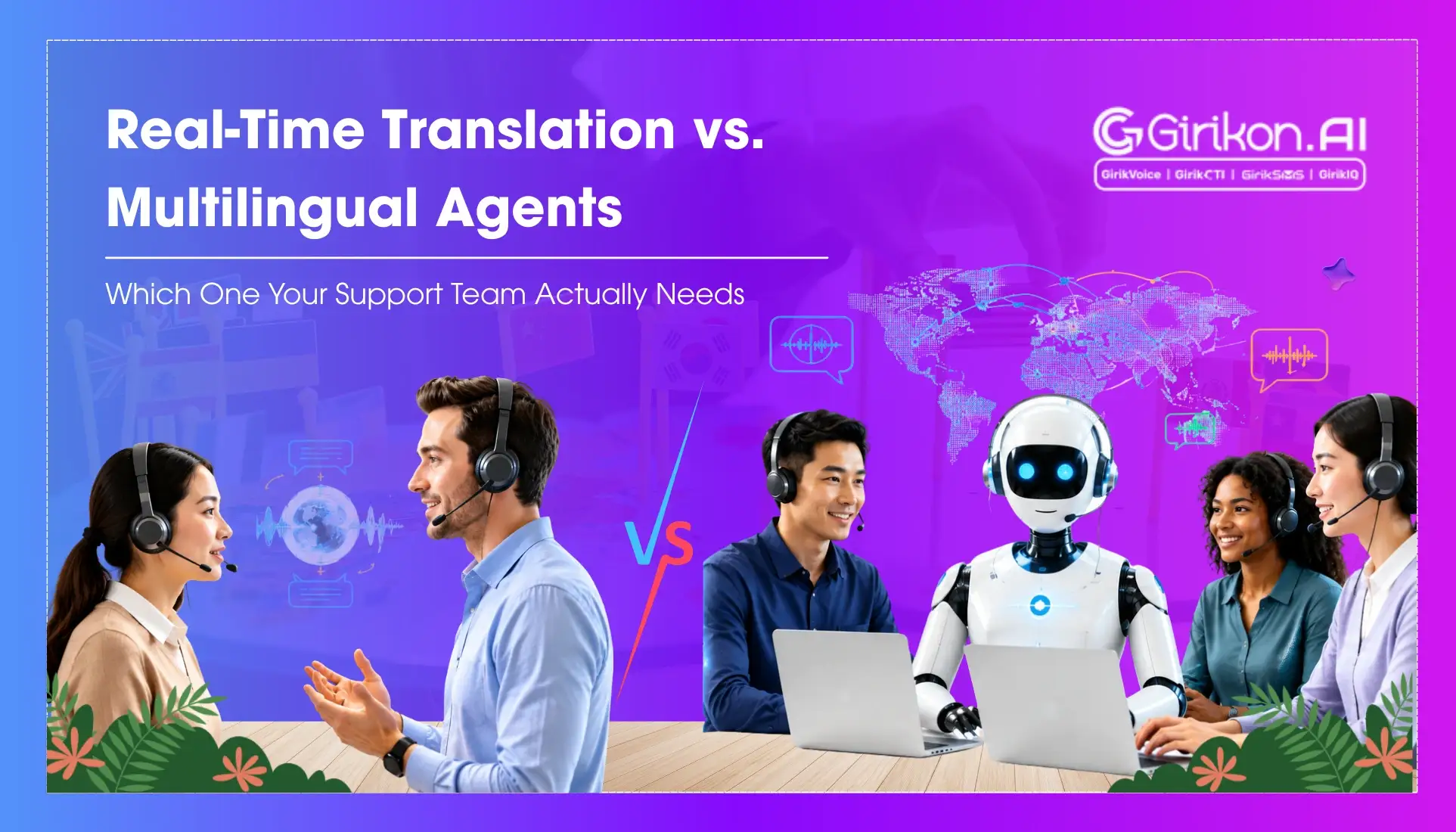
Real-time translation and multilingual AI voice agents both help businesses support customers across languages, but they solve the problem differently. Explore how each approach affects call speed, context, workflows, escalation, and scalability—and determine which option best fits your support team's needs.
- 1Implement multilingual AI voice agents to integrate language support directly into the customer interaction flow, rather than relying on a separate translation layer.
- 2Recognize that real-time translation introduces latency and potential context dilution by adding an extra step to the conversation.
- 3Utilize multilingual AI agents to maintain context and consistent support logic across different languages, simplifying workflow execution.
- 4Evaluate the frequency of multilingual calls to determine if a dedicated multilingual AI model is justified over occasional real-time translation.
- 5Understand that multilingual AI agents make language a core support capability, while real-time translation merely adds language capability to existing processes.
Real-Time Translation vs. Multilingual Agents: Which One Your Support Team Actually Needs
Geographies don't just set businesses apart from their customers. Sometimes, it comes down to how easily the two sides can understand each other. The possibility of communicating with customers in their language allows a business to reach new markets that would otherwise be a far-fetched plan with a single-language model. It allows a business to communicate with customers and gain the trust of multilingual buyers. For expanding businesses, multilingual support becomes a part of their expansion and customer experience.
The practical question is how to deliver it. Two approaches have become common: real-time call translation that helps existing support teams communicate across languages, and multilingual AI voice agents that handle calls in different languages directly. Both expand language capability. How they do it and what that means for the business is where they diverge.
Where Does Real-Time Translation Fall Short
Real-time call translation solves a simple issue for two sides communicating in a call in different languages. The system records the message from one side and then translates it to the other. The response then follows the same path. This approach translates calls in real time without requiring a support team to speak every language its customers use.
The limitation is that translation remains a separate layer in the call flow. The system is translating the conversation, while the agent still has to understand the customer's intent and determine what should happen next. That creates several points where the experience can lose speed or context.
Additional latency: Speech recognition, translation, and response generation all happen within the same interaction. Even small delays can make fast conversations feel less natural.
Context can get diluted: Translation focuses on converting speech between languages. It does not automatically provide more insight into the client’s background or the intent of the request.
Technical terminology needs accuracy: The proper translation of product names, industry jargon, abbreviations, and regional language might pose a challenge.
More moving parts: Translation has to work alongside call routing, CRM integrations, escalation rules, and other CTI functions without disrupting the conversation.
Human escalation remains important: In case the conversation becomes too complicated or sensitive, the system may need to refer the customer to support staff who speak their language.
What Do Multilingual AI Agents Change
Multilingual AI voice agents take a different approach. Instead of translating between the customer and an agent built around another language, the AI agent itself can communicate with the customer in their preferred language.
That changes what the system is responsible for. Language is handled as part of the agent's core conversation flow, alongside speech recognition, intent detection, context management, CRM access, workflow execution, routing, and escalation. The AI is not simply converting what the customer said. It is using live call interpretation to determine how the interaction should progress.
For support teams, this can remove several limitations created by a separate translation layer:
One conversation flow: The customer can speak naturally while the AI handles understanding and response in the same language.
Context stays within the interaction: Customer intent, previous exchanges, and workflow state can remain part of the agent's decision-making process.
Consistent support logic: The same authentication, qualification, troubleshooting, routing, and escalation rules can operate across supported languages.
Broader language coverage: Businesses do not have to establish a whole new translation process for each phone call to accommodate additional languages spoken by their customers.
Smarter escalation: The conversation may be escalated to a human expert in case the AI cannot resolve it with confidence due to a lack of judgement.
This is why interpreter vs AI translation is ultimately a broader architectural question than choosing between the two mediums of communication. Real-time translation adds language capability to an existing call. A multilingual AI voice agent makes language part of the support capability itself.
Making the Right Choice for Your Support Team
There is no better choice between the two; it rather depends on the purpose of multilingual communication that you need to support your business processes. As a possible point of entry, consider asking these questions right away:
How frequently do you receive multilingual calls? Occasional demand may not justify a new AI support model.
Who needs to handle the conversation? If a human agent will handle the call anyway, translation may be enough.
How predictable are the interactions? Repeatable workflows are stronger candidates for multilingual AI automation.
How quickly is multilingual demand growing? Expansion into new markets can make scalable AI support more valuable over time.
What happens when automation reaches its limit? A clear human escalation path is important regardless of the approach.
How integrated is the solution with the existing CTI and CRM? Language support should fit into the broader support architecture rather than operate as an isolated capability.
In some cases, the answer might well be a combination of both options. While human representatives can translate for customers beyond their language skills, multilingual AI agents can handle large volumes of predictable communication.
What is crucial here is the role that each of these technology models plays. Translation helps a support team communicate across a language gap. Multilingual AI can help the support operation serve customers across that gap. That difference is worth considering before deciding which approach deserves a place in the support stack.
Conclusion
Multilingual support is ultimately about the way a business decides to communicate with the audience it intends to target. Real-time call transcription becomes an option for bridging communication barriers, whereas the use of multilingual AI voice agents is a feasible solution for bringing language proficiency right into the automated setup. Neither of the above options necessarily needs to be considered the one and only universal solution. The best option can be determined by call traffic, support workflows, the requirement for specific languages, and the scope of work to be done by the voice system.