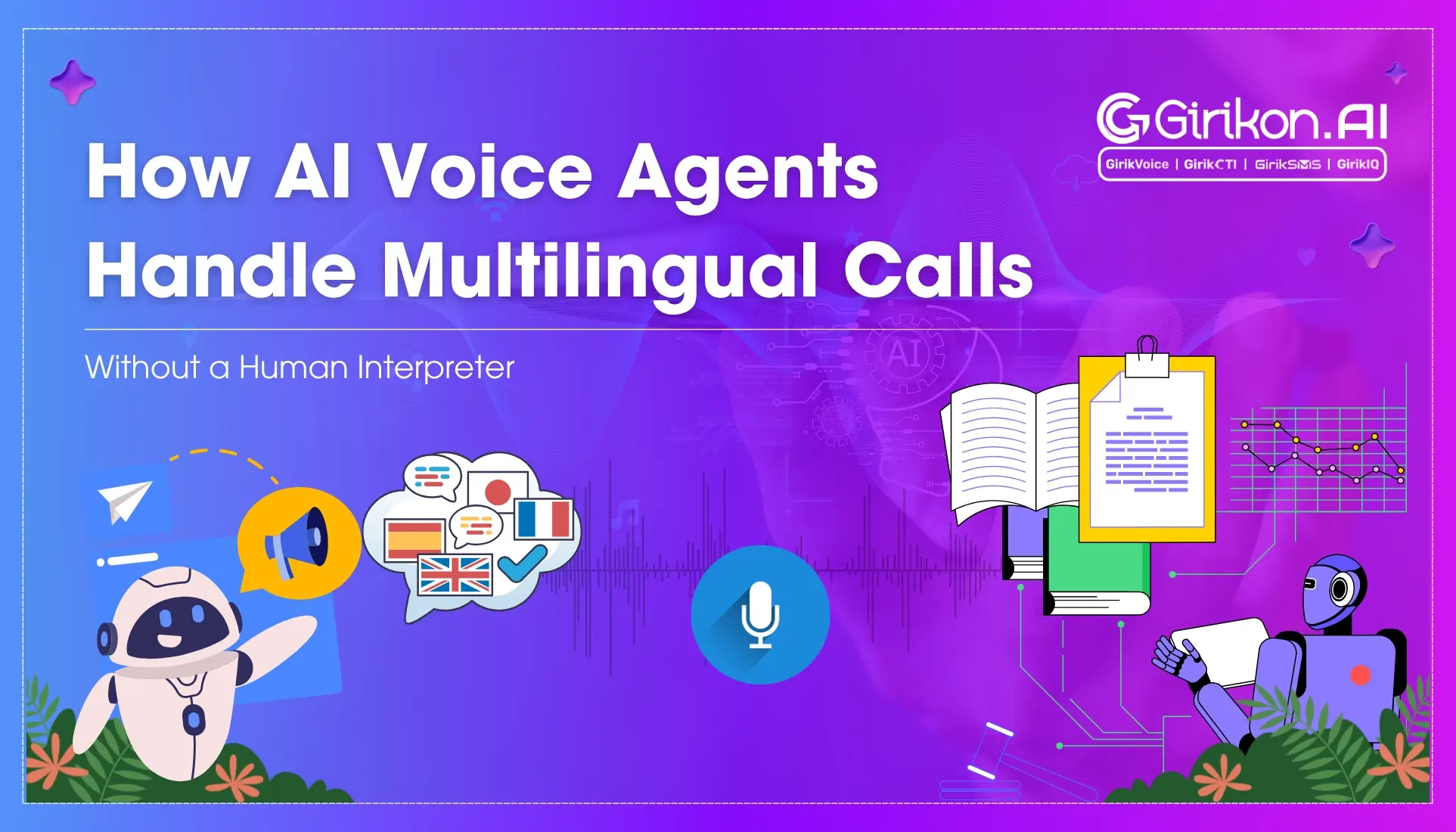
Discover how multilingual AI voice agents enable businesses to communicate with customers in their preferred language without relying on human interpreters. Learn how speech recognition, NLP, AI voice translation, and generative AI power seamless multilingual conversations while improving customer experience, reducing operational costs, and supporting global business expansion.
How AI Voice Agents Handle Multilingual Calls Without a Human Interpreter?
As businesses spread their geographical reach, customer expectations continue to gain pace. Irrespective of where a company is based, customers prefer interacting in their native language. Though, customers relied on bilingual customer service rep or human interpreters to deal with language barrier, these approaches were expensive and difficult to scale – leading to delays into customer interactions.
This is where Multilingual AI voice agents come into the picture. These voice agents are changing how businesses are engaging with their customers by empowering organizations to interact effortlessly with customers across multiple languages in real time. Powered by speech recognition technology, NLP, machine learning, and generative AI, these smart systems can respond to clients instantly without requiring a human interpreter.
AI-powered voice technology enables organizations to offer consistent and efficient interactions across multiple regions irrespective of the industries or sectors they support. Let’s explore through this article the functioning of multilingual AI voice technology, how AI voice translation allows natural interactions, and why multilingual call automation is impacting modern customer experience strategies.
Why Language Has Been a Major Bottleneck Impacting Customer Service?
Language is a major barrier for global businesses dealing with international clientele. This is because customers are comfortable speaking in their native language. Some of the difficulties include:
- Engaging multilingual support agents is costly.
- Maintaining round-the-clock language coverage isn’t easy.
- Human interpreters rise operational costs.
- Call transfers create client frustration.
- Conflicting translations minimizes service quality.
- Venturing into unexplored markets becomes complex.
These limitations often lead to:
- Slower resolution of customer queries
- Declining customer satisfaction scores
- Increased abandonment rates
- Increased recruitment costs
- Lost sales opportunities
With global customer support AI, the equation can be changed.
What Are Multilingual AI Voice Agents?
Multilingual AI voice agents use generative AI and NLP to comprehend customer intent and spoken language while generating precise responses in their preferred language.
These AI agents conduct contextual discussions, which aren’t common in conventional IVR systems that follow rule-based scripts.
Modern voice AI can:
- Comprehend several languages and vernaculars
- Identify customer intent
- Interpret discussions instantly
- Access CRM details
- Reply to complex queries
- Schedule appointments
- Validate customers
- Direct calls smartly
- Finish transactions
- Escalate issues to human agents when required
The result is a human-like conversation that doesn’t feel automated.
How AI Voice Interpretation Works?
AI voice translation forms the core of multilingual communication - bringing numerous AI technologies into a single workflow.
-
Step 1: Speech Recognition
Multilingual AI voice agents use ASR technology to interpret the words spoken by a client into text. Unlike traditional speech identification systems, advanced AI recognizes speakers with different speech patterns, backdrop noise, pauses used, and informal speech - delivering discussions in multiple languages while enhancing customer interactions.
-
Step 2: Language Detection
The AI quickly identifies the preferred language of a customer at the beginning of the interaction. Advanced multilingual conversational AI can detect the language by default that too in no time. This allows customers to start talking naturally without steering through language selection menus. Many platforms also identify when conversational participants shuffle between languages during the same discussion. This ensures smooth conversations and a superior customer experience.
-
Step 3: Intention Recognition
Besides interpreting the language, these AI voice agents can assess the context, intent, as well as meaning to offer human-like responses in their chosen language.
-
Step 4: AI Voice Translation
After comprehending the customer's intent, the multilingual voice agent translates voice to generate precise response in the choicest language of customers. Unlike traditional translation tools that depend on word-for-word, AI considers the entire conversation context, industry-specific terminology, client history, past interactions, and more. This enables the system to offer translations that sound natural and retain the envisioned meaning to offer a more interactive experience.
-
Step 5: Smart Response Generation
Once the customer's intent is identified, the AI after its contextual clarity generates responses by drawing relevant data from enterprise systems such as databases, CRM systems, knowledge bases, help centers, ERP systems and more. The response is then presented accurately in the customer's native language. This offers consistent client experience.
-
Step 6: Text-to-Speech
The response drawn uses neural Text-to-Speech technology to change into speech that sound like human. Modern AI voices imitate human interaction with natural pacing, expressive accent, exact pronunciation, and regional accents. Consequently, customers often struggle to set apart high-quality AI-generated voices from human agents - creating a more authentic interactive experience.
What are The Benefits of Multilingual Interactive AI?
Modern multilingual interactive AI offers major advantages over legacy customer support.
24/7 Availability
Customers across various time zones receive immediate assistance regardless of business hours.
Low Operational Costs
Expenses can be controlled by minimizing dependence on large multilingual support teams while ensuring better service quality.
Faster Response Times
Customers get prompt responses without having to wait for interpreter availability.
Consistent Customer Experience
Every client is given same level of service irrespective of language, with AI applying similar business rules across different interactions.
Seamless International Expansion
Businesses can venture into new markets without hiring support staff who speak native language. This hastens global growth.
Decoding the Best Practices for Implementing Human-like Multilingual AI?
Organizations planning to use voice AI multiple languages should follow a strategic approach:
- Start with high-end customer service situations.
- Select the most regularly used languages by customers.
- Integrate AI with knowledge management systems.
- Train AI continuously using real client interactions.
- Use parameters such as first-call resolution, client satisfaction, response precision and average handling time to monitor performance.
- Maintain clear escalation paths for sensitive issues.
The Future of Multilingual Call Automation?
The next generation of multilingual conversational AI will become smarter.
Emerging capabilities include:
Emotional intelligence
Tailored responses depending on customer preferences
Voice biometry for reliable authentication
Predictive client assistance
Industry-specific language adaptation
Learning from client interactions
Final Words:
Multilingual AI voice agents are helping organizations overcome language barriers - enabling organizations to deliver global customer experiences. Powered by conversational AI, AI voice translation, and multilingual capabilities, they automate discussions with precision and personalization. Multilingual call automation helps businesses reduce costs and offer global customer support AI while scaling globally and ensuring high-quality customer service.