Most of us have had the call where you get passed from department to department, each transfer adding a little more friction, a little more explaining yourself from scratch. The frustrating part was never really the handoff itself - it was the reset. The losing of context. The feeling that whatever you said two minutes ago simply evaporated. What's worth paying attention to now is how multi agent handoff between AI voice agents is starting to address exactly that failure, not by removing handoffs from the call flow, but by making them invisible to the caller in a way that no human-to-human transfer ever really managed.
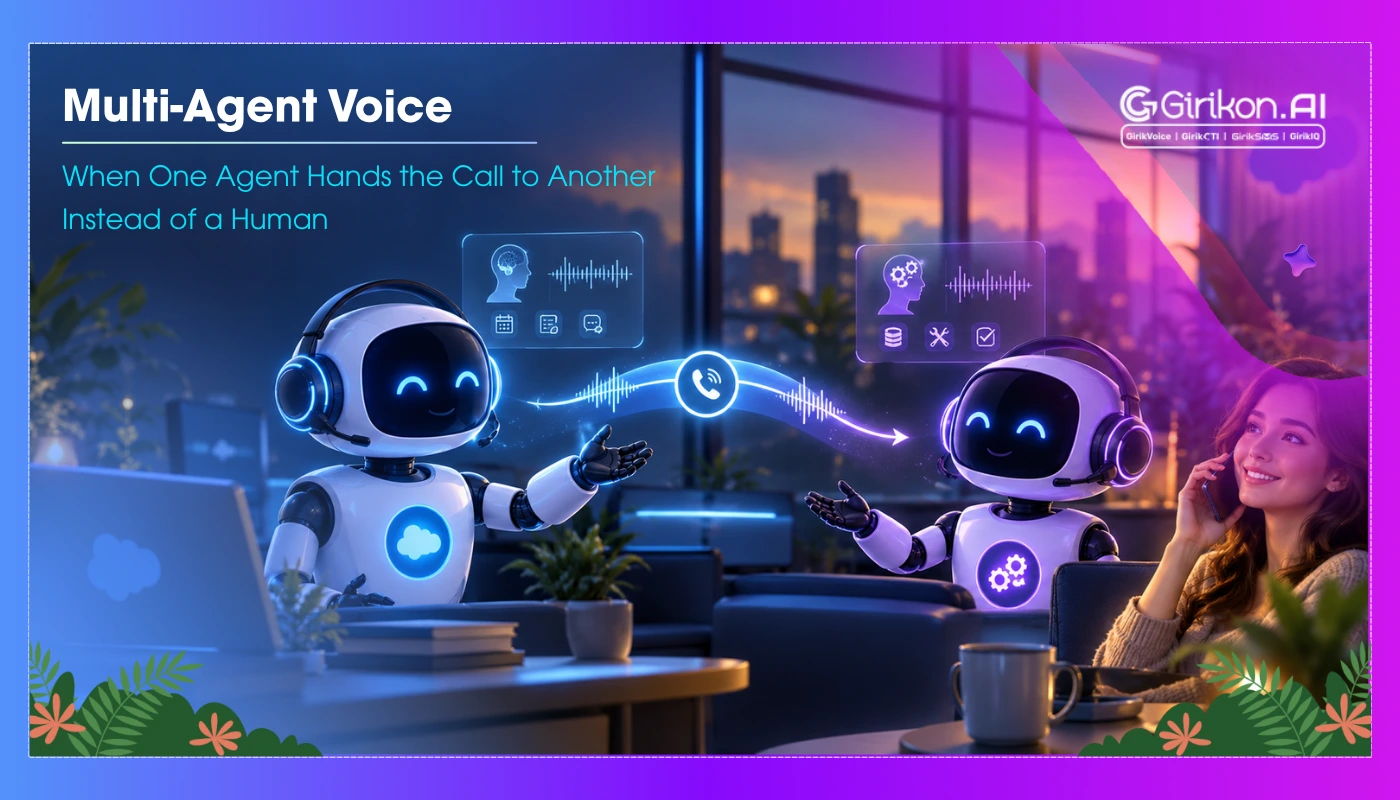
Multi-Agent Voice: When One Agent Hands the Call to Another Instead of a Human
Most of us have had the call where you get passed from department to department, each transfer adding a little more friction, a little more explaining yourself from scratch. The frustrating part was never really the handoff itself - it was the reset. The losing of context. The feeling that whatever you said two minutes ago simply evaporated. What's worth paying attention to now is how multi agent handoff between AI voice agents is starting to address exactly that failure, not by removing handoffs from the call flow, but by making them invisible to the caller in a way that no human-to-human transfer ever really managed.
Why the Single-Agent Model Breaks Down Under Real Call Volume
Here's the thing about building a single voice agent to handle everything: it works fine until it doesn't - and "doesn't" tends to show up exactly when call volume spikes or a conversation veers somewhere unexpected. Teams that have deployed general-purpose voice agents know the wall I'm describing - the agent starts hedging, looping, or just failing outright on questions that need more domain depth than it was ever really trained to handle. Billing edge cases. Clinical intake questions. Regulatory disclosures that vary by state.
The instinct is usually to retrain the same agent with more data. That helps, sometimes. But the deeper issue is architectural. A single agent trying to cover everything is the voice equivalent of a call center generalist who's been told to also handle legal, IT support, and account escalations. The knowledge base bloats, response quality dilutes, and confidence thresholds drop across the board.
Worth noting: this isn't a capability ceiling that will be solved purely by larger models. The problem is specialization, not raw intelligence.
The Case for Specialist Agents That Own a Domain Completely
Honestly, the shift that's made multi-agent voice architectures feel less like a research concept and more like a real operational choice is the maturation of specialist voice agents as a design pattern. Rather than training one agent to know everything at medium depth, teams are now building narrower agents that know one domain at high depth - and routing calls between them based on what the conversation actually needs.
A healthcare provider, for example, might run a scheduling agent that handles appointment booking with full EHR integration, a triage intake agent trained on clinical decision-support workflows, and a billing agent that's been specifically tuned to handle insurance verification language and payment plan negotiation. None of those three agents could comfortably do the other's job. But together, they cover the call center floor without the quality degradation that comes from a single overloaded model.
The benefit table below shows how the specialist model compares at a high level:
| Dimension | Single General Agent | Specialist Agent Network |
|---|---|---|
| Domain depth per topic | Moderate | High |
| Failure rate on edge cases | Higher | Lower within domain |
| Training complexity | Simpler upfront | Higher upfront, lower ongoing |
| Context transfer on handoff | N/A - no handoff | Requires architecture design |
| Caller experience on complex queries | Degrades | Consistent per agent |
The "context transfer on handoff" row is the one that actually determines whether this model works in production. Get that wrong, and you've just rebuilt the frustrating transfer experience with AI agents instead of humans.
AI Agent Orchestration - The Layer That Makes It Work
This is the part that tends to be underestimated in initial deployments. The orchestration layer - the system that decides which agent is handling the call at any given moment and manages what information gets passed between them - is not a simple routing table. It's closer to a call director with memory, judgment, and awareness of what each downstream agent can and can't handle.
Good orchestration involves at minimum: real-time intent classification that updates as the conversation evolves, a shared context object that travels with the call across agent boundaries, and a confidence threshold system that triggers a transfer before an agent fails rather than after. That last part is important. The worst multi-agent implementations wait for a failure before escalating - the best ones recognize the approaching edge of competence and hand off proactively.
A rough framework for how orchestration decisions get made in a well-designed system:
- The entry-point agent handles the opening intent classification and routes to the appropriate specialist based on the primary topic - not the first keyword spoken.
- The receiving specialist agent gets the call with a context bundle already loaded - conversation transcript, extracted entities like account number, date of birth, claim ID, and the confidence score that drove the original routing decision. It doesn't arrive empty-handed.
- When the specialist agent runs into a secondary intent that sits outside its trained domain - it doesn't try to muscle through it. It flags the issue mid-conversation and kicks off a lateral transfer instead.
- The orchestration layer logs the transfer event, the reason, and the context state at time of transfer - which is what allows QA teams to actually audit the call flow afterward.
How Routing Decisions Get Made in Practice
Agent routing AI sounds straightforward until you're actually trying to configure what triggers a transfer. The failure mode that teams run into most often is building routing logic around keywords or topics rather than intent confidence. A caller who says "I want to talk about my bill" sounds like a billing call. But if the next sentence is "because I was told it was related to my diagnosis," that's a clinical conversation layered over a billing inquiry, and a keyword-based router will send it to the wrong place every time.
Intent classification models that operate at the utterance level - updating their assessment of what the caller actually needs as each sentence arrives - are significantly more reliable for routing decisions than static topic detection. The routing layer needs to be thinking about where this call is going, not just where it started.
To be fair, even the best intent classifiers misroute a meaningful percentage of calls, especially when callers mix topics or shift focus mid-conversation. That's why the orchestration layer needs to support lateral transfers - not just entry-point routing - and why specialist agents need to be designed with graceful escalation paths built in, not bolted on afterward.
What the Caller Actually Experiences
From the caller's side, a well-executed agent-to-agent handoff should feel like a brief pause - similar to being placed on a short hold - followed by a new voice that already knows the context. No re-introduction of the account number. No repeating the reason for the call. The new agent references what was already established and picks up from there.
That experience is what separates architectures that work from ones that just technically function. An agent to agent transfer that requires the caller to re-authenticate or re-explain their issue has failed, regardless of whether the routing decision was technically correct. The context bundle has to be real - not symbolic - and it has to arrive at the receiving agent before the call does.
Some teams handle this with a short synthetic bridging phrase from the transferring agent: "Let me connect you with someone who handles this specifically - they'll have everything we've discussed." It buys two or three seconds of processing time while the context payload is transmitted, and it sets a caller expectation that the next agent is already informed. Small thing, but it changes how the handoff is perceived.
The Parts Nobody Talks About Enough
There are a few places where multi-agent voice architectures quietly create new problems while solving old ones, and they tend to surface a few months into production rather than during pilot.
- QA teams discover that attributing a call failure to a specific agent is harder when four agents touched the same call - the audit trail needs to be designed explicitly, not assumed.
- Caller authentication that was performed at call entry needs to be validated or passed correctly at every subsequent transfer, otherwise agents two and three in the chain may be operating on stale identity assumptions.
- Latency at transfer points accumulates. Each handoff adds a small delay, and on mobile connections or with older callers who may pause frequently, that accumulation starts to register as awkwardness.
- Training and retraining cycles for specialist agents are simpler per agent, but coordinating updates across a network of agents - especially when one agent's behavior change affects another's expected inputs - requires more governance than most teams initially plan for.
None of those are dealbreakers. But they're the kinds of operational realities that determine whether a multi-agent deployment stays in production or quietly gets simplified back to a single-agent model after the pilot team moves on.
The broader tension here is that multi-agent voice is genuinely better suited to real call center complexity than single-agent approaches - but the operational overhead of running it well is higher than most procurement conversations acknowledge upfront. Whether that gap closes as tooling matures or stays as a persistent implementation tax is still, honestly, an open question.
```