The collections industry has been running into a specific kind of regulatory friction lately, and it's not entirely new friction - it's old rules meeting new technology in ways that nobody fully anticipated when the original statutes were drafted.
The collections industry has been running into a specific kind of regulatory friction lately, and it's not entirely new friction - it's old rules meeting new technology in ways that nobody fully anticipated when the original statutes were drafted. AI debt collection compliance is now a real operational concern for collections teams, not a theoretical one, and the legal exposure sitting underneath some of these AI-powered dialing programs is significant enough that compliance officers are starting to ask questions that their vendors often can't answer cleanly. Worth thinking about carefully before the first call goes out, not after. The stakes around FDCPA compliance are real and growing as automated systems scale.
What Happens When Automation Meets a Law Written for Humans
The Fair Debt Collection Practices Act dates back to 1977. Nobody drafting that statute was picturing an autonomous AI voice agent running four hundred calls on a Tuesday afternoon with zero humans watching. They were thinking about aggressive collectors on phones - actual people, making judgment calls, sometimes badly. The statute got built around disclosure obligations, contact limits, third-party protections - all of it premised on a human being present on the line.
That assumption doesn't hold when you swap in an AI system, and it falls apart pretty fast.
The FDCPA requires that collectors identify themselves and the purpose of the call within a reasonable timeframe. For a human agent, that obligation is instinctive - you introduce yourself, you say why you're calling. For an AI system, that same obligation needs to be explicitly engineered. It has to be baked into the call script from the very first utterance, not treated as something the system will figure out contextually. Teams that deploy AI dialers and assume the system will handle identity disclosure the way a trained human would tend to find out fairly quickly that the assumption was wrong, usually after a consumer complaint lands somewhere uncomfortable.
Honestly, the disclosure question is probably the most technically solvable of the FDCPA challenges. You can script it. You can test it. You can audit recordings to confirm it's happening consistently. The harder problems are the ones that require judgment.
FDCPA Compliance and the Disclosure Problem No One Talks About
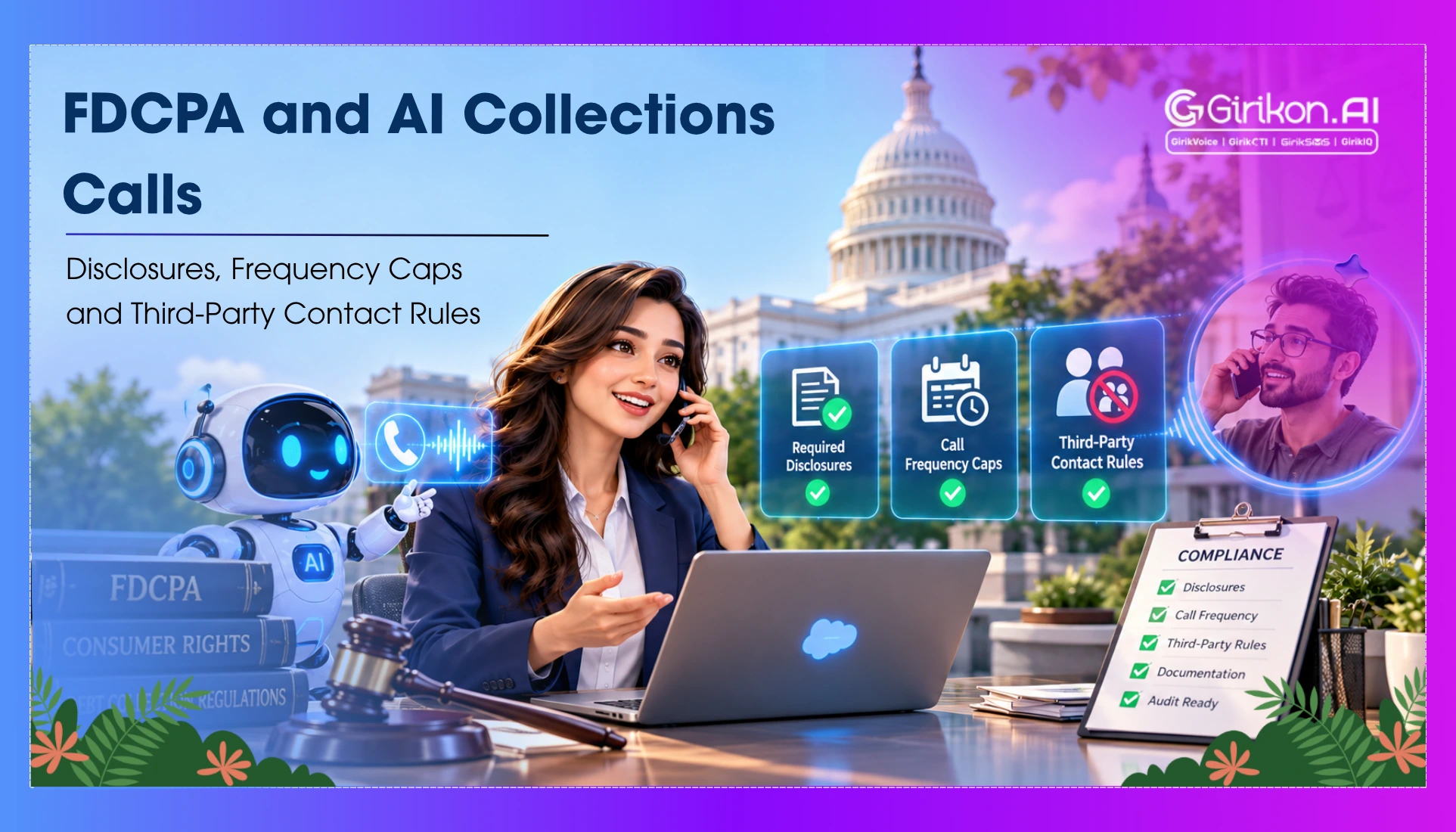
Here is something that doesn't get nearly enough attention in the vendor conversations: the FDCPA requires mini-Miranda disclosures on every communication - not just the first one. The language isn't optional. "This communication is an attempt to collect a debt, and any information obtained will be used for that purpose." This is the statutorily mandated disclosure - often called the "mini-Miranda" - required under the Fair Debt Collection Practices Act (FDCPA) on collector communications. Through repeated use, a human collector commits the disclosure to memory and recites it as a matter of routine compliance rather than deliberate articulation. An AI system delivers it mechanically, which is - depending on how the script is built - either reliably accurate or reliably problematic.
The issue isn't whether the AI says the words. The issue is whether the AI says them in a way that a reasonable consumer can understand them to be a disclosure, not background noise. Regulators and courts have both shown interest in whether disclosures are delivered in a manner that actually informs rather than technically complies. An AI agent that buries the mini-Miranda in a ninety-second preamble at full speaking speed has technically said the words. Whether a regulator or a court finds that satisfying is genuinely another question.
Compliance note for legal teams: Disclosure timing and delivery format matter as much as content. An AI system should be configured to pause after the mini-Miranda, not immediately continue into the collections pitch. That brief silence isn't dead air - it's defensible evidence of intentional disclosure.
The secondary disclosure issue involves voicemails. The FDCPA and its implementing regulations place real restrictions on what an AI system can say when it reaches a voicemail. If the message identifies the call as debt-related and a third party hears it, that's a potential third-party disclosure violation. This is one area where AI creates genuine new exposure because high-volume AI dialers are reaching voicemail constantly, at scale.
Frequency Caps and How AI Systems Tend to Overshoot Them
The CFPB's Regulation F, which took effect in late 2021, put a specific number on call frequency for the first time: collectors are presumed to violate the harassment prohibition if they call more than seven times within seven consecutive days, or within seven days after a conversation with the consumer. That collection call frequency limit sounds simple, but it creates real operational complexity when an AI dialing system is managing thousands of accounts simultaneously across multiple campaign queues.
Here's the thing - AI systems don't naturally track this the way a human team lead might. The frequency cap operates at the per-account, per-consumer level. An AI dialer optimized for contact rates is going to push toward maximum contact attempts unless someone has specifically configured it not to. That configuration responsibility falls on the collections operation, not the technology vendor. The vendor's platform may have the capability; whether it's being used correctly is a different matter.
| Risk Factor | Human Agent Environment | AI Dialer Environment |
|---|---|---|
| Frequency cap enforcement | Manual tracking, supervisor oversight | Requires explicit system configuration |
| Mini-Miranda consistency | Variable, training-dependent | Consistent if scripted, blind if not |
| Third-party voicemail exposure | Lower volume, case-by-case judgment | High volume, automated, higher risk |
| Identification of automated nature | Inherent, caller is human | Must be explicitly disclosed |
| Account-level contact history | CRM-dependent, usually visible | Algorithm-dependent, may not integrate |
The account-level contact history row in the table above is the one that catches teams off guard most often. AI dialers running off campaign lists that don't sync back to the main debt management platform in real time can easily lose track of where an account sits in the frequency window. The dialer thinks it's making a first attempt. The system of record shows it's attempt seven.
Third-Party Contact Rules Don't Get Simpler When a Machine Is Calling
The FDCPA puts strict limits on contacting third parties - family members, employers, neighbors, anyone who isn't the consumer. The general rule is that collectors can only contact third parties to locate the consumer, and they can't disclose that the call is debt-related when doing so. These rules assume that a human collector can read the situation - recognize when they've reached an employer's main line versus a mobile number, adjust the conversation accordingly.
AI systems can't read the situation in that way. They process the call based on the number dialed and the response received. If a wrong number picks up - or if a family member answers a phone that's listed under the debtor's name - the AI system's response to that scenario has to be pre-programmed. And most of those pre-programmed responses are not calibrated for FDCPA third-party disclosure rules. They're calibrated for contact rate optimization.
The regulation of collections calls involving third parties is one area where the CFPB has been fairly clear that the identity of the caller - human or machine - doesn't change the underlying obligation. Nobody gets to point at the machine and walk away clean. The legal duty sits with the collector. An AI made the call - fine, noted - but that fact doesn't reframe the analysis in your favor. If anything, it raises the question of whether the operation was actually supervising what the system was doing.
The Broader Problem Sitting Underneath All of This
None of this, to be clear, makes AI collections calling illegal or even a bad idea. Systems built correctly - compliant scripting, real frequency-cap logic, integrated account histories, voicemail handling that doesn't blow up on third-party rules - can operate within the FDCPA framework. Some shops are actually doing this well.
The ones that aren't tend to look pretty similar when you pull the thread. They deployed the AI for the efficiency story and somewhere along the way compliance became someone else's configuration step. The vendor figured the client's legal team had eyes on the script. The compliance team figured the vendor built the guardrails. The AI, doing exactly what it was told to do, ran thousands of calls that nobody with actual legal authority had reviewed from start to finish.
That's how you generate exposure at a scale and speed that a human collections team physically couldn't match.
Collections teams should conduct a full call recording audit within the first sixty days of any AI dialer deployment, specifically checking for mini-Miranda delivery timing, frequency violations at the account level, and voicemail content against FDCPA third-party standards.
Legal teams reviewing vendor contracts should confirm whether the AI system provides per-account call frequency logging with timestamps that integrate directly into the collections platform - not just campaign-level reporting.
Compliance officers should treat the CFPB's Regulation F guidance and the FTC's existing FDCPA interpretations as the floor, not the ceiling, because several state attorneys general have shown interest in pushing standards higher for automated callers specifically.
The honest tension here is that the FDCPA was never designed for technology that operates at this scale and speed. The law is being applied to AI collections through regulatory interpretation and enforcement action, not through purpose-built statutory language. How that interpretation continues to develop - particularly as the CFPB considers further rulemaking on automated communications - is something collections operations probably shouldn't be waiting on passively while their AI dialers run.